SEO for lead generation is the work of getting your website found by people who are ready to enquire, and then making it easy for them to call, WhatsApp or fill a form. It is not about traffic. If you run an IT services firm, a clinic, a coaching institute, a real estate project or a manufacturing unit, this guide shows you what to build, how to track SEO leads, how to report them to leadership, and what AI search changes.
TL;DR
- Target buying searches, not all searches. “Service + city” and “agency for [industry]” pages bring enquiries. Generic blogs mostly bring readers.
- AI search cuts clicks on information queries, not the need to be found. US studies show fewer clicks when an AI summary appears, but brands cited inside it still get more clicks.
- Indian buyers enquire by phone and WhatsApp. Track only forms and you undercount SEO leads.
- Measure leads, qualified leads and revenue. Rankings and sessions are supporting numbers.
- SEO compounds slowly. Plan in phases and keep paid ads running while organic builds.
Key takeaways
- Agree what a “qualified lead” means with sales before you pick a single keyword.
- Build service, industry and city pages first. Blogs support them.
- Every page needs a call button, a WhatsApp button and a short form.
- Set up GA4 key events and pass lead source into your CRM.
- Get listed and reviewed where buyers look: Google Business Profile, plus Clutch, GoodFirms, IndiaMART or Justdial where they fit.
What is SEO for lead generation?
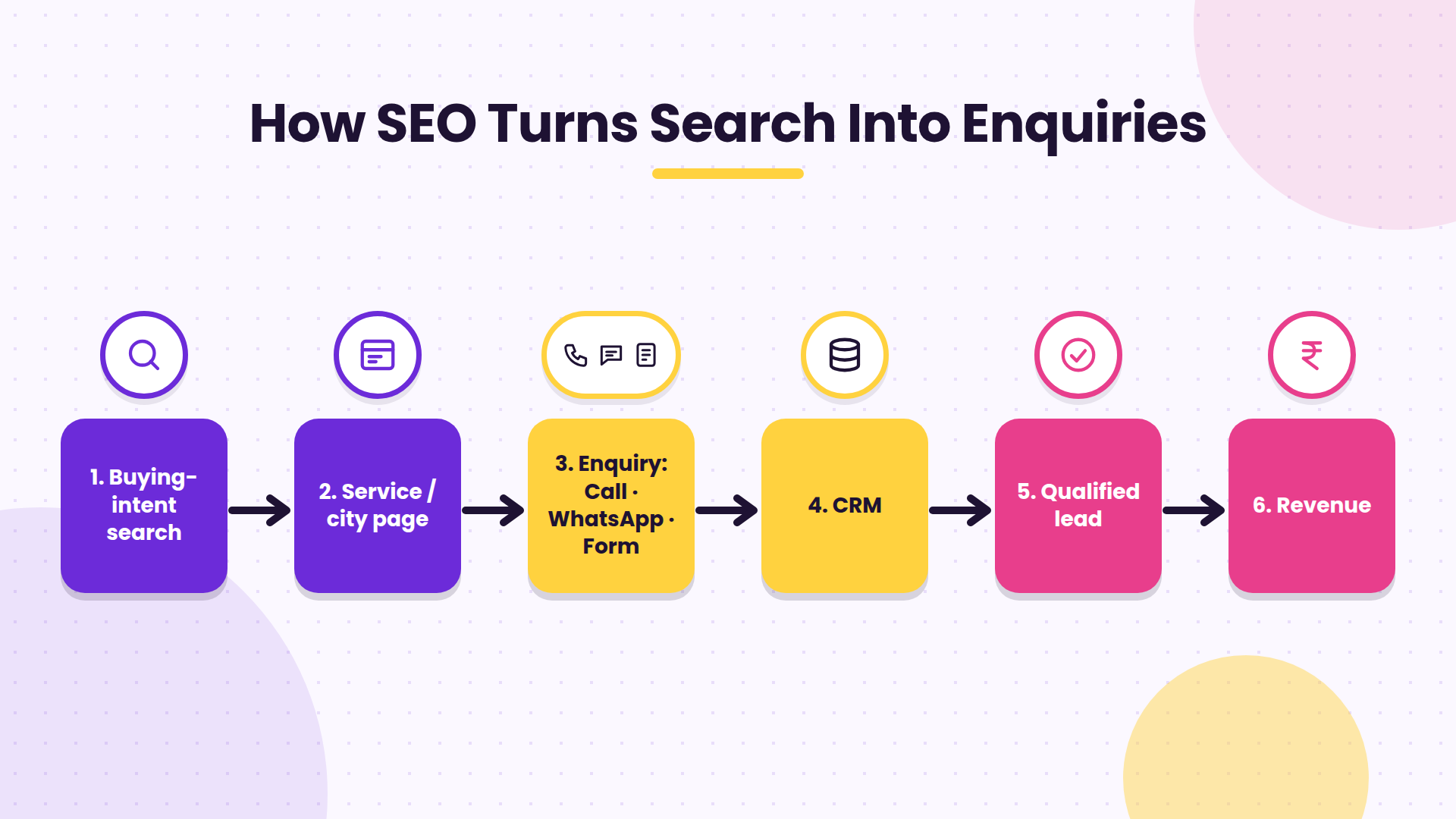
SEO for lead generation means optimising your website so it ranks for searches made by people who are close to hiring or buying, and then turning those visitors into enquiries your sales team can close. The goal is qualified leads and revenue, not rankings or traffic. It focuses on commercial-intent keywords, conversion-ready pages, local and trust signals, and tracking every call, WhatsApp message and form.
You will also hear it called SEO lead generation or lead gen SEO. It is one channel inside your wider lead generation mix. If you want the full picture across ads, email, events and referrals, read our lead generation guide. This post covers the SEO channel only. If you would rather have a team run it, see our SEO agency in Mumbai.
SEO leads vs SEO traffic
SEO leads are enquiries that come from organic search: a person found you on Google (or another search engine), landed on your site, and then called, sent a WhatsApp message or submitted a form. SEO traffic is everyone who arrived from search, including students, job seekers and competitors.
Traffic is easy to grow and easy to report. A blog on “what is digital marketing” can bring plenty of visits and zero enquiries, while a page for “healthcare digital marketing agency in india” brings fewer visits and more serious conversations. Ask for leads first, traffic second.
Direct vs assisted SEO leads
A direct SEO lead searches, lands and enquires in the same visit. An assisted SEO lead finds you through search, leaves, and returns later via a direct visit, referral, WhatsApp forward or ad before enquiring.
B2B buyers do a lot of this research alone. Gartner found that 67% of B2B buyers prefer a rep-free buying experience (Gartner, 2026), and that buyers spend only 24% of their buying time engaging with suppliers (Gartner research). Both are global surveys, not India-specific, but the point holds: much of the shortlisting happens before anyone fills your form. Last-click reports undercount SEO, so track assisted conversions too. For the wider B2B picture, see B2B marketing strategies that generate pipeline.
Is SEO still worth it for leads in the age of AI search?
Yes, but the type of search that pays has narrowed. AI answers reduce clicks on general information queries. Searches for a provider, a comparison or a local business still send visits, and being cited inside AI answers is now part of the job.
What the data says about clicks
The studies below (Pew Research Center, Ahrefs, Seer Interactive and BrightEdge) are from the US or global samples. There is no equivalent published study for India yet, so read them as direction, not as Indian benchmarks.
| Study | What it found | Scope |
|---|---|---|
| Pew Research Center, 2025 | Users clicked a traditional result in 8% of visits when an AI summary appeared, vs 15% without one. They clicked a link inside the summary in 1% of visits. | 900 US adults, 68,879 searches |
| Ahrefs, 2026 | AI Overviews correlated with 58% lower click-through rate for the top-ranking page. | 300,000 keywords, desktop, correlation study |
| Seer Interactive, 2025 | Organic CTR on queries with AI Overviews fell 61% (1.76% to 0.61%). Brands cited in the AI Overview got 35% higher organic CTR than brands that were not cited (0.70% vs 0.52%). | 3,119 informational queries across 42 client accounts |
| BrightEdge, 2026 | AI search was under 1% of referral traffic from January to August 2025, and organic search delivered significantly more conversions. | BrightEdge client data |
Two things stand out. The Seer data covers informational “what is” and “how to” queries, where click loss is sharpest. And being cited changes the picture: brands inside the AI answer did better than brands outside it.
Why lead-intent searches hold up better
Someone searching “social media marketing packages mumbai” wants prices, proof and a phone number. An AI summary can list options, but the buyer still has to visit a site and contact someone.
AI visitors also tend to arrive further along. Semrush estimated that the average AI search visitor is 4.4 times as valuable as a traditional organic visitor, based on conversion rate, and forecast that AI search visitors could pass traditional search visitors by early 2028 (Semrush, 2025). Treat the 2028 figure as a forecast, not a fact.
SEO for service businesses vs SEO for B2B lead generation
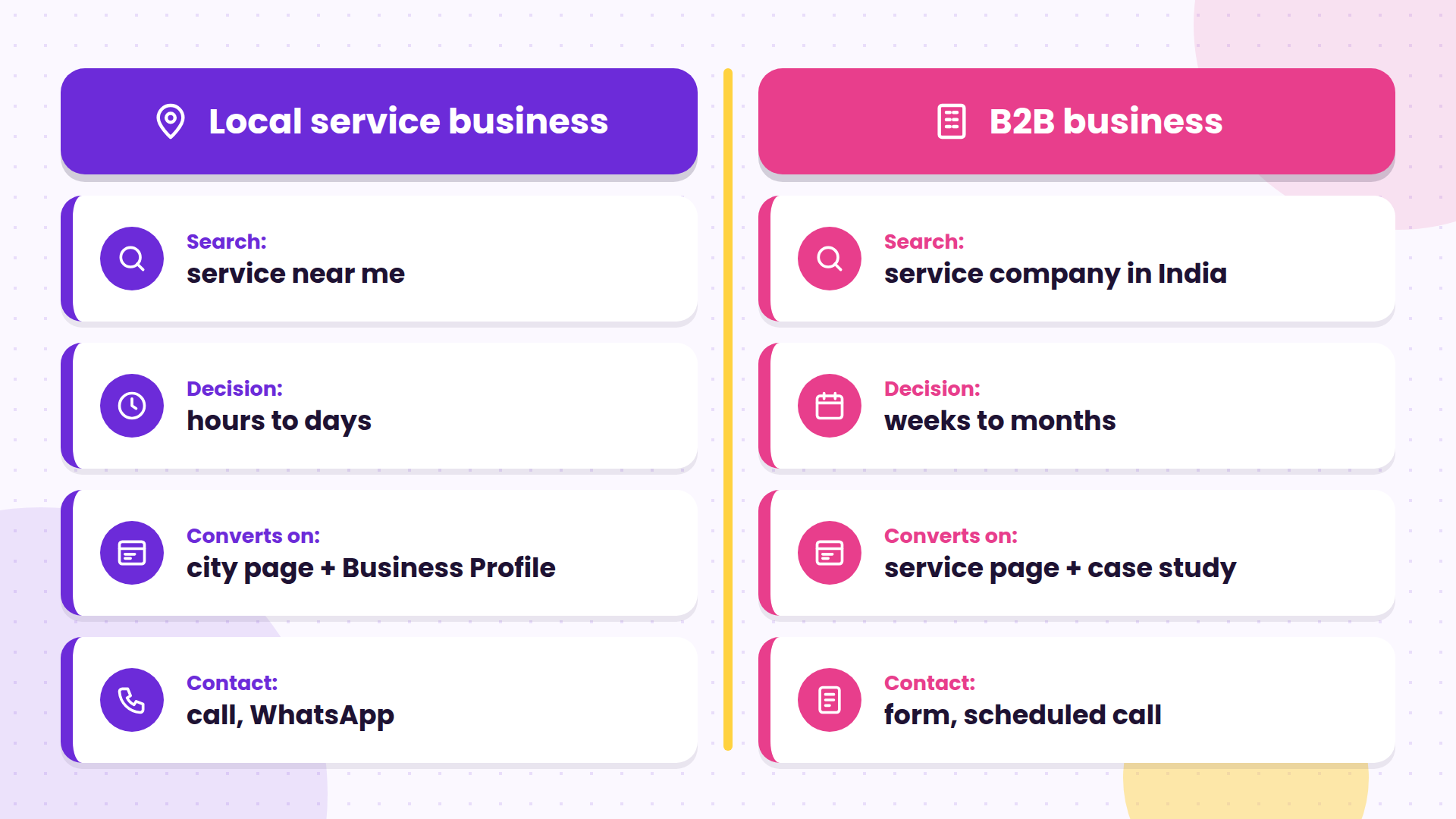
The basics are the same, but the buyer, the search and the page that converts are different. A local service business needs calls this week. A B2B firm needs to be on a shortlist that forms over months.
| Local service business (clinic, salon, coaching, real estate, repairs) | B2B business (IT services, consulting, SaaS, manufacturing) | |
|---|---|---|
| Who searches | The end customer, often on mobile | A manager, founder or procurement team, often several people |
| Typical search | “[service] near me”, “[service] in [area]”, “best [service] in [city]” | “[service] company in india”, “[industry] [service] agency”, “[product] manufacturer”, “[tool] alternative” |
| Decision time | Hours to days | Weeks to months |
| Page that converts | City/area page, service page, Google Business Profile | Service page, industry page, case study, comparison page |
| Preferred contact | Call, WhatsApp, walk-in | Form, email, WhatsApp, scheduled call |
| Trust signals | Google reviews, photos, doctor/staff credentials, pricing clarity | Case studies, client logos, certifications, directory reviews (Clutch, GoodFirms), original data |
| Main directories | Google Business Profile, Justdial, Practo (healthcare) | Clutch, GoodFirms, IndiaMART (manufacturing/suppliers), LinkedIn company page |
For B2B, buyers decide a lot before they speak to you. 6sense’s 2025 buyer survey found buyers first contact vendors around 61% of the way through their journey, buyers initiate 79% of first engagements, and the vendor contacted first wins around 80% of the time (6sense, 2025). That is vendor research across North America, APAC and EMEA, not India alone. The lesson still holds: if you are not visible while buyers research, you may never get the call.
For an industry example of how this works in practice, see our guide to SEO for banks, or our digital marketing for BFSI page.
Sector pages follow the same logic. See how we approach B2B digital marketing, healthcare marketing and real estate marketing.
How to generate leads through SEO: a 7-step engine
This is the SEO lead generation strategy we would run for an Indian service or B2B business. Work through the steps in order. Skip step 1 and SEO may “work” while sales still complains.
Step 1: Define a qualified lead with your sales team
Sit with sales and write down what a good enquiry looks like: service needed, budget range, location, company size, timeline. Also write down what a bad one looks like: job seekers, students, vendors pitching you, out-of-area requests.
This definition drives keyword choice, page copy and form fields, and lets you judge SEO fairly. If you use MQL (marketing qualified lead) and SQL (sales qualified lead) stages, agree what moves a lead between them. Then have sales mark each organic lead as qualified or not every week or fortnight.
Step 2: Pick bottom-of-funnel keywords first
Start with searches where the person is looking for a provider: “[service] company in [city]”, “[service] for [industry]”, “[service] cost”, “[service] near me”. Pull them free from Google Search Console, Google Ads Keyword Planner, and Google autocomplete and “People also ask”.
Group keywords by the page that should rank for them: one page per service, industry and city. Never target the same keyword with two pages.
Step 3: Build pages that match buying intent
A service page that converts answers the buyer’s questions in order: what you do, who it is for, how it works, what affects cost, proof, and how to start. Landing page SEO makes sure this page can rank: a clear title and H1 with the main keyword, descriptive headings, fast mobile loading, internal links from related blogs, and schema markup for your organisation and services.
Build these before you write more blogs. Blogs help when they answer buyer questions and link to the right service page.
Step 4: Make every page enquiry-ready for Indian buyers
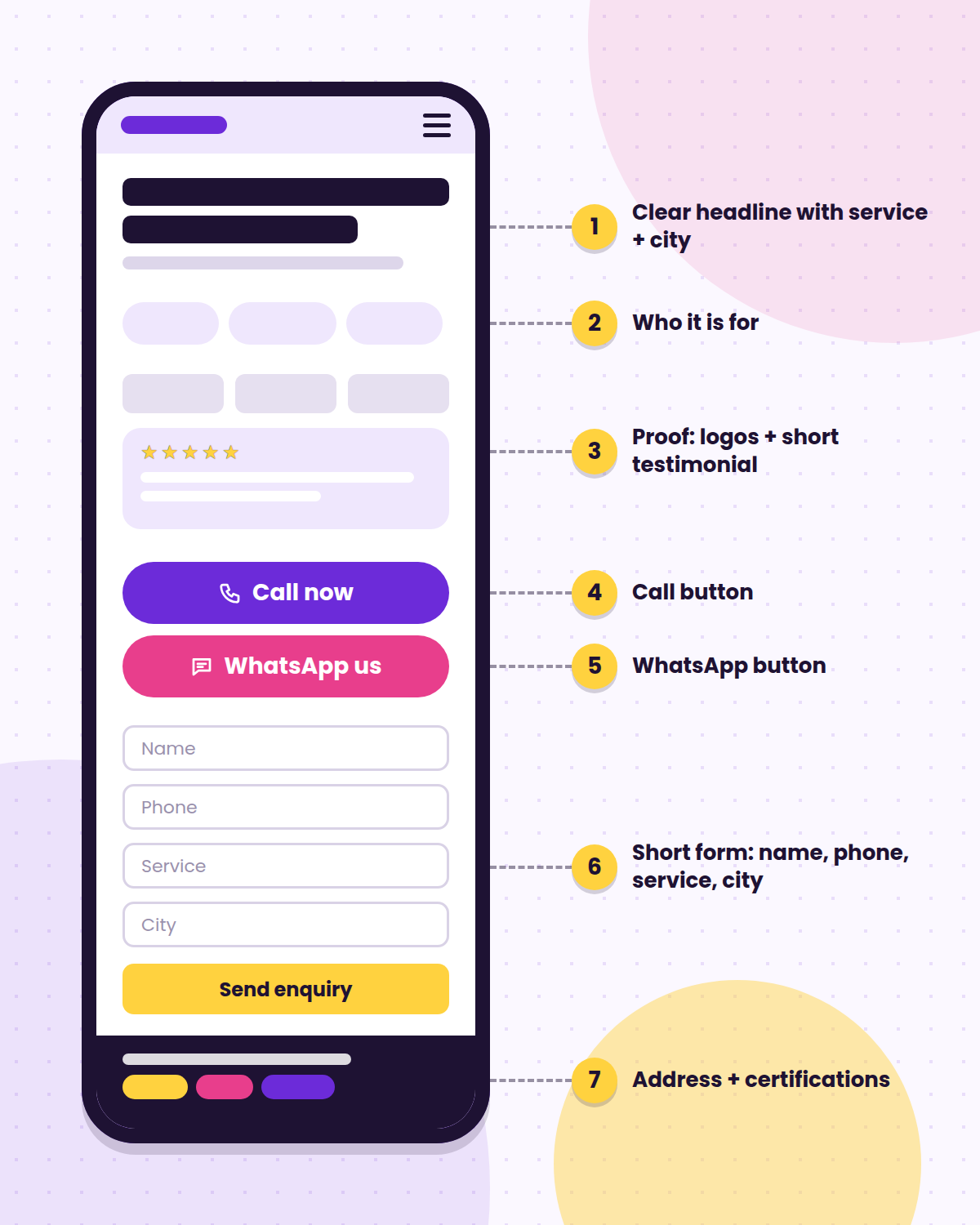
Indian buyers often prefer to call or WhatsApp rather than fill a long form. Give them all three options on every service and city page:
- Click-to-call button that is visible on mobile without scrolling.
- WhatsApp click-to-chat button with a pre-filled message that mentions the page (“Hi, I’m interested in [service]”).
- Short form: name, phone, service needed, city. Ask for more only if sales truly uses it.
- Response speed: decide who replies to web enquiries and how fast. A lead that waits till tomorrow may have already called your competitor.
- Trust near the CTA: client logos, a short testimonial, certifications, years in business, a real office address.
If your site template makes these hard to add, our web development services in Mumbai can fix that.
Step 5: Strengthen local SEO and entity signals
Local SEO lead generation starts with your Google Business Profile. Fill every field, pick accurate categories, add real photos, list services, and reply to every review. For local businesses, profile calls and direction requests are SEO leads too.
Then list your business on the directories your buyers and AI tools read: Clutch and GoodFirms for B2B services, IndiaMART for manufacturers and suppliers, Justdial and platforms like Practo for local and healthcare services. Keep name, address, phone and service descriptions consistent everywhere. These profiles also send referral visits.
Step 6: Build trust and links with proof, not volume
Buyers and search engines both look for evidence. The strongest assets for a service business are:
- Case studies: industry, problem, what you did, what changed. See the format in our client case studies.
- Original data, such as a customer survey or a benchmark from your own work.
- Expert content under a named author with real credentials, which supports E-E-A-T (experience, expertise, authoritativeness, trust).
- Mentions and links from industry associations, local news, partners and directories.
Skip bulk link packages. They rarely bring leads and can hurt you. See what backlinks are and why they matter for what to earn instead.
Step 7: Optimise for AI answers
Generative engine optimization (GEO) is making your content easy for AI tools like ChatGPT, Gemini, Perplexity and Google’s AI Overviews to find, understand and cite. The practical steps:
- Open each section with a direct one or two sentence answer (how to optimise content for AI search engines).
- Use clear definitions, tables for comparisons, and FAQs written in plain language.
- Add schema markup (Organization, Service, Article, FAQPage) so machines can read what the page is about.
- Get mentioned on third-party sites AI tools draw from: directories, reviews, industry publications and comparison lists.
- Keep facts consistent across your site and profiles, including services, locations and founding year.
Need help here? Our AI marketing services in Mumbai cover it.
How to track SEO leads in GA4 and your CRM
To track SEO leads, mark every enquiry action as a key event in Google Analytics 4 (GA4), capture the traffic source when the lead is created, and pass it into your CRM. Without this, calls and WhatsApp chats from organic search show up as “unknown” and SEO gets no credit.
Events to set up
| Enquiry action | GA4 event name (suggested) | How to track | Mark as key event? |
|---|---|---|---|
| Form submitted | form_submit or generate_lead | Thank-you page view or form success trigger in Google Tag Manager | Yes |
| Click-to-call | click_to_call | GTM click trigger on links starting with tel: | Yes |
| WhatsApp click | whatsapp_click | GTM click trigger on links containing wa.me or api.whatsapp.com | Yes |
| Email click | email_click | GTM click trigger on mailto: links | Optional |
| Brochure or price list download | file_download | GA4 enhanced measurement or GTM | Optional |
| Booking made | booking_complete | Booking tool confirmation page or integration | Yes |
A call or WhatsApp click shows intent, not a confirmed conversation. Count confirmed chats and calls in your CRM or call-tracking tool.
Connect leads to your CRM
- UTMs on everything you control: Google Business Profile website link (for example utm_source=google&utm_medium=organic&utm_campaign=gbp), directory profiles and email signatures. This separates Business Profile leads from other organic leads.
- Hidden form fields: capture landing page, source/medium and first-visit page in hidden fields, so each form lead arrives in the CRM with its source.
- WhatsApp and calls: use a pre-filled WhatsApp message that names the page, and ask “How did you find us?” on calls. If you use a call-tracking tool, assign a separate number to the website.
- Offline conversion import: record won and lost outcomes in the CRM. If you run Google Ads, you can import them back to Google. For SEO, a monthly CRM report by lead source is enough to start.
How to see leads from ChatGPT and other AI assistants
AI assistants show up in GA4 as referral traffic. To see them in one place:
- Go to GA4 > Explore > Free-form.
- Add the dimensions “Session source” and “Landing page + query string”, and the metrics “Sessions” and “Key events”.
- Add a filter: Session source > matches regex > chatgpt|perplexity|gemini|copilot|claude.
- Set the date range and look at which pages AI tools send people to, and whether those visits turn into key events.
Which KPIs should you report to leadership?
Report leads, lead quality and revenue first, then the SEO numbers that explain them. Leadership wants business, not keyword movements.
| KPI | What it tells you | Where it comes from | How often |
|---|---|---|---|
| Organic leads (form + call + WhatsApp) | Volume of enquiries from search | GA4 key events + CRM | Monthly |
| Qualified leads (MQL/SQL) from organic | Whether SEO brings the right buyers | CRM, sales feedback | Monthly |
| Organic lead-to-customer rate | Lead quality in revenue terms | CRM | Quarterly |
| Revenue / pipeline from organic | Business impact | CRM | Quarterly |
| Cost per organic lead | Efficiency vs other channels | SEO spend ÷ organic leads | Quarterly |
| Visitor-to-enquiry conversion rate on service pages | Whether pages convert | GA4 | Monthly |
| Clicks and impressions for commercial queries | Visibility where it matters | Search Console (filtered) | Monthly |
| Google Business Profile calls and website clicks | Local demand | Business Profile performance | Monthly |
| AI assistant sessions and key events | Visibility in AI answers | GA4 (regex filter above) | Monthly |
For an external reference, First Page Sage publishes benchmarks from its own clients: organic visitor-to-lead conversion of 2.6% for B2B and 2.1% for B2C, versus 1.2–1.5% for paid search (First Page Sage), and in B2B SaaS, 51% of SEO MQLs became SQLs versus 26% for PPC (First Page Sage). These are one agency’s client figures, not India-specific and not peer-reviewed. Your own numbers are the baseline.
How long does SEO take to generate leads?
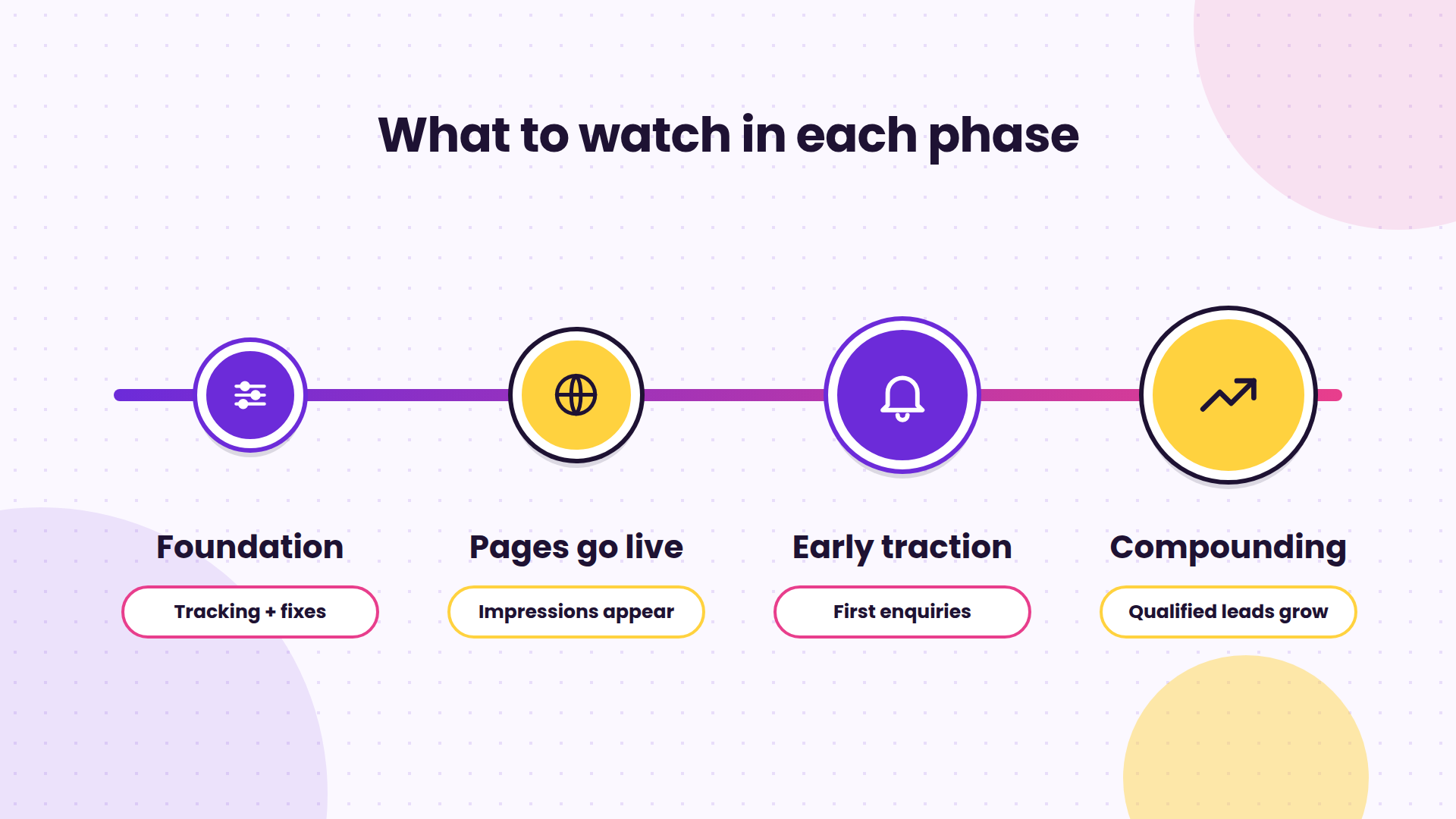
There is no fixed timeline. It depends on your site’s current authority, local and industry competition, and how many pages need building. Plan in phases and watch the right signal in each.
| Phase | What happens | What to watch | When to worry |
|---|---|---|---|
| Foundation | Tracking, technical fixes, lead definition, Business Profile | Key events firing, pages indexed in Search Console | Tracking still broken after setup |
| Pages go live | Service, industry and city pages published or rebuilt | Impressions for commercial queries start appearing | No impressions for target queries after pages are indexed |
| Early traction | Pages move up, first organic enquiries arrive | Clicks on commercial queries, first key events | Clicks rise but enquiries stay at zero (a page or CTA problem, not a ranking problem) |
| Compounding | More pages rank, reviews and mentions build | Qualified organic leads each month, share of pipeline | Lead volume rises but sales rejects most of them (a keyword or definition problem) |
Keep your paid channels running while organic builds. SEO should reduce your dependence on ads over time, not replace them on day one.
SEO or Google Ads for leads?
Google Ads brings leads as soon as campaigns go live and stops when you stop paying. SEO takes longer but keeps working once pages rank. Most service and B2B businesses do best with both: ads for immediate demand and keyword testing, SEO for credibility and a lower long-term dependence on paid clicks. Use your ads search terms report to find converting keywords, then build SEO pages for them. If you need the paid side set up, see our PPC agency in Mumbai page. For a full comparison of budgets and trade-offs, read SEO vs paid ads: where should your marketing budget actually go.
Lead math: a template to size your SEO lead opportunity
Before you invest, estimate what SEO could be worth using your own numbers. Do not plug in industry averages. Fill in this template with real data from your tools.
Formula: Monthly searches × click-through rate × visitor-to-enquiry rate × enquiry-to-qualified rate × qualified-to-won rate × average deal value = monthly revenue potential from SEO
| Input | Your number | Where to get it |
|---|---|---|
| Monthly searches for your bottom-of-funnel keywords | ______ | Google Ads Keyword Planner, Search Console impressions |
| Expected click-through rate at your target position | ______ % | Your own Search Console CTR for similar pages |
| Visitor-to-enquiry rate (form + call + WhatsApp) | ______ % | GA4 key events ÷ sessions on service pages |
| Enquiry-to-qualified rate | ______ % | CRM, sales feedback |
| Qualified-to-won rate | ______ % | CRM |
| Average deal value (first year) | ₹ ______ | Accounts / CRM |
| Monthly revenue potential | ₹ ______ | Multiply the rows above |
Run it twice: once for today, once for where you could be if key pages ranked and converted better. The gap shows whether SEO is worth it, and which lever (rankings, conversion or lead quality) matters most.
[IMAGE 7 — seo-lead-math-template.png | Purpose: visual of the lead math formula | Alt text: “SEO lead math formula: searches times CTR times enquiry rate times qualified rate times win rate times deal value equals revenue” | Prompt for ChatGPT/image model: Flat vector equation graphic, 16:9, white background. Six rounded tiles in a row joined by “×” symbols, then “=” and a final larger tile. Tile labels exactly: “Monthly searches”, “CTR %”, “Enquiry rate %”, “Qualified %”, “Win rate %”, “Deal value ₹”, final tile “Revenue from SEO ₹”. Each tile shows a blank line “____” under the label (no numbers anywhere). First six tiles purple #6a4796 with white text, final tile gold #fdc91d with dark #1a1a2e text. No people, no photos.]
A 90-day SEO lead generation plan
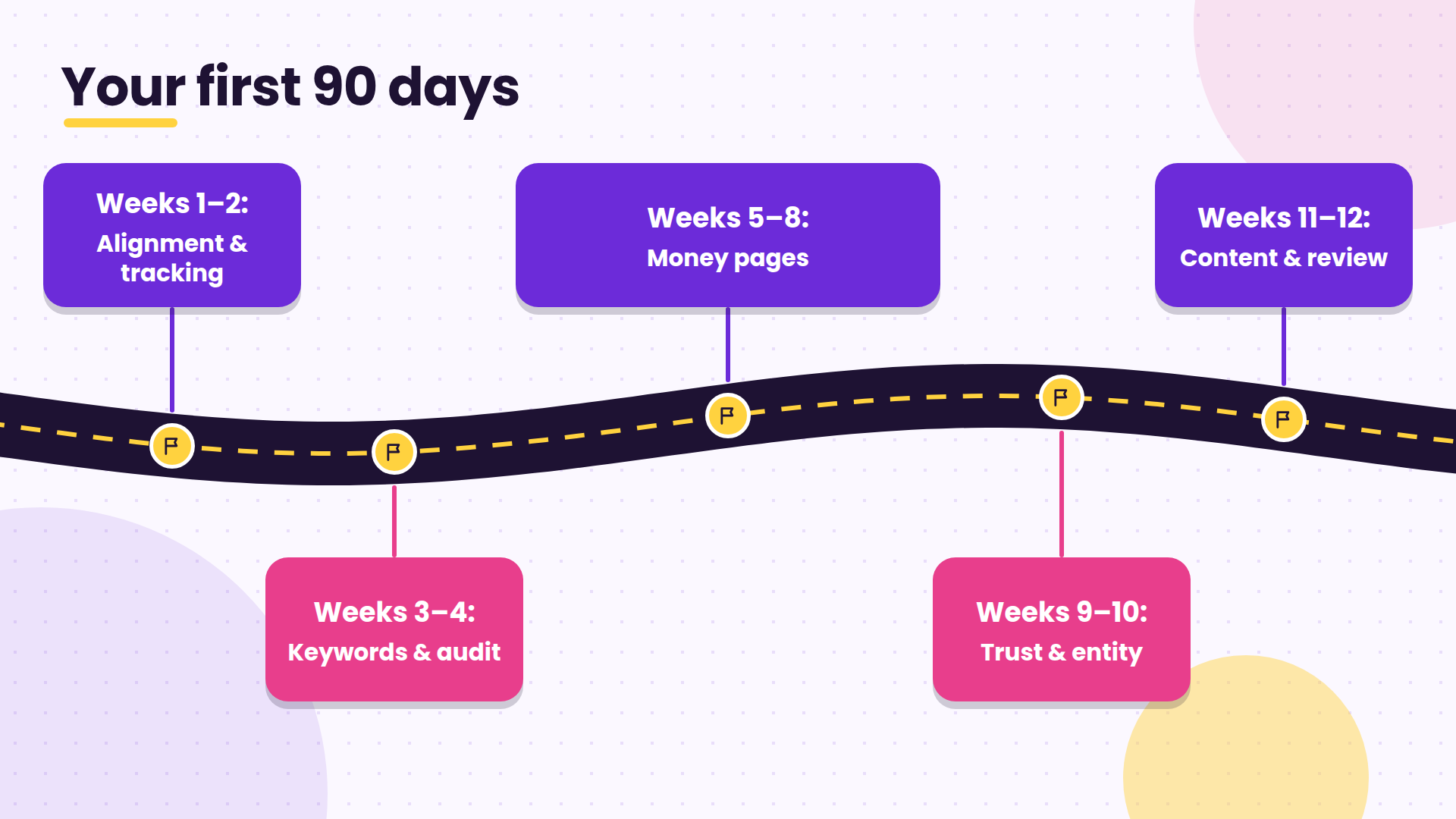
This is a work plan for the first 90 days, not a promise of results in 90 days. It puts the foundation, key pages and tracking in place.
| Weeks | Focus | Tasks | Output |
|---|---|---|---|
| 1–2 | Alignment and tracking | Agree lead definition with sales; GA4 key events for form, call, WhatsApp; hidden source fields | Lead definition; working tracking |
| 3–4 | Keywords and audit | Pull bottom-of-funnel keywords; map keywords to pages; technical and mobile audit | Keyword-to-page map; fix list |
| 5–8 | Money pages | Build or rewrite top service, industry and city pages with call, WhatsApp, short form, proof and schema; complete Business Profile | Enquiry-ready pages live |
| 9–10 | Trust and entity | Publish 1–2 case studies; update relevant directory profiles; start review requests | Proof assets; consistent profiles |
| 11–12 | Content and review | Publish buyer-question FAQs and guides linking to service pages; review lead quality with sales | First SEO lead report; next-quarter plan |
Common mistakes that kill organic lead generation
- Reporting rankings instead of leads. Rankings for terms nobody buys from do not pay salaries.
- Blogs before service pages. Informational traffic is what AI answers absorb fastest.
- Tracking only forms. Uncounted calls and WhatsApp chats make SEO look weaker than it is.
- No agreed lead definition. Marketing celebrates volume, sales complains about quality.
- Slow replies to web enquiries. Buyers who contacted several providers go with whoever answers.
- Copy-paste city pages. Pages that only swap the city name rarely rank or convert.
- Ignoring Business Profile and directories. Buyers often check you there first.
- Long forms. Ask only what sales needs for the first call. See conversion rate optimisation for Indian brands.
Questions to ask before you hire an SEO partner
- How will you measure leads, not just rankings and traffic?
- Which pages would you build or fix first, and why?
- How will you track calls and WhatsApp enquiries?
- Can you show a case study with leads or revenue in our industry?
- What will you report monthly, and who explains it?
- How do you approach AI search visibility?
You can put the same questions to our SEO team in Mumbai.
For a fuller checklist on choosing a partner, read how to choose the right digital marketing agency in India.
Frequently asked questions
Is SEO dead now with AI?
No. AI answers have reduced clicks on general information searches, according to US studies from Pew Research and Seer Interactive. But people still search for providers, compare options and check reviews before they enquire. SEO now includes being cited in AI answers, and Seer found cited brands got higher organic click-through rates than brands that were not cited.
What is the 80/20 rule in SEO?
The 80/20 rule, or Pareto principle, suggests a small share of your pages and keywords drive most of your results. For lead generation, that usually means your service, industry and city pages. Find the pages and queries that bring enquiries in GA4 and Search Console, and spend most of your effort improving those before you create new content.
Can I do SEO myself?
Yes, for the basics. You can set up Google Business Profile, fix page titles, add call and WhatsApp buttons, and write service pages yourself. Technical fixes, tracking setup, link building and ongoing content take more time and skill. Many owners start themselves and bring in help once the basics are done. Our guide on agency vs in-house covers the trade-offs.
What is the biggest mistake in lead generation?
Chasing lead volume without agreeing what a qualified lead is. Marketing ends up celebrating numbers while sales rejects most of the enquiries. Write down your qualified-lead criteria with the sales team, track lead source into your CRM, and review lead quality every few weeks so targeting and pages can be fixed.
How can I use SEO to generate leads?
Target bottom-of-funnel searches such as “[service] company in [city]” and “[service] cost”. Build a strong page for each service, industry and city. Add a call button, WhatsApp button and short form to every page. Complete your Google Business Profile, get listed on relevant directories, publish case studies, and track every enquiry in GA4 and your CRM.
Can ChatGPT do SEO?
ChatGPT can help with parts of SEO: keyword ideas, outlines, meta descriptions and FAQ drafts. It cannot see your Search Console data, fix your site, earn reviews or build real relationships for links. Its facts also need checking. Use it as an assistant and keep a person responsible for strategy, accuracy and results.
Is SEO paid or free?
You do not pay Google for organic clicks, which is why SEO is often called free. The work itself costs time or money: content, technical fixes, tools and expertise. The trade-off with ads is that SEO costs are mostly upfront and ongoing effort, while ad costs rise with every click.
How long does SEO take to generate leads?
There is no fixed timeline. It depends on your site’s current strength, competition and how many pages need work. Watch progress in phases: tracking and fixes first, then impressions for commercial queries, then clicks and first enquiries, then a steady flow of qualified leads. Keep ads running while SEO builds.
How do I track leads from organic search?
Set up GA4 key events for form submissions, click-to-call and WhatsApp clicks. Capture the source and landing page in hidden form fields so each lead arrives in your CRM with its source. Add UTM tags to your Google Business Profile link. Ask “How did you find us?” on calls, and report organic leads and qualified leads monthly.
Why is my traffic high but leads low?
Usually one of three reasons. Your traffic comes from informational keywords, not buying searches. Your pages do not make enquiring easy, with no visible call or WhatsApp button and a long form. Or your tracking misses calls and WhatsApp chats. Check which pages get traffic, which get key events, and fix the service pages first.
Where to start
SEO for lead generation works when it is built around your buyer, not traffic. Define a qualified lead, build pages for searches people make when ready to hire, make every page easy to call or WhatsApp, and track every enquiry into your CRM. AI search has changed which clicks you can win, not the need to be the business buyers find and trust.
If you want a team to build this for you, see our SEO services in Mumbai.
Want to get on the Social Pill? Let’s schedule a consultation.