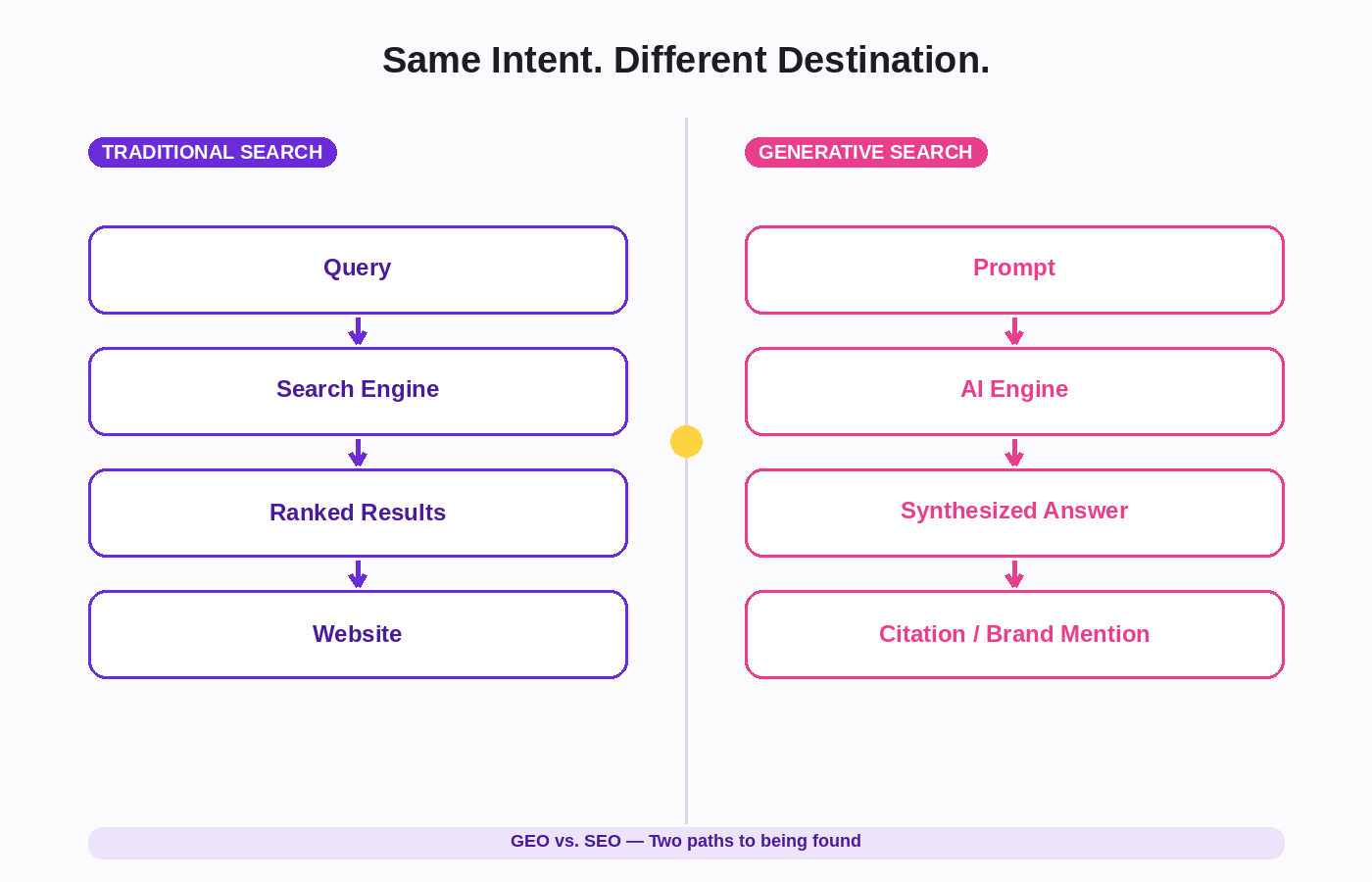
A consumer looking for a face serum for oily skin used to open Google, scan ten blue links, and compare a few product pages. Increasingly, the same consumer now opens an AI assistant and asks it to recommend a serum based on skin type, budget, and ingredients. Both paths start with the same intent. They end in very different places.
This shift has put a new acronym in front of CMOs and founders: GEO, or generative engine optimisation. It sits next to SEO, the discipline most marketing teams have invested in for over a decade. Some conversations treat GEO as a replacement for SEO. Others dismiss it as a rebrand of the same old work. Neither view holds up well under scrutiny.
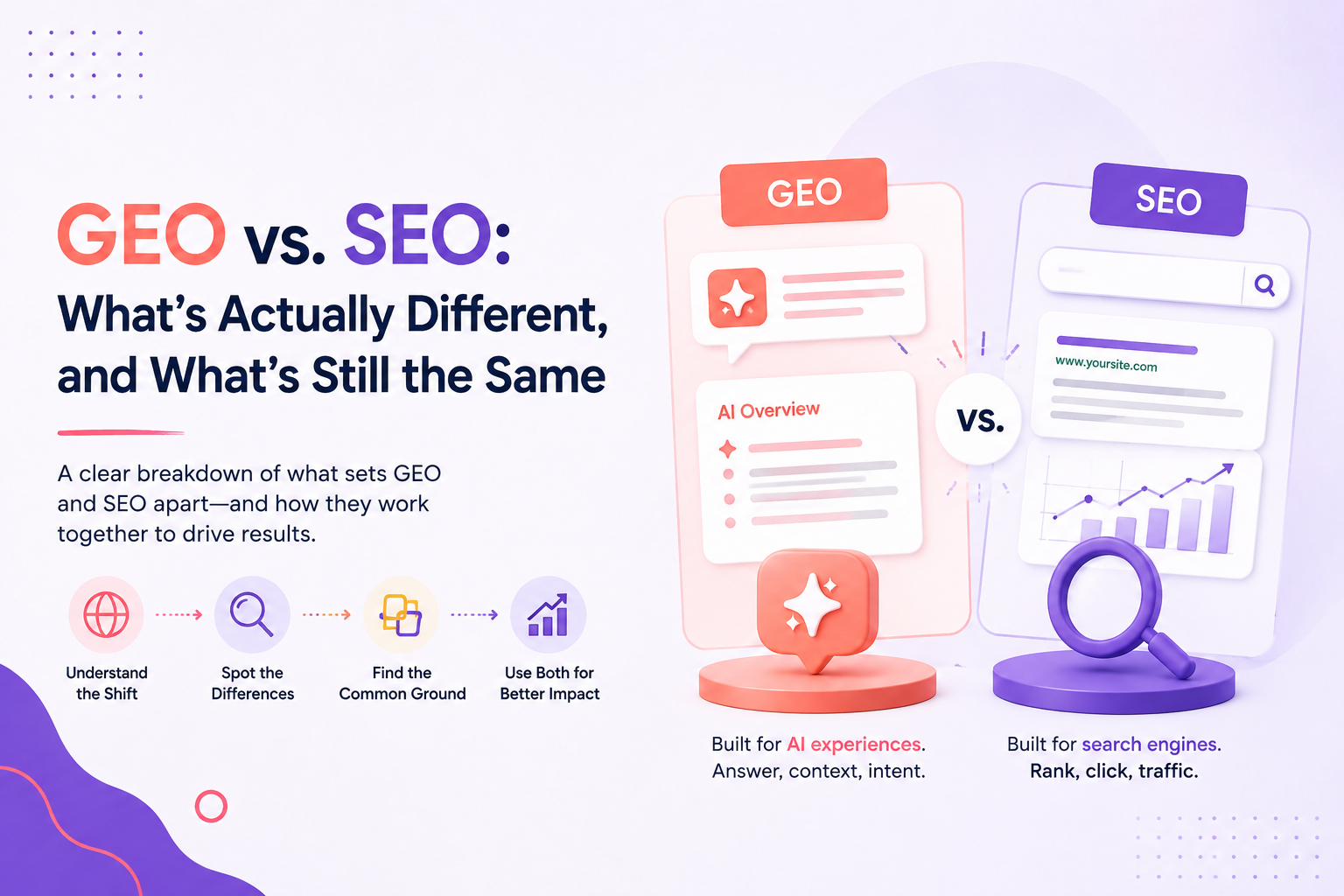
Before comparing tactics, it helps to settle the geo vs seo meaning in one line: SEO is built for ranking; GEO is built for being understood by AI systems. If brands already invest heavily in SEO, what actually needs to change for AI-driven search?
What Is SEO?
Search engine optimization is the practice of making a website easier for search engines to find, understand, and rank. Search engines crawl the web, index pages, and rank them based on relevance and authority signals.
For a brand, this means several things happen at once. Keyword research identifies what customers actually type into a search bar. On-page SEO aligns titles, headings, and content with that language and with search intent. Technical SEO makes sure a site is fast, crawlable, and mobile-friendly. Backlinks from credible sources signal authority to the algorithm.
Take a skincare brand targeting “best vitamin C serum in India.” Winning that search typically means building a detailed category page, writing content that addresses real buying questions, and earning links from skincare publications or reviewers. Rankings do not happen overnight. They build over months, through consistent publishing and a technically sound site. The output of good SEO is straightforward: the brand shows up on the search engine results page, and a share of those searchers click through to the website. That click is the unit SEO has optimized around for two decades.
What Is GEO?
Generative engine optimization is the practice of making content easier for AI systems to understand, evaluate, and potentially reuse inside a generated answer. The systems in question include ChatGPT, Google’s AI Overviews, Perplexity, and Gemini.
The difference starts with the interface. A traditional search returns a results page ten or so links a person scans and chooses from. A generative search returns a synthesized answer, built by pulling information from multiple sources and phrasing it as a direct response. This is closer to semantic search, where a system tries to understand meaning and intent rather than just matching keywords.
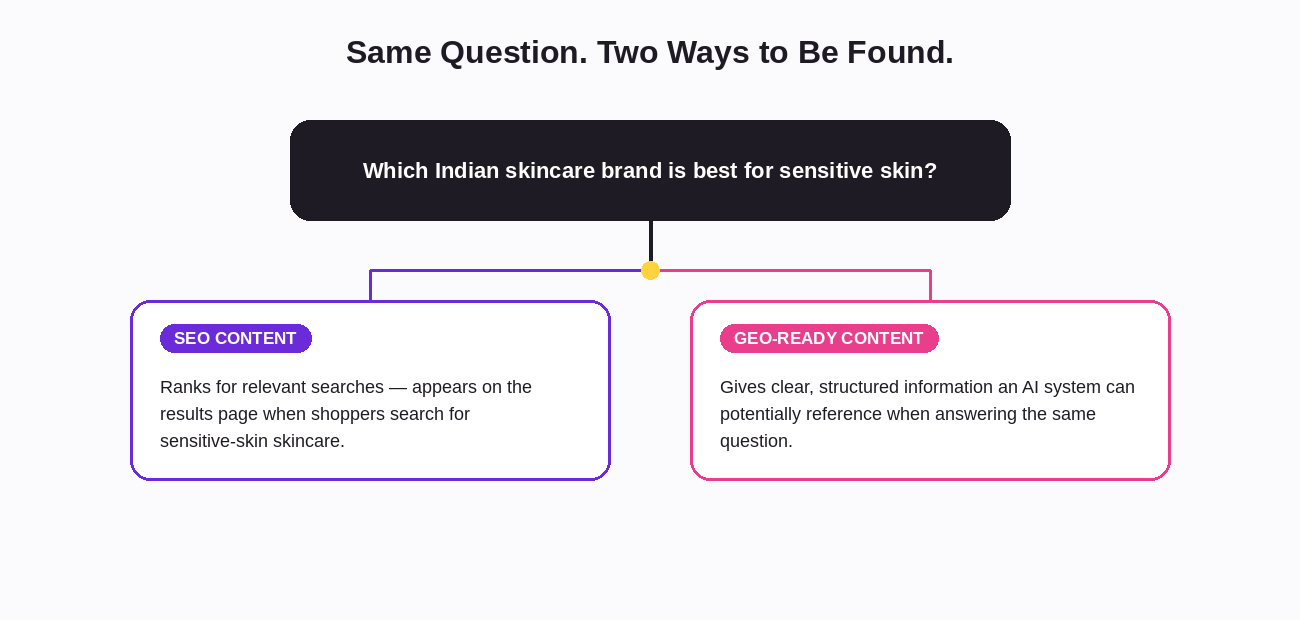
Consider two versions of a similar need. An SEO-style search might read “best D2C skincare brands in India.” A GEO-style prompt looks more like “Which Indian skincare brands are best for sensitive skin, and what makes each one different?” The second version asks the AI system to reason across several brands and produce a recommendation in one response.
That difference changes the optimization challenge. A page can rank without ever being quoted inside an AI answer, and a page referenced by an AI system may never appear as a traditional blue link. Brands cannot force this outcome directly, and no responsible agency should promise otherwise. What content can do is increase the likelihood of being surfaced, improve visibility to the systems doing the summarizing, and make information easier to interpret and attribute correctly.
GEO vs. SEO: The Real Difference
The biggest difference between GEO and SEO is not simply Google versus AI. Both approaches now coexist on the same platforms, and Google itself blends ranked results with AI Overviews on many queries. The deeper difference sits in the optimization objective.
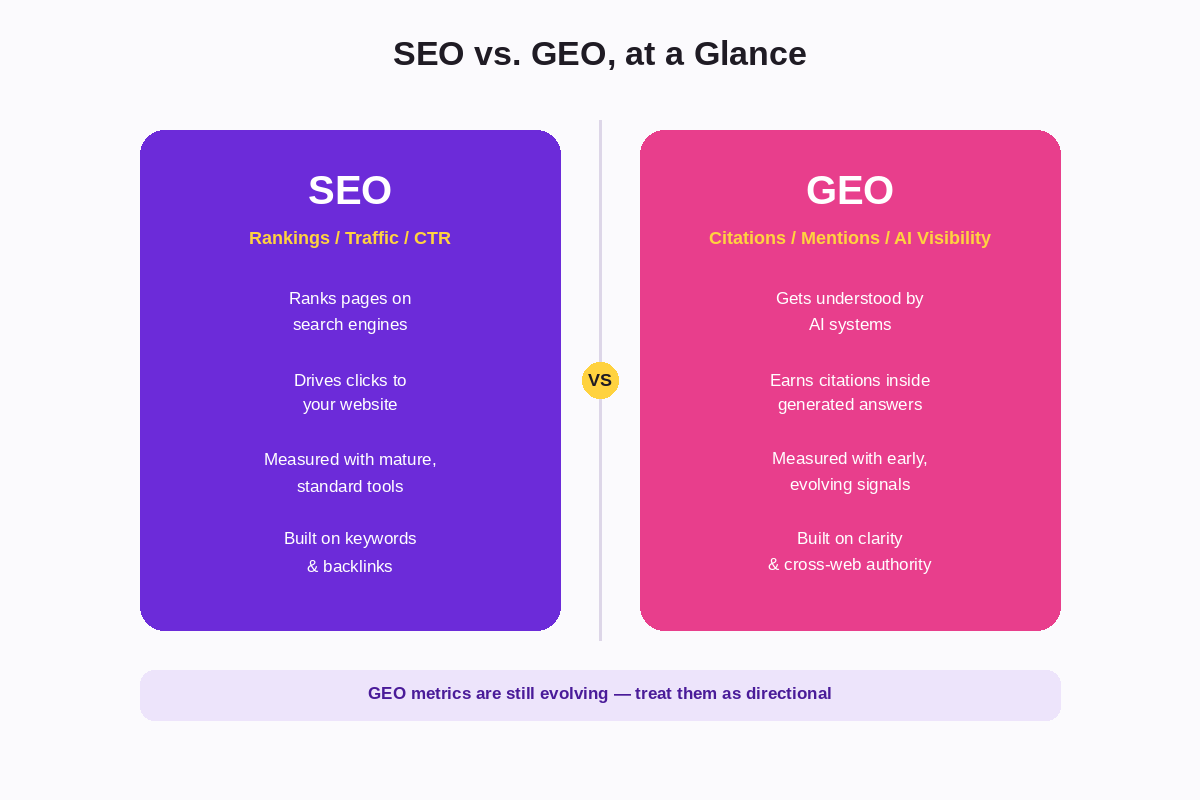
SEO generally aims to rank pages, attract clicks, generate organic traffic, and capture existing search demand. GEO generally aims to make content understandable to AI systems, increase the odds of inclusion in generated answers, and strengthen visibility across generative search experiences. A useful shorthand: SEO helps a brand get discovered. GEO helps it get included in the answer.
Keywords vs. Questions and Prompts
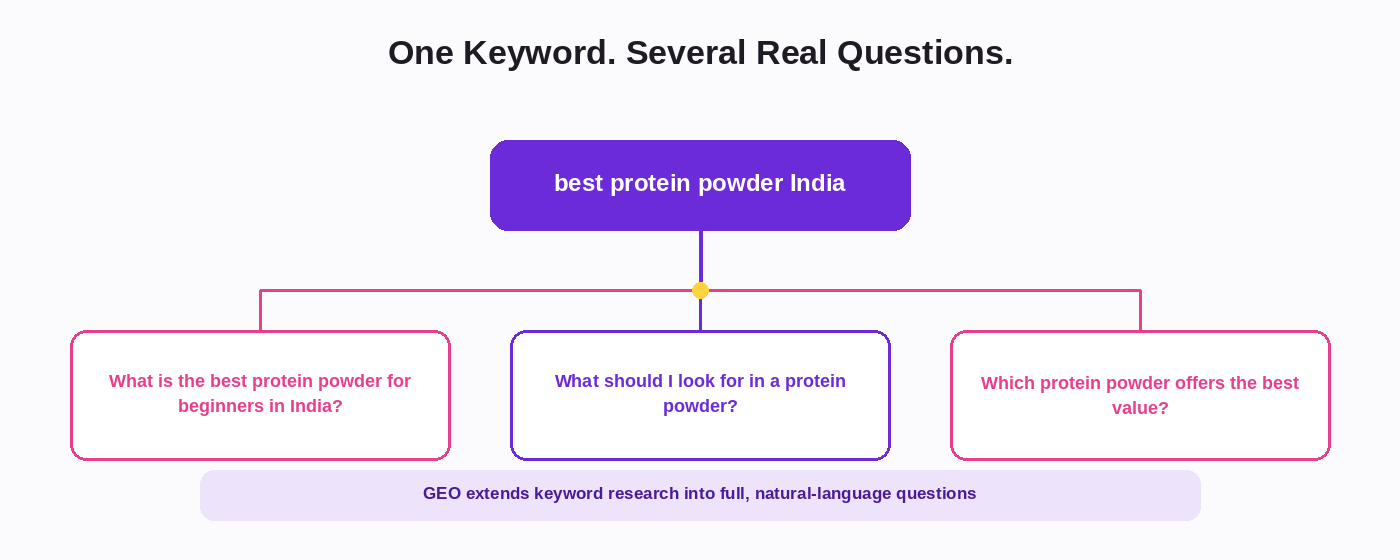
SEO usually starts with keyword research. A team identifies a term such as “best protein powder India,” checks its search volume, and builds content to rank for it. GEO asks marketers to think in fuller questions. A generative system responds to natural-language prompts like “What is the best protein powder for beginners in India?” or “How should I choose a protein powder based on ingredients and price?” These prompts carry more context than a keyword phrase alone.
This does not make keywords irrelevant. Keywords, entities, topics, and natural-language questions work together. A strong content plan still starts with what people search for. It simply extends that research into the fuller questions people ask when talking to an AI system instead of typing into a search bar.
Rankings vs. AI Visibility
SEO has a mature measurement stack. Rankings, impressions, organic traffic, click-through rate, and conversions are all trackable in tools most marketing teams already use. GEO-related visibility looks different and is still taking shape. It can include AI citations, brand mentions inside generated answers, inclusion in AI-driven recommendations, and early attempts at tracking AI share of voice. This is one of the clearest places the GEO vs SEO distinction shows up in day-to-day reporting. None of it is as standardized yet as a rank tracker or an analytics dashboard.
A CMO evaluating GEO performance should treat these metrics as directional, not definitive. A mention inside one platform’s answer today says little about whether it will reappear next month, on a different platform, or for a slightly different prompt.
Backlinks vs. Citations, Mentions, and Context
Backlinks remain a core SEO signal. A link from a credible publication tells a search engine that other sites vouch for a page’s authority. GEO puts more weight on whether a brand is represented consistently and credibly across the wider web, not only on its own domain.
A D2C nutrition brand might have well-built product pages and still have almost no presence in independent reviews or comparison articles. That gap matters more for GEO, because generative systems often draw from a wider set of sources when constructing an answer.
This does not make backlinks irrelevant to GEO. A credible backlink profile still signals authority to AI systems trained on web-wide data. GEO simply broadens “authority” beyond links, to include how a brand is discussed and cited across the internet.
Ranking Pages vs. Being Reused in Answers
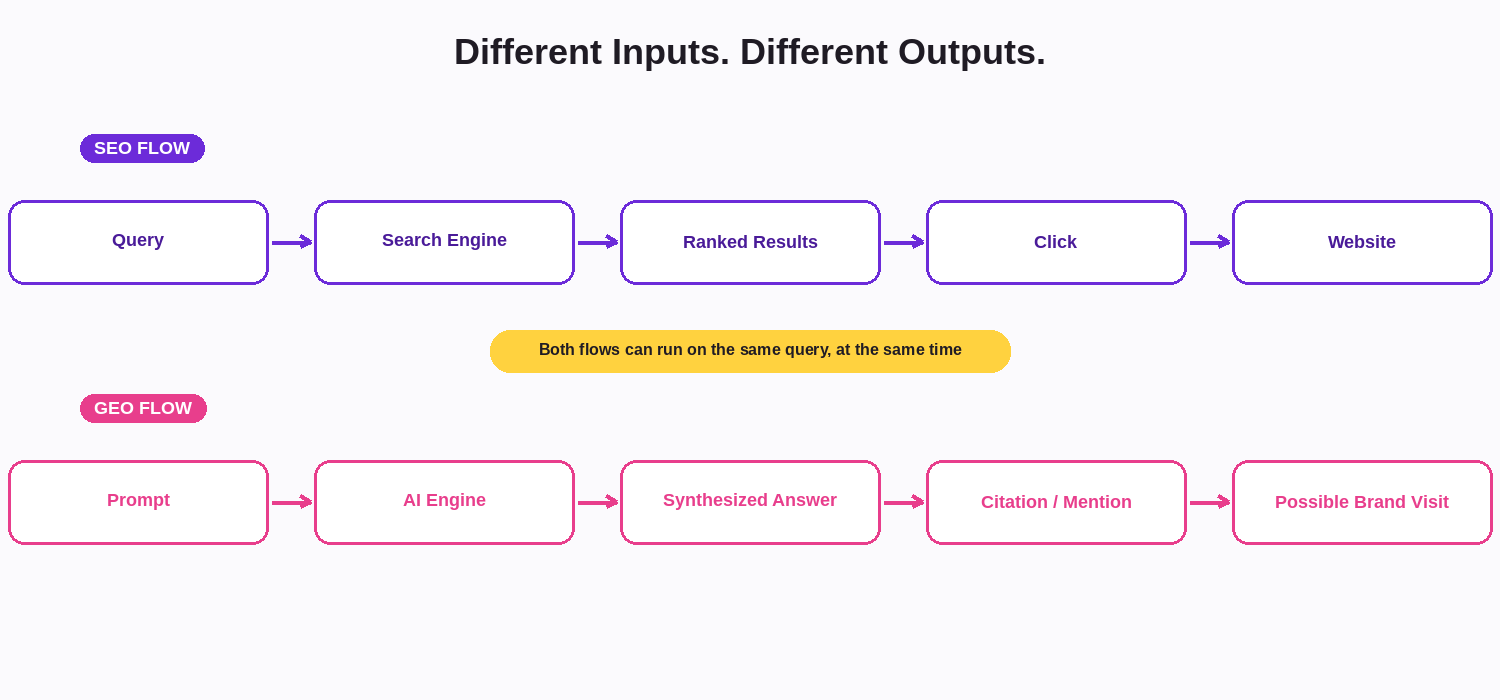
SEO typically sends a user to a page. The results page is a doorway, and the website is the destination. Generative search can summarize information inside the answer itself, without sending the user anywhere.
Traditional search: User → Google → Brand article → Website. Generative search: User → AI platform → Synthesized answer → Possible citation or brand mention.
A person may get a full answer to “which Indian skincare brand suits sensitive skin” without ever clicking through to a website. The brand’s information still traveled. The visit simply did not happen the same way. This changes how a marketer should define visibility a page can influence a decision by being read and referenced, even without recording a session in an analytics tool.
What GEO and SEO Still Have in Common
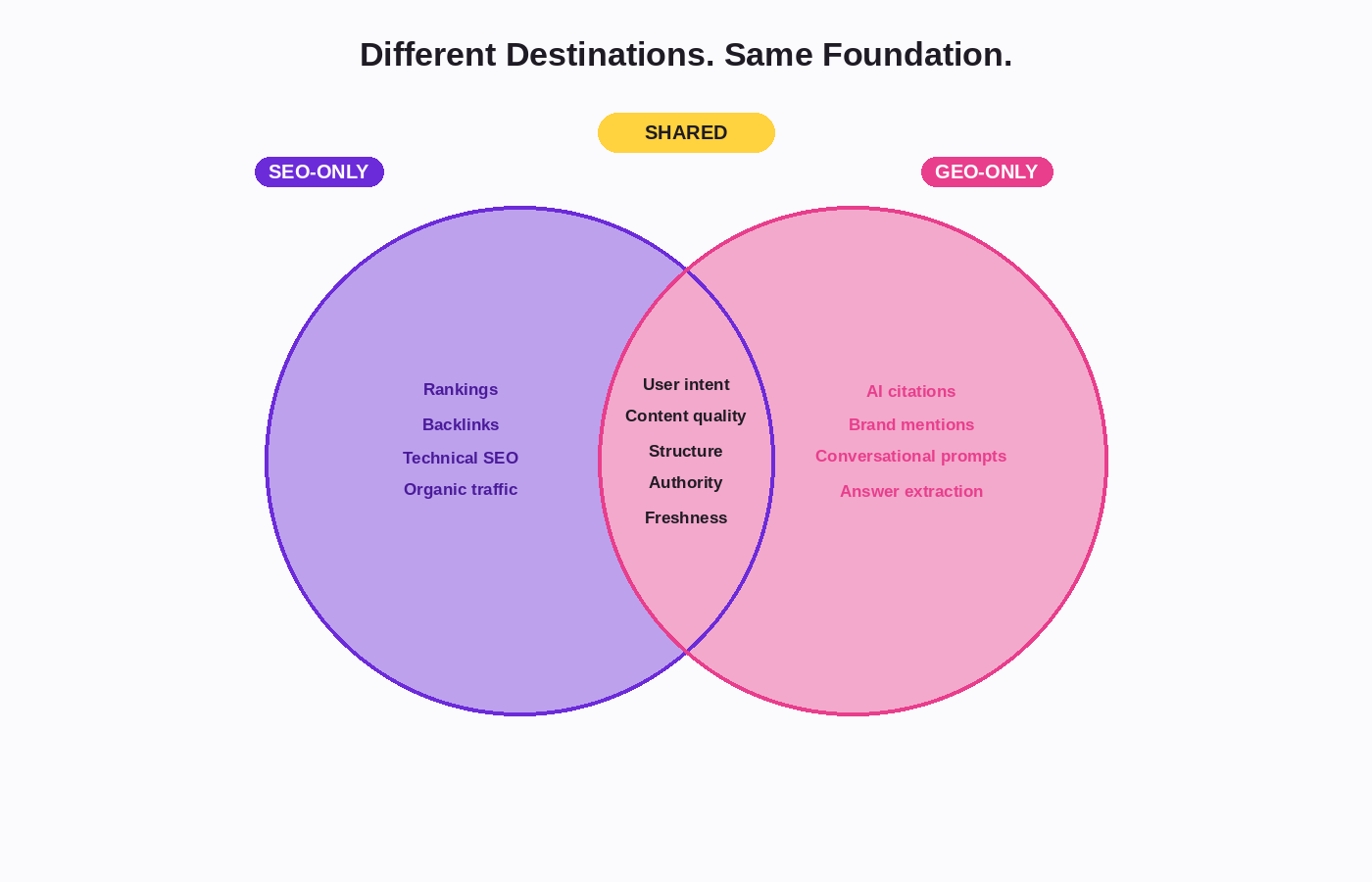
GEO is not a completely separate universe from SEO. Both rest on the same foundation of quality content, clear structure, and genuine authority.
User Intent Still Comes First
Both strategies need to answer what the user is actually trying to solve. A shopper researching “gel vs cream moisturizer” wants a clear comparison, not a brand pitch. Whether that comparison appears in a ranked article or inside an AI answer, the underlying job is the same.
Content Quality Still Matters
Original, accurate, useful content matters to both systems. A generic line like “drink enough water” adds little value anywhere. A brand publishing original research or expert-backed guidance gives a search engine and an AI system something more substantial to rank or summarize.
Structure Still Matters
Descriptive headings, clear sections, short paragraphs, plain definitions, tables, and FAQs help a reader scan a page quickly. They help an AI system extract a reliable answer just as fast.
A page that buries its main point inside a long, unstructured paragraph is harder for both a human and a model to use. Logical hierarchy is close to a prerequisite for GEO, not a nice-to-have.
Authority and Trust Still Matter
E-E-A-T, Google’s framework for experience, expertise, authoritativeness, and trust, still applies. Author credentials, expert review, transparent sourcing, original data, credible backlinks, and consistent brand information all build the same kind of trust an AI system is trained to weigh.
Technical Foundations Still Matter
Crawlability, site speed, mobile experience, internal linking, and clean site architecture remain non-negotiable. Schema markup and other structured data help both a search engine and an AI system parse a page correctly. GEO is not an excuse to neglect technical SEO a page that cannot be crawled may never reach either system’s index.
GEO vs. SEO: Advantages and Disadvantages
SEO Advantages
SEO runs on a mature ecosystem. Measurement is well established, from rank tracking to attribution models connecting organic traffic to revenue. A well-optimized page can compound in value for years after publishing.
SEO also captures existing search demand directly. A skincare brand ranking for “best sunscreen for Indian skin” reaches people already searching with clear purchase intent a channel the brand fully owns.
SEO Disadvantages
Ranking takes time, often months, and algorithm updates can shift performance without warning. Competitive keywords in categories like beauty or fashion can be slow and expensive to win.
Traffic also does not always equal qualified demand. Zero-click results, where a searcher gets an answer directly on the results page, have reduced click-through rates for many informational queries, even when content ranks well.
GEO Advantages
GEO offers visibility inside a discovery layer that barely existed a few years ago. It aligns naturally with conversational search, where people ask fuller questions instead of typing fragments.
It also creates a chance to shape consideration before a website visit happens. A wellness brand’s ingredient philosophy could influence how an AI system describes an entire category, even for users who never land on its site. GEO also rewards content built around complex, comparative questions an area many brands have underserved.
GEO Disadvantages
GEO measurement is still developing, and no brand should treat early tools as fully reliable. AI outputs are not fully predictable, and inclusion in a generated answer cannot be guaranteed by any single tactic.
Models and AI search interfaces change quickly, sometimes month to month, which makes long-term planning harder than it is for SEO. GEO also depends on broader authority across the web, and results can vary by prompt, platform, context, and time.
GEO vs. SEO Comparison: What Actually Changes?
The table below summarizes where SEO and GEO diverge across the factors that matter most to a search and content strategy.
| Factor | SEO | GEO |
|---|---|---|
| Primary goal | Rank pages and drive clicks | Get understood, mentioned, or cited in AI answers |
| Main environment | Search engine results pages | AI chat and generative search interfaces |
| Typical user input | Short keyword phrases | Full natural-language questions |
| Optimization focus | Rankings, on-page and technical signals | Clarity, extractability, topical depth |
| Content approach | Keyword-mapped pages and clusters | Direct answers to conversational questions |
| Key authority signals | Backlinks, E-E-A-T, domain authority | Cross-web mentions, consistency, credible sourcing |
| Search output | Ranked list of links | Synthesized answer with possible citation |
| User journey | Click through to website | Answer delivered, visit optional |
| Core metrics | Rankings, traffic, CTR, conversions | Citations, mentions, AI share of voice |
| Update requirements | Ongoing content and technical maintenance | Ongoing content and brand-presence maintenance |
| Main challenge | Time to rank, algorithm volatility | Unpredictable, still-evolving measurement |
How GEO Impacts SEO
GEO should not be treated as a replacement for SEO, because the two increasingly run through the same content. AI search is already changing click behavior. Search visibility today includes ranked results and AI-generated experiences on the same query.
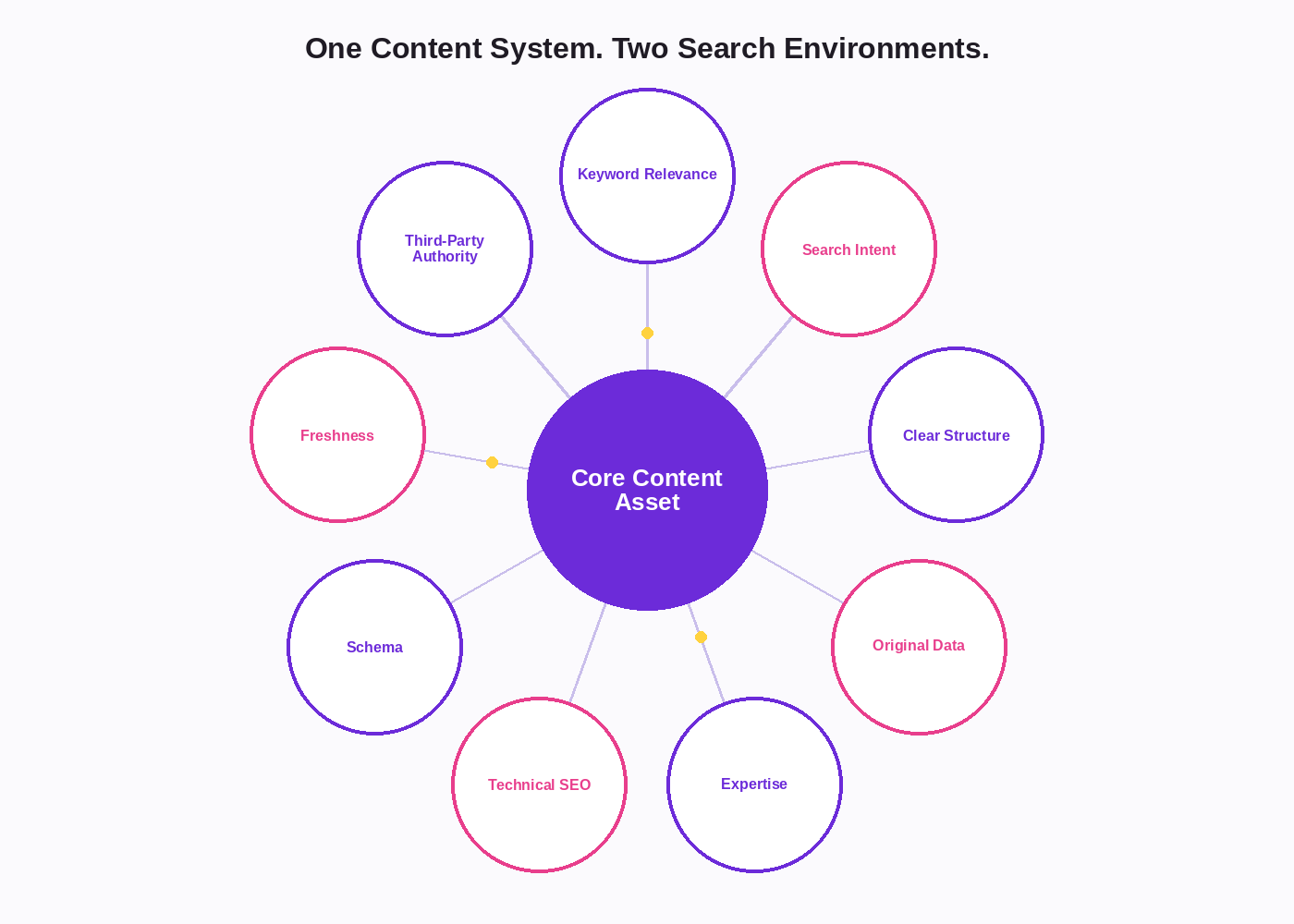
Strong SEO content provides the foundation GEO needs. A page that is well-structured, technically sound, and built around clear search intent is also easier for an AI system to interpret. Content needs to work for a crawler and a language model at the same time.
Take a fashion brand ranking for “best ethnic wear brands in India.” That ranking reflects strong SEO. The brand may also want AI systems to understand its positioning, price range, and what sets it apart when a shopper asks a comparative question. SEO builds discoverability and authority on the brand’s own site. GEO expands the number of places that authority can potentially surface.
How to Optimize for Both GEO and SEO
Start With Search Intent
Identify the real questions customers ask before and after they search. A skincare brand’s list might include “best moisturizer for oily skin,” “gel vs cream moisturizer,” and “is niacinamide good for acne-prone skin.”
These questions can become content clusters: a core guide supported by related pages, each answering one question in depth. That structure serves a search engine’s topic model and gives an AI system multiple, clearly scoped sources to draw from.
Build Content Around Topics, Not Just Keywords
Topical authority comes from covering a subject thoroughly, not chasing one high-volume keyword. “Skincare for oily skin” can support a cleanser guide, a moisturizer guide, a sunscreen guide, an ingredient guide, a routine guide, and a product comparison page.
Each page reinforces the others through internal links and shared terminology, creating a stronger knowledge base than any single page could build alone.
Make Answers Easy to Extract
Clear definitions, direct answers, descriptive headings, and concise explanations all help a system extract a reliable answer. A vague opening such as “skincare can be confusing for many people” gives a model little to work with.
A direct rewrite “oily skin benefits from a lightweight, oil-free moisturizer applied after cleansing” gives both a reader and an AI system something concrete to use. A short FAQ at the end of a page reinforces the same clarity.
Strengthen Trust Signals
Named expert authors, original research, clear citations, transparent sourcing, genuine reviews, and consistent company information across the web all build credibility. These signals matter for E-E-A-T in traditional search and for how confidently a generative system treats a brand as reliable.
Keep Information Fresh
Both SEO and GEO require ongoing maintenance, not a one-time publish. Pricing, product availability, ingredients, specifications, and regulations all change. For a consumer electronics brand, a two-year-old comparison page with outdated specs can mislead shoppers and AI systems alike. A content calendar should include scheduled reviews, not just new publishing.
Expand Beyond Your Own Website
Brand presence across credible publications, industry sites, expert interviews, genuine reviews, and social platforms all shape how a brand is understood beyond its own domain. This is not an invitation to spam link building or attempt to manipulate AI systems.
It means investing in earned visibility so a brand’s information stays consistent wherever it appears, for both a search engine and an AI system.
How Should Indian D2C Brands Think About GEO vs. SEO?
The right approach depends on a brand’s growth stage, not a fixed rulebook. Brands still building organic visibility should treat SEO as foundational. Ranking for core category and product terms creates the discoverability everything else builds on.
Brands already producing significant content can add GEO-focused improvements to existing assets, rather than starting a separate content stream. Restructuring an existing guide with clearer headings and direct answers often does more than publishing something new.
Brands entering categories where AI-heavy discovery is common, such as personal care or nutrition, should build content around conversational questions, product comparisons, and category education, alongside clear information about what the brand actually offers.
Brands with strong products but weak digital authority should prioritize credible third-party visibility first. A well-built product page cannot compensate for near-total silence across independent reviews and industry coverage.
Should You Invest in GEO or SEO?
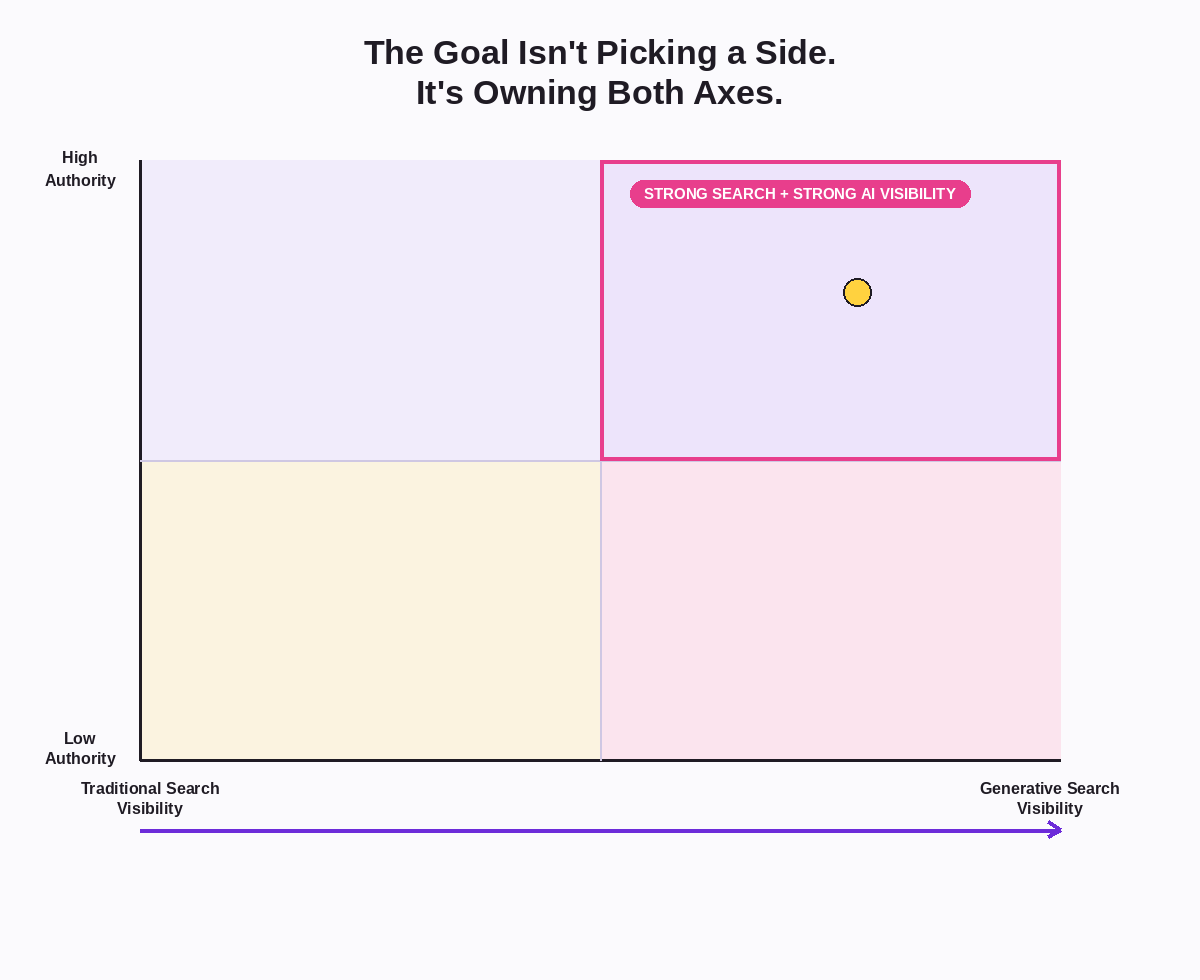
For most brands, the answer is both, but not equally, and not in the same way. The right allocation depends on existing organic visibility, search demand in the category, content maturity, competition, brand authority, the customer journey, and how well a team can actually measure results. A brand with almost no organic footprint gains little from chasing AI mentions before building basic search visibility.
A new D2C skincare brand should not abandon technical SEO and keyword research to chase AI citations. It should establish a strong SEO and content foundation first, then layer GEO considerations into that same content system as it matures.
The Future Is Not GEO vs. SEO. It Is Search Visibility Everywhere.
The GEO vs SEO conversation will keep evolving, but framing it as a contest undersells what is actually happening. Marketers increasingly need content that can rank, answer, get cited, build authority, educate, and convert often from the same page. The strongest strategy is not building one separate GEO program next to an existing SEO program. It is building a content ecosystem capable of serving traditional search and generative discovery from a shared foundation of clarity, structure, and credibility.
This is the perspective Social Pill brings to search strategy: SEO and GEO are not competing budgets, they are two outputs of the same underlying content system. Before building an entirely new GEO content machine, most brands would benefit from auditing what they have already published, and testing how it holds up when read by a search engine and a language model at once.
FAQ
- What does GEO mean in marketing?
GEO stands for generative engine optimization the practice of making content easier for AI systems like ChatGPT, Gemini, and Perplexity to understand and potentially cite in generated answers. - GEO vs SEO: what’s the actual difference?
SEO focuses on ranking pages and driving clicks on traditional search engines, while GEO focuses on being understood, mentioned, or cited within AI-generated answers. - Does GEO replace SEO?
No. GEO builds on the same foundation as SEO content quality, structure, and authority and works alongside it rather than replacing it. - Do I still need SEO if I invest in GEO?
Yes. Strong SEO content, technical foundations, and authority signals make it easier for AI systems to find and understand a brand’s content in the first place. - How is GEO measured?
GEO measurement is still developing and can include AI citations, brand mentions, and inclusion in AI-generated recommendations, though none of these are as standardized as traditional SEO metrics yet. - How do you optimize content for GEO?
Write clear, direct answers to real questions, use strong structure and headings, and build credible brand presence across the wider web, not just your own website. - Does GEO affect organic traffic?
GEO can influence organic traffic indirectly, since AI-generated answers sometimes reduce clicks to websites even while drawing on a brand’s information which is why both channels are worth tracking together.