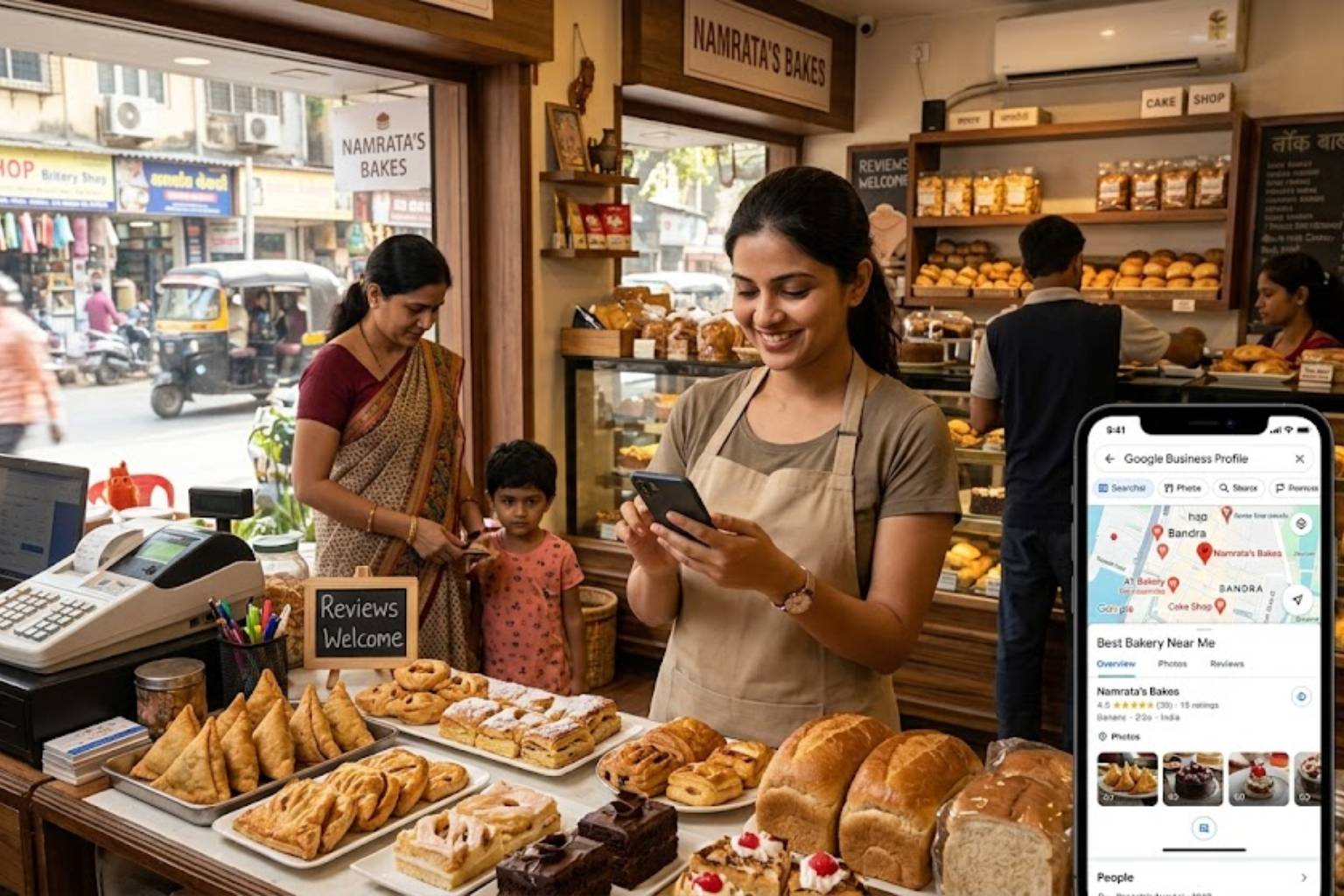
If someone searches “best bakery near me” right now, three businesses show up instantly before websites, before ads, before anything else. That space is called the Local Pack. And getting there isn’t luck, it’s strategy.
For small businesses in India, local search has quietly become one of the most powerful ways to grow. You don’t need a massive budget. You don’t need complex tools. But you do need consistency, clarity, and a basic understanding of how Google decides who gets seen and who doesn’t.
Let’s break it down.
What Is Local SEO?
Local SEO (Search Engine Optimisation) is the process of improving your business’s visibility in location-based search results. When users search for services or products using terms like “best café near me,” “salon in Mumbai,” or “electrician nearby,” Google delivers results based on their geographic location. These results typically appear on Google Maps, and in the Local Pack, the top three business listings are shown before organic results.
Unlike traditional SEO, which focuses on ranking web pages, Local SEO is designed to help your business appear in front of nearby customers at the exact moment they are searching. Whether it’s a boutique in Bandra, a clinic in Coimbatore, or a hardware store in Ludhiana, Local SEO enables customers to discover, evaluate, and choose a business within seconds.
Why Local SEO Matters for Small Businesses in India
India is a mobile-first market. Most searches happen on smartphones, and a large portion of them have local intent. People aren’t just browsing, they’re looking for something nearby, and they usually need it fast.
Searches like “plumber near me” or “restaurant in Pune” often lead to immediate action. That’s what makes local SEO so powerful. Here’s what it directly impacts:
- More calls – your phone number is visible right in search
- More footfall – directions are just one tap away
- More trust – reviews, ratings, and photos build credibility instantly
And here’s the advantage small businesses have: proximity. You’re already close to your customers. Local SEO just helps them find you.
How Does Local SEO Work?
Google ranks local businesses based on three core factors:
1. Relevance
How well your business matches what someone is searching for. If someone searches “vegetarian restaurant in Jaipur,” Google needs to clearly understand that your business fits that description. This depends on your Google Business Profile, your website, and how you’ve categorised your business.
2. Distance
How close your business is to the person searching or to the location mentioned. You can’t control distance, but you can make sure your address and location details are accurate, so you’re included in the right searches.
3. Prominence
Prominence refers to how well-known and trusted your business is, both online and offline. Google evaluates this through signals like customer reviews, directory mentions, backlinks, and your activity on the Business Profile. In simple terms, the stronger these signals, the more likely your business is to be seen as trustworthy and rank higher in local search results.
Local SEO Checklist for Small Businesses
1. Claim and Complete Your Google Business Profile
Your Google Business Profile (GBP) is your foundation. If you haven’t claimed it yet, that’s your first step. Fill out everything: business name, address, phone number, website, timings, and description. A complete profile not only ranks better but also converts more visitors into customers.
2. Choose the Right Business Categories
Your categories tell Google what your business actually does. Be specific. Instead of just “Gym,” consider options like “Fitness Centre,” “Yoga Studio,” or “Personal Trainer”, depending on your services. This directly affects when your business shows up.
3. Keep Your NAP Information Consistent
NAP stands for Name, Address, and Phone number. This information should be the same everywhere on your website, Google profile, and directories like Justdial or Sulekha. Even small inconsistencies can confuse Google and hurt your ranking.
4. Actively Collect and Respond to Reviews
Reviews play a huge role in local rankings. Ask happy customers to leave a review, it works more often than you think. And make sure you respond to every review, whether it’s positive or negative. It shows Google (and customers) that you’re active and engaged.
5. Add Photos and Posts Regularly
Profiles with photos get more clicks. It’s that simple. Upload images of your products, space, or team. You can also use Google Posts to share updates, offers, or announcements. Regular activity signals that your business is active and relevant.
6. Build Local Citations and Backlinks
A citation is any mention of your business on another website. List your business on trusted platforms like Justdial, Sulekha, and industry-specific directories. Beyond that, try getting featured on local blogs, news sites, or community pages. These mentions build credibility and improve your visibility.
7. Create Location-Specific Content on Your Website
Your website adds context to your business. Make sure you have a proper contact or location page with your full address and a Google Map. If you operate in multiple cities, create separate pages for each location. This helps Google understand exactly where you serve customers.
How Long Does Local SEO Take to Show Results?
Local SEO doesn’t deliver overnight results, but it’s faster than most forms of SEO.
Here’s a realistic timeline:
- 4–8 weeks – early improvements in visibility
- 1–3 months – noticeable ranking growth
- 3–6 months – strong local presence
The timeline depends on:
- Competition in your area
- How complete is your profile
- How quickly you gain reviews
- How consistent are your efforts
The businesses that keep showing up win.
Final Thoughts
Local SEO isn’t as complicated as it sounds.
At its core, it’s about:
- Showing accurate information
- Building trust
- Staying consistent
For small businesses in India, where customers rely heavily on local discovery, showing up in Google Maps and nearby searches is no longer optional. It’s where decisions are made.
Start with your Google Business Profile. Build consistency across platforms. Keep your business active online. Do that well and over time, the results follow.
Social Pill is a digital marketing agency that helps small and mid-sized businesses grow through practical, results-driven strategies.