The importance of marketing in the education sector comes from the way students and parents now make choices. They look for courses, check out schools, read comments, watch videos and pick a few options online, usually before they talk to an admissions officer.
A website alone is not enough. Institutions need to be present where it matters most. They must appear credible wherever students go to look. They need to respond fast when interest turns into a question. Education digital marketing brings all of this together. It has become just as important as campus reputation in attracting students. This guide explains how the student decision journey works. It covers which strategies should come first. It shows how to track results and points out mistakes institutions make.
The Importance of Digital Marketing in the Education Sector: How Discovery Has Changed
Admissions once ran on newspaper ads, hoardings, education fairs, counsellor visits and word of mouth. These still work, particularly in smaller towns. But they now sit next to a research process that mostly happens on a phone.
A prospective student may search for a course, check fees and eligibility, watch a campus video, read reviews, look at accreditation and rankings, download a brochure and compare three institutions. Parents often run a parallel search focused on safety, placements, hostel facilities and total cost. Students and parents ask different questions, and both ask them online.
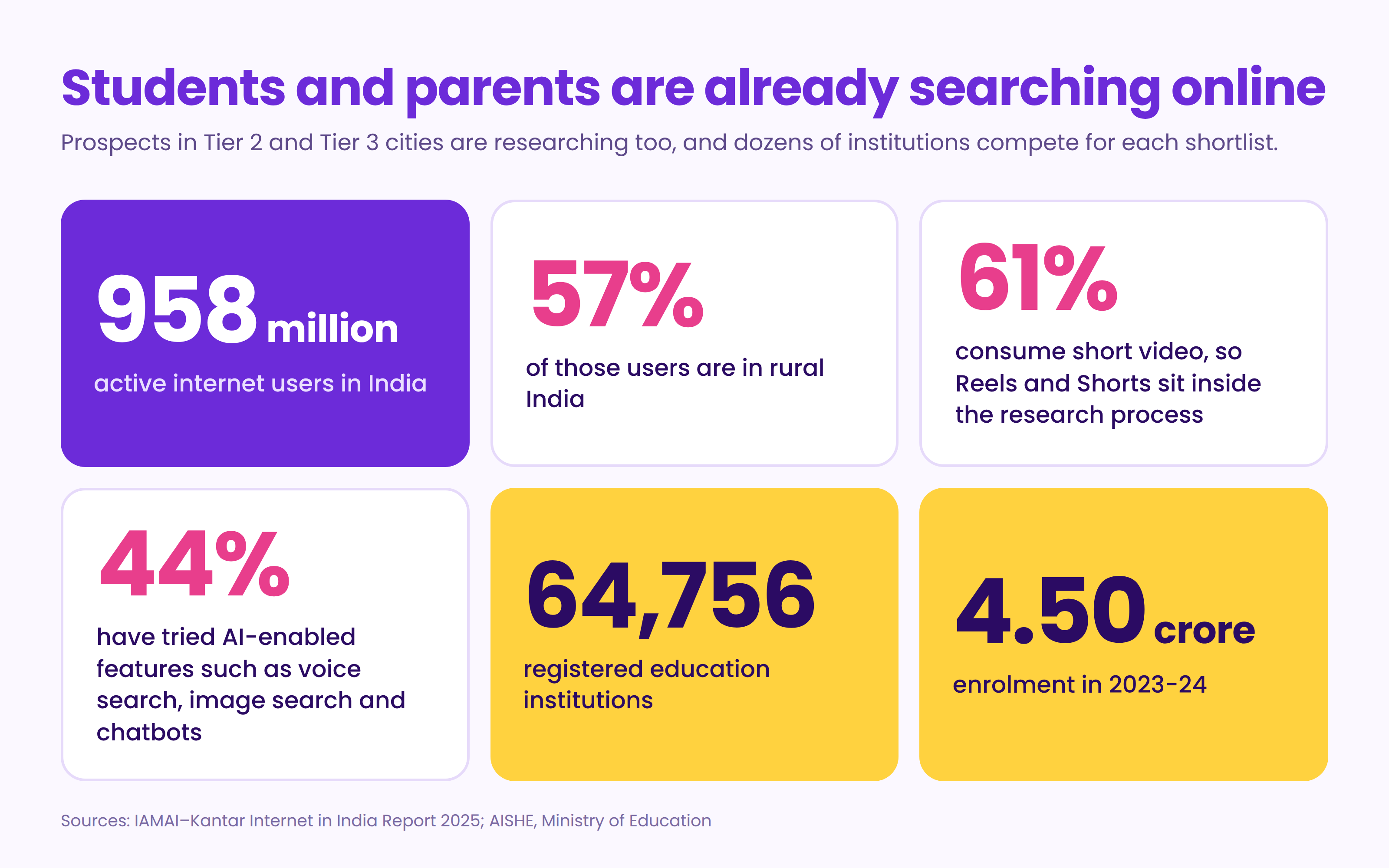
The audience is large and no longer limited to metros. The IAMAI–Kantar Internet in India Report 2025 counts 958 million active internet users, with rural India making up 57 per cent of them. Prospects in Tier 2 and Tier 3 cities are searching too. The same report says 61 per cent of users consume short video, which is why Reels and Shorts now sit inside the research process.
Search itself is also changing. Around 44 per cent of users have tried AI-enabled features such as voice search, image search and chatbots. Institutions need clear, accurate course information that both people and AI tools can pick up.
Competition makes the stakes higher. AISHE data, from the Ministry of Education shows that there are 64,756 registered education institutions and enrolment reached 4.50 crore in 2023-24. In courses and cities dozens of higher education institutions fight for the same shortlist. Being visible, credible and easy to compare is what keeps education institutions on it.
How Digital Marketing Supports the Admission Journey
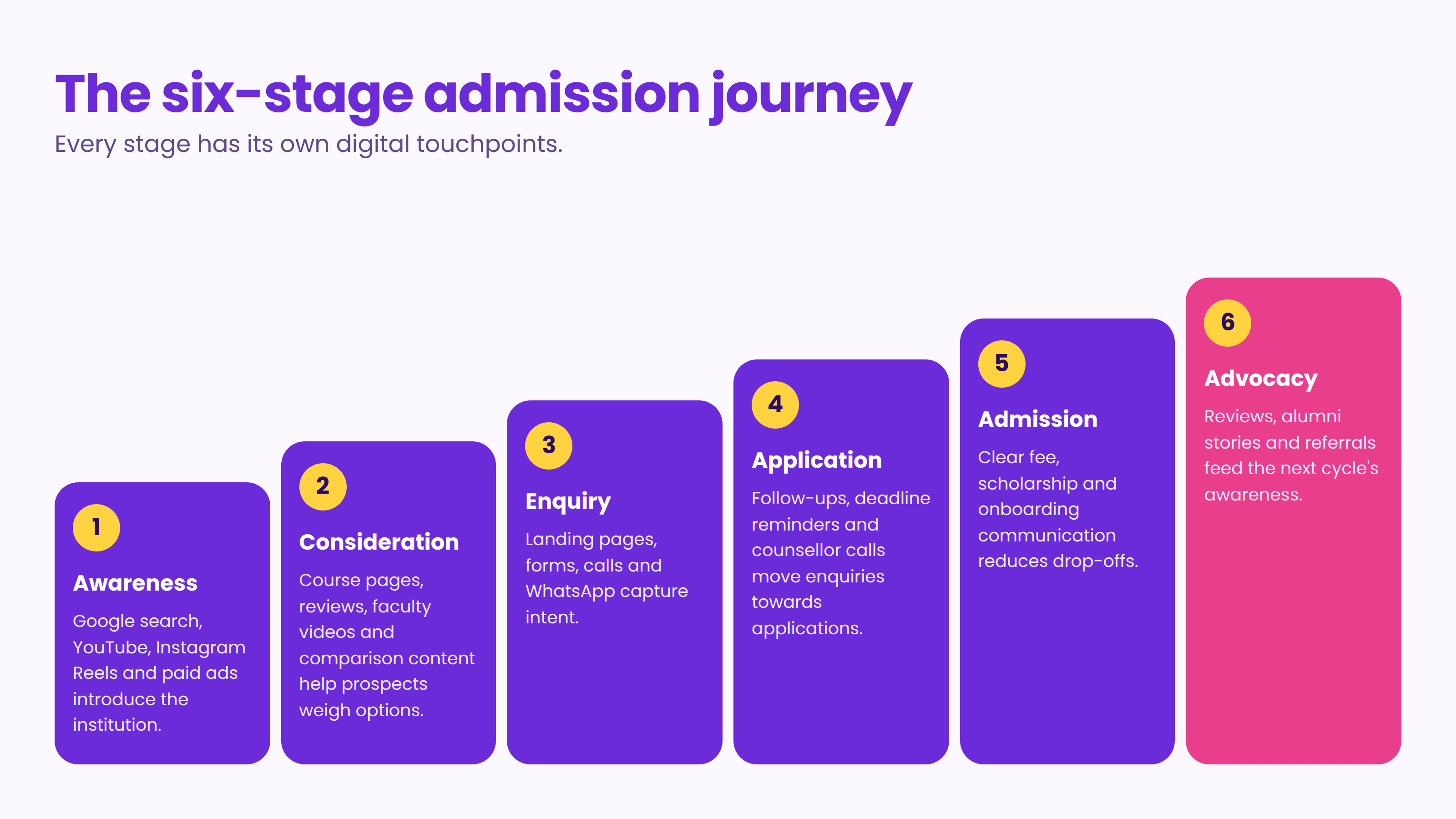
Digital marketing supports admissions by placing the right information in front of the right person at each decision stage. The journey has six stages, and each has its own digital touchpoints.
- Awareness: Google search, YouTube, Instagram Reels and paid ads introduce the institution.
- Consideration: Course pages, reviews, faculty videos and comparison content help prospects weigh options.
- Enquiry: Landing pages, forms, calls and WhatsApp capture intent.
- Application: Follow-ups, deadline reminders and counsellor calls move enquiries towards applications.
- Admission: Clear fee, scholarship and onboarding communication reduces drop-offs.
- Advocacy: Reviews, alumni stories and referrals feed the next cycle’s awareness.
Consider a student searching “MBA colleges in Mumbai”. She finds three institutions on Google, then watches a Reel by a current student at one of them. She visits its website to check specialisations and fees, reads Google reviews and submits an enquiry form. Her parents later message on WhatsApp to ask about placements and hostels.
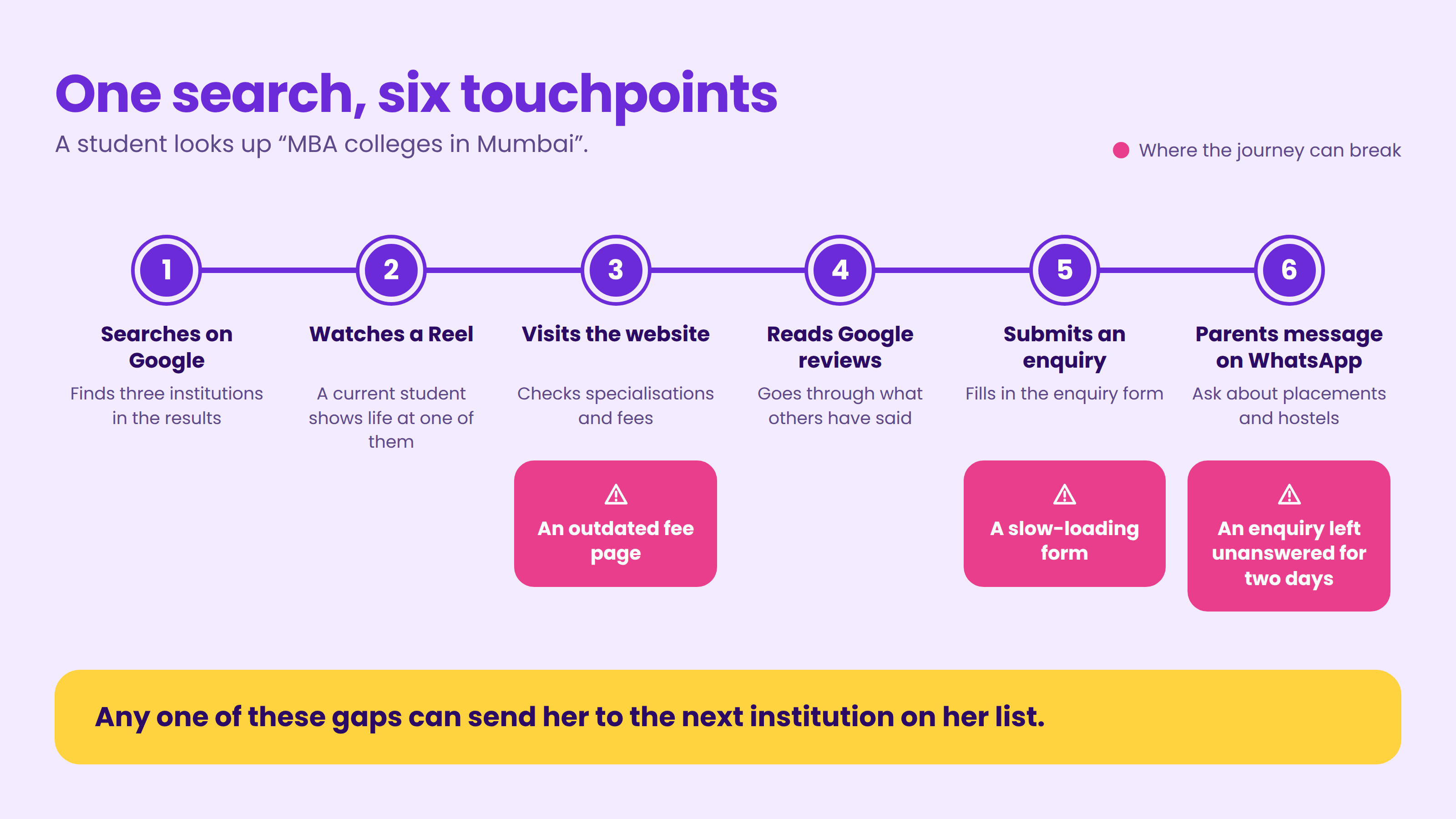
Every step in that path is a digital touchpoint. An outdated fee page, a slow-loading form or an enquiry that goes unanswered for two days can send her to the next institution on her list.
Timing matters as well. Admission cycles create peaks around board results, entrance-exam results and counselling dates, while coaching institutes and edtech brands often enrol through the year. Plan awareness and consideration content well before the peak, so prospects already know you when applications open.
What Digital Marketing Helps Educational Institutions Achieve
The benefits only matter if they turn into admissions. These are the ones that count most.
Visibility at the point of decision. Ranking for course, city and fee searches puts you in front of prospects who are already looking. Organic visibility also compounds. A well-built course page can keep bringing enquiries long after a campaign ends, which a print ad cannot do.
Targeting that fits how families decide. Paid campaigns can be aimed by location, course interest and age group. A school can focus on families near the campus. A postgraduate programme can target working professionals in specific cities. This cuts spend on people who could never enrol.
Qualified enquiries. A landing page built for one course tells you exactly what the prospect wants, so counsellors can start the conversation with context instead of a generic call.
Credibility. Reviews, accreditation details, faculty profiles and consistent content signal that an institution is established. This matters most for newer private institutions competing against older names.
Retargeting and lead nurturing. Most prospects do not enquire on the first visit. Retargeting ads, emails and WhatsApp updates keep your institution in view while families compare, and they let you speak to a parent differently from a student.
Audience insight. Search terms, ad response and website behaviour show which courses draw interest and where prospects drop off. That data supports personalised follow-ups and, over time, expansion into new cities without new counselling offices.
Digital Marketing Strategies for Educational Institutions: Capturing Search Intent
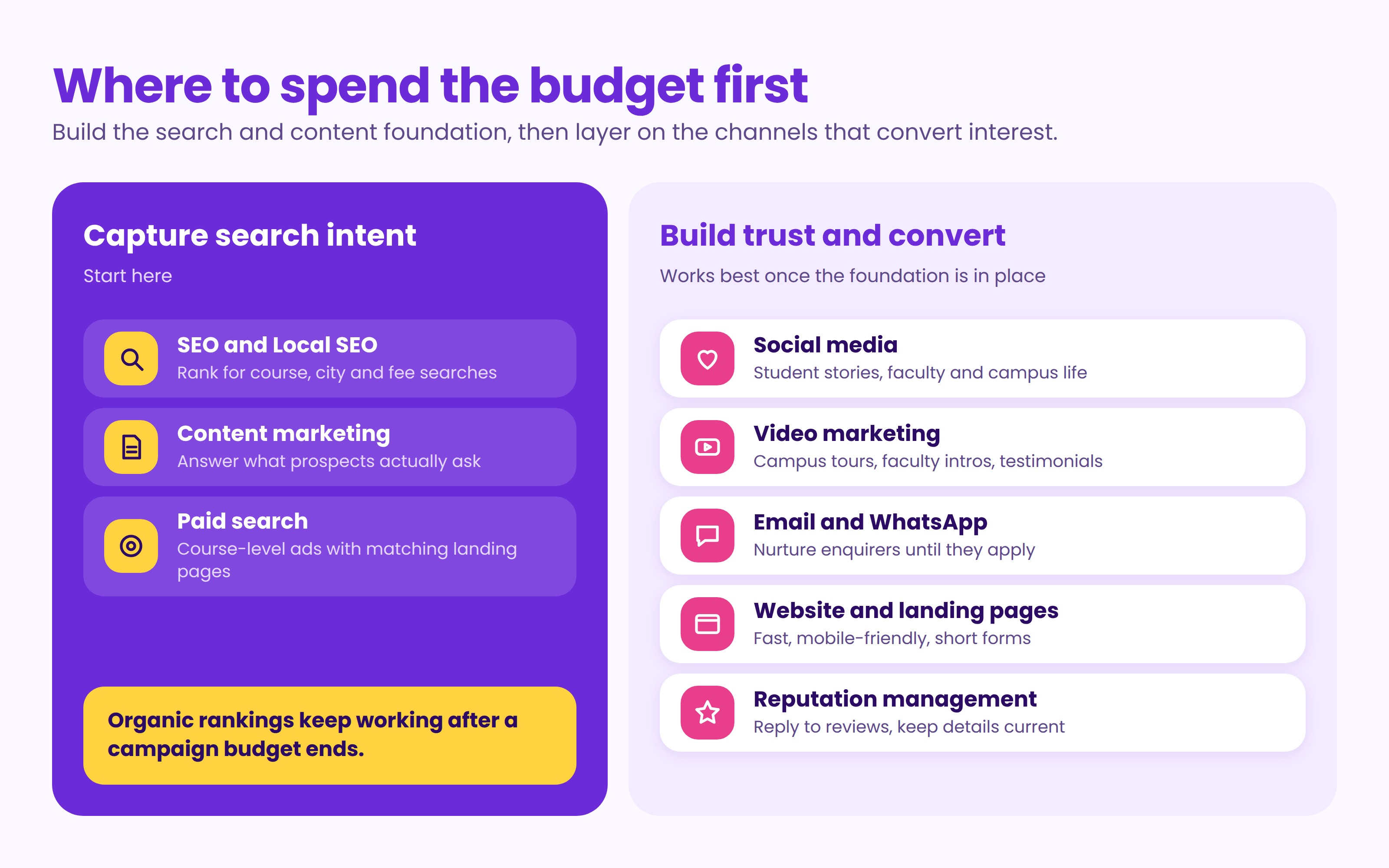
Not every channel deserves equal budget. Start with the ones below, each with one action you can take this week.
SEO and Local SEO
What it means: SEO for an institution is building visibility for searches on courses, locations, fees, eligibility, admissions, careers and comparisons, including “near me” searches on Google Maps.
Why it matters: These searches come from prospects who are actively researching, and rankings keep working after a campaign budget ends, which is why sustained SEO work usually anchors an education marketing plan.
Try this week: Pick one priority course and build a three-page cluster around “best BBA colleges in Mumbai”, “BBA admission process” and “BBA fees in Mumbai”, with each page linking to the main course page.
Content Marketing
What it means: Content marketing is publishing course guides, career guides, admission explainers, comparison pages and FAQs that answer what prospects actually ask.
Why it matters: It builds trust before the first enquiry and feeds SEO. Google’s guidance says its ranking systems are built to favour helpful, reliable content made for people rather than for search rankings, so thin, keyword-stuffed course pages work against you.
Try this week: Ask your admissions team for the ten questions they answer most often. Turn the top three into detailed FAQ pages covering fees, eligibility and dates.
Paid Search and Google Ads
What it means: Paid search places course-specific ads in front of people searching for programmes, with location targeting and a matching landing page.
Why it matters: During admission windows, paid search captures demand as it appears, and remarketing brings back visitors who did not enquire. It also gives fast feedback on which courses and cities respond, which organic search cannot do quickly.
Try this week: Split one broad campaign into course-level ad groups, such as “MBA in Pune” and “PGDM admission Pune”, each sending traffic to its own landing page instead of the homepage.
Digital Marketing Strategies That Build Trust and Convert Interest
These channels turn attention into confidence, and confidence into enquiries. They work best when the search and content foundations above are already in place.
Social Media Marketing
What it means: Social media marketing for an institution means using Instagram, YouTube, LinkedIn and Facebook to show student stories, faculty expertise, campus life, course explainers and achievements, rather than only posting admission dates.
Why it matters: Prospects use social media to judge culture and outcomes, and parents use it to verify what they have heard. Students respond to Reels and day-in-the-life content. Parents want clarity on safety, placements and fees. Where your audience is spread across cities, posting in Hindi or a regional language alongside English widens reach.
Try this week: Ask three current students to record 30-second Reels on why they chose their course, and pin the best one to your profile.
Video Marketing
What it means: Video marketing covers campus tours, faculty introductions, student testimonials, course explainers and short educational clips.
Why it matters: Families in other cities often cannot visit before deciding. A good video lets them see the campus and hear from faculty first. Short cuts of the same video can also feed Reels and YouTube Shorts.
Try this week: Record a two-minute faculty video for your highest-enrolling course covering who it suits, what is taught and which careers follow. Publish it on the course page and YouTube.
Email and WhatsApp Lead Nurturing
What it means: Lead nurturing is staying in touch with enquirers through email, SMS and WhatsApp until they apply or drop out.
Why it matters: Many enquirers compare options for weeks before applying. Families often find WhatsApp easier than email, provided you have their consent to message. Segment by course, and by student versus parent, so messages stay relevant.
Try this week: Set up a three-step follow-up: an instant acknowledgement, a brochure and fee summary on day one, and a counsellor-call reminder on day three.
Website and Landing Page Optimisation
What it means: This means making course, fee, eligibility and application details easy to find and act on, especially on mobile.
Why it matters: Every channel sends traffic here. A slow page or a long form wastes the ad spend that brought the visitor.
Try this week: Cut your enquiry form to name, phone number, city, course and preferred call time, then test it on a mid-range Android phone.
Online Reputation Management
What it means: Reputation management is monitoring and responding to Google reviews and education portal ratings, and keeping accreditation and placement information current.
Why it matters: Reviews are often the last check before an enquiry, and unanswered complaints signal indifference. Active review profiles also support your local visibility on Google.
Try this week: Reply to your last ten unanswered Google reviews, starting with the critical ones, with specific and courteous responses.
How to Measure Digital Marketing in Education
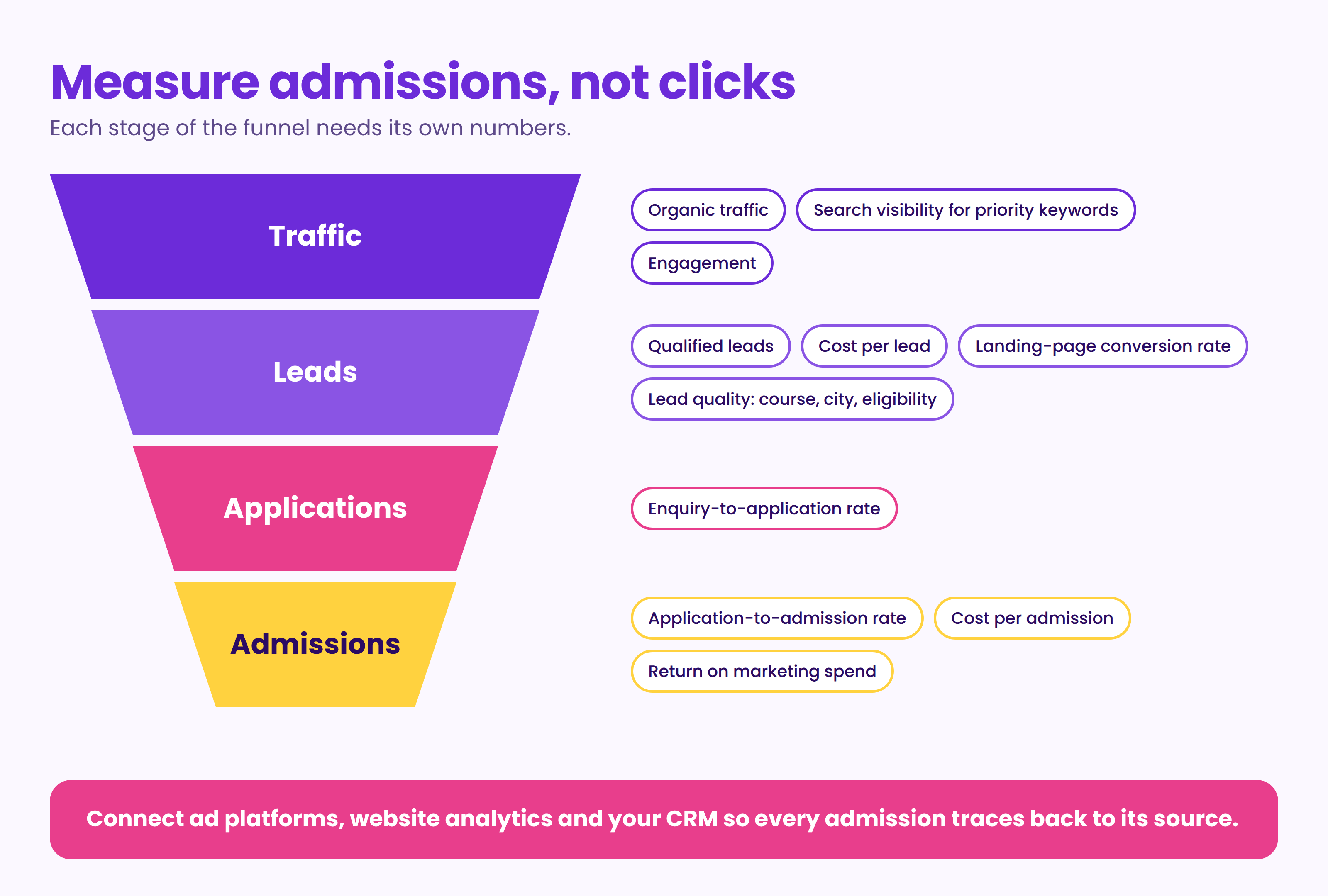
Measure digital marketing by admissions, not clicks. The funnel moves through traffic, leads, applications and admissions, and each stage needs its own numbers.
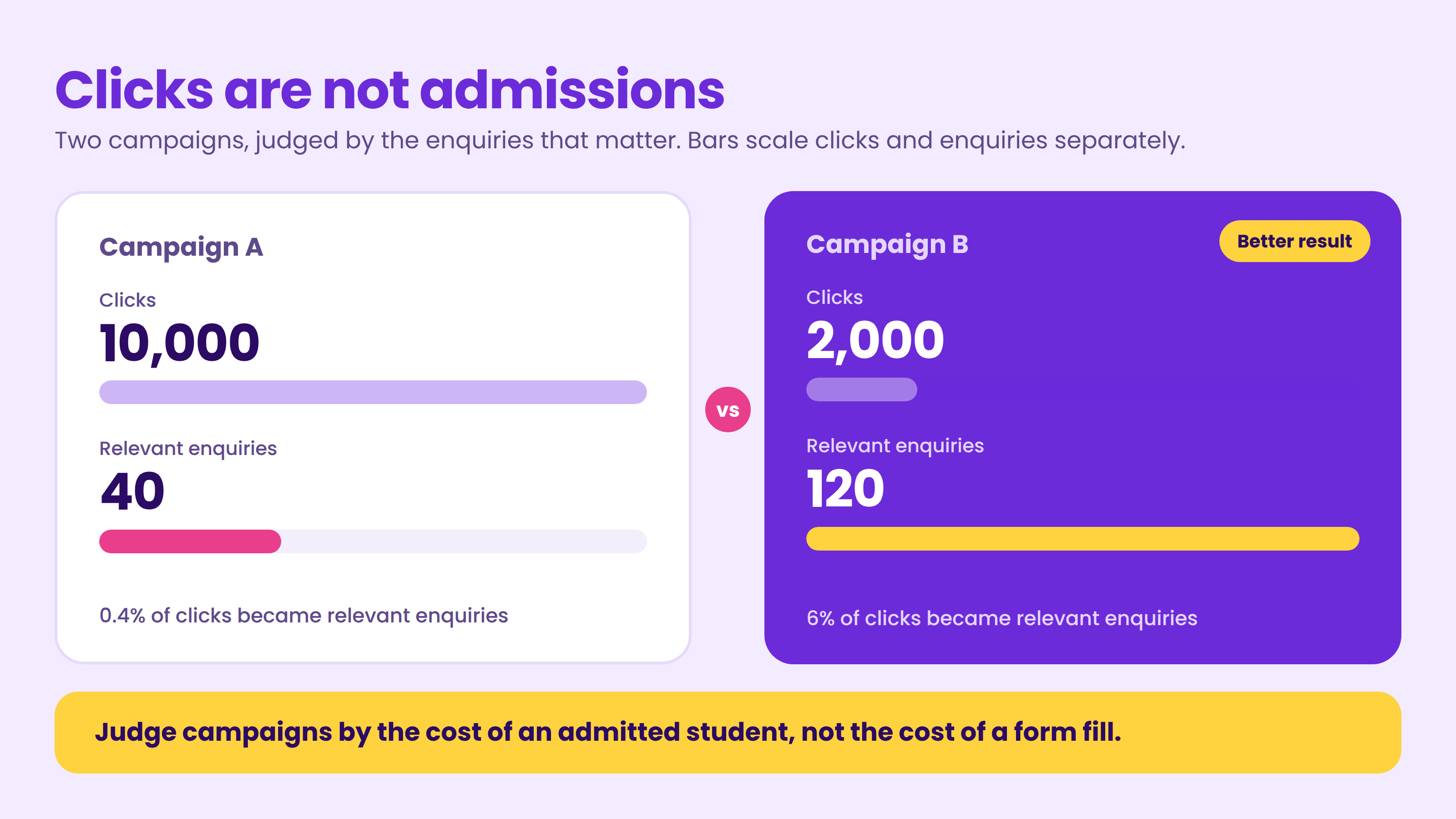
A campaign that brings 10,000 clicks is not a success if the visitors are outside your catchment, ineligible for the course or unwilling to fill in a form. For example, 2,000 clicks that produce 120 relevant enquiries beat 10,000 clicks that produce 40.
Track these by stage:
- Traffic: organic traffic, search visibility for priority course keywords and, where relevant, engagement.
- Leads: qualified leads, cost per lead, landing-page conversion rate and lead quality, such as right course, city and eligibility.
- Applications and admissions: enquiry-to-application rate, application-to-admission rate, cost per admission and return on marketing spend.
Cost per lead can mislead on its own. A cheap lead from a mismatched audience costs little to acquire and a lot of counsellor time to chase. Judge campaigns by the cost of an admitted student, not the cost of a form fill.
Connect your ad platforms, website analytics and CRM so each admission traces back to its source. Include offline steps such as counsellor calls and campus visits, since many admissions are finalised there. Ask counsellors to tag lead quality after first contact, then feed that back into targeting. Compare cost per admission by course and city, because averages hide the campaigns worth scaling.
Common Mistakes in Education Marketing and How to Fix Them
Most problems come from gaps between channels, not from any single channel.
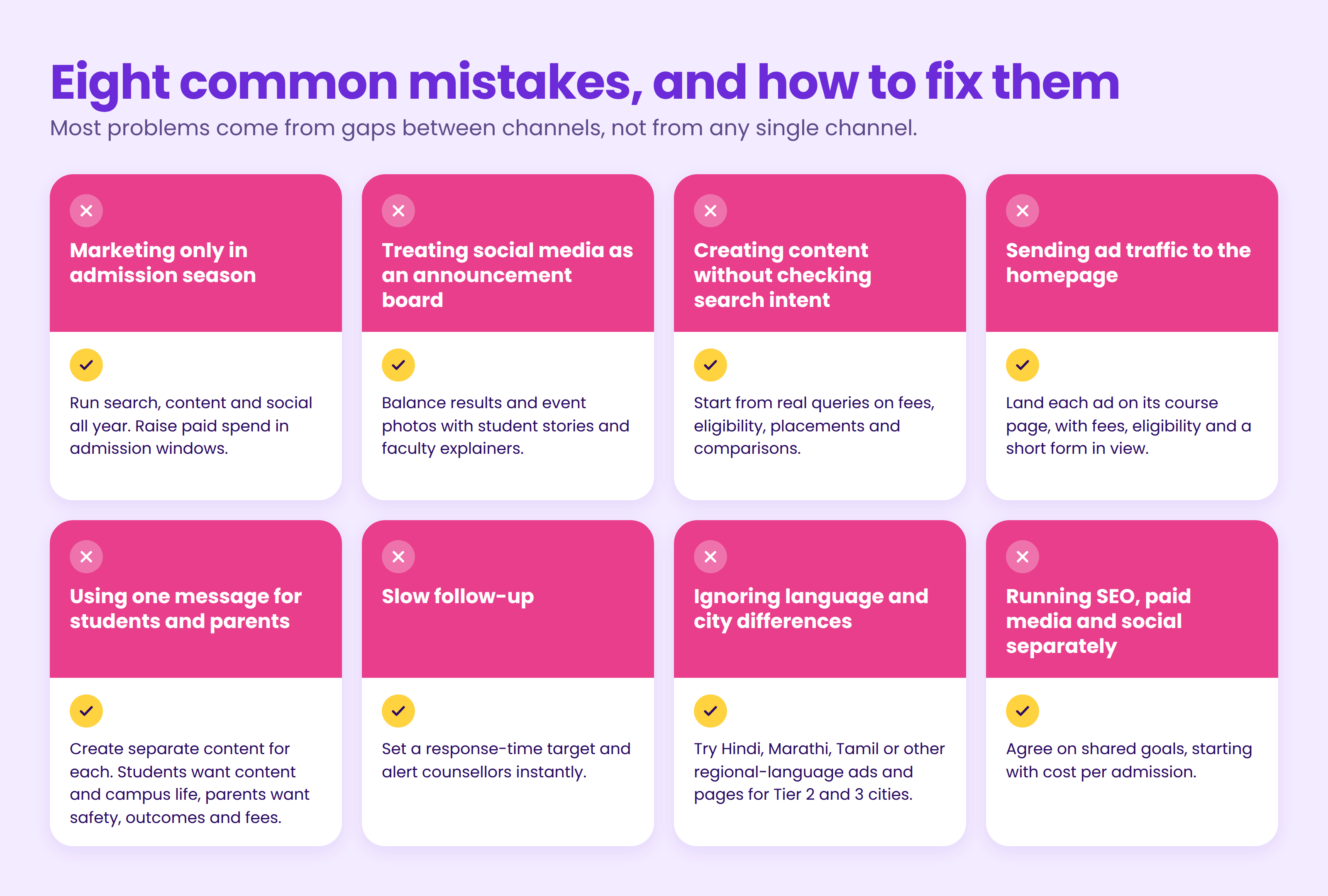
Marketing only in admission season. Prospects begin researching months before applications open. Keep search, content and social running through the year, and increase paid spend during admission windows.
Treating social media as an announcement board. Result declarations and event photos do not help a parent decide. Balance them with student stories, faculty explainers and answers to common questions.
Creating content without checking search intent. A generic “about our courses” page rarely matches what people type. Start from real queries on fees, eligibility, placements and comparisons, then write the page that answers each one.
Sending ad traffic to the homepage. A prospect who clicked an MBA ad should land on the MBA page, with fees, eligibility and a short form in view.
Using one message for students and parents. A student cares about course content and campus life. A parent cares about safety, outcomes and fees. Create separate content for each.
Slow follow-up. A lead that waits a day for a call may already be talking to another institution. Set a response-time target and alert counsellors instantly.
Ignoring language and city differences. In some categories and regions, Hindi, Marathi, Tamil or other regional-language ads and landing pages reach Tier 2 and Tier 3 audiences better than English alone.
Running SEO, paid media and social separately. When each team reports different numbers, leadership cannot see what works. Agree on shared goals, starting with cost per admission.
Conclusion
The importance of digital marketing in the education sector is practical, not theoretical. It puts your institution in front of students and parents while they research, builds the trust that turns interest into an enquiry, and shows which activity leads to admissions.
Start with the basics: a fast website, clear course pages, tracked enquiry forms and quick follow-up. Then build search visibility, social proof and paid campaigns around your priority courses, and review cost per admission every month.
Education brands get the best results when content, SEO, social media, performance marketing and conversion-focused web experiences work as one system, so the ads, pages and follow-up tell a consistent story. Social Pill, a Mumbai-based social media and digital marketing agency, works across these areas. If you are planning your next admission cycle, explore our digital marketing services.
FAQs
How does digital marketing help increase admissions?
It makes an institution visible for course searches, captures interest through landing pages and forms, and follows up by email and WhatsApp until prospects apply. It also shows which campaigns produce enquiries that convert, so budgets can move towards what works.
Which digital marketing channel works best for educational institutions?
No single channel wins. Search, through SEO and Google Ads, captures prospects with clear intent. Social media and video build trust, and email or WhatsApp nurture leads. Most institutions should start with search and a strong landing page, then add social and video.
How much should an educational institution spend on digital marketing?
There is no fixed figure. Budgets depend on the course, city, competition and admission targets. A practical method is to work backwards: set target admissions, estimate the enquiry-to-admission rate, then calculate the enquiries and cost per lead you need. Adjust monthly.
What should educational institutions track to judge results?
Track cost per lead, landing-page conversion rate, enquiry-to-application rate, application-to-admission rate and cost per admission. Traffic and search visibility show reach, but admissions and return on marketing spend show whether the work paid off.
Do schools, coaching institutes and colleges need different strategies?
Yes. Schools mainly reach parents and local families, so local SEO, reviews and WhatsApp matter most. Colleges speak to both students and parents. Coaching institutes often build on results, faculty credibility and short-form video. Edtech and vocational providers usually lean on paid performance campaigns.