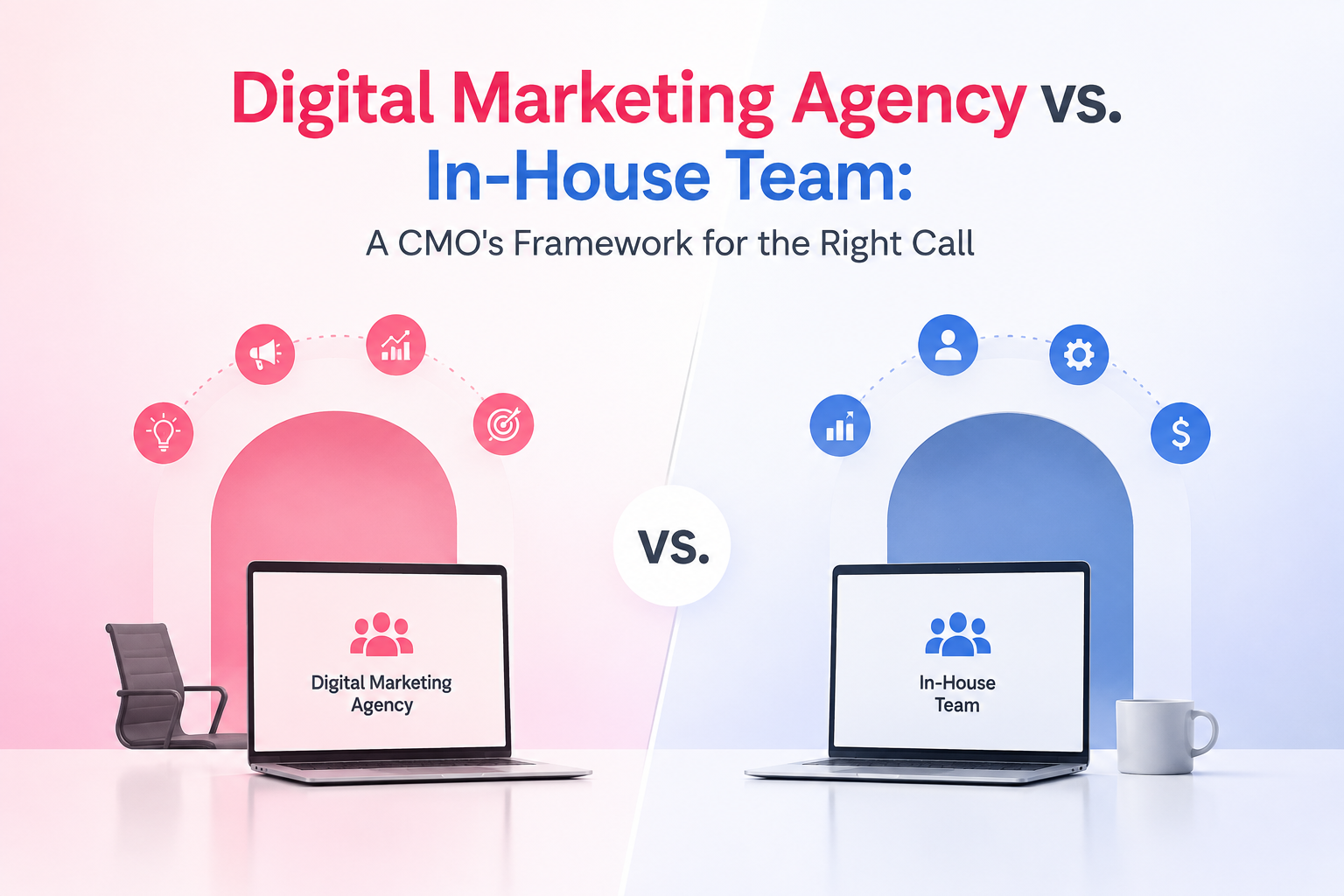
CMOs face this decision every quarter now, not once. Digital marketing has fragmented into paid media, SEO, content, CRO, marketing automation, and AI-driven search each demanding real depth. No CMO can credibly own expertise across all of them, and few agencies claim it evenly either. The traditional framing digital marketing agency vs in-house team treats this as a binary choice. It isn’t. It’s a question of where the business needs to own capability and where it can access it on demand.
That distinction matters more for Indian D2C, FMCG, and retail brands than it did five years ago. Platform shifts, festive-season spikes, and the shift from marketplace dependence to owned D2C channels now move faster than most hiring cycles. This article gives CMOs a practical framework for deciding what to build internally, what to access externally, and how that balance should shift as the business grows. Social Pill works with brands making exactly this call, and the patterns are consistent enough to lay out clearly.
Why This Decision Is Harder Than It Used to Be
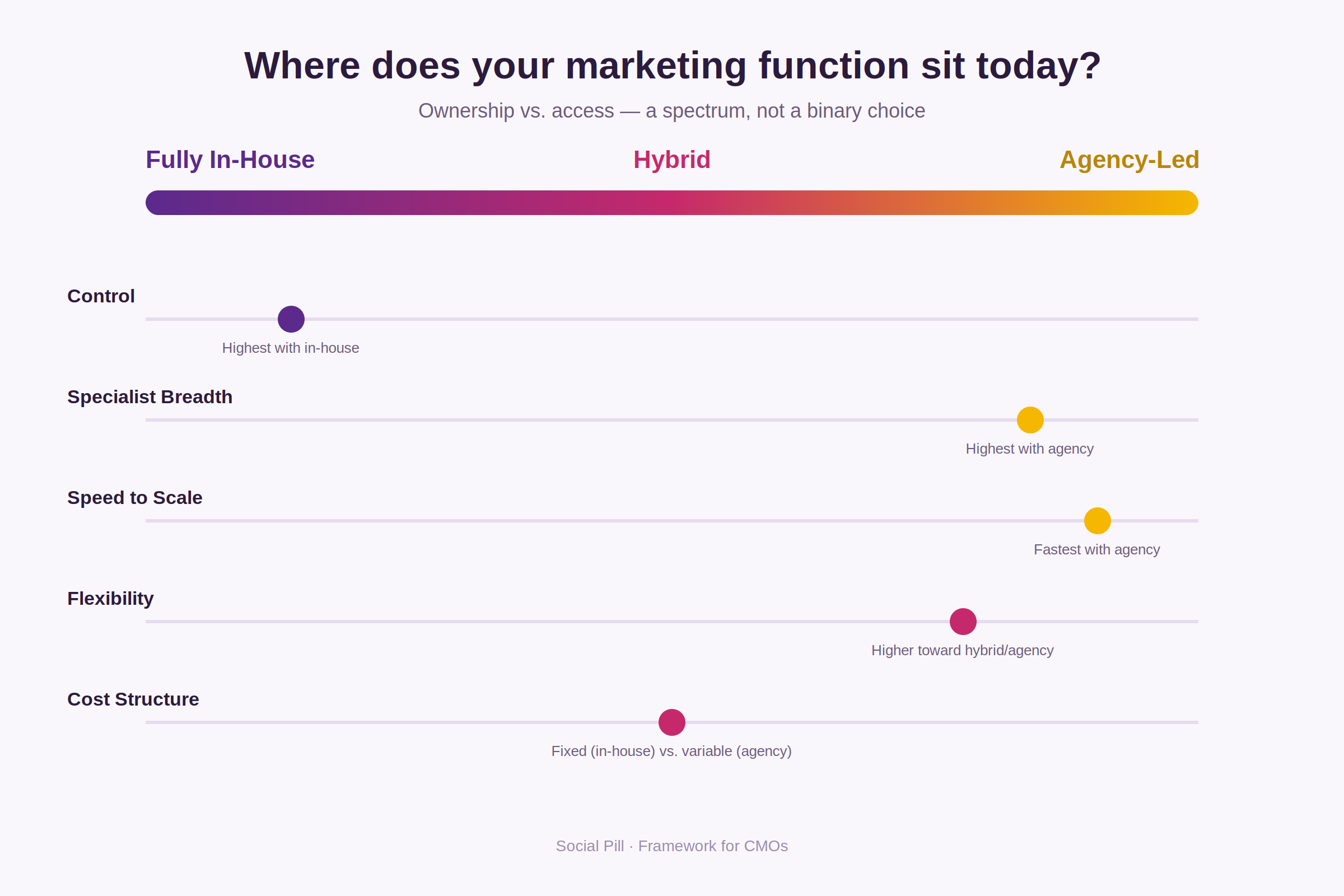
Ten years ago, digital marketing meant a website, some search ads, and maybe a Facebook page. One generalist could run all of it. That’s no longer true. A single D2C brand today might need paid media specialists for Meta and Google, an SEO lead tracking AI-driven search changes, a CRO analyst, a content team, and someone managing lifecycle automation five fast-moving skill sets under one function.
Platform changes compound this. When Meta adjusts attribution, or Google ships a core update, campaigns that worked last quarter can quietly underperform. Fixing that needs specialists who track these shifts closely, not generalists learning on the job. For Indian D2C brands, this shows up sharply around festive periods. A skincare brand planning a Diwali campaign needs creative, paid media, and CRO capacity ready weeks in advance, not being recruited as the sale calendar locks.
The real question isn’t “should we outsource this?” It’s whether the business can build and sustain the breadth and speed required to compete inside, outside, or through some mix of both.
Digital Marketing Agency vs In-House Team
Before comparing the two models, it’s worth being precise about what each one actually is.
What an Agency Model Looks Like
An agency model gives a business access to external specialists under a retainer or project structure. Instead of hiring a performance marketer, an SEO lead, and a designer separately, the company works with one partner that houses all three. Agencies typically bring exposure to multiple accounts and industries, and that exposure shapes how they solve problems a media buyer running campaigns for a beauty brand, an electronics brand, and an F&B chain in the same month sees more of what’s actually working.
Example: a fashion D2C brand preparing for its first major sale season might use an agency to activate paid media, creative, and analytics at once without hiring four people in six weeks.
What an In-House Model Looks Like
An in-house model means employees dedicated fully to one company, embedded in its daily operations. They sit in the same planning conversations as sales, product, and CX teams. This proximity matters. An in-house marketer at a wellness brand often knows which SKUs are backordered, which claims legal has flagged, and which complaints are trending before a report is even generated.
Example: an FMCG company launching a D2C channel alongside its retail business may need marketers who already understand distributor relationships and pricing sensitivities context an outside partner would take months to learn.
The Fundamental Difference
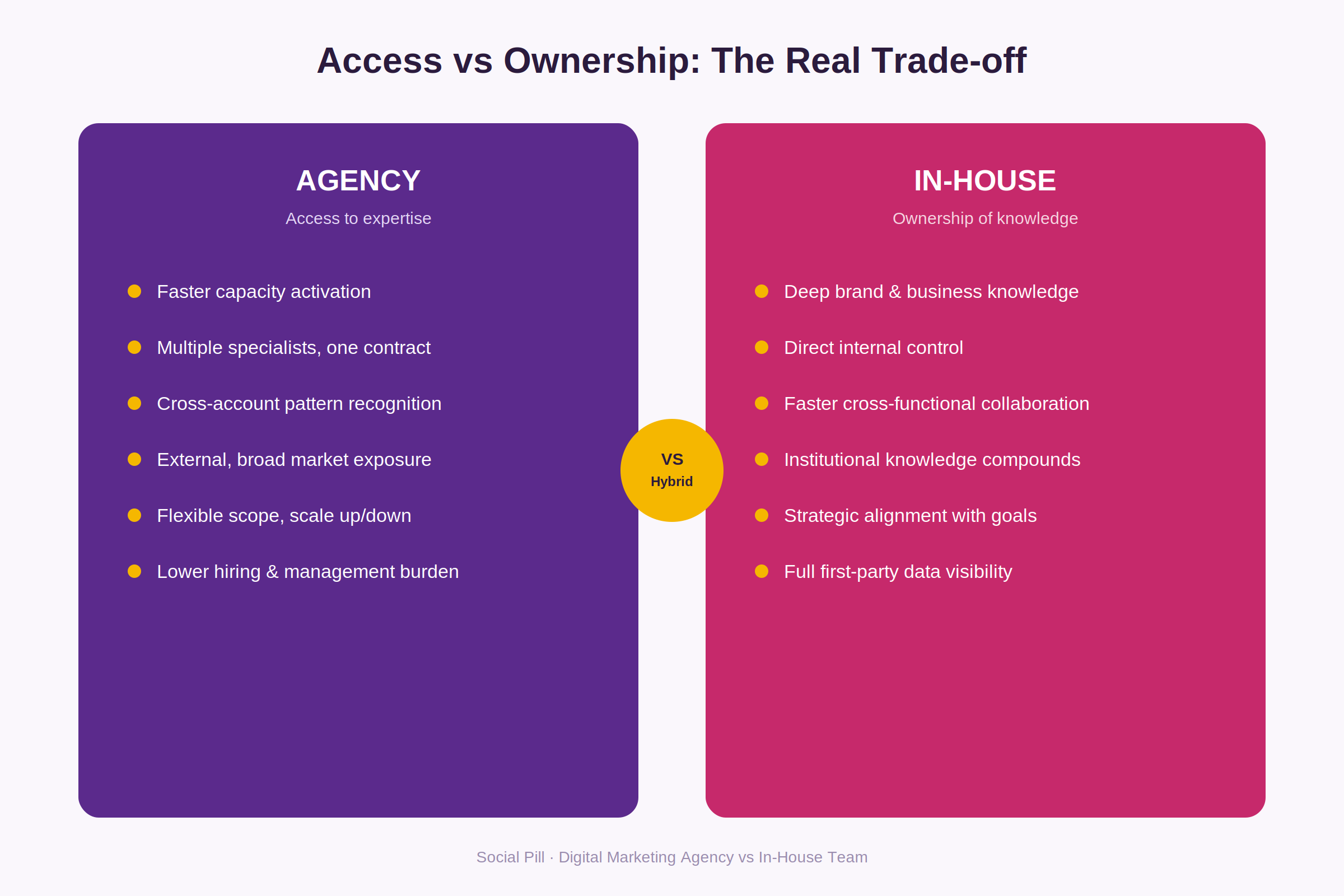
Strip away the details and one distinction holds: an agency primarily gives a business access to expertise and capacity. An in-house team primarily gives it ownership and institutional knowledge. Neither is inherently better. A business moving fast into a new area a marketplace-to-D2C migration, say often benefits more from access than ownership at that stage. A business whose growth depends on deep customer knowledge usually needs ownership more.
The trade-off isn’t expertise versus no expertise. It’s whether that expertise sits inside the organisation, building institutional memory, or outside it, bringing broader exposure but less day-to-day context. Most scaling
| Factor | Digital Marketing Agency | In-House Team |
| Speed to scale | Fast specialists activate within days to weeks | Slower hiring and onboarding take weeks to months |
| Specialist expertise | Broad, across disciplines and accounts | Deep, but limited to hired roles |
| Brand knowledge | Builds gradually, depends on onboarding | Strong from day one, compounds over time |
| Hiring burden | Low managed by the agency | High recruitment, screening, retention |
| Flexibility | High scale scope up or down | Lower headcount changes take time |
| Access to multiple skill sets | Wide, under one contract | Limited to team size and budget |
| Control | Shared depends on scope and communication | High direct oversight of execution |
| Institutional knowledge | Partly resides with the agency; can be lost on exit | Resides within the company |
| Response to platform changes | Fast, if the agency invests in specialist training | Depends on individual employee expertise |
| Management overhead | Lower one point of contact | Higher hiring, appraisals, performance management |
| Scalability | Easier to scale services with demand | Requires new hires to scale meaningfully |
| Accountability | Defined by contract, SLAs, and reporting cadence | Defined by internal reporting lines |
Advantages & Disadvantages of Digital Marketing Agency
Speed and Capacity
A launch often needs several capabilities at once: paid media, creative, SEO, landing pages, analytics, and social support. Building all of that internally takes months of recruiting. An agency that already employs specialists in each discipline can activate capacity within days. For an electronics brand launching before Diwali, that speed can decide whether it catches the festive window.
The downside: agency availability isn’t unconditional. It depends on account prioritisation and how clearly the scope was defined upfront. A vague brief can quietly slow everything down.
Specialist Expertise
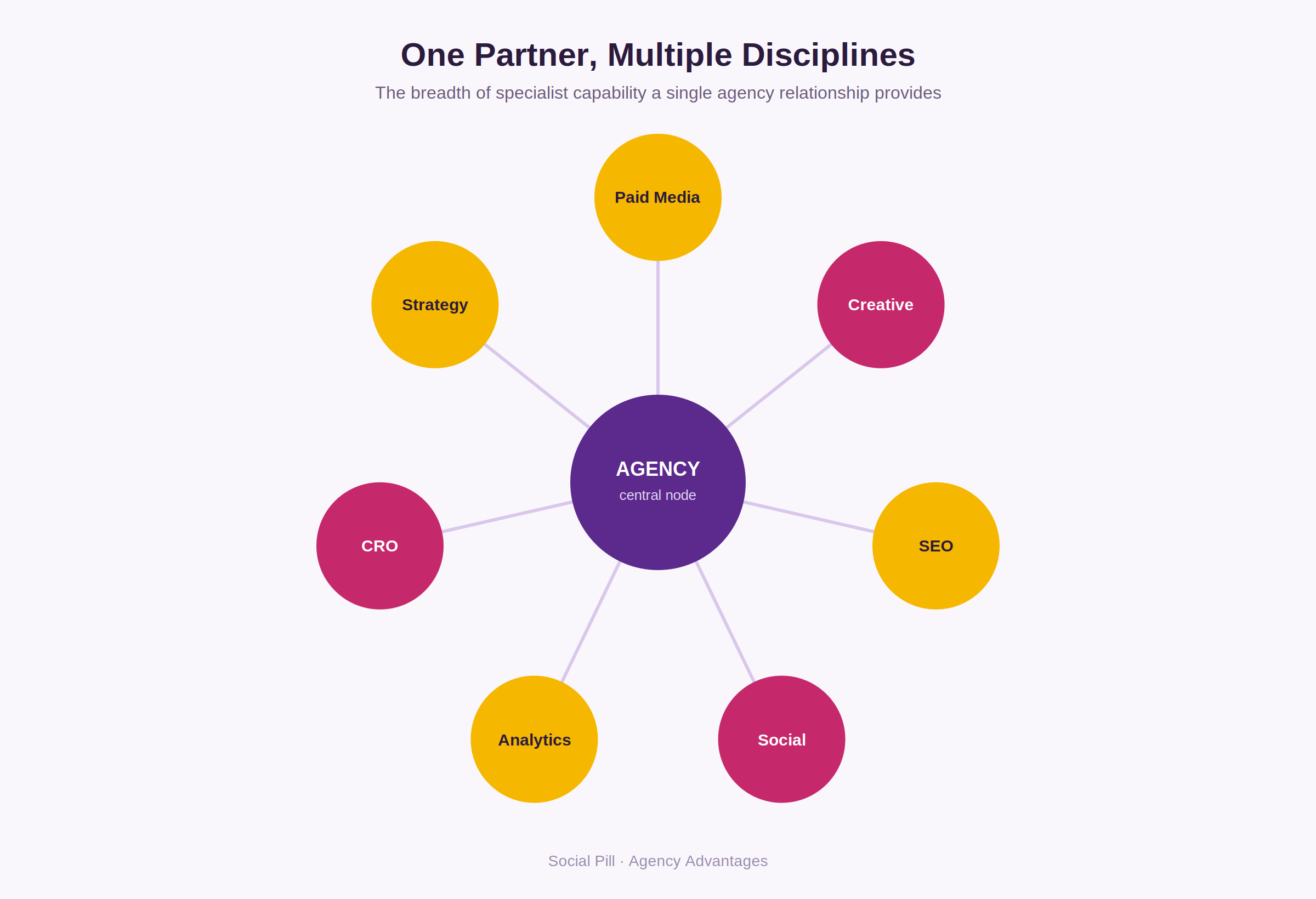
Agencies typically employ people who specialise a paid media buyer who only runs performance campaigns, an SEO lead who only tracks visibility, a CRO analyst who only tests landing pages. This matters most when something breaks. When a Meta or Google update disrupts performance, diagnosing the cause fast needs someone who has seen the pattern before, not someone learning mid-crisis.
A beauty brand relying on one generalist may take weeks to spot why acquisition costs spiked. A specialist team, having tracked similar shifts elsewhere, often catches it faster.
Exposure to Different Markets and Campaigns
Agencies work across categories skincare one week, electronics the next, F&B after that. This exposure shows up as pattern recognition.
A team that has run festive campaigns for five D2C brands knows which creative formats fatigue fastest, which audiences respond to urgency, and which channels underperform during high-competition periods like Diwali. That knowledge transfers across clients, even across categories.
Algorithm and Platform Changes
Agencies can respond faster to platform changes but only when they invest in specialists who track those changes closely. This isn’t automatic. An agency running Meta campaigns for a dozen accounts will notice attribution or targeting shifts almost immediately, because the impact shows up across multiple dashboards at once. That’s harder for a single in-house marketer managing one account.
The advantage disappears the moment monitoring becomes reactive instead of an ongoing service.
The Downsides of Agency Relationships
Agencies work with multiple clients, and attention is finite. A brand unclear about KPIs, priorities, and decision rights can end up with inconsistent senior attention. Communication gaps are the most common failure point. If a fashion brand doesn’t share sale-calendar changes promptly, the agency plans around outdated information.
Fixed scope can also slow approvals when unplanned work needs sign-off first. And because agency teams don’t sit inside daily operations, brand context can lag behind what an in-house team would catch immediately. None of this is inevitable. It’s usually a symptom of weak briefing, not a flaw in the model itself.
Advantages & Disadvantages of an In-House Team
Deep Business and Brand Knowledge
An in-house team accumulates knowledge that’s hard to hand over in a briefing document: product nuances, pricing logic, complaint patterns, sales cycles, internal priorities. A healthcare brand’s in-house marketer knows which claims are compliance-sensitive and which objections come up most in support tickets. That context shapes messaging without a separate briefing round each time.
This knowledge compounds. The longer someone stays embedded, the faster they make sound calls without escalating every decision.
Faster Internal Collaboration
In-house teams sit next to sales, product, CX, and finance literally or on the same channels. That proximity speeds up decisions that would otherwise need external coordination.
When a retail brand’s inventory team flags a stockout risk, an in-house marketer can pause a campaign the same day. An external agency might not learn about it until the next scheduled sync. This advantage disappears when the team is overloaded, or decision-making itself is slow. Proximity doesn’t help if approvals still take a week.
Stronger Ownership and Control
In-house teams typically have direct access to first-party data, full visibility into performance, and clear accountability. Strategic alignment with business goals tends to be tighter.
But more control doesn’t automatically produce better results. A brand with full ownership and a thin bench of expertise can still run underperforming campaigns control only helps when paired with the skills to use it.
The Cost of Hiring Specialists
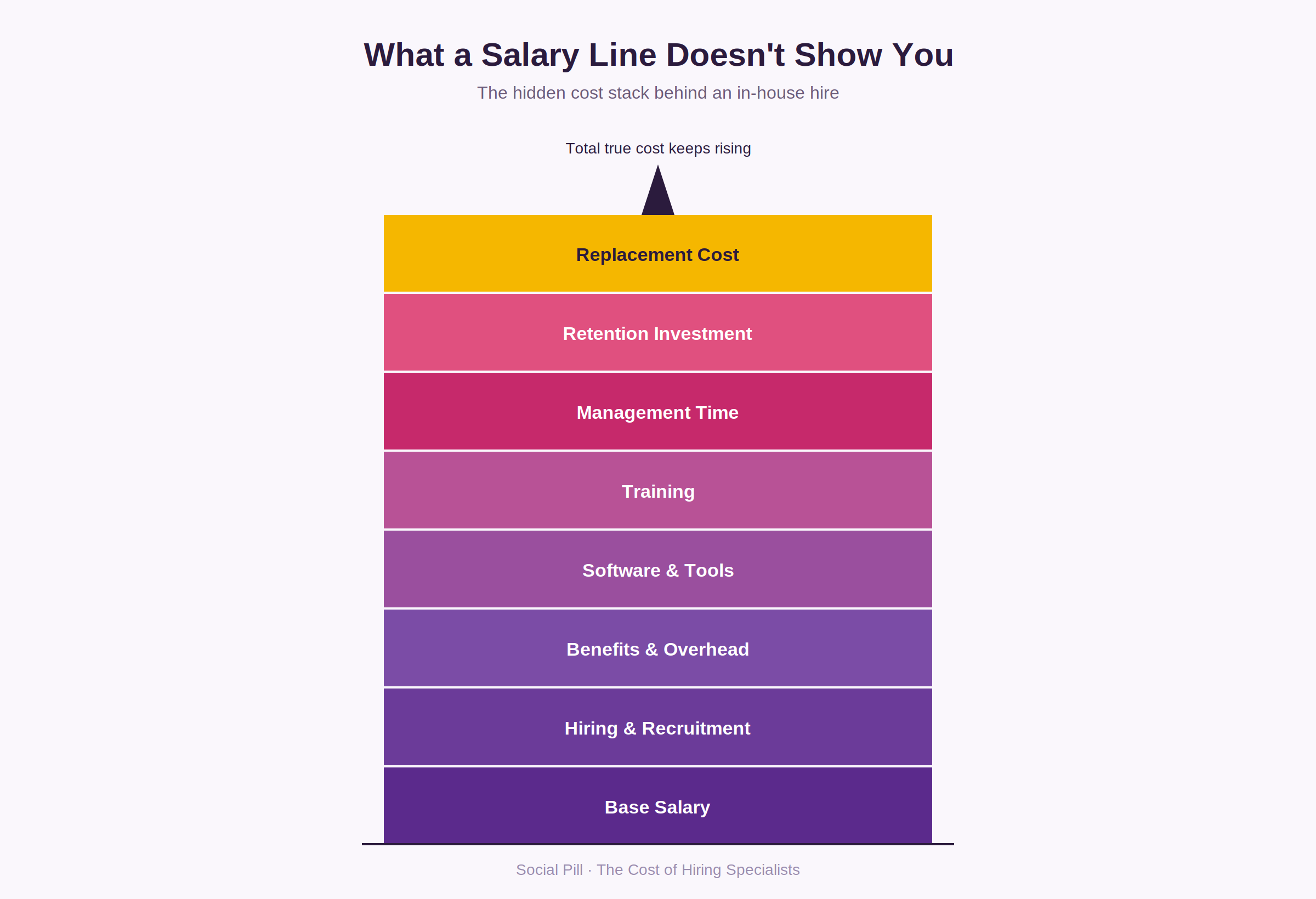
Building a strong in-house digital marketing team usually means hiring across several roles: a performance marketer, SEO specialist, content strategist, designer, social media manager, analyst, and often a CRM specialist. Salary is only the starting cost. Recruitment, onboarding, software, training, and management time all add up before a campaign goes live.
Attrition compounds this. Senior digital marketing talent in India remains competitive to hire and retain, especially for performance and analytics roles. When someone leaves, the company absorbs replacement costs and a capability gap during the search; the true cost of an in-house team rarely shows up on a single salary line.
The Risk of Capability Gaps
When one or two employees own a critical function, their departure creates immediate exposure. If a brand’s only SEO specialist leaves during a major algorithm shift, the company loses expertise and institutional context at once.
This is key-person risk, more common in lean teams than most CMOs admit. A single point of failure in a five-person team is a far bigger structural risk than the same gap in a fifty-person team.
The Risk of Becoming Too Insular
Teams working exclusively on one brand can become fluent in that brand and less aware of what’s changing elsewhere. This isn’t inevitable; it becomes a problem when a team stops tracking competitor moves and platform changes beyond its own dashboards. A D2C skincare brand’s team might miss a shift in how competitors use creator-led content if attention stays fixed on their own campaign performance.
Risk and Accountability of Digital Marketing Agency vs In-House Team
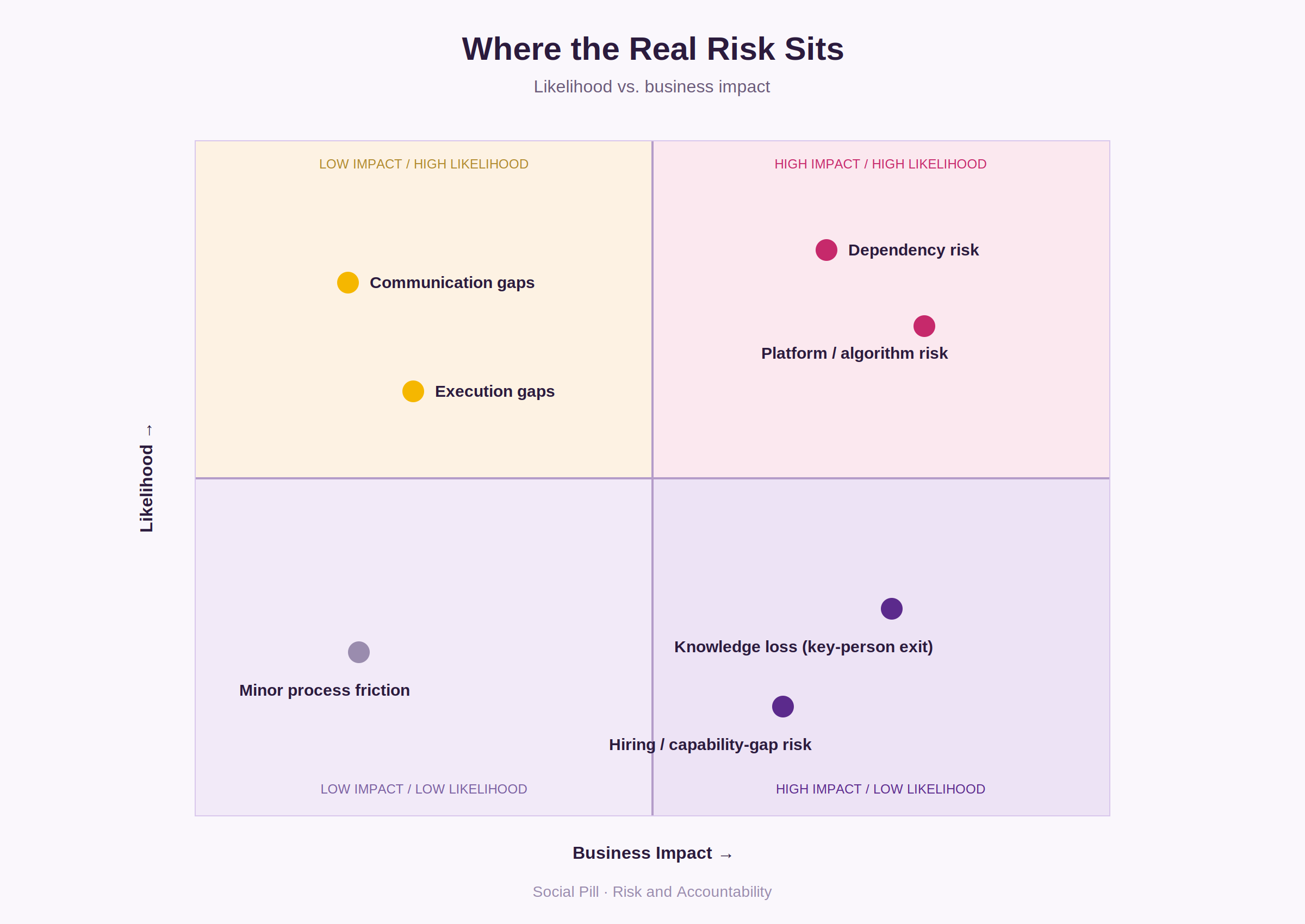
Accountability isn’t a property of the model itself. It depends on whether KPIs, ownership, reporting, and decision rights are clearly defined regardless of who executes the work. A well-managed agency can be more accountable than a poorly structured in-house team, and the reverse is just as true. The more useful exercise is breaking risk into its actual categories.
Execution Risk
Who is responsible when a campaign underperforms? With an agency, this should be defined by SLAs and reporting cadence. With an in-house team, it should be defined by role clarity and manager oversight. Ambiguity here, not the model itself, is usually why underperformance goes unaddressed too long.
Knowledge Risk
What happens when a key employee leaves, or an agency contract ends? Both create knowledge gaps. Documented strategy, shared dashboards, and recorded decisions reduce the impact either way. A brand that never documents its campaign logic is vulnerable regardless of who held that logic.
Strategic Risk
Who challenges the company’s assumptions when a strategy stops working? In-house teams can develop blind spots from sitting too close to the brand. Agencies, seeing multiple accounts, can sometimes surface this faster but only if the relationship allows genuine pushback.
Platform Risk
How does the team respond when Meta changes its auction logic, or Google ships a core update? This depends on how closely someone is tracking the change, not on whether that person sits inside the company or at an agency.
Dependency Risk
The sharpest risk in either model is over-dependence on one employee, one agency, or one platform. A brand routing most of its revenue through a single ad channel, managed by a single person, is exposed regardless of whether that person is on payroll or on retainer. Reducing this risk means building redundancy into knowledge and channels, not picking the “safer” model.
Where Cost Actually Fits In
Cost comparisons often collapse into “agency retainer vs employee salary.” That’s incomplete on both sides. Cost should be evaluated as total operating and capability cost, not a single monthly figure.
Agency Costs
Agency costs typically include the retainer, project fees for one-off work, media management fees (often a percentage of ad spend), and charges for scope expansions beyond the original agreement.
In-House Costs
In-house costs go well beyond salaries: recruitment, benefits, software subscriptions, training, day-to-day management time, and the cost of replacing people who leave. An agency can look expensive on a monthly invoice while still costing less than assembling an equivalent multi-specialist in-house digital marketing team. A brand needing paid media, SEO, content, and CRO at once may find one retainer costs less than four full-time hires plus overhead.
The reverse holds too. A company with stable, high-volume needs and strong internal leadership can often build in-house capability that becomes more cost-efficient over time, once the ramp-up period is behind it. The real comparison isn’t retainer versus salary. It’s total capability cost, measured against speed, flexibility, and growth stage.
The Hybrid Model: What Most Companies Actually Do
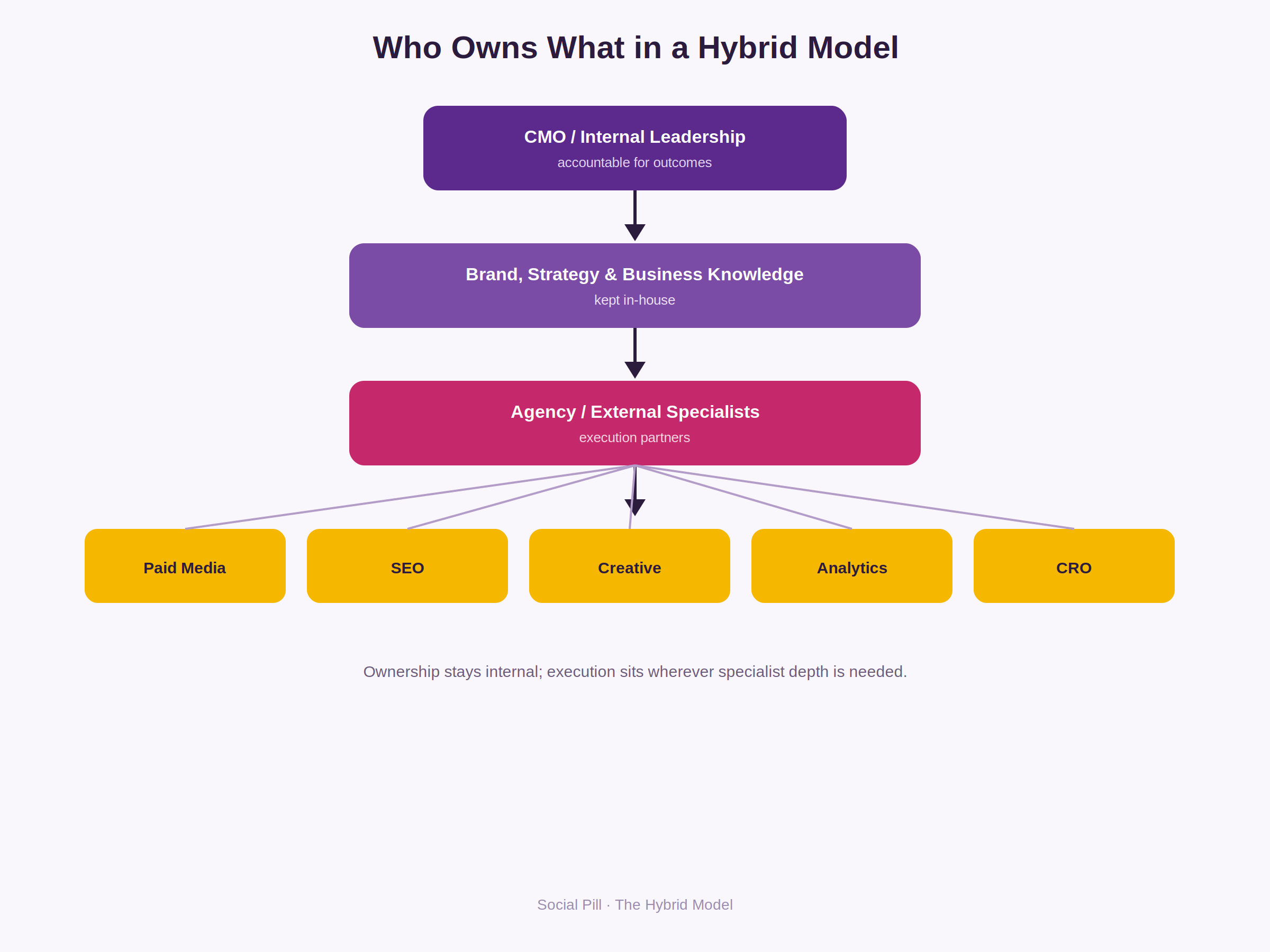
Most scaling Indian D2C and FMCG brands don’t choose one model exclusively. They build a hybrid marketing team that combines internal ownership with external specialist capability, deciding deliberately what to keep close and what to access on demand.
Keep Strategy and Brand Leadership In-House
Brand direction, customer knowledge, business strategy, positioning, and core decisions tend to work best owned internally. These need continuous context that’s hard to hand over cleanly, and they shape everything downstream. A CMO who owns strategy but outsources execution keeps control of what the brand stands for, even while accessing external hands for delivery.
Use External Specialists Where Depth Is Expensive
Performance marketing, SEO, creative production, social management, analytics, CRO, and emerging channels are often better accessed externally, especially when volume doesn’t yet justify a full-time hire. A mid-sized F&B brand may not need a full-time CRO analyst, but still needs that expertise periodically when testing new landing pages.
Build the Team Around the Business Constraint
The right split depends on where the actual constraint sits. A D2C brand with a strong CMO but a small execution team might outsource performance marketing and creative while keeping strategy and CRM internal.
Another brand might keep paid media in-house, where daily budget calls need fast turnaround, while using an agency for SEO and content, where specialist depth matters more than internal speed. Hybrid doesn’t mean hiring an agency “to help out.” It requires clear ownership someone internally accountable for outcomes, even when execution sits externally.
A Framework for Making the Call
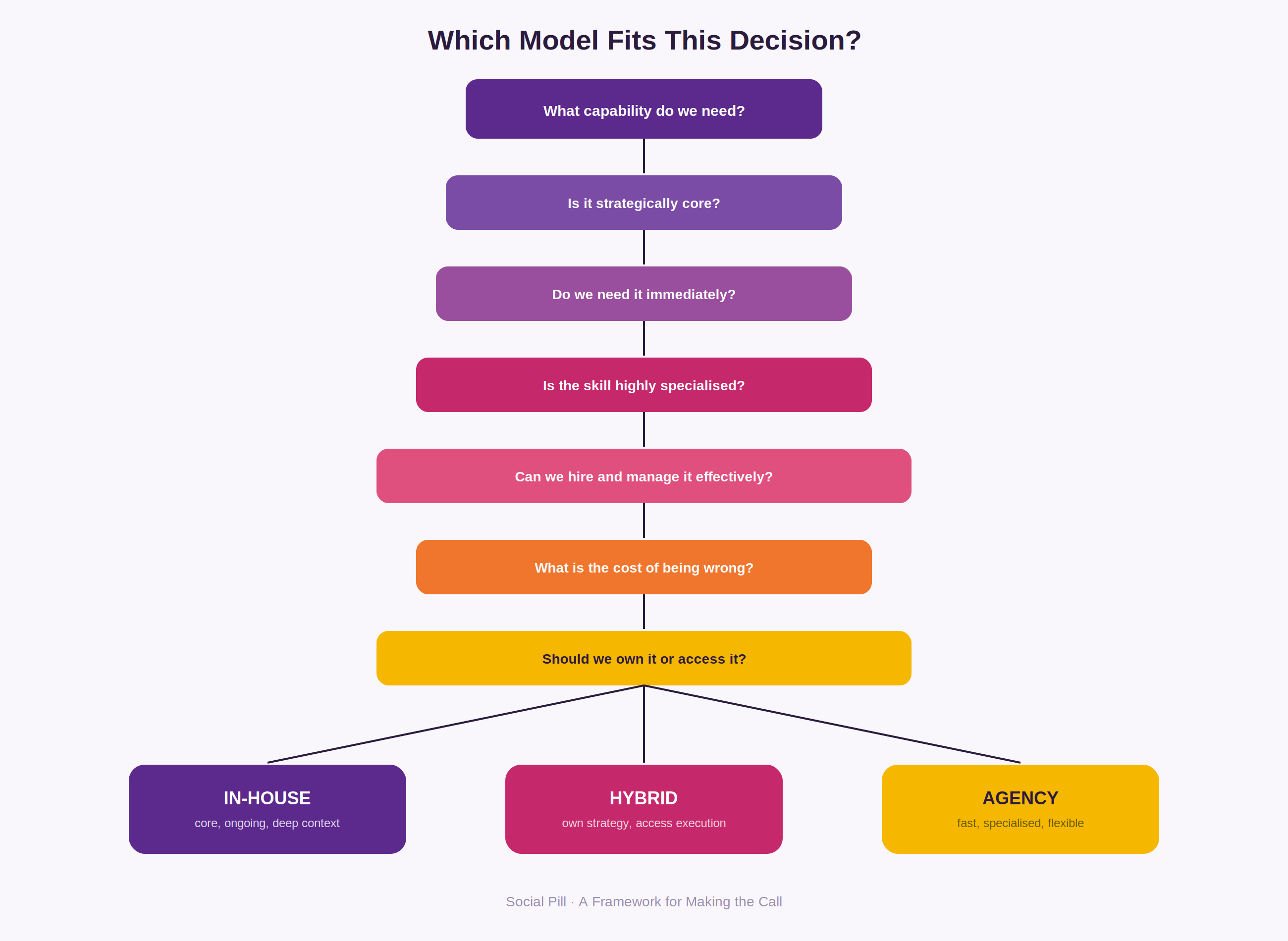
1. What Capability Do We Need?
Start by naming the actual problem. Is it strategic deciding what the brand stands for? Operational running weekly campaigns? Specialist diagnosing a performance drop? Or capacity needing more hands during a festive push? Each answer points toward a different model.
2. How Fast Do We Need It?
If a capability is needed within weeks, outsourcing usually beats recruiting hiring cycles rarely move that fast. If it will be central to the business for years, building it internally is often worth the slower ramp-up.
3. How Much Institutional Knowledge Does It Require?
If success depends heavily on internal product, customer, or operational knowledge, ownership matters more than raw execution speed. CRM strategy and lifecycle marketing often fit this pattern better than one-off campaign execution does.
4. How Specialist Is the Capability?
For highly specialised or fast-changing skills AI-driven search optimisation, for instance external expertise can be more practical than building and retaining that depth internally while the discipline itself is still evolving.
5. Can We Manage the Capability Internally?
This is less about desire and more about capacity. Assess leadership bandwidth, hiring ability, management structure, and training resources honestly. A team shouldn’t be built internally simply because ownership sounds appealing without bandwidth to hire and manage well; an internal team can underperform an external one with far less friction.
6. What Is the Cost of Being Wrong?
This is the question CMOs skip most often. What happens if the decision doesn’t work: slow execution, a skill gap, a platform change no one catches, an employee leaving mid-campaign, or an agency relationship that underdelivers?
A consumer electronics brand relying on one in-house performance marketer during a major sale period has a narrower margin for error than one with agency backup. Weighing that downside, not just the upside, sharpens the decision.
7. What Should We Own vs What Should We Access?
This is the better question to end on. Rather than asking “agency or in-house,” identify which capabilities are strategically core and which can be accessed externally without losing ground.
Brand strategy, customer knowledge, and core positioning are usually worth owning. Execution-heavy or intermittently needed specialist work is often worth accessing. Most scaling brands land somewhere between the two deliberately, not by default.
Conclusion
There’s no universal winner in this decision, and any article claiming otherwise is selling something. What works for a five-person D2C skincare brand validating its first product line looks nothing like what works for an FMCG company scaling a mature D2C channel alongside retail.
As a brand moves from validation to growth to scale to maturity, the right balance between agency and in-house capability shifts. Early-stage brands often need agency access more than ownership, since speed and breadth matter more than institutional depth at that point. As marketing becomes central to revenue, internal ownership of strategy and customer knowledge tends to matter more, even while specialist execution stays outsourced.
The best marketing team isn’t necessarily the largest internal department or the biggest agency roster. It’s the model that gives the business the right combination of ownership, expertise, speed, and accountability for where it currently stands. Social Pill works with Indian brands navigating exactly this transition, helping CMOs work out what’s worth owning internally and what’s better accessed through the right external partner, at the stage the business is actually in.
FAQs
- Is it cheaper to hire a digital marketing agency or build an in-house team?
It depends on your needs and total costs, including hiring, software, training, and management. - Can I start with an agency and move to an in-house team later?
Yes, many brands start with an agency and gradually bring key capabilities in-house. - Do agencies really understand my business as well as an in-house team?
Not immediately, but agencies can build strong business understanding through effective onboarding, collaboration, and access to data. - What’s the biggest risk of going fully in-house?
The biggest risks are capability gaps, specialist hiring challenges, key-person dependency, and higher management overhead. - Should I use one agency for everything, or a mix of in-house and agency support?
A hybrid approach often works well, combining internal strategic ownership with specialist agency expertise.