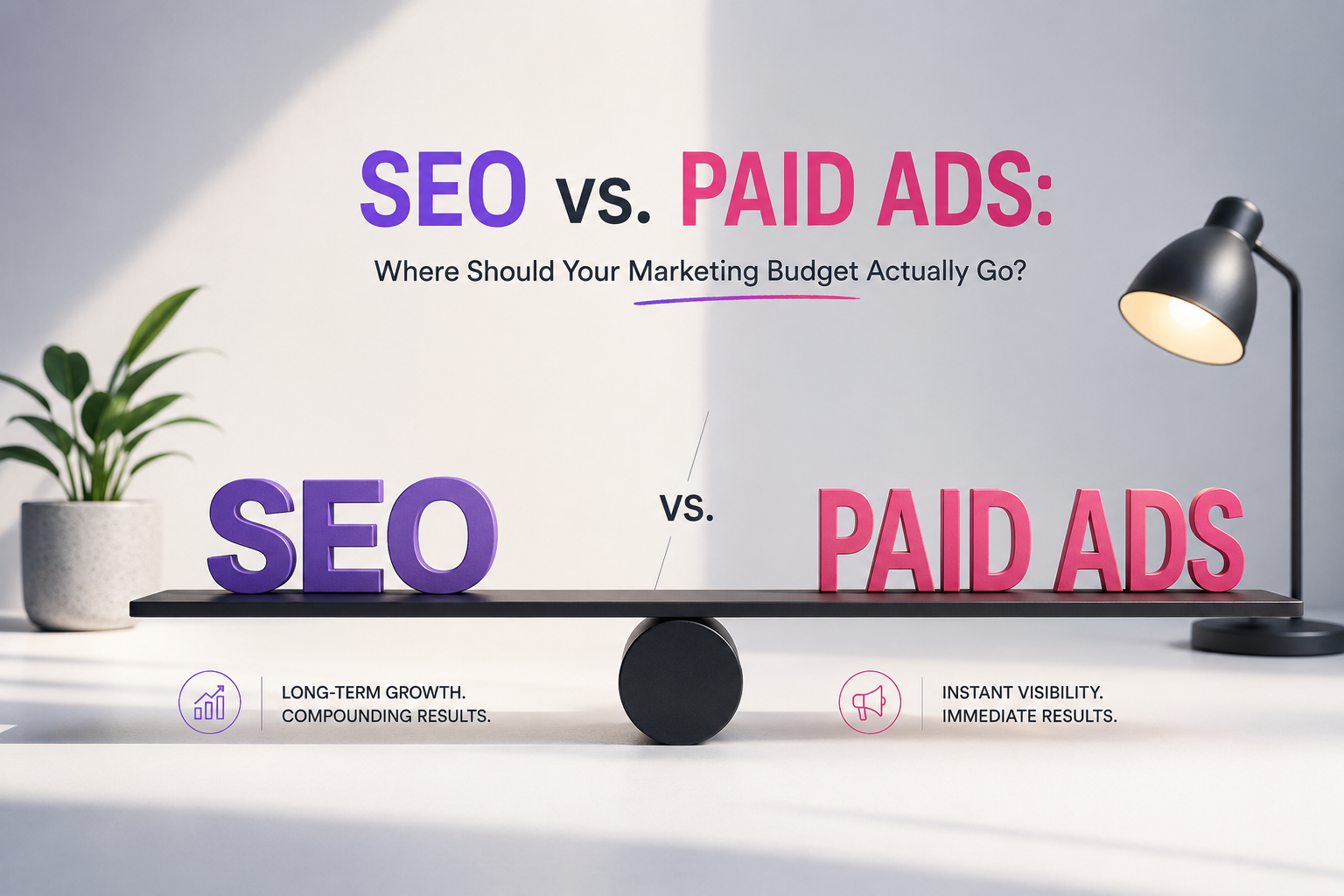
Picture a Mumbai-based D2C skincare brand with ₹12 lakh to deploy this quarter. The performance team wants it on Google and Meta Ads because it can start converting by next week. The content team wants it on SEO because paid traffic disappears the moment the budget runs out. Both teams are right, but each is telling only half the story.
The SEO vs paid ads debate gets framed as a contest with a winner. That framing is misleading. Search engine optimisation and paid advertising solve different problems, on different timelines, with different economics. A rupee spent on Google Ads behaves nothing like a rupee spent on a content and technical SEO programme.
This article isn’t here to declare which is better, SEO or paid ads. It’s here to help CMOs and founders answer a sharper question: given your business stage, margins, and growth targets, which channel deserves your next rupee and how should that ratio shift as the business matures?
What Is SEO?
SEO is the practice of earning visibility in organic (unpaid) search results by making a website more relevant, credible, and usable for both search engines and people. It spans four connected layers.
On-page SEO covers what’s on the page itself product descriptions, category copy, headings, and how well that content matches what someone actually typed into Google. Technical SEO covers whether Google can crawl, index, and render the site properly: page speed, mobile experience, structured data, and site architecture. Content and internal linking determine whether the site answers real search intent and whether authority flows correctly between pages. Off-page SEO, largely backlinks and digital PR, signals to Google that other credible sites vouch for yours.
For an Indian D2C brand, this plays out concretely. A skincare label targeting “best sunscreen for oily skin” doesn’t need to buy every click for that phrase. It can build a well-optimised category page, backed by a comparison guide and ingredient-education content, and let that page earn ranking position over time. Once it ranks, each additional visitor from that query costs nothing incremental in media spend.
That’s SEO’s real advantage: visibility compounds. A page published this quarter can keep attracting search intent-based traffic a year later, provided it stays relevant and competitive. It also tends to capture high-intent, bottom-of-funnel searches someone typing “buy vitamin C serum for pigmentation” is often closer to purchase than someone scrolling a feed.
But SEO isn’t free or fast. Meaningful rankings take sustained content and technical investment, and results aren’t guaranteed Google’s algorithm changes routinely, and competitive categories like skincare or fashion require real effort to break into. Attribution is also messier: someone might discover a brand organically, then convert weeks later via a branded search, and standard analytics will often miscredit that journey.
What Are Paid Ads?
Paid advertising means paying a platform Google, Meta, LinkedIn, or others for guaranteed access to visibility and traffic. Search engine marketing (SEM) covers Google Search Ads, which appear against specific queries. Paid social covers Meta Ads and LinkedIn Ads, which target audiences based on behaviour, interests, or job function rather than a search query. Display marketing extends this to banner placements across the web, usually for awareness rather than direct response.
Each format plays a distinct role for a D2C brand. Google Ads captures a shopper who has already decided they want a product and is actively searching for it; someone typing “buy protein powder online India” is close to a purchase decision. Meta Ads work differently: they introduce a new skincare or apparel brand to an audience that fits a lookalike or interest profile, before that audience has any search intent at all. Retargeting campaigns then reconnect with people who viewed a product page or added to cart but didn’t buy, which is often where paid media earns its keep on thin margins.
Paid media’s core advantage is speed. A campaign can go live today and start generating clicks, impressions, and conversion data within hours. That’s valuable for testing which audiences, offers, creatives, and landing pages actually convert, before committing a larger budget. Targeting is also far more precise than organic reach, and every rupee spent is directly measurable against a return.
The disadvantages are just as real. The moment spend stops, traffic drops sharply. Customer acquisition cost (CAC) tends to climb as an audience saturates, or a category gets more competitive; a Diwali campaign that performed well last October may cost noticeably more to repeat this year. Creative fatigue sets in when the same ad runs too long, and a weak landing page can waste a well-targeted campaign entirely.
SEO vs Paid Ads: At a Glance
| Factor | SEO | Paid Ads |
| Speed to results | Slower weeks to months | Fast hours to days |
| Initial investment | Content, technical work, expertise | Media spend + campaign management |
| Traffic after stopping spend | Can continue | Usually drops sharply |
| Long-term compounding | Strong potential | Limited |
| Testing speed | Slower to iterate | Fast to test and adjust |
| Targeting basis | Search intent and relevance | Audience, keyword, and platform data |
| Algorithm/platform dependency | High (Google’s ranking systems) | High (auction dynamics, platform policy) |
| Best suited for | Sustainable, compounding demand | Immediate acquisition and market testing |
| Main risk | Slow results, ranking volatility | Rising CAC, creative fatigue |
The Real Difference: Renting vs. Owning Visibility
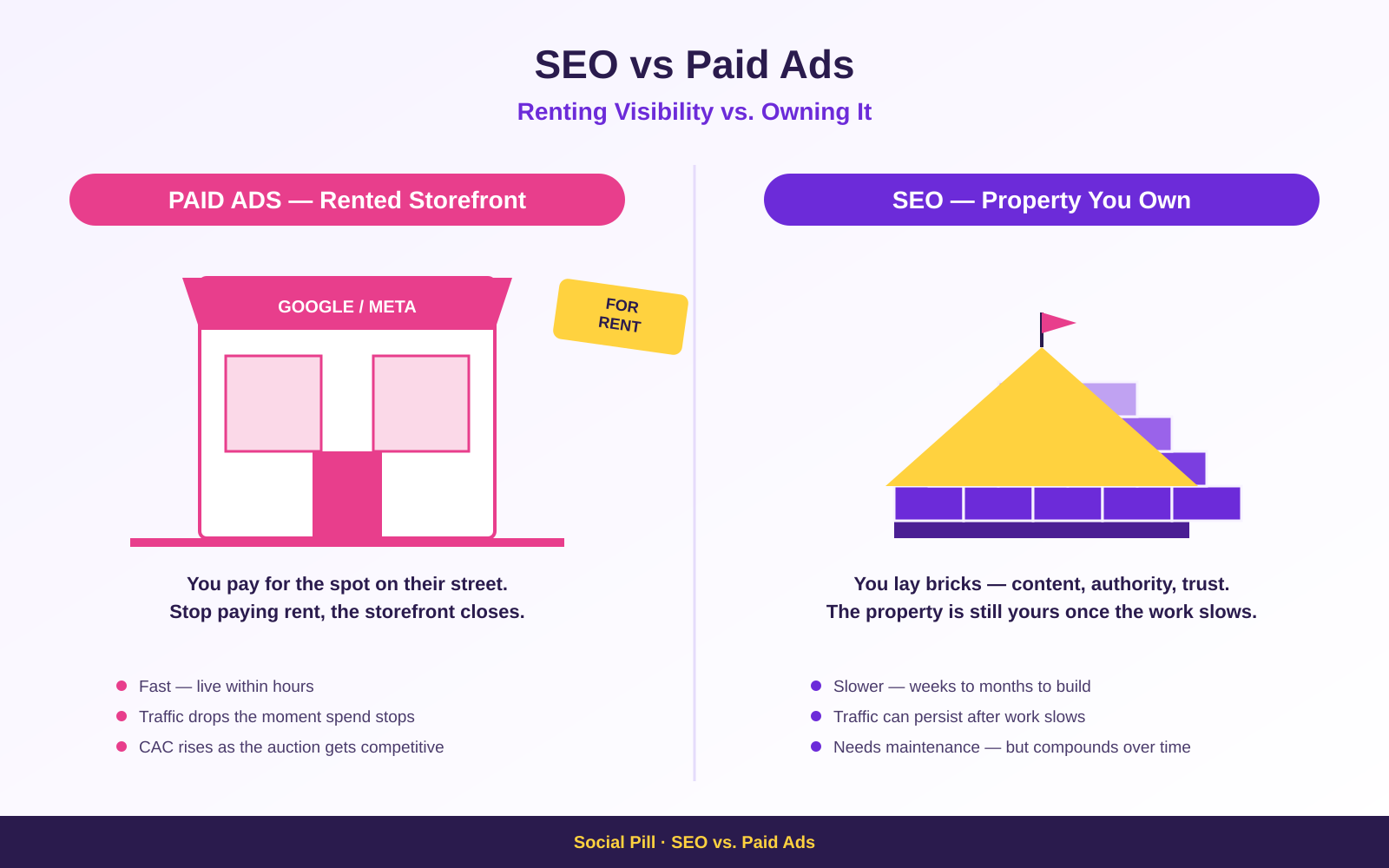
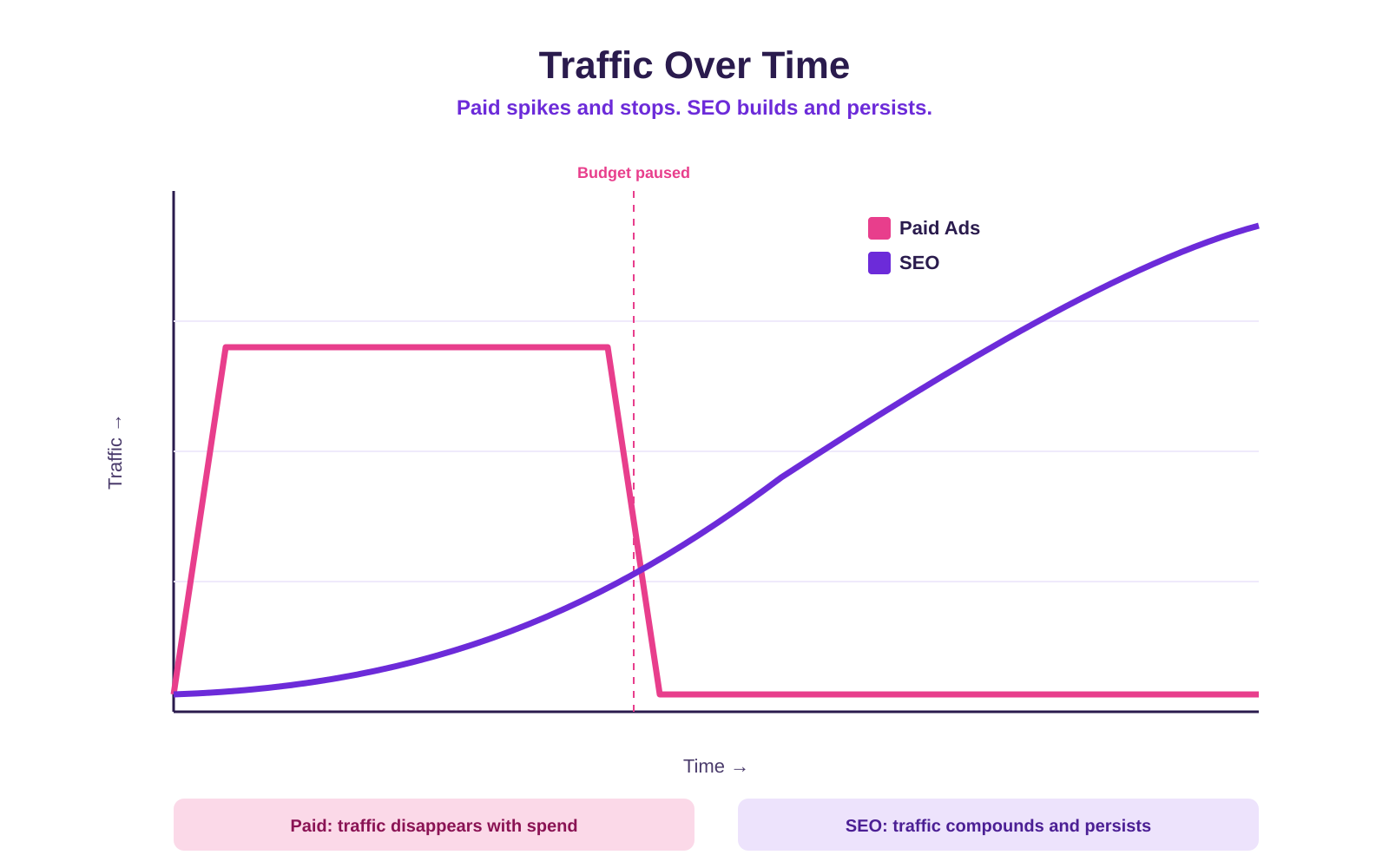
The clearest way to separate these channels is a simple metaphor: paid ads rent visibility, SEO builds it. With paid ads, you’re paying Google or Meta for temporary access to their audience. The moment the campaign is paused, that visibility largely disappears; there’s no residual traffic sitting on a shelf. With SEO, you’re investing in an asset: content, site structure, authority, and relevance that can keep generating traffic after the original work is done.
Take an Indian D2C nutrition brand. It runs a Google Ads campaign for “best whey protein for beginners,” and traffic stops the day the budget is paused. It also publishes a detailed buying guide on the same topic, which ranks on page one eight months later and keeps attracting new visitors every month without additional spend, as long as it stays accurate and competitive.
This doesn’t mean SEO is free or permanent. Owning the asset still requires maintenance: updating content, fixing technical issues, building authority, and adapting when Google changes how it ranks pages. An unmaintained SEO asset depreciates just more slowly and less visibly than a paused ad account.
Speed How Fast Each One Actually Works
Paid ads can generate impressions and clicks almost immediately. A new D2C beauty brand can launch Google and Meta campaigns this week and start collecting real conversion data by the weekend. That speed is valuable beyond traffic alone; it’s a fast way to validate messaging, pricing, and product-market fit before a larger spend commitment.
SEO works on a longer clock. Indexing takes time, content needs creating and refining, and pages need to earn authority relative to competitors already ranking. Depending on competition, domain strength, technical health, content quality, and existing search demand, meaningful gains can take months rather than weeks. A low-competition niche keyword can still rank faster than a broad, contested term like “protein powder.”
This gap matters directly for budget sequencing. A brand that needs revenue this quarter cannot rely on SEO alone to deliver it. But a brand that starts SEO only after paid budgets feel expensive is a year behind where it could have been.
Cost What You’re Really Paying For
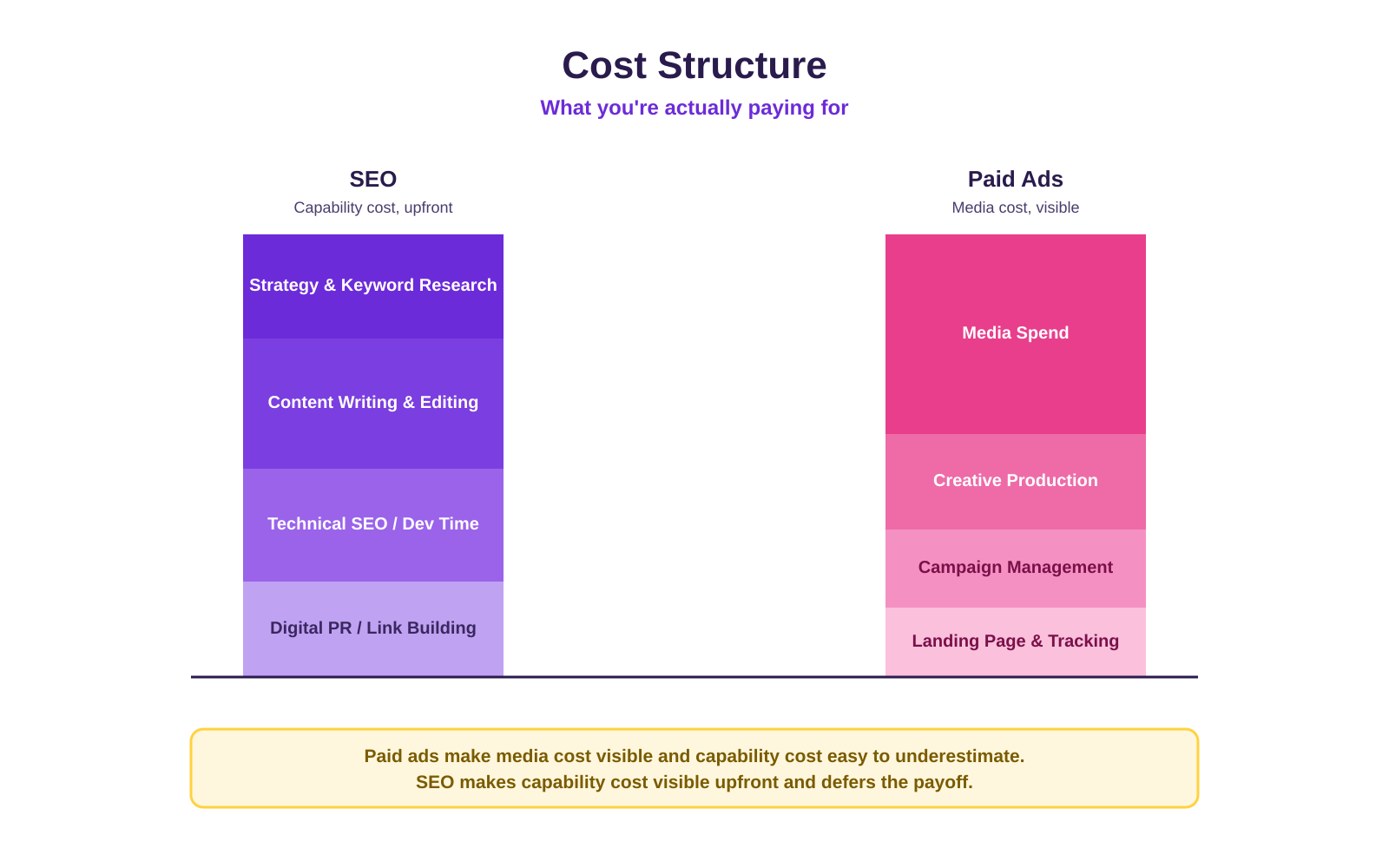
“SEO is cheaper than paid ads” is an oversimplification that misleads more CMOs than it helps. Both channels carry real costs; they’re just structured differently. SEO costs sit mostly in capability: strategy, keyword research, content writing and editing, technical SEO and developer time, digital PR or link acquisition, and the expertise to run all of it consistently. None of this is a line item you can pause without consequence; the work compounds, but so does the cost of doing it inconsistently.
Paid advertising costs split into media spend and management: agency or in-house fees, creative production, landing page development, tracking, and ongoing testing. A brand with a ₹5 lakh monthly ad budget still needs people who can build audiences, write copy, and read performance data; without that, the spend underperforms regardless of size.
The useful distinction is media cost versus capability cost. Paid ads make media cost visible and capability cost easy to underestimate. SEO makes capability cost visible upfront and defers the payoff. An Indian FMCG brand entering D2C often learns this the hard way: it budgets for ad spend, but not for the content and technical teams needed to make that spend efficient.
What the Data Actually Says About ROI
Numbers are more useful than opinions here, so long as they’re read correctly. India’s digital advertising market itself is instructive. Dentsu’s Digital Advertising Report 2026 found that digital advertising grew 19% in 2025, now accounting for roughly 59% of India’s total ad spend, with paid search projected to grow at 16.54%, stabilising at around a 23% share of digital budgets. Paid search isn’t shrinking; brands are still increasing what they commit to it, even as search itself changes shape.
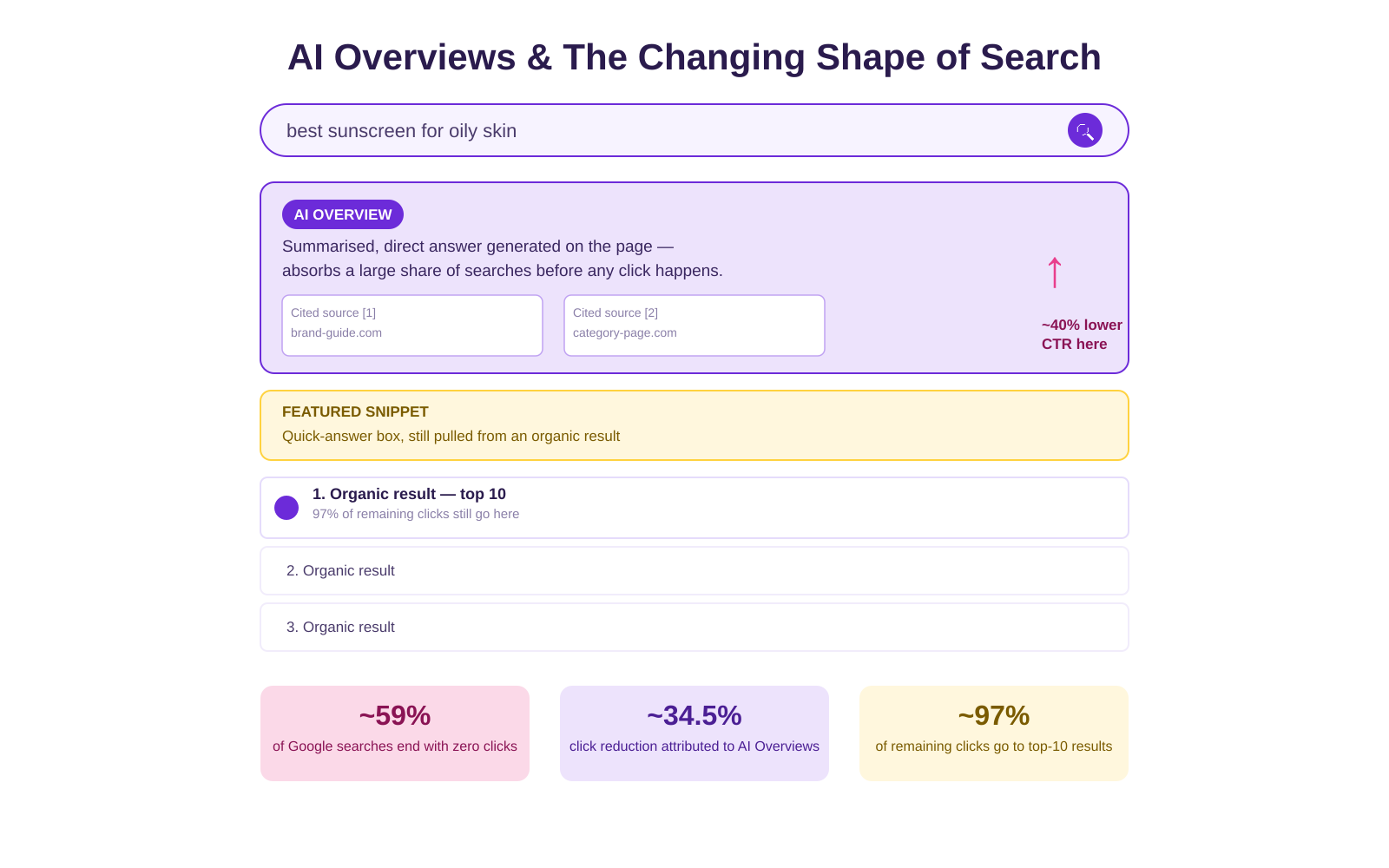
That change in search itself is the second piece of data worth sitting with. Semrush’s 2025 Zero-Click Search Study found that roughly 59% of Google searches in both the US and EU now end without any click to a website at all. Separately, BrightEdge’s 2025 research found that click-through rates fall by around 40% on queries where an AI Overview appears, compared with a traditional results page. Ahrefs’ analysis puts the click reduction attributable to AI Overviews at roughly 34.5%, while also finding that nearly all remaining clicks, around 97%, still go to results ranked in the top 10.
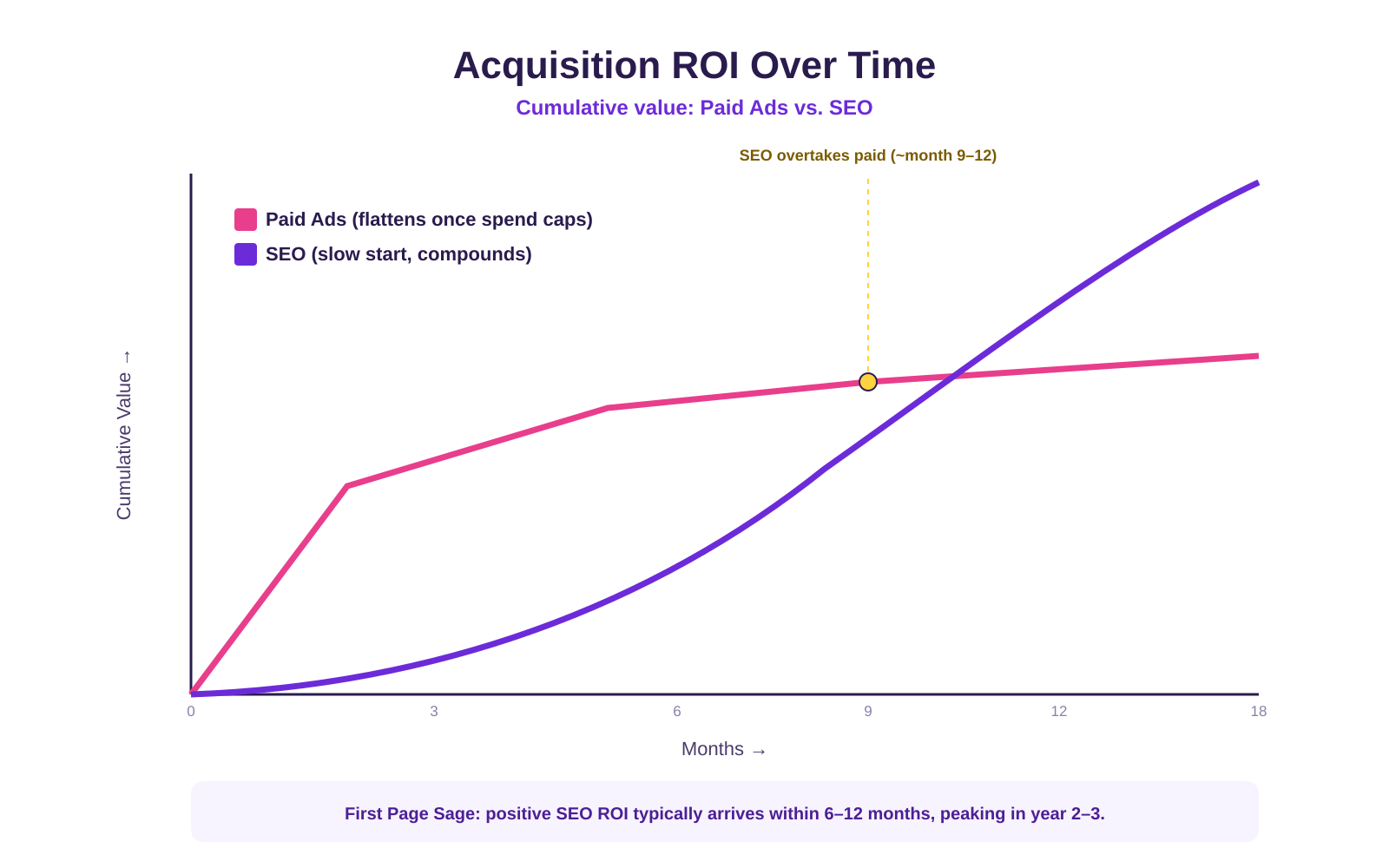
On the SEO investment side, First Page Sage’s proprietary research across SEO campaigns run between 2021 and 2025 found that positive ROI typically arrives within 6 to 12 months, with the strongest financial returns showing up in year two or three of a sustained programme.
What does a CMO do with this? First, paid search remains a growing, defensible line item in India; the data doesn’t support abandoning it. Second, organic click volume is under real pressure from AI-driven search, so an SEO strategy built purely around ranking position is increasingly incomplete. Third, SEO’s payoff is real but backloaded budget it as a multi-quarter investment, not a channel judged against one month’s traffic report.
Where Paid Ads Win
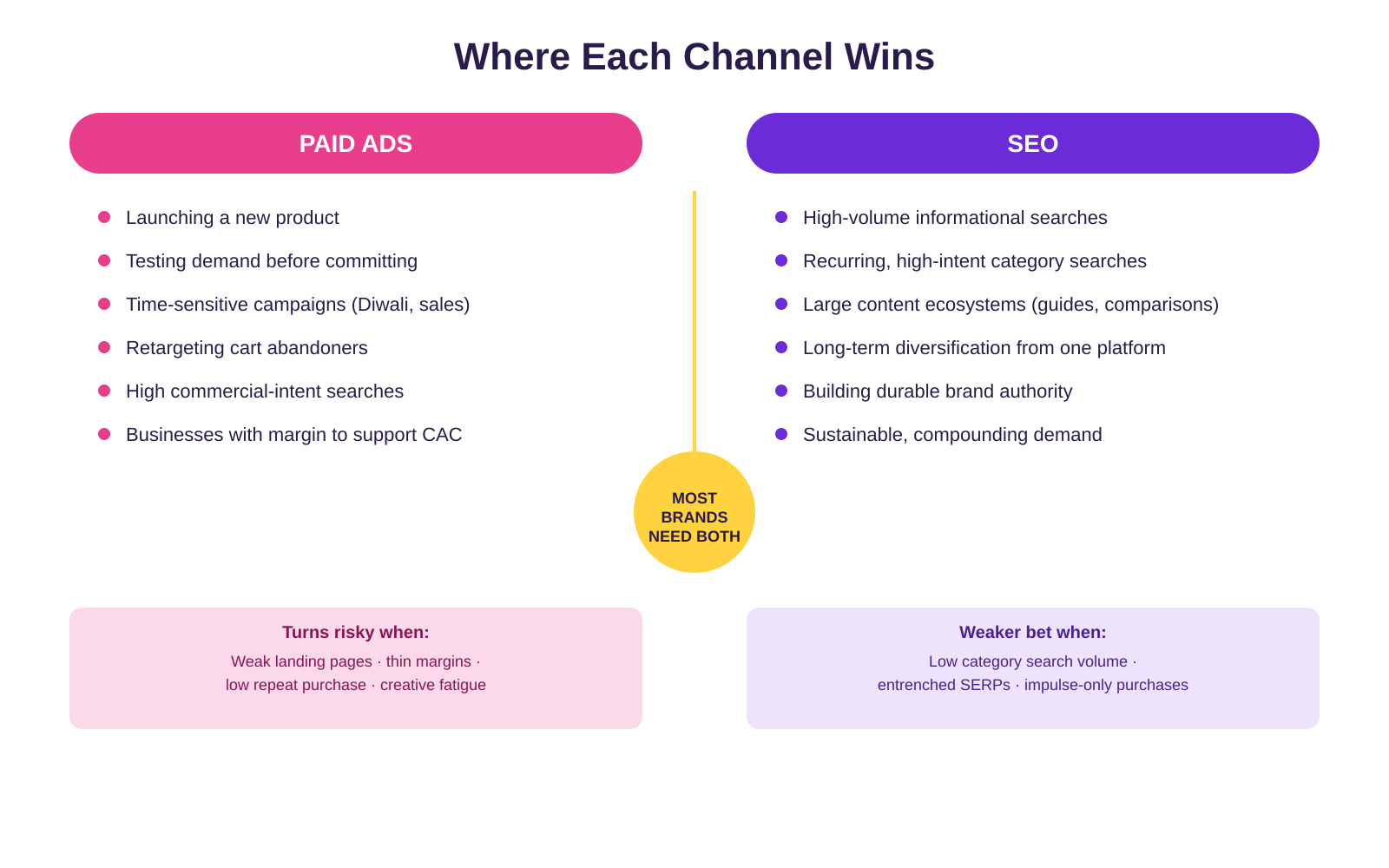
Launching a new product. A new D2C beverage brand needs immediate traffic and real purchase data, not a six-month ranking runway.
Testing demand before committing. Paid campaigns let a brand test audiences, messaging, offers, and landing pages in parallel, and kill what doesn’t work within days.
Time-sensitive campaigns. Festive windows Diwali, Independence Day sales, flash promotions reward channels that can turn on and scale within a fixed calendar. SEO cannot be switched on for a two-week sale.
Retargeting. Meta and Google can reconnect with users who viewed a product or abandoned a cart, often at a lower CAC than a fresh visitor.
High commercial intent. When someone actively searches “buy running shoes size 9 India,” Google Ads puts the brand directly in front of a near-ready buyer.
Businesses with the margin to support it. Paid acquisition works best when unit economics order value, contribution margin, repeat purchase rate can absorb a real CAC and stay profitable.
Paid ads turn dangerous under specific conditions: poor conversion rates, weak landing pages, thin margins, low repeat purchase behaviour, creative fatigue, or an audience shown the same ad too many times. In those situations, more spend just accelerates the losses.
Where SEO Wins
High-volume informational searches. Someone searching “how to choose the right sunscreen for oily skin” is researching, not buying yet SEO content can capture that intent without a cost per click.
High-intent category searches. A query like “best protein powder for beginners in India” recurs every month, indefinitely. Ranking for it once means capturing that demand repeatedly.
Large content opportunities. A wellness or beauty brand can build an entire content ecosystem guides, comparisons, ingredient explainers around a category, becoming the resource searchers return to.
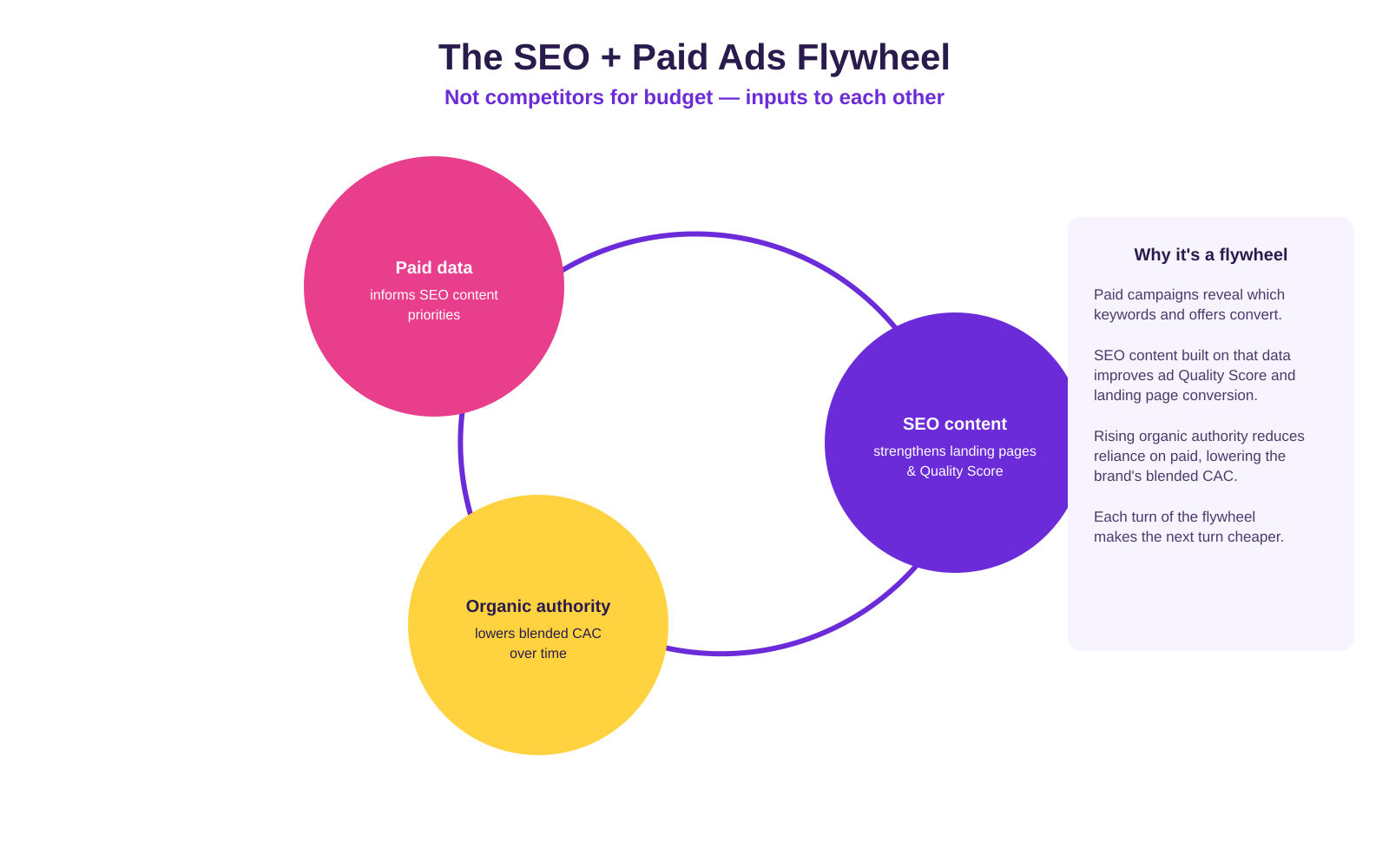
Long-term diversification. SEO reduces dependence on any single paid platform’s auction dynamics, which matters when CAC on Meta or Google climbs unpredictably.
Building authority. Genuinely useful content earns trust that supports every other channel, including how confidently a paid landing page converts.
SEO is a weaker bet when category search volume is genuinely low, when SERPs are dominated by entrenched competitors, when purchases happen almost entirely through impulse discovery on social feeds, or when the business lacks the resources to sustain the work consistently.
The Shift Nobody’s Talking About AI Overviews & Zero-Click Search
The old SEO model was simple: rank in position one, get the click. That model is breaking down, and any 2026 strategy conversation that ignores this is already out of date. Google’s AI Overviews now answer many queries directly inside the search results page, without requiring a click at all. Combined with featured snippets, People Also Ask boxes, and knowledge panels, a growing share of search journeys now complete entirely on Google’s own interface. As covered in the ROI section, Semrush’s 2025 research put zero-click outcomes at roughly 59% of searches, and BrightEdge found AI Overview queries see click-through rates fall by around 40% compared with standard results pages.
This does not mean SEO is dead. It means the objective is shifting. Ranking position still matters, but it’s no longer the only currency. What’s increasingly valuable is whether a brand’s content gets cited inside an AI-generated answer, whether it demonstrates clear topical authority across a category, and whether Google’s systems can confidently understand what entity what brand, what product, what expertise the content represents.
Practically, this pushes SEO toward structured, well-sourced, original content rather than thin pages built purely to rank. It also means tracking visibility across more surfaces than the traditional ten blue links, including how often a brand gets referenced inside AI-generated summaries. Nobody, including Google, has published a precise formula for how sources get selected into these summaries any strategy claiming certainty here should be treated with suspicion. For a D2C brand, the practical implication is this: SEO content now needs to earn a click and earn a citation. Both matter. Neither replaces the other.
How to Actually Split Your Budget
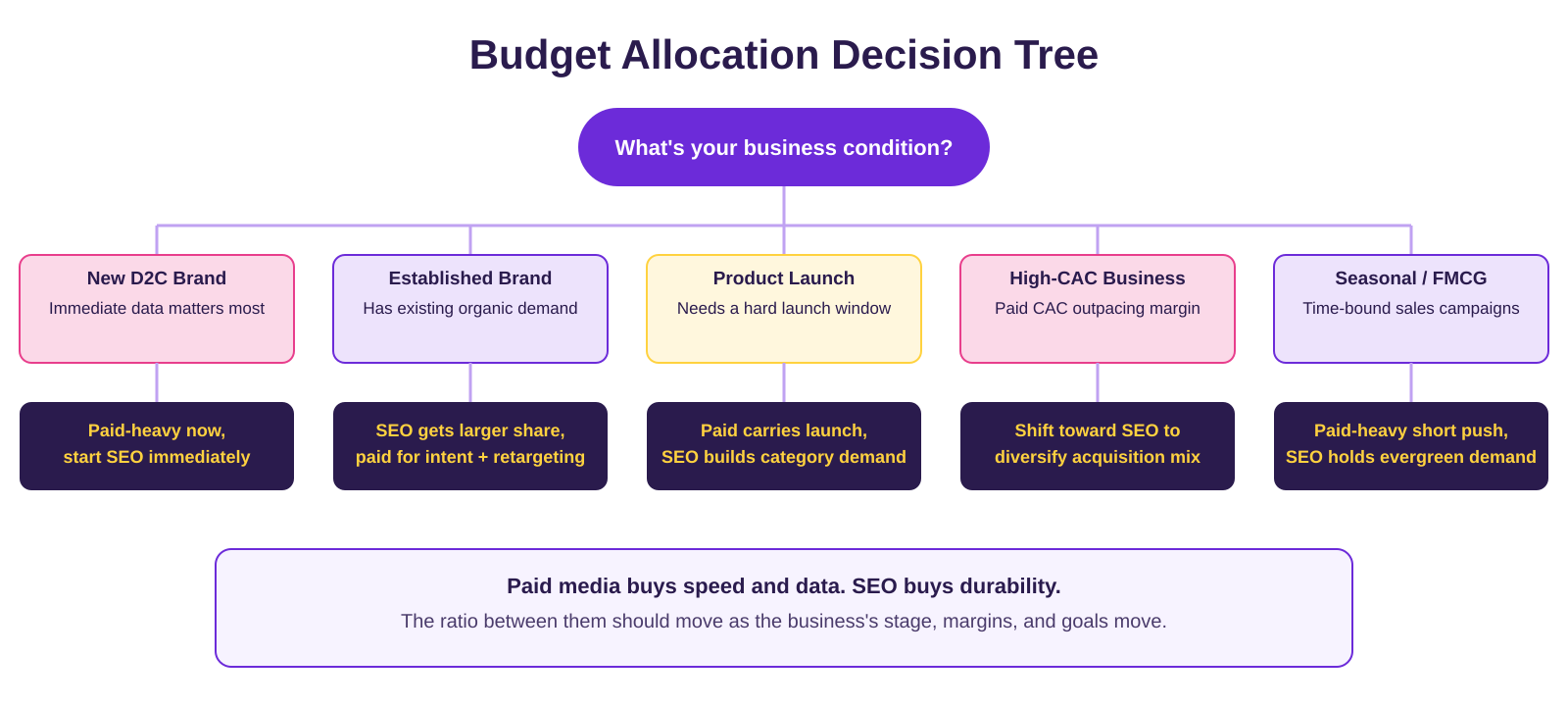
There’s no universal percentage split that works across every D2C brand anyone offering one is oversimplifying. What works is matching allocation to business condition.
New D2C brand
Paid media usually deserves the larger share early on, since immediate traffic and conversion data matter more than compounding. But SEO should start now a brand that waits a year to begin has postponed compounding it will never fully recover.
Established brand with existing organic demand
If a brand already has meaningful organic visibility, SEO can justify a larger share, since extending an existing content and authority base costs less than building one from scratch. Paid ads keep playing a role for high-intent terms and retargeting.
Product launches
Paid media should typically carry the launch. SEO supports category education and long-term discoverability, building demand that outlasts the launch window.
High-CAC businesses
When paid CAC rises faster than margins can absorb, SEO becomes a tool for reducing overdependence on any single paid channel and improving the overall acquisition mix.
Seasonal and FMCG campaigns
Time-bound campaigns Diwali, back-to-school, monsoon ranges reward a paid-heavy short-term push. SEO’s job is keeping the evergreen category demand captured year-round, not just during the sale window.
Across all five situations, the same principle holds: paid media buys speed and data, SEO buys durability, and the ratio between them should move as the business’s stage, margins, and goals move.
Conclusion
So, SEO vs paid ads, which is better? Neither, universally. That’s not a hedge it’s the actual answer once you look at how each channel behaves economically. Paid ads rent visibility. They’re fast, measurable, and indispensable for launches, testing, and time-sensitive demand provided the unit economics support the CAC. SEO builds visibility. It’s slower and requires sustained investment, but it can compound into a lower-cost, more durable acquisition channel, even as AI Overviews and zero-click search reshape what “ranking well” actually means.
Sophisticated D2C brands stop asking which channel to commit to and start treating budget allocation as a portfolio decision one that shifts deliberately as the business moves from launch to scale to category leadership. The brand that gets this right isn’t the one that picks a side. It’s the one that keeps asking, every quarter, which channel its next rupee should fund.
That’s the kind of decision that benefits from an outside read on the numbers which is where a team like Social Pill typically comes in, helping brands stress-test their acquisition mix against actual CAC, margins, and search demand rather than a generic rule of thumb.
FAQ
1. Is SEO or paid ads better for a new business?
Start with both use paid ads for quick results and SEO for long-term growth from day one.
2. How much should I spend on SEO vs. paid ads?
Your budget split depends on your business stage, goals, margins, and customer acquisition strategy.
3. Can I just do SEO and skip paid ads entirely?
Yes, but you’ll sacrifice the speed and testing advantages that paid ads provide.
4. Why do my paid ads stop working the moment I stop paying?
Because paid ads deliver visibility only while you’re paying, unlike SEO’s long-term organic value.
5. Does SEO still matter now that Google shows AI-generated answers?
Yes, SEO now focuses on earning visibility in both search rankings and AI-generated results.