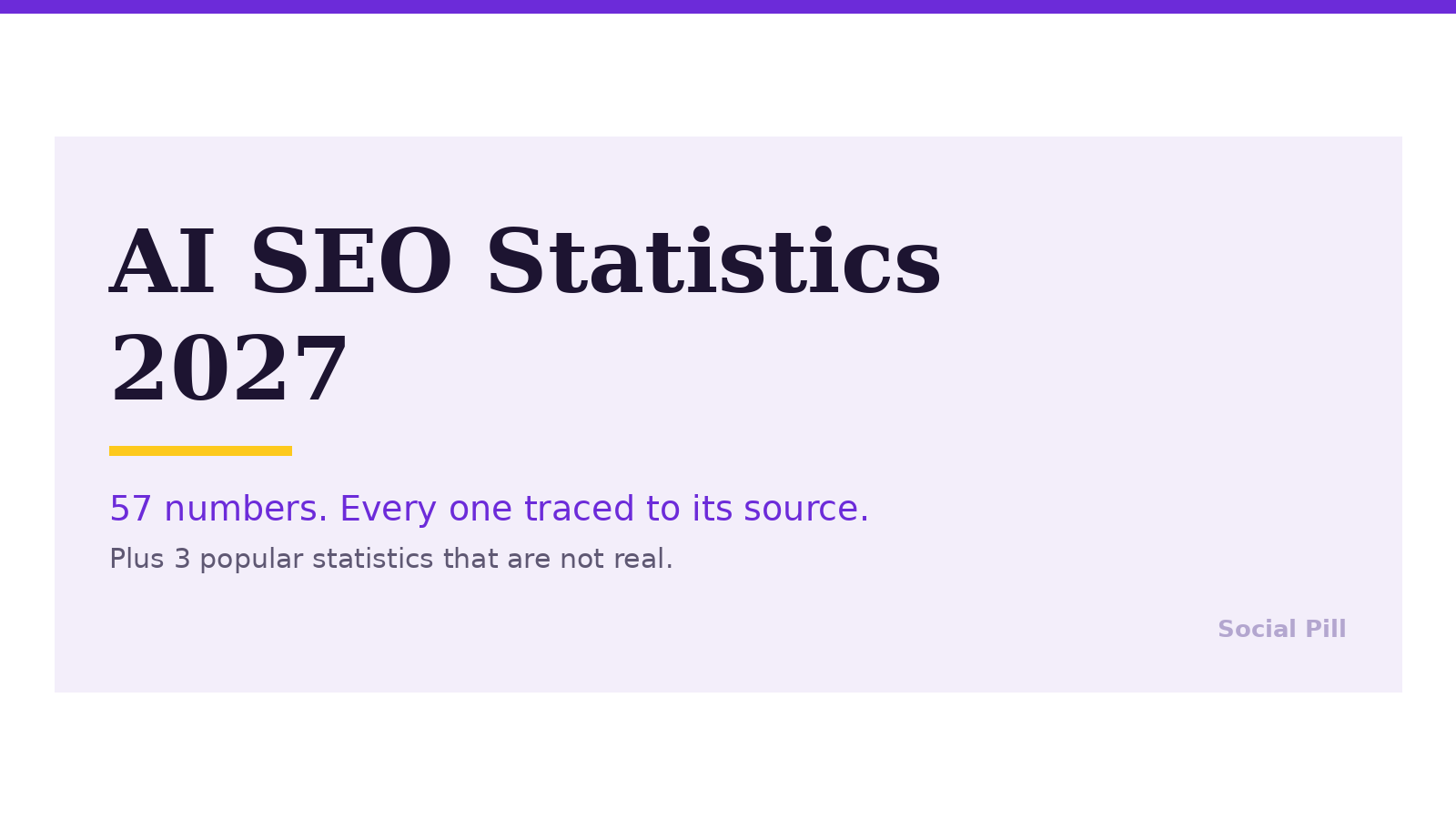
Most AI SEO statistics pages compete on how many numbers they list. The counts have reached 140 and 300, which is more statistics than this field has produced primary research to support. This page takes the opposite approach. It carries 57 figures, every one of them traced to the platform announcement, documentation page or study that produced it, with the sample size and the date attached. It also names three widely quoted statistics that fall apart when you look for their source, and three contradictions you need to know about before you quote anything here in a board deck.
Key Takeaways
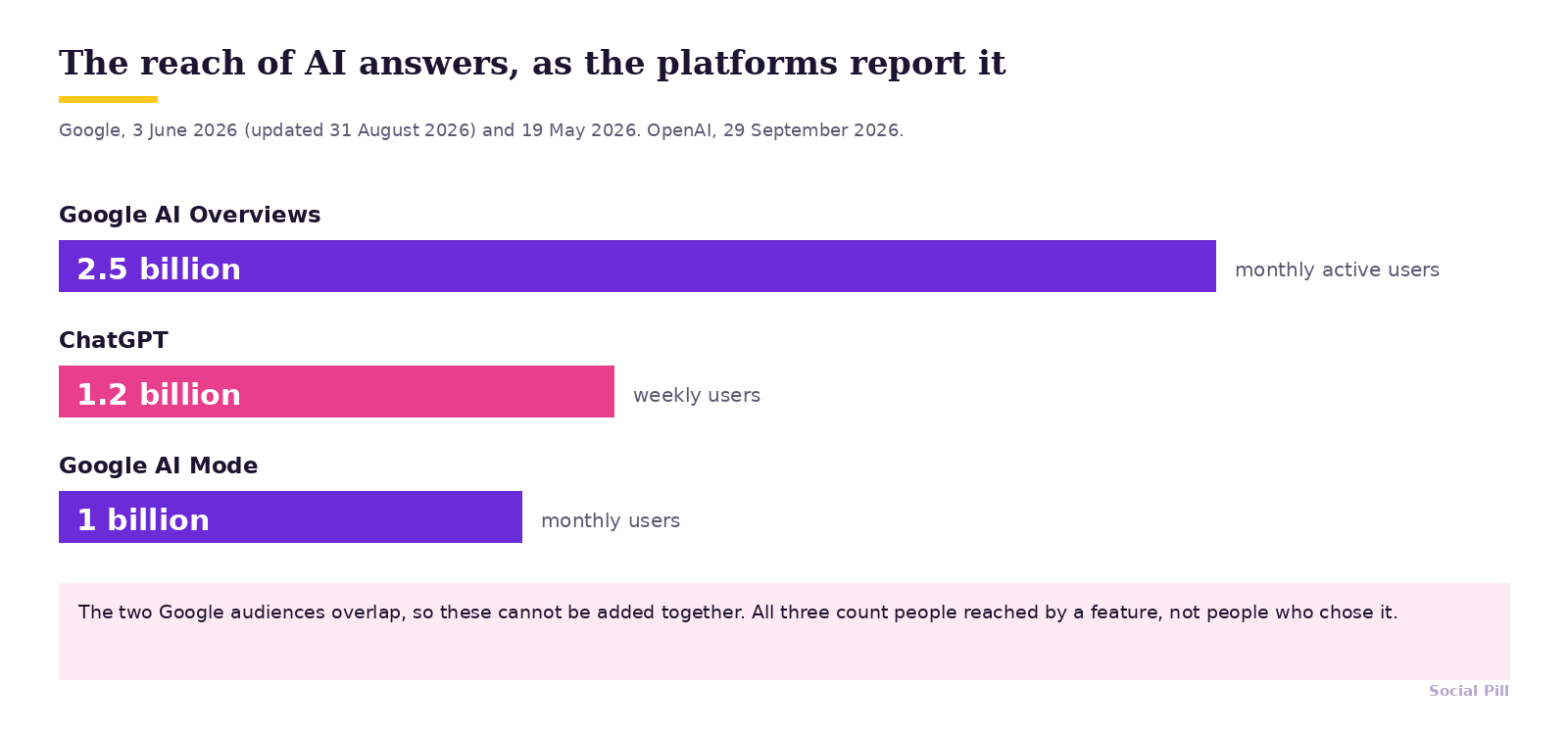
- Google reports AI Overviews at over 2.5 billion monthly active users and AI Mode at over 1 billion, with AI Mode queries more than doubling every quarter since launch. OpenAI reports 1.2 billion weekly ChatGPT users.
- Google’s own data says the average AI Mode search runs triple the length of a traditional search query. That single number explains most of what changes about keyword and content work.
- Since 31 August 2026 every site worldwide has a Search Console toggle to opt out of Google’s generative AI features, and new Search Console reporting on which pages appear in AI responses. Almost nobody writing about AI SEO has noticed.
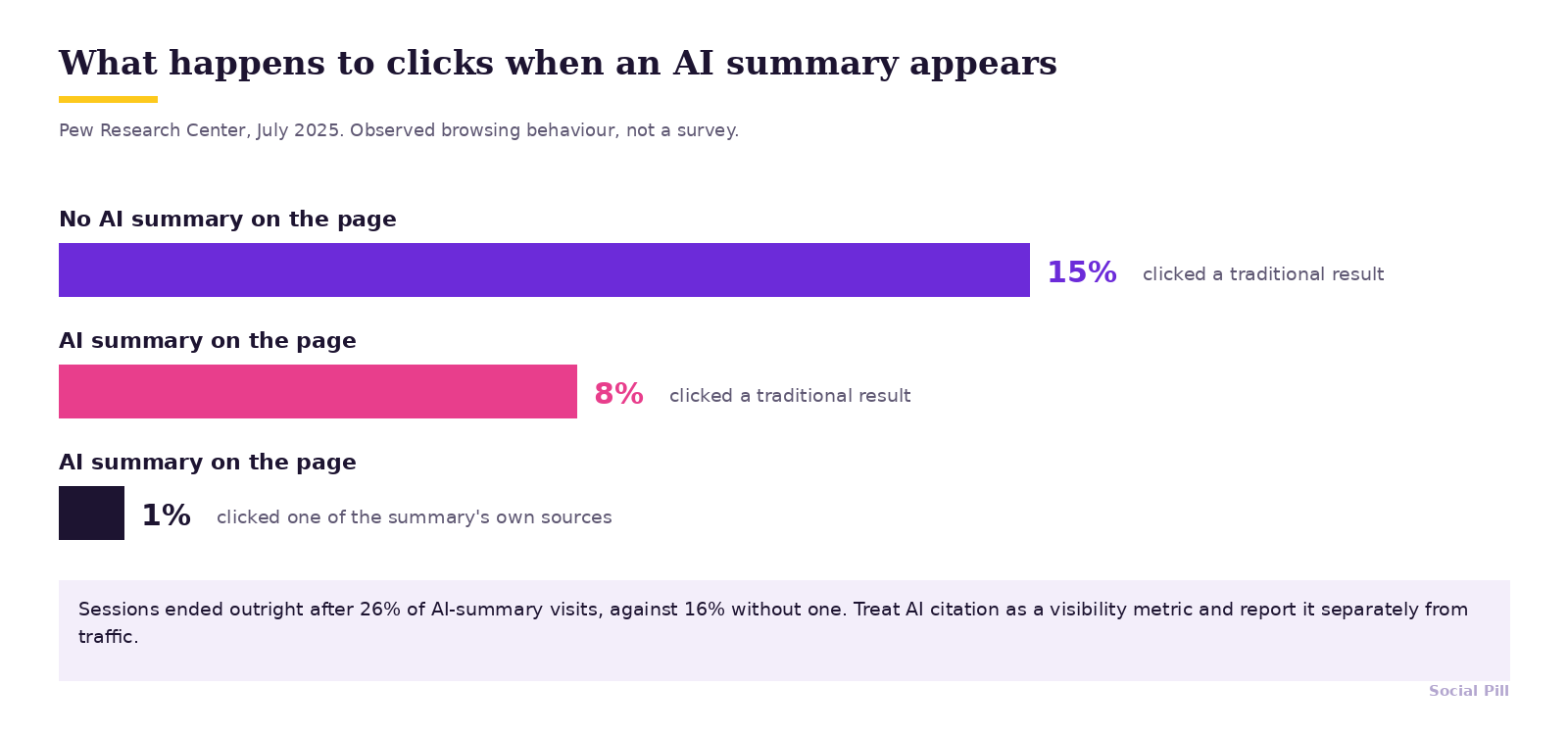
- Pew Research Center found that 1 per cent of visits to a results page carrying an AI summary included a click on one of that summary’s own cited links. Citation and traffic are not the same metric.
- Two of the pages currently ranking on page one for this topic republish statistics that have no traceable primary source, and one of them is contradicted by the only controlled test we could find.
- In India, “chatgpt” averages 226 million searches a month against 368,000 for “google ai mode”. Assistant demand and AI-search-feature demand are different scales.
How to Read This Page
Every figure below carries a grade, because an AI SEO statistic can mean four very different things.
| Grade | What it means |
|---|---|
| Platform | Google, OpenAI or Perplexity publishing a number or a rule about its own product. Authoritative for what the platform says, which is not the same as independently measured |
| Research | A study with a stated sample. Neutral research bodies and software vendors both appear here. Vendors have a commercial interest in their conclusion, which is noted where it matters |
| Secondary | A study we could only read through someone else’s reporting of it. Usable, weaker |
| Our own data | Figures we pulled ourselves for this page from the Google Ads API on 11 November 2026 |
Anything we could not trace to one of those four is in the section on statistics that are not real, rather than in the count.
The Scale of AI Search (Platform Figures)
| # | Figure | Source and date |
|---|---|---|
| 1 | AI Overviews “now has over 2.5 billion monthly active users” | Google, website owners announcement, 3 June 2026, updated 31 August 2026 |
| 2 | “AI Mode has surpassed one billion monthly users, with queries more than doubling every quarter since launch” | Google, same announcement and its AI Mode insights post, 19 May 2026 |
| 3 | ChatGPT has “our collective 1.2B weekly users” | OpenAI, DevDay 2026 recap, 29 September 2026 |
| 4 | “Search’s new AI features are the leading reason why we’re seeing queries at an all-time high” | Google, AI Mode insights, 19 May 2026 |
Two cautions before these numbers go into a slide. The AI Overviews and AI Mode audiences overlap, so they cannot be added together. And all three are counts of people reached by a feature rather than counts of people who chose it. The gap between those two things is the most useful finding on this page, and it sits in the section on contradictions below.
How People Actually Search in AI Mode (Platform Figures)
Google published its own analysis of US AI Mode behaviour a year after launch. These four numbers do more to shape a content plan than any citation study.
| # | Figure | Why it matters |
|---|---|---|
| 5 | “The average AI Mode search is triple the length of a traditional Search query” | Head-term keyword lists do not describe this demand. Question-level and conversational coverage does |
| 6 | “More than one in six searches in the U.S. now use voice or images, with image searches growing over 40% month-over-month” | Product and store imagery becomes a retrieval surface rather than decoration |
| 7 | AI Mode planning queries “have grown faster than AI Mode queries overall by 80% in the past 6 months” | Planning intent is the fastest-growing commercial opening |
| 8 | Brainstorming queries in AI Mode “have grown 30% faster than queries overall since launch”, and searches starting with “where to”, “where should I” and “ideas for” are growing | Early-stage, undecided demand is where AI answers are being used most |
Source: Google, “How AI Mode is changing and expanding the way people search”, 19 May 2026. US data.
Clicks, Zero-Click and What Visibility Is Worth
| # | Figure | Grade |
|---|---|---|
| 9 | 8 per cent of visits to a results page with an AI summary included a click on a traditional result link, against 15 per cent when no summary appeared | Research, Pew Research Center, July 2025. Browsing logs of 900 US adults covering 68,879 Google searches in March 2025, of which 12,593 returned an AI summary |
| 10 | 1 per cent of AI-summary visits included a click on one of the summary’s own cited source links | Research, Pew, same study |
| 11 | Sessions ended entirely after 26 per cent of AI-summary visits, against 16 per cent of visits without one | Research, Pew, same study |
| 12 | 88 per cent of AI summaries cited three or more sources, and the median summary ran 67 words | Research, Pew, same study |
| 13 | 68 per cent of US Google searches ended without a click in early 2026 | Secondary, SparkToro study reported via trade press |
Number 10 is the one that should change a reporting template. Being named in an AI answer is worth something, and what it is worth is almost never a click. If AI visibility is reported in the same column as sessions, it will look like a failure every month. We set out the alternative in zero-click searches and AI Overviews. It is also the first thing to rule out when organic sessions fall while rankings hold, which we work through in why website traffic drops.
What Gets Cited in AI Answers
| # | Figure | Sample and source |
|---|---|---|
| 14 | A page retrieved in first position was cited 58.4 per cent of the time. At position 10 it was cited 14.2 per cent of the time | 16,851 queries run 3 times each in ChatGPT, 50,553 responses, 353,799 pages. AirOps with Kevin Indig, 13 April 2026 |
| 15 | Pages whose headings closely matched the query were cited 41.0 per cent of the time, against 30.2 per cent where the heading match was weak | Same study |
| 16 | Domain authority and backlink counts showed no positive correlation with being cited | Same study |
| 17 | Pages carrying JSON-LD were cited 38.5 per cent of the time against 32.0 per cent without it, as a correlation rather than a test | Same study. Compare with number 21, which tested it |
| 18 | Branded web mentions correlated with AI Overview brand visibility at 0.664 against 0.218 for backlink count | 75,000 brands, filtered to DR above 40. Ahrefs |
| 19 | YouTube mentions correlated at roughly 0.737, the strongest single signal measured. ChatGPT showed the weakest correlations of three assistants studied for almost every traditional authority signal | Ahrefs, 12 December 2025 |
| 20 | Of 680 million AI citations, Wikipedia was 7.8 per cent of all ChatGPT citations and 47.9 per cent of citations among its top 10 sources. Reddit was 6.6 per cent on Perplexity | Profound, August 2024 to June 2025. Vendor sells AI visibility tracking |
| 21 | “GEO can boost visibility by up to 40% in GE responses”, with efficacy varying by domain | Aggarwal et al., KDD 2024, peer reviewed. The per-technique percentages circulating from this paper are not in its abstract and should not be quoted as exact |
Numbers 14 to 16 are the practical core. Getting retrieved and matching the question in a heading outperformed every authority signal measured. Heading-to-query matching is a language problem rather than a keyword-density one, which is the ground covered in natural language processing in SEO. That is on-page work, and the mechanics are in how to optimise content for AI search engines. Number 18 is the off-site half, covered in the future of SEO.
What Does Not Move Citations
| # | Figure | Sample and source |
|---|---|---|
| 22 | Adding JSON-LD schema to 1,885 pages moved AI Overview citations by -4.6 per cent, AI Mode by +2.4 per cent and ChatGPT by +2.2 per cent. The stated conclusion was no major uplift on any platform | 1,885 pages against 4,000 matched controls, all already carrying 100+ AI Overview citations. 30-day before and after windows, August 2025 to March 2026. Ahrefs |
| 23 | “You don’t need to create new machine readable files, AI text files, or markup to appear in these features” | Platform. Google Search Central, AI features and your website |
| 24 | “There’s also no special schema.org structured data that you need to add” | Platform. Same page |
| 25 | “There are no additional requirements to appear in AI Overviews or AI Mode, nor other special optimizations necessary” | Platform. Same page |
| 26 | To be used as a supporting link, a page “must be indexed and eligible to be shown in Google Search with a snippet” | Platform. Same page |
Number 22 is the only controlled before and after test on schema and AI citations that we could find, and it tested pages that were already being cited. Read alongside numbers 23 to 25, it is hard to justify selling schema as the lever that gets a brand into AI answers. Schema still earns rich results in classic search and still helps machines read a page’s facts accurately. Those are different jobs. The same split applies to FAQ content: the format still earns its place with readers and with retrieval, which is a separate question from what its markup does, and we have written about why FAQ pages are resurfacing.
Crawler and Control Statistics
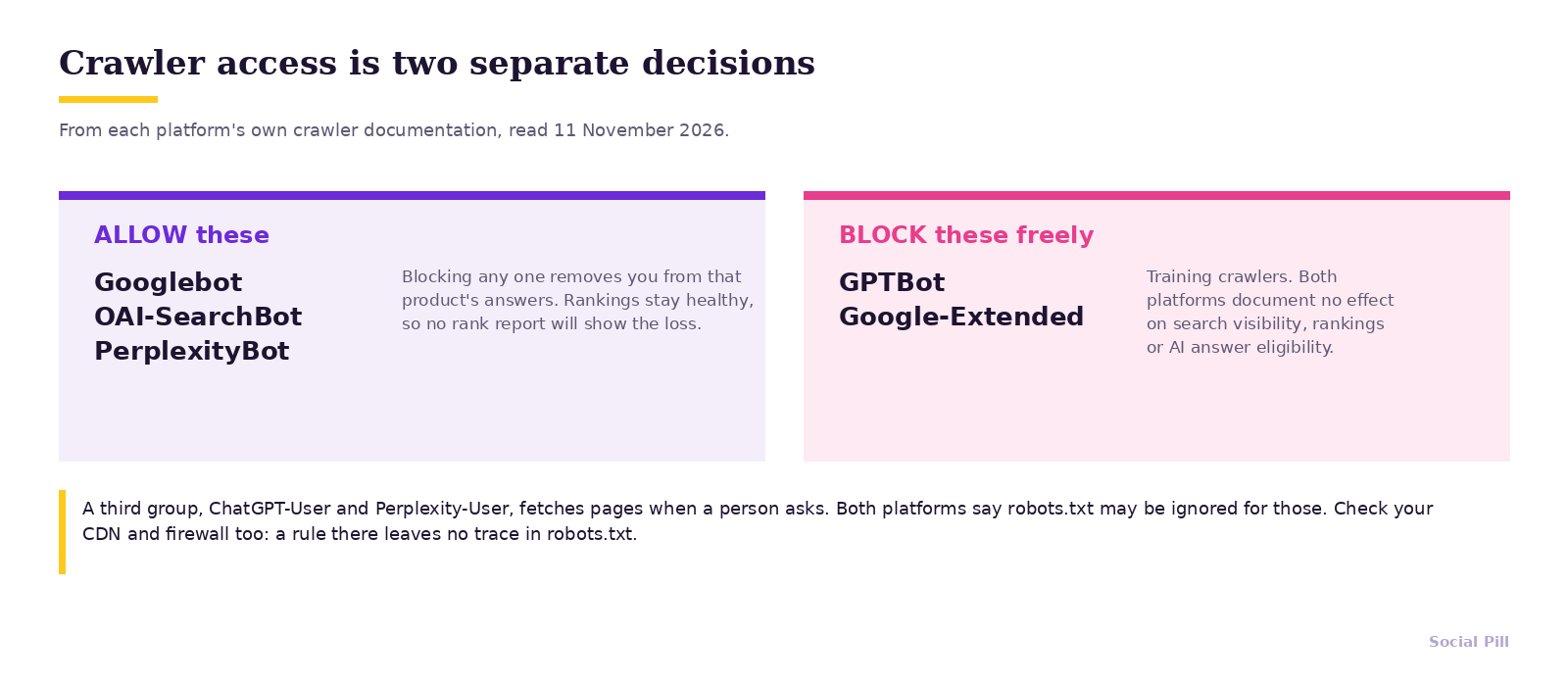
This is the section almost every AI SEO statistics page leaves out, and it contains the only rules on this page with documented cause and effect. We checked all of it against each platform’s own documentation on 11 November 2026: Google’s crawlers and fetchers, OpenAI’s crawler overview and Perplexity’s crawler reference.
| # | Rule | Platform |
|---|---|---|
| 27 | Since 31 August 2026, every website worldwide has a Search Console toggle controlling whether its site appears in and helps ground Google’s generative AI features. “Sites that opt out will not receive traffic or impressions from our generative AI features” | |
| 28 | That control “will not be used as a ranking signal for search results outside of these generative AI Search features” | |
| 29 | New Search Console insights “include impressions metrics and information about which pages appear in AI responses and in what countries”, with more metrics promised | |
| 30 | Google-Extended “does not impact a site’s inclusion in Google Search nor is it used as a ranking signal in Google Search”. Blocking it keeps content out of Gemini training and grounding only | |
| 31 | GPTBot is “used to make our generative AI foundation models more useful and safe”. Disallowing it opts a site out of model training, with no other documented effect | OpenAI |
| 32 | Sites that opt out of OAI-SearchBot “will not be shown in ChatGPT search answers” | OpenAI |
| 33 | For ChatGPT-User, which fetches a page when a person asks ChatGPT to open it, “robots.txt rules may not apply” because the action is user-initiated | OpenAI |
| 34 | OAI-AdsBot is “used to validate the safety of web pages submitted as ads on ChatGPT” and its data is not used for model training | OpenAI |
| 35 | PerplexityBot “is not used to crawl content for AI foundation models”. Perplexity recommends allowing it | Perplexity |
| 36 | Perplexity-User “generally ignores robots.txt rules” because a user requested the fetch | Perplexity |
| 37 | Google’s recommended practice list opens with allowing crawling “in robots.txt and through any CDN or hosting infrastructure” |
The combination that costs the most. Numbers 30 to 32 split into two independent decisions that a single blanket robots.txt rule collapses into one. A site can refuse model training and keep every bit of its AI answer visibility. A site that blocked everything has usually made the second decision by accident. Number 37 matters because a firewall or CDN rule leaves no trace in robots.txt at all.
AI Search Demand in India (Our Own Data)
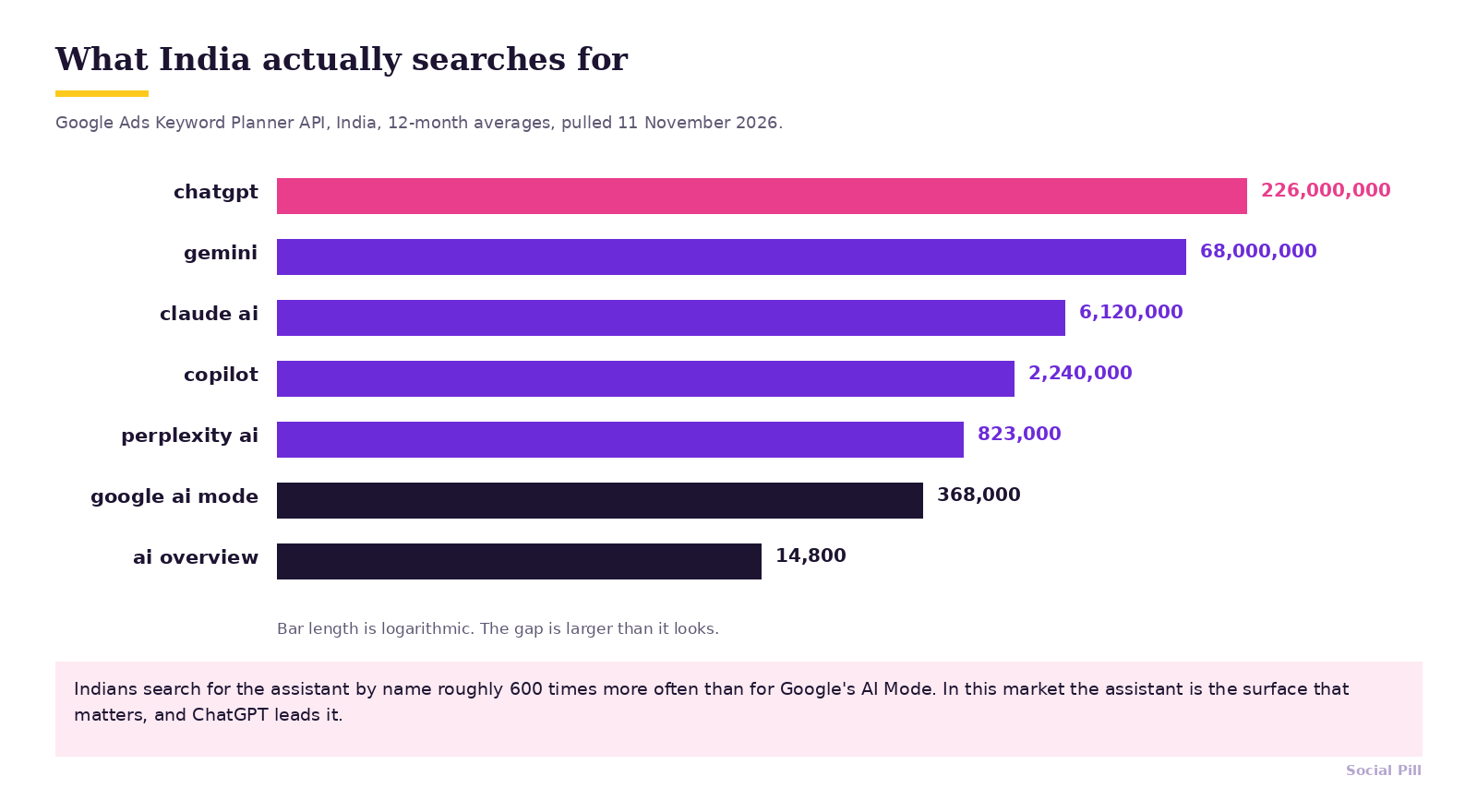
Every statistics page on this topic that we audited reports US or global figures. Two of the eight mentioned India once. So we pulled the India numbers ourselves from the Google Ads API on 11 November 2026. These are Google’s own 12-month averages, which Google rounds and groups across close variants.
| # | Search term | Average monthly searches, India |
|---|---|---|
| 38 | chatgpt | 226,000,000 |
| 39 | gemini | 68,000,000 |
| 40 | claude ai | 6,120,000 |
| 41 | copilot | 2,240,000 |
| 42 | deepseek | 1,830,000 |
| 43 | grok | 1,830,000 |
| 44 | perplexity ai | 823,000 |
| 45 | google ai mode | 368,000 |
| 46 | ai overview | 14,800 |
| 47 | ai search | 12,100 |
| 48 | llms txt | 2,900 |
Three things fall out of that table.
Indians look for the assistants by name at a scale that dwarfs interest in the search features. “chatgpt” at 226 million a month against 368,000 for “google ai mode” is a ratio of roughly 600 to 1. For an Indian brand, the assistant is the surface that matters, and ChatGPT specifically.
Gemini’s 68 million is large enough that treating AI visibility as a ChatGPT-only problem is a mistake in this market, even though the correlation research in number 19 says ChatGPT is the hardest of the assistants to influence through traditional signals.
And “llms txt” at 2,900 a month is demand for a file that no platform documents reading. People are searching for it because vendors are selling it.
What Indian businesses search about AI SEO itself
| # | Search term | Average monthly searches, India |
|---|---|---|
| 49 | ai seo | 4,400 |
| 50 | ai seo services | 1,900 |
| 51 | ai seo tools | 1,300 |
| 52 | ai seo agency | 720 |
| 53 | generative engine optimization | 2,400 |
| 54 | geo seo | 1,600 |
| 55 | answer engine optimization | 1,300 |
| 56 | aeo seo | 720 |
| 57 | llm seo | 720 |
Note what the split says about the market. 2,620 searches a month in India are for someone to do this work, against 4,400 trying to understand what it is. The acronyms together add another 6,020, which is the clearest evidence available that the naming is still unsettled. If the labels are the confusing part, we have an explainer on AEO, GEO, SXO and AI optimisation and a direct comparison of GEO against SEO. If you are in the smaller group looking for the work rather than the definition, that is what our LLM SEO practice in Mumbai does.
Three AI SEO Statistics With No Source
These three circulate widely, including on pages currently ranking on page one for this exact keyword. We went looking for the primary source of each and could not find one.
| Claim | What we found |
|---|---|
| “Sites with complete schema markup see 2.5 times higher AI citation rates” | No primary source. No study, sample or method is ever named alongside it. It is also contradicted by number 22, the only controlled before and after test we could find, which measured no meaningful uplift. One page ranking in the top five for “ai seo statistics” republishes it |
| “FAQ and schema markup produced a 44 per cent increase in AI citations” | No primary source. The figure is attributed to a vendor study that we could not locate on that vendor’s own site. Two pages ranking in the top ten for this keyword set republish it |
| “llms.txt has 10.13 per cent adoption, and only 408 llms.txt fetches occurred across more than 500 million AI-bot visits” | We have carried this in our own internal notes since September 2026 and have never been able to fetch it to a primary source. The direction is consistent with every platform’s silence on llms.txt, but the two numbers should not be quoted as fact. We are including it here because we were tempted to use it |
The general test is simple. If a statistic about AI search arrives without a sample size, a date and a named study, it is a sentence rather than a number. The field is roughly two years old and the quantity of statistics in circulation has outrun the quantity of research conducted.
Where These Numbers Contradict Each Other
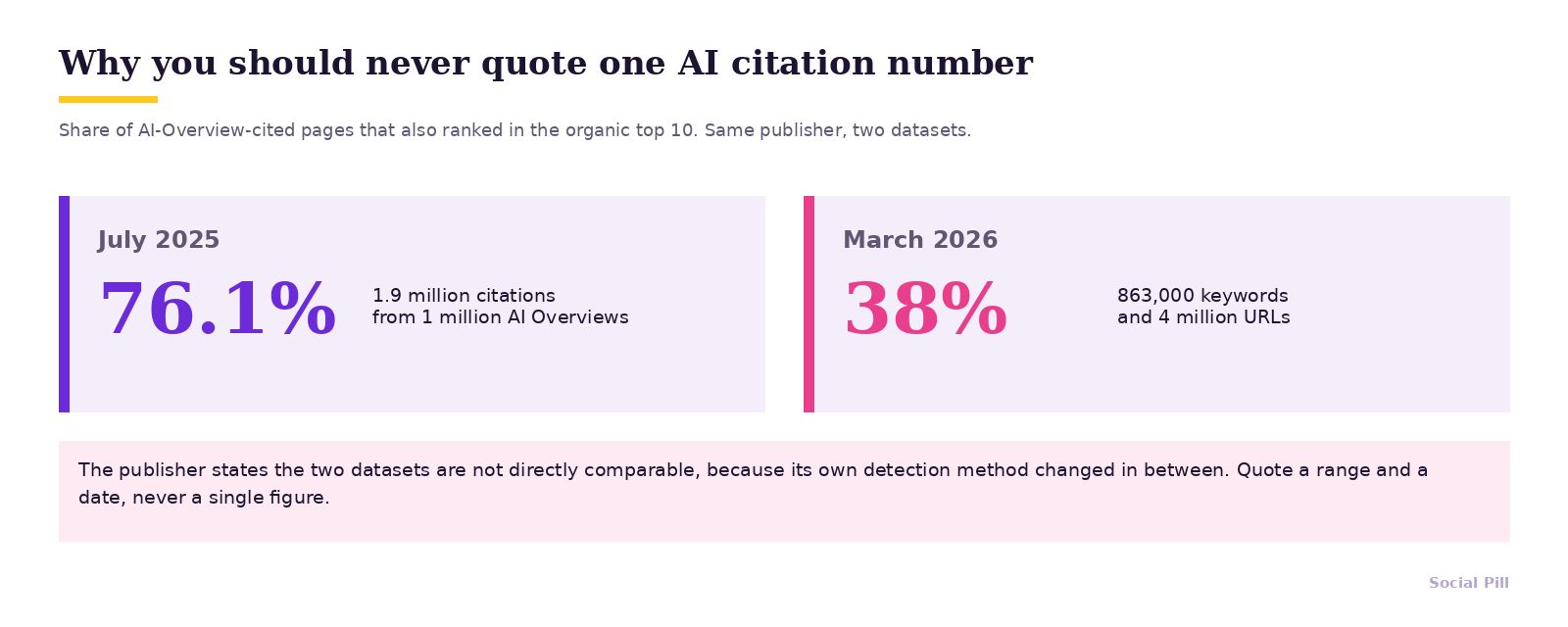
1. The ranking overlap figure moved by 38 points
Ahrefs found 76.1 per cent of AI-Overview-cited pages ranked in the organic top 10, from 1.9 million citations across 1 million AI Overviews in July 2025. Its March 2026 dataset, covering 863,000 keywords and 4 million AI Overview URLs, found 38 per cent. Ahrefs states the two are not directly comparable because its own detection method changed, and attributes part of the move to Google splitting a query into sub-queries and citing pages that perform across the cluster. Quote a range and a date, never a single number.
2. A billion AI Mode users, and almost no AI Mode searches
Google reports AI Mode passing one billion monthly users. A SparkToro analysis of US Google searches from January to April 2026, using a Similarweb desktop and mobile web panel, found that 0.34 per cent of searches transitioned into AI Mode. Both can be true at once: a feature can be seen by a billion people and chosen by very few of them. The study excludes Google’s mobile search app, and we could only read it through trade reporting. Anyone planning on the basis of the billion alone is planning for a surface that is not yet carrying the queries.
3. Schema correlates with citation and does not cause it
Number 17 found pages with JSON-LD cited more often. Number 22 added JSON-LD and measured no uplift. Both are probably right. Sites that implement schema tend to be technically mature in other ways, and the maturity is doing the work. This is the clearest example on the page of why a correlation should never be sold as a lever.
How to Use These Numbers
- Check the Search Console toggle this week. Numbers 27 to 29 are new, worldwide and actionable. Confirm the site has not opted out of generative AI features, then start reading the new AI appearance insights, because that is first-party data about your own pages rather than a vendor’s panel.
- Audit the crawler layer against numbers 30 to 37. Decide model training and AI answer visibility separately. Check the CDN as well as robots.txt.
- Rebuild keyword inputs around number 5. Queries that run three times longer are questions. Map them as questions.
- Stop reporting AI visibility next to session counts. Numbers 9 to 12 make that comparison misleading by design.
- Baseline with repetition. One study of 2,961 runs found two platforms returning the same brand list in under 1 per cent of cases, so a single check proves nothing. Use a fixed prompt set, run monthly, tracked as share of answers across runs.
- In India, measure ChatGPT first and Gemini second. Numbers 38 and 39 set the priority and numbers 45 to 47 show that feature-level search interest is not where the audience is.
For the page-level mechanics behind points 3 and 4, see how to optimise content for AI search engines and search intent and topical authority.
Frequently Asked Questions
How many people use AI search?
Google reports AI Overviews at over 2.5 billion monthly active users and AI Mode at over one billion. OpenAI reports 1.2 billion weekly ChatGPT users. The two Google figures overlap and cannot be added, and all of them count reach rather than deliberate choice.
Does appearing in an AI answer bring traffic?
Rarely. Pew Research Center found that 1 per cent of visits to a results page with an AI summary included a click on one of the summary’s own cited links, and that clicks on traditional results fell from 15 per cent to 8 per cent when a summary appeared.
What percentage of Google searches end without a click?
68 per cent of US Google searches in early 2026, according to a SparkToro study we could only read through trade reporting. The figure covers all zero-click behaviour, not only AI summaries.
Does schema markup increase AI citations?
The only controlled before and after test we could find says no. Adding JSON-LD to 1,885 pages that were already being cited moved citations by -4.6 per cent on AI Overviews, +2.4 per cent on AI Mode and +2.2 per cent on ChatGPT. Google separately documents that no special structured data is needed to appear in its AI features.
Can I stop Google using my site in AI Overviews?
Yes, since 31 August 2026. A Search Console toggle controls it for every site worldwide. Google states that sites which opt out will not receive traffic or impressions from its generative AI features, and that the control is not used as a ranking signal for results outside those features.
Which AI crawler should I never block?
OAI-SearchBot, if ChatGPT visibility matters to the business. OpenAI documents that sites opting out of it will not be shown in ChatGPT search answers. GPTBot is the training crawler and blocking it has no documented effect on search or on ChatGPT answers.
How big is AI search in India?
Measured by search demand for the assistants themselves, very large. “chatgpt” averages 226 million searches a month in India and “gemini” 68 million, against 368,000 for “google ai mode”. Those are Google’s own 12-month averages, pulled on 11 November 2026, rounded and variant-grouped by Google.
Why does this page have fewer statistics than others?
Because we removed the ones we could not source. Pages listing 140 or 300 AI SEO statistics are counting recycled figures, and at least two of the better-ranking ones include numbers that have no traceable study behind them. 57 traceable figures are more useful in a client conversation than 300 you cannot defend when asked.
How We Researched This Page
Platform documentation and announcements were fetched and read directly on 11 November 2026: Google Search Central “AI features and your website” and “Google’s crawlers and fetchers”; the Google blog posts “New opportunities, control and insights for website owners” (3 June 2026, updated 31 August 2026) and “How AI Mode is changing and expanding the way people search” (19 May 2026); OpenAI’s “Overview of OpenAI crawlers” and its DevDay 2026 recap (29 September 2026); and Perplexity’s crawler documentation. Quoted wording is as those pages read on that date.
India search volumes are Google’s own 12-month averages, pulled from the Google Ads API KeywordPlanIdeaService on 11 November 2026. Google rounds these figures and groups close variants, so they indicate scale rather than exact counts. No volume on this page is an estimate.
Behavioural data is from Pew Research Center, “Google users are less likely to click on links when an AI summary appears in the results” (July 2025), which observed the real browsing behaviour of 900 US adults rather than surveying people.
Citation and correlation studies are published by SEO software vendors (Ahrefs, AirOps with Kevin Indig, Profound, SparkToro with Gumshoe.ai). Each is reported with its stated sample and date. Vendors have a commercial interest in their findings, correlation studies do not establish cause, and where two datasets from the same publisher disagree we have given both.
The competitive audit behind the section on unsourced statistics used a Google India results capture for “ai seo statistics” and “ai search statistics” on 11 November 2026, followed by a full-text capture of eight ranking pages. We are not naming those pages. The claims we flagged were checked against our own source notes, which have carried them as unverified since September 2026.
Where a figure could not be traced to a primary source, it is in the section on statistics that are not real rather than in the count of 57.
Want to get on the Social Pill? Let’s schedule a consultation.
If you want these numbers turned into a baseline for your own brand, our AI marketing team in Mumbai starts with the crawler and Search Console layer before touching content.