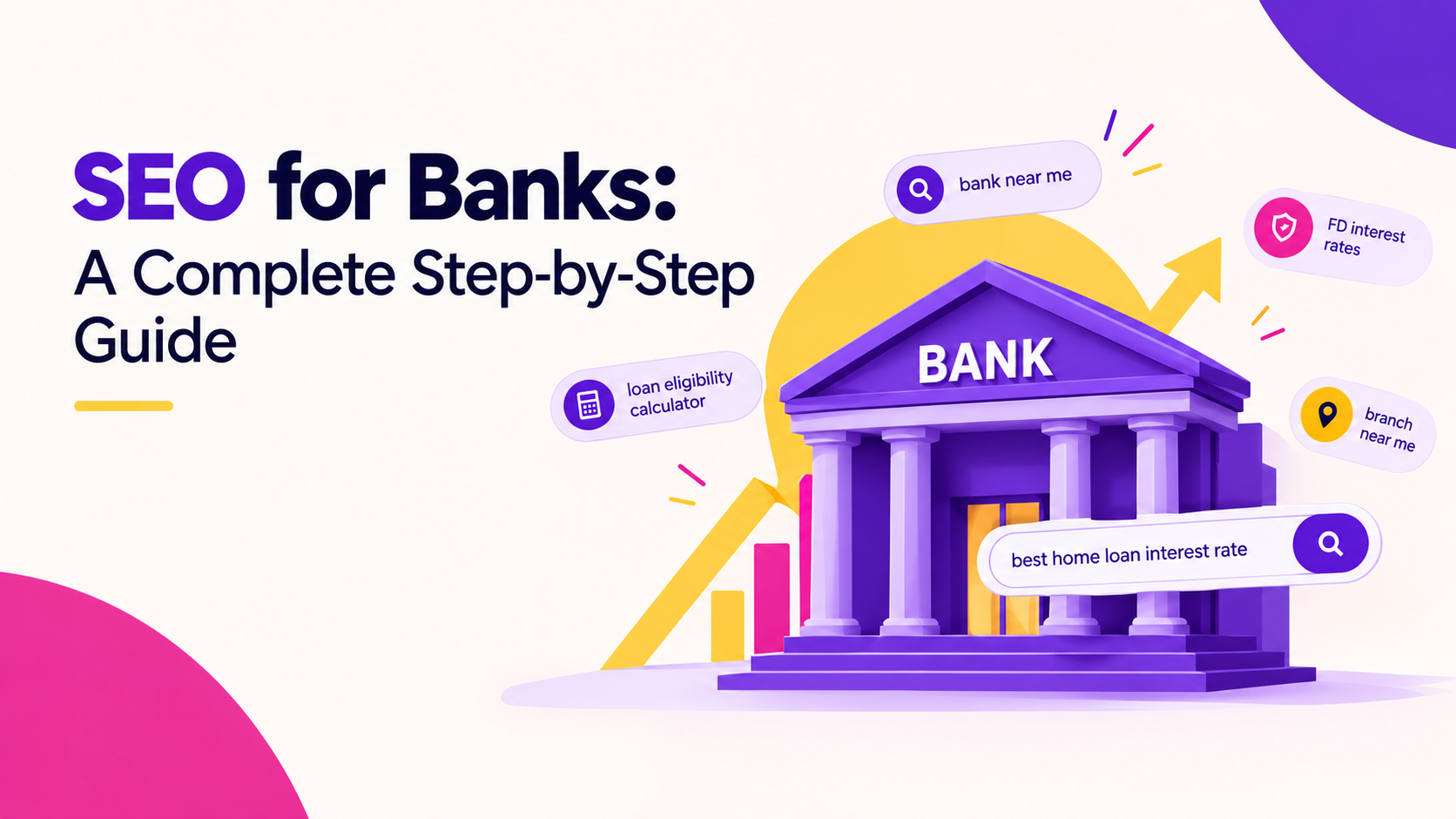
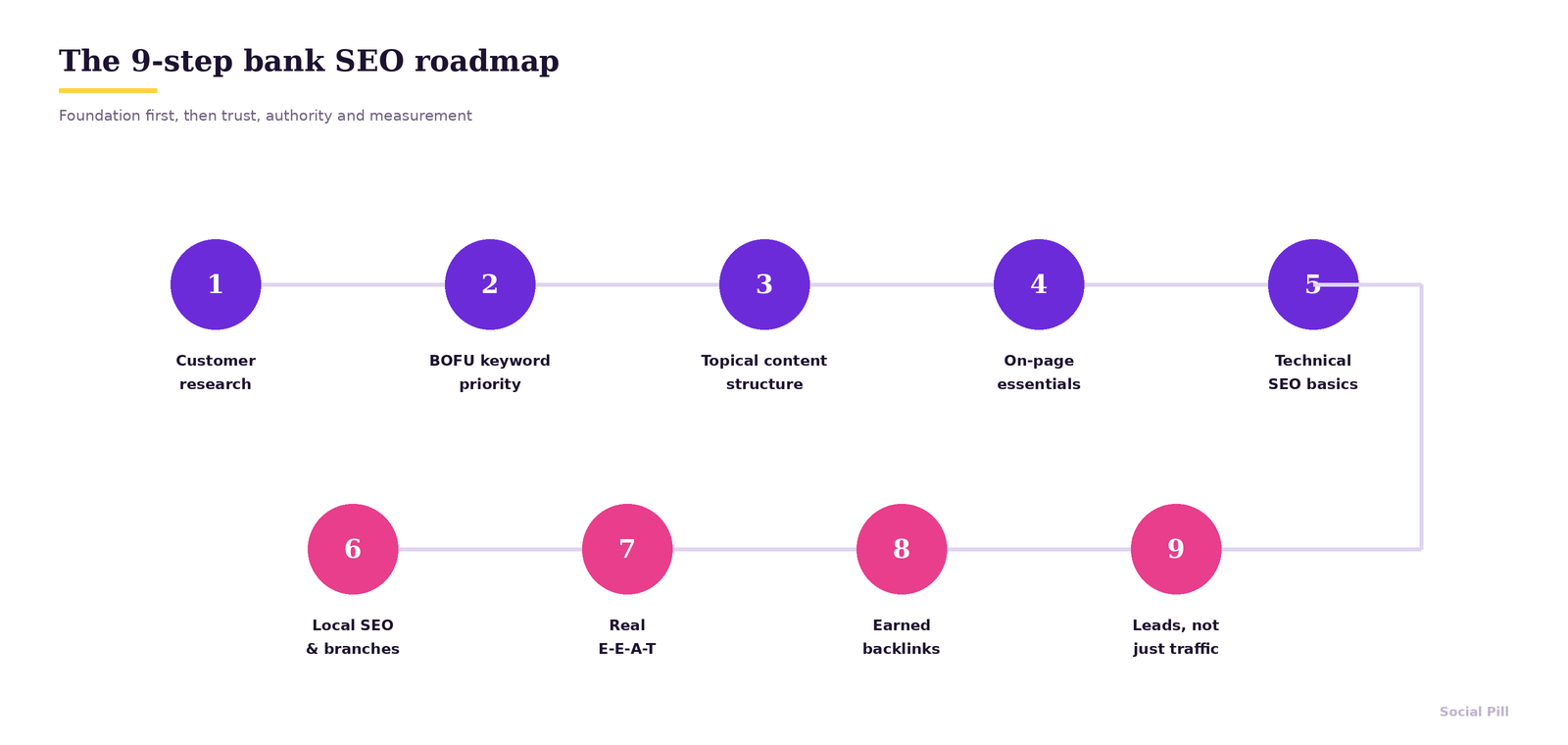
SEO for banks means optimising a bank, NBFC, or fintech’s website so it ranks for the searches that actually lead to applications: loan queries, account openings, card comparisons, and branch lookups. It differs from ordinary SEO because banking sits inside Google’s YMYL territory, or “Your Money or Your Life.” There, search systems weigh trust and accuracy far more heavily than for a travel blog or a fashion store. In India, the challenge is sharper still, because banks aren’t only competing with each other. They’re also competing with platforms like BankBazaar, Paisabazaar, Groww, and ET Money, built specifically to dominate financial search results.
What Is SEO for Banks and Why It’s Different in the Indian Market
At its core, SEO for banks covers keyword strategy, content structure, technical performance, and local search. It’s applied to a category where a wrong number can mislead someone’s financial decision. Google treats YMYL pages, those that can affect a person’s health, money, or safety, with extra scrutiny. Search systems tend to favour banking content that shows real expertise and current accuracy over content that’s merely well-optimised.
That’s the first thing separating a bank SEO strategy from e-commerce or hospitality SEO. Content quality alone won’t carry a page if the trust signals around it are weak. A personal loan landing page needs visible proof of credibility too: regulatory status, clear authorship, accurate rates, and a transparent application process.
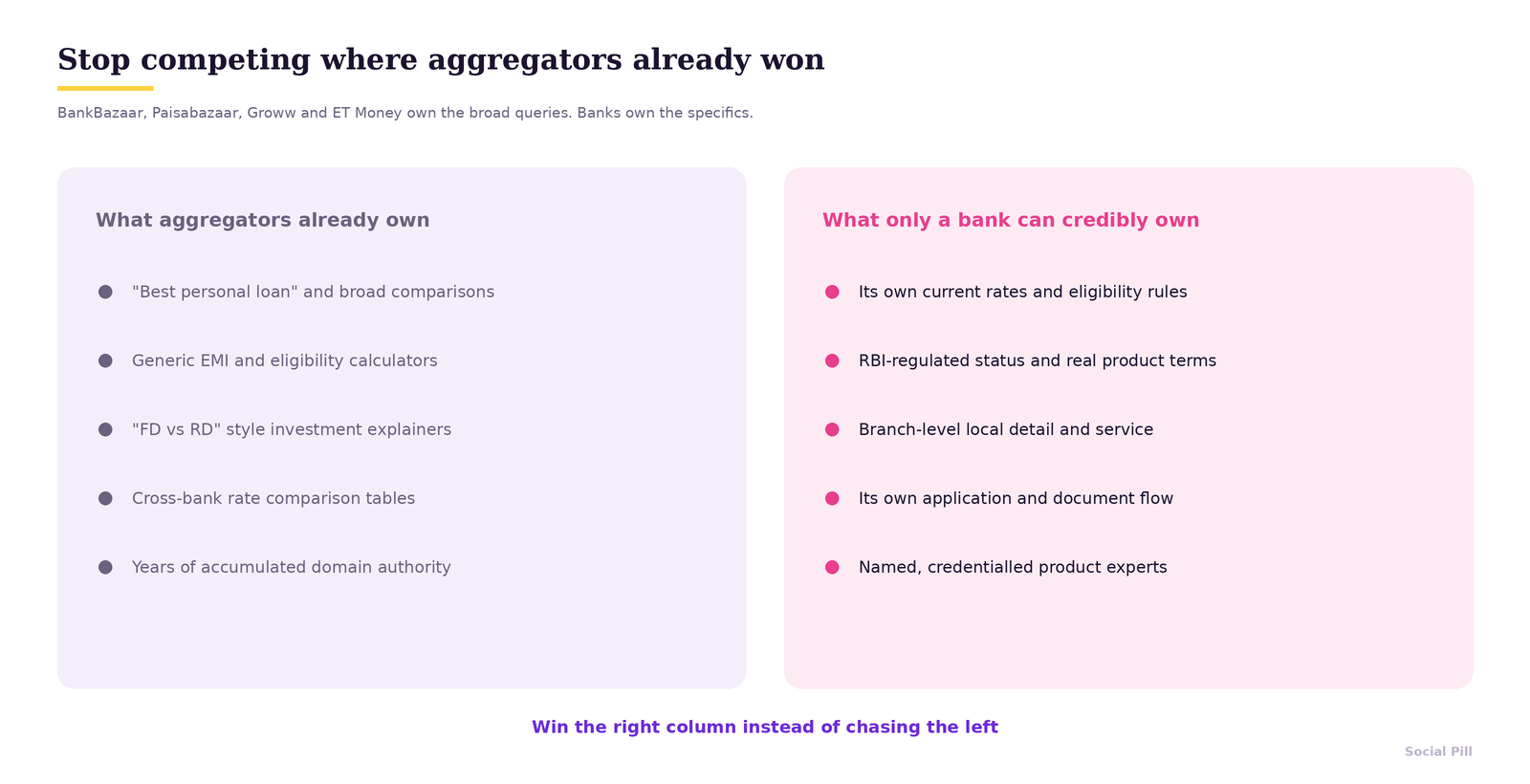
The second thing that makes banking SEO distinct in India is the competitive set. Public and private banks, NBFCs, and fintech lenders aren’t only up against each other. They’re also competing with large financial-content and comparison platforms. BankBazaar and Paisabazaar dominate loan and credit-card comparison queries; Groww and ET Money do the same for investment content. These platforms have built entire businesses around ranking for exactly what banks want: “best personal loan,” “FD vs RD,” EMI calculators, and eligibility checkers.
This doesn’t mean banks can’t win. It means focusing on what only the bank can credibly answer: its own products, rates, and eligibility rules. Trying to out-publish comparison sites at their own game rarely works.
Step 1 – Start with Customer Research, Not Just Keyword Tools
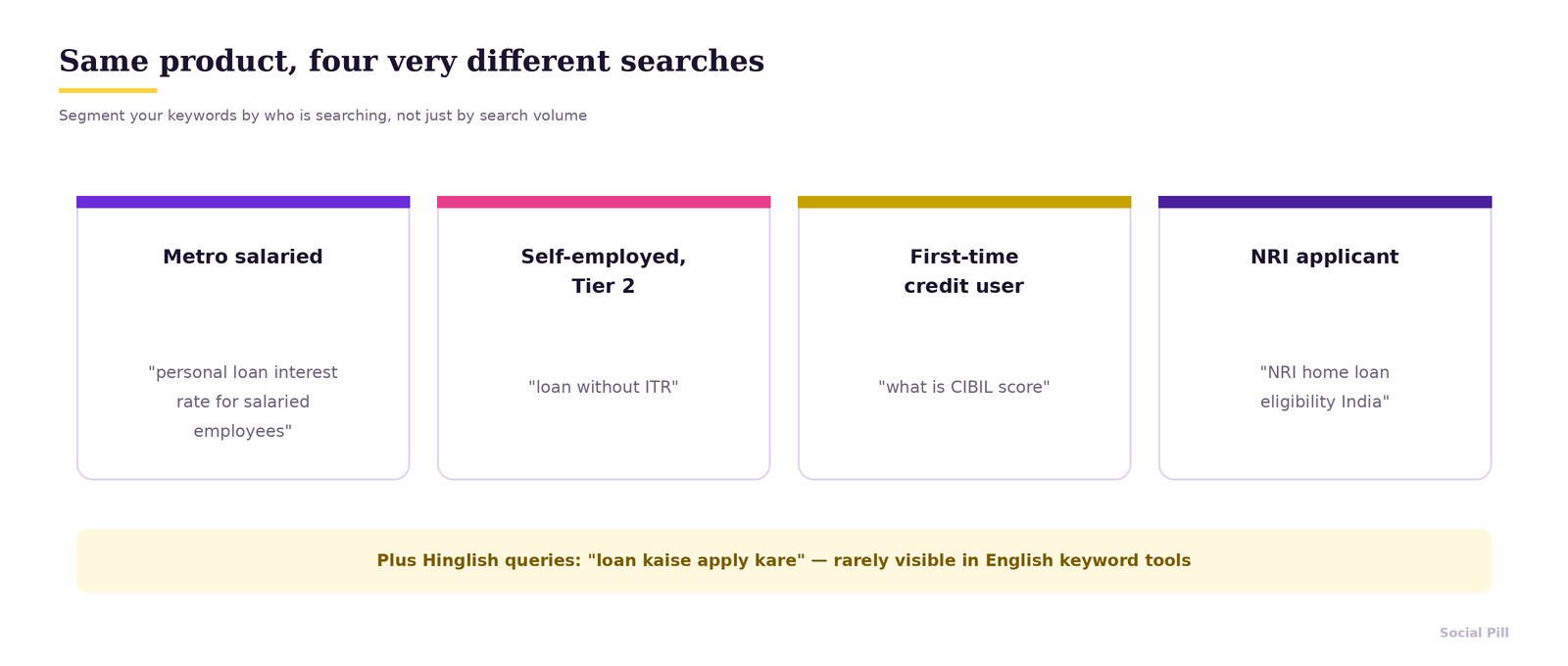
Good banking SEO starts with understanding who is searching, not just what they’re typing. A keyword tool will show that “personal loan interest rate” gets solid volume. It won’t show that a Tier 2 self-employed applicant and a metro salaried professional are asking very different questions.
A salaried professional in Bangalore might search “personal loan interest rate for salaried employees.” A small business owner in Indore might search “loan without ITR.” An NRI might type “NRI home loan eligibility India.” Same underlying need, three different queries.
Language adds another layer. Hinglish queries, like “loan kaise apply kare” or “sabse sasta home loan kaun sa bank deta hai,” are common across Tier 2 and Tier 3 India. They rarely map cleanly onto English keyword tools. First-time credit users search informationally (“what is CIBIL score”), while repeat borrowers search transactionally (“apply personal loan online”).
This week, pull five real customer queries or call-centre questions from each major segment: metro salaried, self-employed, first-time borrower, and NRI. Check whether your existing content answers them in their words, not just yours.
Step 2 – Prioritize Bottom-of-Funnel, High-Intent Keywords First
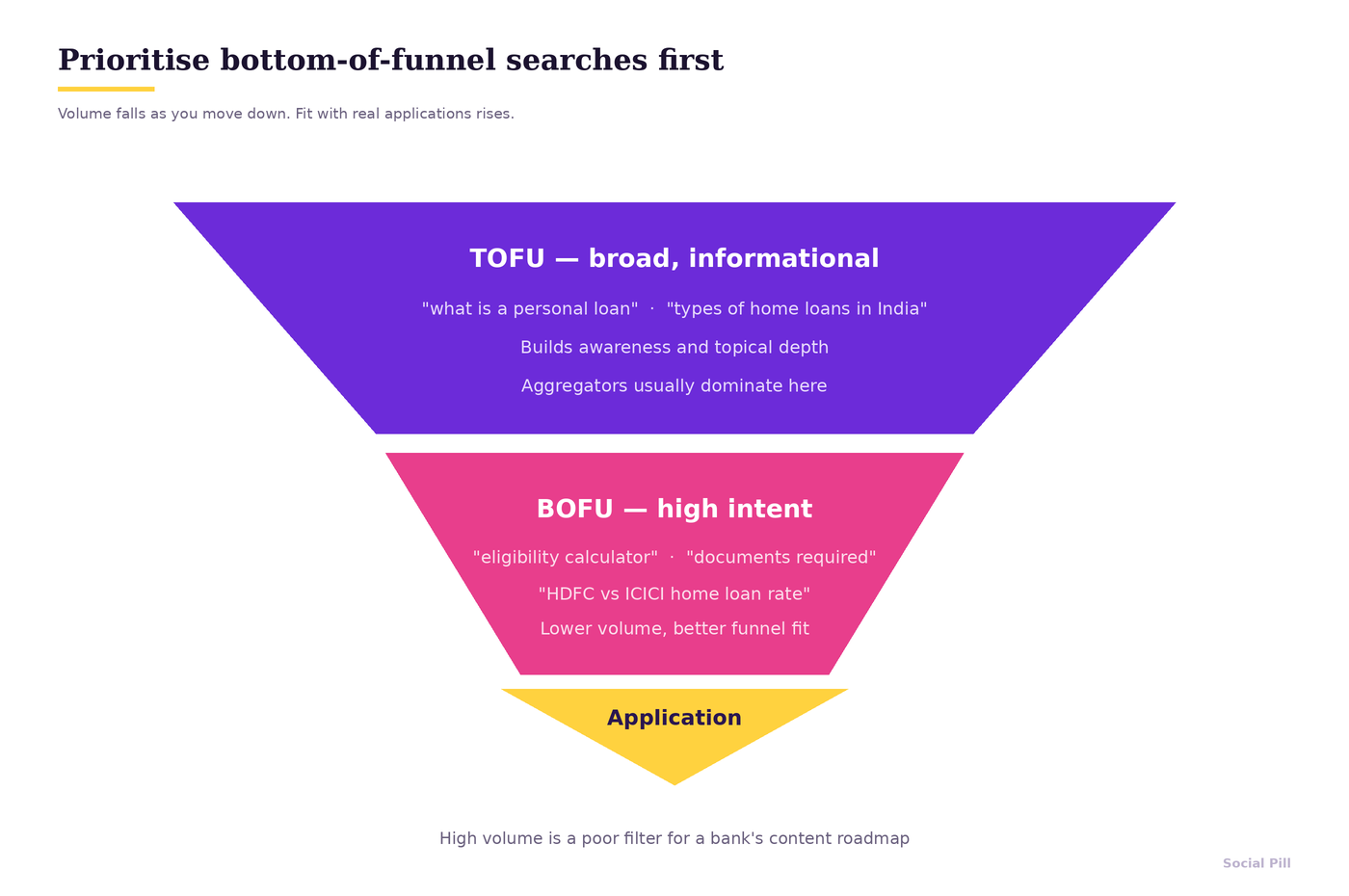
High search volume is seductive, but it’s a poor filter for a bank’s content roadmap. A broad term like “personal loan” carries huge volume and near-impossible competition, much of it from platforms with years of accumulated authority. A smaller, more specific search often sits closer to a real application.
TOFU: Broad Informational Searches
These are wide, top-of-funnel queries: “what is a personal loan,” “types of home loans in India,” “how does FD interest work.” They build awareness and support topical authority, but rarely convert directly, and comparison sites and finance publishers tend to dominate them.
BOFU: High-Intent, Decision-Stage Searches
These sit closer to a decision: “personal loan eligibility calculator,” “HDFC vs ICICI home loan interest rate,” “documents required for personal loan.” Searchers here have usually chosen a product category and are comparing specifics or checking eligibility. Volume is lower, but the fit with a bank’s funnel is often stronger, though this varies by product and shouldn’t be assumed automatically.
This week, audit your content calendar and count how many pieces target BOFU intent versus TOFU intent. Most banking content libraries lean too heavily toward broad topics that comparison platforms already own.
Step 3 – Build a Topical Content Structure
Topical authority comes from covering a subject in depth, not from scattering isolated pages that each chase one keyword. For home loans, that means a hub page covering the product broadly. It’s supported by spokes: an EMI calculator, tax benefits, eligibility criteria, interest rate ranges, documentation checklists, NRI home loan rules, and balance transfer guidance.
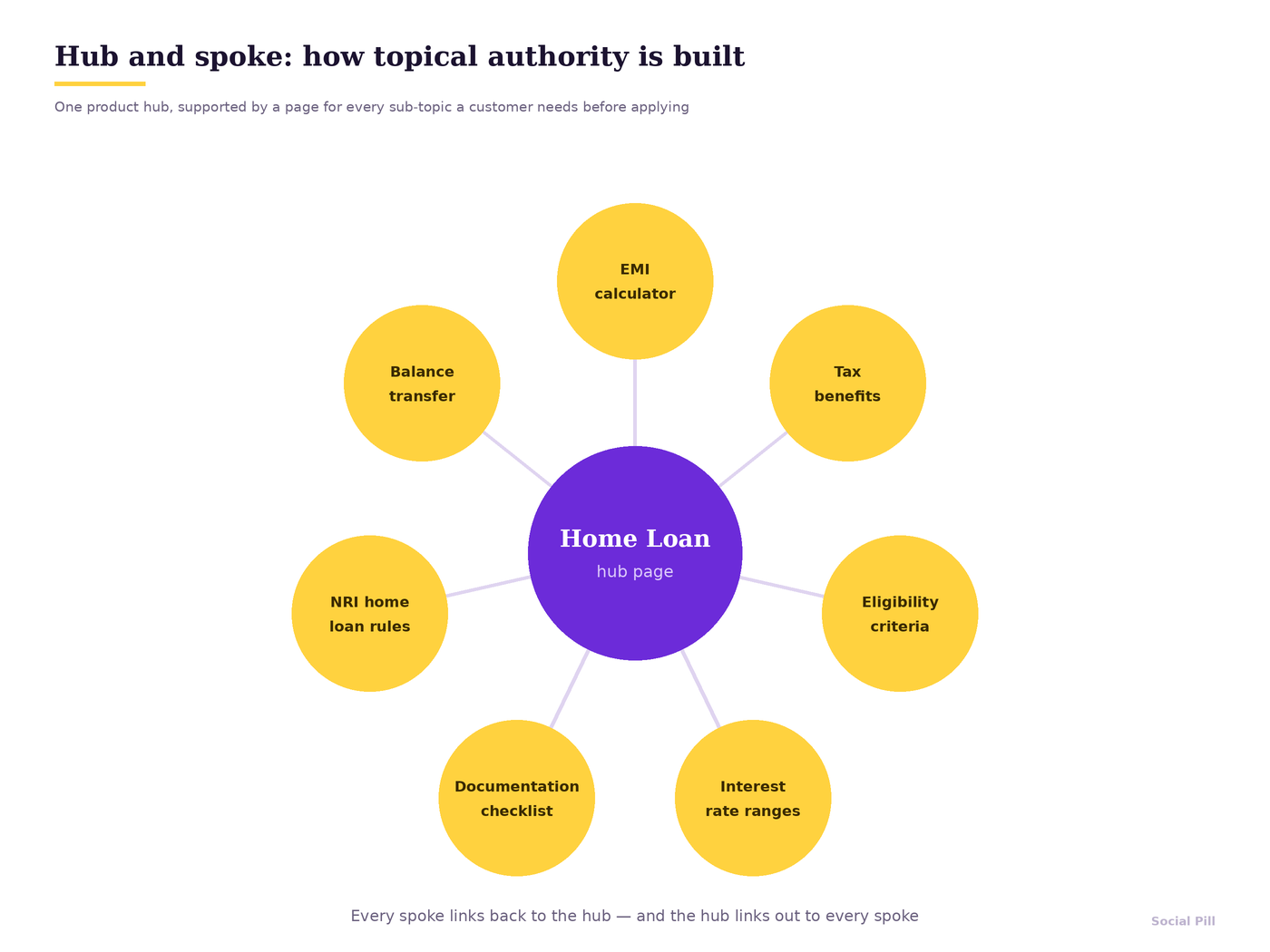
Each spoke should link back to the hub, and the hub should link out to every spoke. This lets search engines and users see how the topic connects. This also protects against cannibalisation, where two of your own pages compete for the same query instead of covering distinct intents.
Content depth should shift with the audience. Retail content, personal loans, savings accounts, credit cards, can stay in plain language for a general reader. Business banking content, aimed at SME owners, needs more operational specificity: working capital, GST-linked lending, invoice discounting. Corporate banking content serves a narrower, technical audience and can afford denser language, because that’s who’s actually searching for it.
This week, map every sub-topic a customer needs before applying for your highest-priority product, and check whether each one already has a dedicated page. Gaps in that map are usually gaps in your rankings too.
Step 4 – On-Page SEO Essentials
On-page SEO for a bank works like it does everywhere else, with one added layer: every page needs to match search intent precisely. A mismatch, informational content ranking for a transactional query or vice versa, erodes both rankings and conversions over time.
Titles and meta descriptions should reflect what the page delivers, not just carry the keyword. Header hierarchy helps users and crawlers understand structure. URLs should be descriptive and stable: /personal-loan-eligibility performs better than a parameter-heavy, CMS-generated string. For a broader refresher on writing pages that satisfy both intent and readability, we’ve laid out the fundamentals in our guide to SEO-friendly content writing.
Location pages need particular care. A structure like /home-loans-mumbai can genuinely help, if the page contains real local information: branch details, local processing timelines, city-specific documentation quirks. What actively hurts a site is dozens of near-identical city pages with the same paragraph and a swapped city name. Google treats these as thin or duplicate content, and users notice too.
This week, pick your three highest-traffic product pages and check the title tag, meta description, and H1 against the intent they’re meant to serve.
Step 5 – Fix Technical SEO Basics
Technical SEO is where banking websites quietly lose ground, often because product and marketing teams don’t control the platform decisions behind it. Mobile experience matters more here than in most categories. A large share of banking research and applications in India happens on phones, often on slower or inconsistent connections. A slow-loading EMI calculator or application form isn’t just a UX issue. It directly hurts Core Web Vitals and, with them, search performance.
The basics still matter: clean crawlability, an accurate XML sitemap, HTTPS everywhere, and no broken links on high-value pages. Correct canonicals also matter, so duplicate product variants don’t split ranking signals. If your site leans on JavaScript, confirm key content is actually visible to crawlers, not just to a browser.
Structured data is worth implementing, including Organization schema, breadcrumbs, and FAQ markup where genuinely relevant, but it’s worth being realistic about what it delivers. Google’s own documentation notes that FAQ rich results now mostly show for well-known, authoritative government and health sites. A bank adding FAQ schema shouldn’t expect a guaranteed rich snippet. Structured data helps search engines understand your content correctly; it doesn’t automatically produce a better-looking result.
This week, run your top ten product and application pages through a free Core Web Vitals check and fix whichever one loads slowest first.
Step 6 – Win Local SEO for Multi-Branch Banks and NBFCs
For any lender with physical branches, local SEO for banks decides whether you show up when someone nearby searches “bank near me,” “ATM near me,” or “[city] home loan branch.” This matters more as lenders expand into Tier 2 and Tier 3 cities, where branch discovery increasingly happens through search rather than word of mouth.
Google Business Profile should sit at the centre of this effort. Every branch needs an accurate, individually managed profile: correct address, working hours, phone number, and the services offered there. Inconsistent NAP (name, address, phone) details across branches, your website, and directories confuse both users and search engines, and can quietly suppress local visibility.
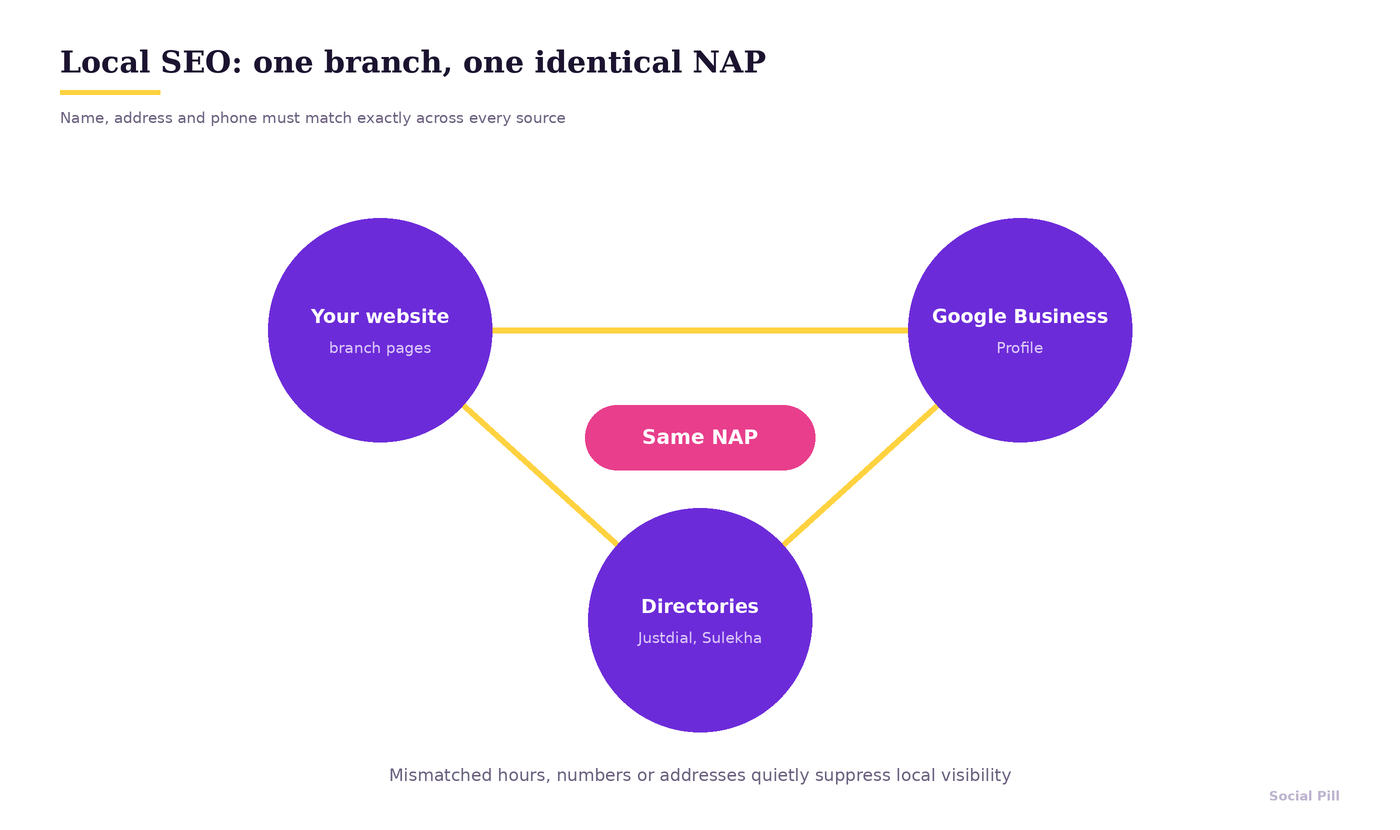
Indian directories like Justdial, Sulekha, and IndiaMART still carry weight for certain categories and local searches. Their relevance varies by business type, though, and none should replace Google Business Profile as the primary local asset. Reviews matter too, not because they carry some fixed numerical weight in Google’s algorithm, but because they visibly shape whether a nearby customer chooses your branch over a competitor’s.
This week, audit five branch listings at random. Check whether the address, phone number, and hours match exactly across your website, Google Business Profile, and any directory listing you can find. We’ve covered the mechanics of ranking in local results in more depth in our piece on local SEO for small businesses, and most of it applies directly to a multi-branch banking network.
Step 7 – Build Real E-E-A-T, Not Just the Checklist Version
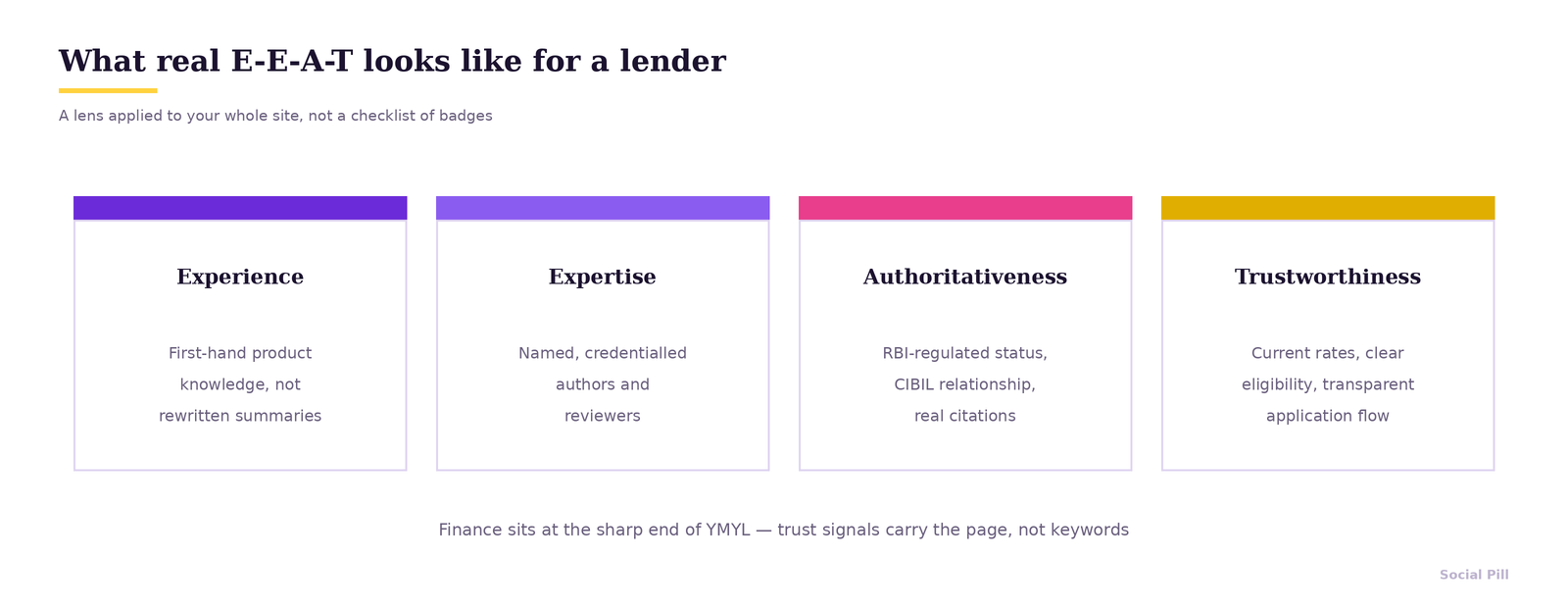
E-E-A-T, experience, expertise, authoritativeness, and trustworthiness, is the framework Google’s quality evaluators use to judge whether content deserves to be trusted. Finance sits at the sharp end of it. E-E-A-T isn’t a checklist you tick off for a ranking boost. It’s a lens applied to your content and site as a whole, and treating it as badges to collect misses the point.
For a bank, real E-E-A-T looks like content reviewed by someone who actually understands lending or investment products. It means author bylines with genuine credentials instead of a generic “admin” attribution, and rate or policy information that’s kept current.
Indian trust signals can support this without being ranking factors in themselves. Being regulated by the Reserve Bank of India is a verifiable fact worth stating clearly on About and product pages. If your content covers credit scores, referencing your relationship with a bureau like TransUnion CIBIL, where genuinely applicable, adds specificity. ISO certifications and industry awards can build user confidence too. None of these guarantee better rankings on their own, but they do the job E-E-A-T is actually about: helping a real person trust what they’re reading.
This week, audit five of your highest-traffic financial guides and confirm each has a named, credentialed author or reviewer attached, not just a brand byline.
Step 8 – Earn Backlinks the Right Way
Backlinks still matter for a bank SEO strategy. But mass link-building tactics that work elsewhere are genuinely risky here, given how closely Google scrutinises YMYL sites for manipulative link patterns. The better path is building assets that finance journalists and industry sites actually want to reference.
Original research carries real weight. A data-driven report on regional lending trends or salary-linked borrowing behaviour is the kind of thing publications like Economic Times, Mint, Moneycontrol, or YourStory might cite if it’s genuinely useful and well-sourced. That said, coverage from any of these outlets isn’t guaranteed, and guest-posting arrangements with major finance publications aren’t something you can simply arrange on demand.
Beyond research, practical tools tend to earn links naturally: a well-built EMI calculator, a tax-saving guide kept current each financial year, or an investment calculator that does something competitors’ versions don’t. We’ve written more on link building without shortcuts in our piece on backlinks and why they matter for SEO.
This week, identify one internal data set, loan disbursal trends or average approval times, that could become a citable public report.
Step 9 – Track What Actually Matters: Leads, Not Just Traffic
Traffic is the easiest thing to report and the least useful thing to optimise for in banking SEO. A page that gets ten thousand visits and zero loan applications isn’t a success story, whatever the traffic chart suggests.
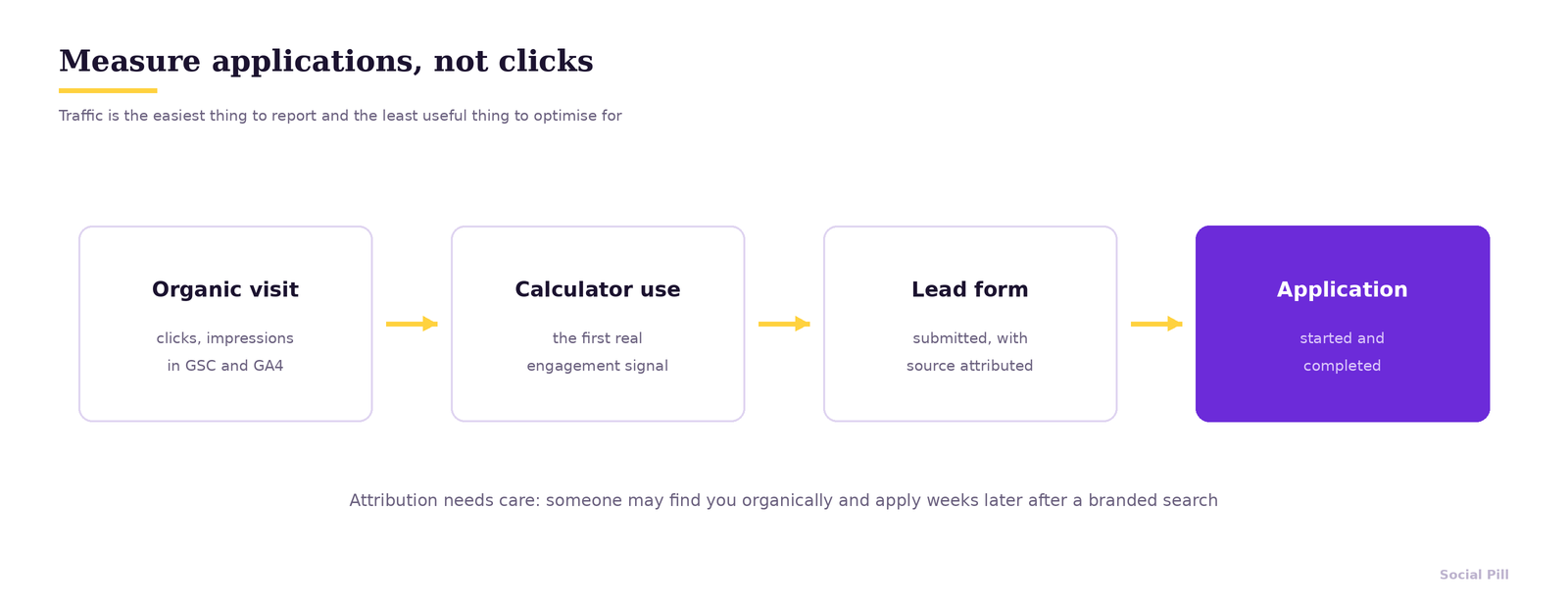
Google Search Console and GA4 remain the starting point: organic clicks, impressions, and ranking positions tell you whether you’re visible at all. But the metrics that actually matter sit one layer deeper: calculator usage, lead form submissions, application starts and completions, and branch enquiries attributed to organic sessions.
Attribution needs care. Someone might discover your home loan page organically, compare rates elsewhere, then apply weeks later after a branded search or branch visit. Treating that application as purely “direct” understates what SEO actually did. Assisted-conversion reporting and multi-touch paths give a fairer picture, though SEO can rarely be credited as the sole cause of any single application.
This week, map your last twenty organic-to-lead conversions in GA4 and check whether they came through a product page, a calculator, or an informational guide.
Common SEO Mistakes Indian Banks and NBFCs Make
These banking SEO tips only help if the basics aren’t quietly undermining them:
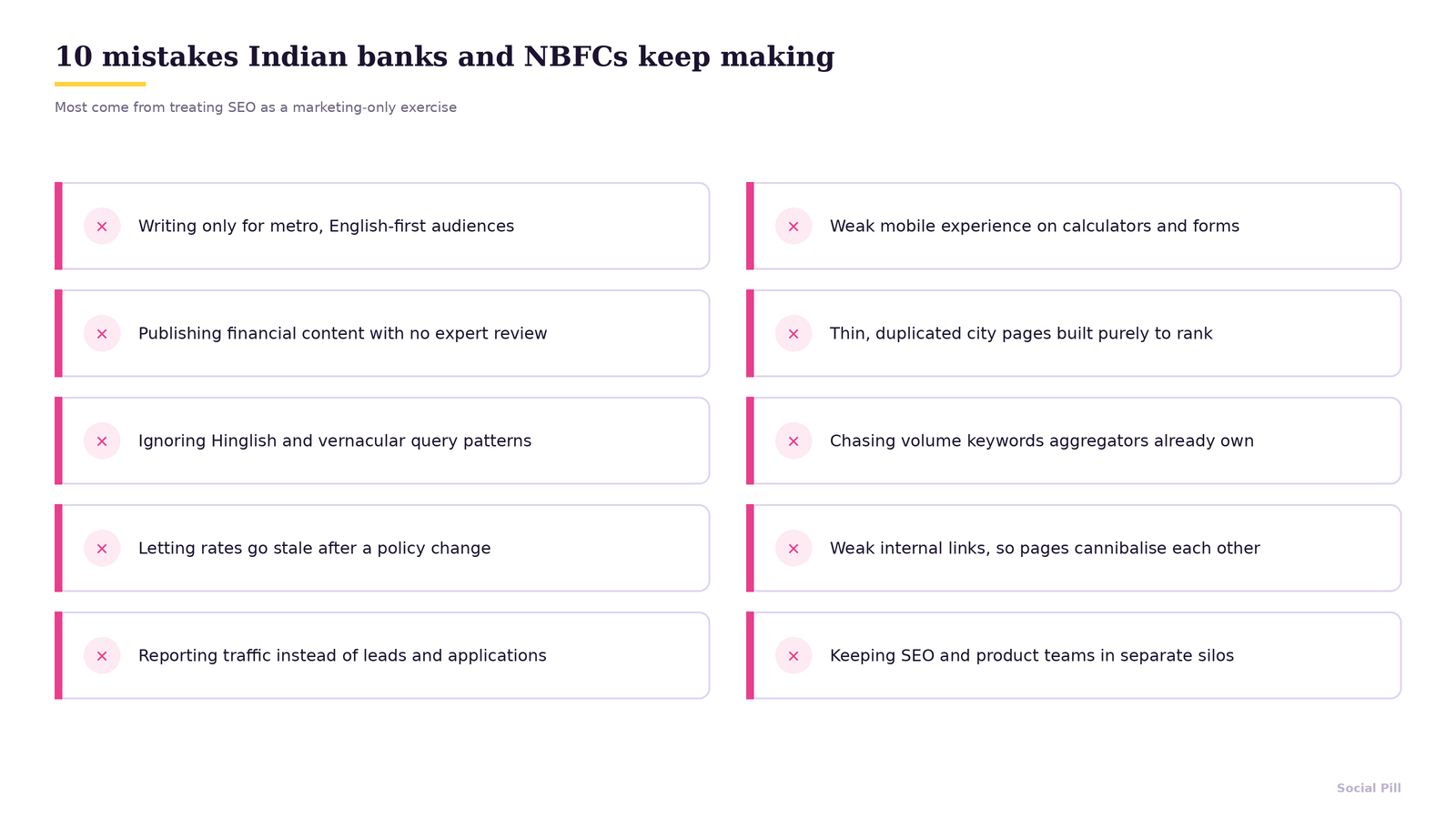
Most of these come from treating SEO as a marketing-only exercise, rather than something that touches product, compliance, and customer service too.
Conclusion
Effective SEO for banks isn’t about chasing more keywords or more traffic. It’s about understanding the segments searching for your products, prioritising searches closest to a real application, building genuine topical depth, and backing it with the technical performance and trust signals YMYL content demands. Local SEO, real E-E-A-T, and relevant backlinks build on that foundation, but none of it means much if success is still measured in clicks instead of applications.
At Social Pill, we treat SEO for banks, NBFCs, and fintechs as a business strategy question first and a technical one second, because a page that ranks but doesn’t lead to an application hasn’t done its job. If you’re reassessing how your financial brand shows up in search, we’d be glad to look at what’s working in your current strategy and where the gaps are.
FAQs
- What is SEO for banks?
SEO for banks is the process of optimizing a banking website to improve organic visibility for financial products, services, and customer searches. - Why is SEO important for banks?
SEO helps banks reach customers searching for loans, accounts, credit cards, interest rates, and other financial services through organic search. - How is SEO for banks different from regular SEO?
Banking SEO requires stronger attention to accuracy, trust, expertise, regulatory considerations, and YMYL content because financial information can affect users’ money and decisions. - How can banks improve their organic search rankings?
Banks can improve rankings through customer-focused keyword research, useful financial content, technical SEO, internal linking, local SEO, and authoritative backlinks. - What keywords should banks target for SEO?
Banks should target a mix of high-intent product, location, comparison, eligibility, calculator, and informational keywords based on their customers and business goals.