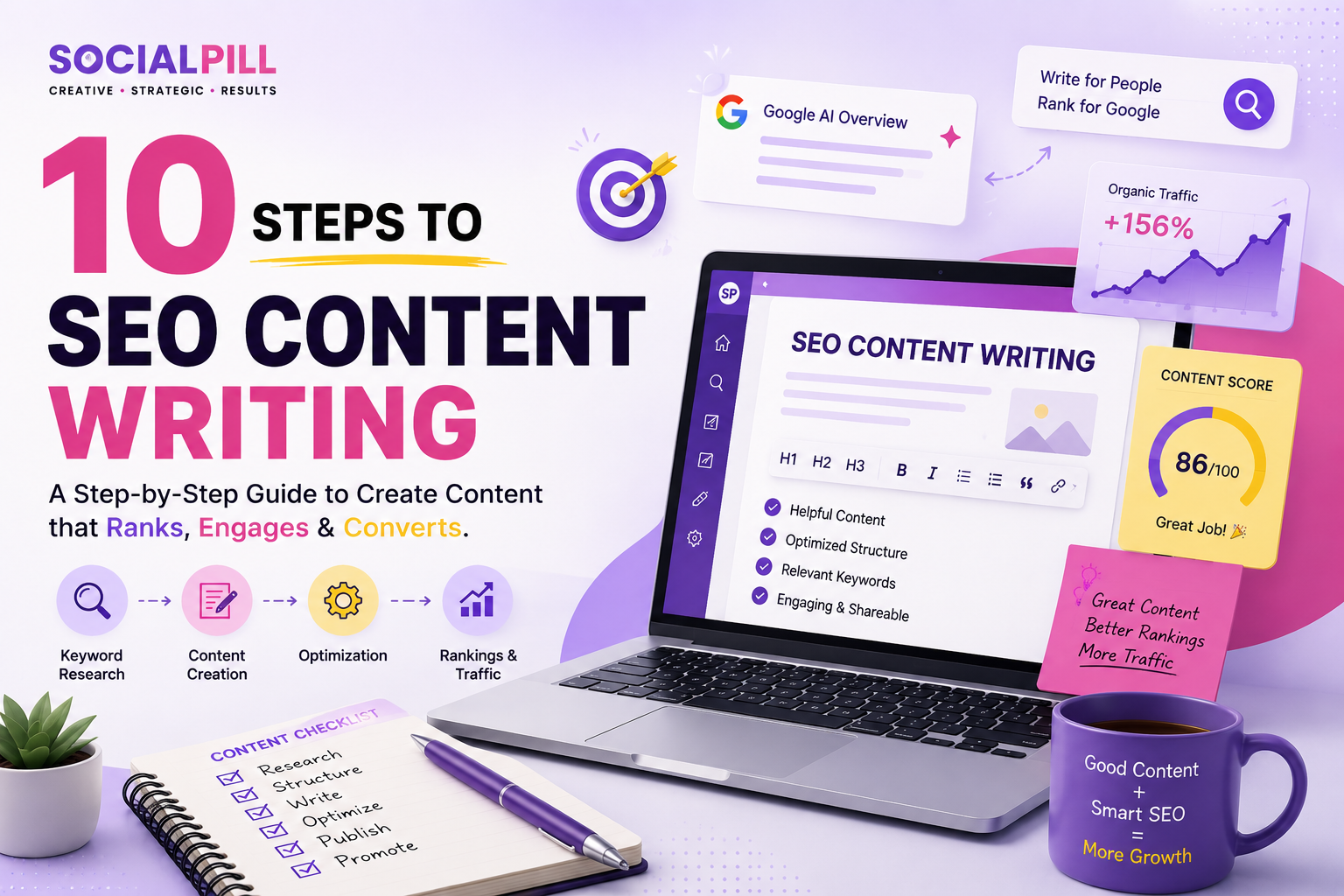
Getting your website in front of the right people isn’t just about having a great product or service. It’s about showing up when someone searches for what you offer and staying there. That’s where optimising for search engines and user experience comes in. Sites with strong authority, solid content, and a healthy backlink profile consistently rank higher, and that visibility is what turns browsers into customers. This is exactly why SEO content writing has become non-negotiable for brands that want to be found online.
So, what is SEO content writing, really? In simple terms, it’s the practice of creating content that people genuinely enjoy reading while structuring and optimising it so search engines can understand, index, and rank it. Producing truly SEO friendly content takes research, planning, and consistent effort, but when it’s done well, the payoff is long-term organic traffic that keeps compounding.
Here’s the thing: if your page ranks on the first page of Google, you get more clicks, more shares, and more engagement. But if nobody ever finds your content, none of that quality matters. That’s precisely why understanding how to write SEO content and building a repeatable SEO content strategy around it is one of the highest-leverage skills a business can invest in today. At Social Pill, we’ve seen firsthand how the right strategy turns an ordinary blog into a steady source of qualified leads.
Let’s break down exactly how to do it, step by step. Here are 10 Ways You Can Create SEO Friendly Content and Build a Solid SEO Content Strategy
Do Your Keyword Research for SEO Content
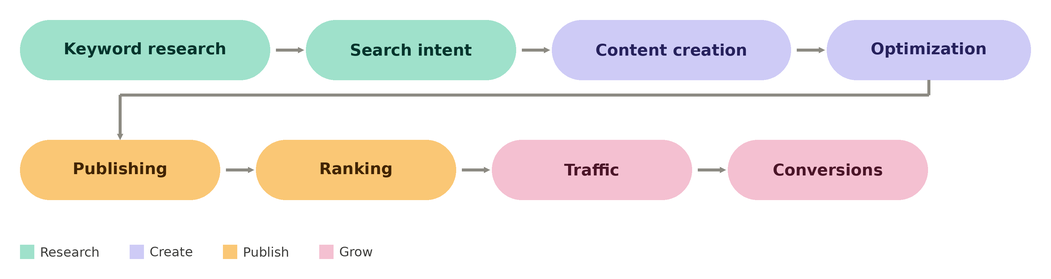
Every piece of strong SEO content starts with research, not writing. Skip this step, and you’re basically guessing what your audience is searching for.
Here’s what solid keyword research for SEO content writing actually involves:
- Search volume – how many people are searching for a term each month. High volume sounds attractive, but volume alone doesn’t guarantee results.
- Keyword difficulty – a score that tells you how hard it will be to rank for a term based on existing competition.
- Primary vs secondary keywords – your primary keyword is the main topic (like “SEO content writing”), while secondary keywords support and expand on that topic (like “SEO content writing services” or “SEO content strategy”).
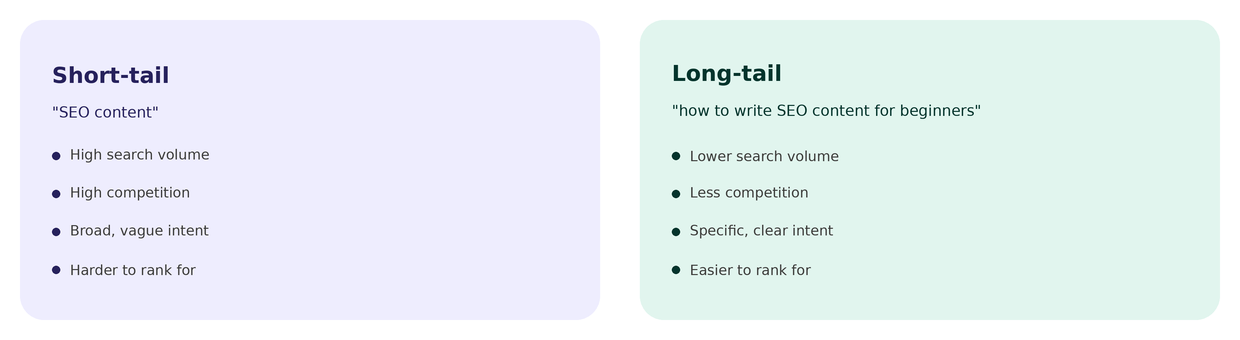
- Long-tail keywords – longer, more specific phrases like “how to write SEO content for a small business blog.” These usually have lower volume but higher intent and less competition.
- Semantic keywords – related terms and concepts (like “organic traffic” or “search rankings”) that help search engines understand the full context of your content.
- Google Autocomplete – type your topic into Google and see what it suggests. These are real phrases real people search for.
- People Also Ask – this section on the search results page reveals related questions you should be answering in your content.
- Competitor keyword research – look at what’s already ranking on page one. What are they covering that you aren’t?
- Keyword clustering – grouping related keywords together so one page can rank for multiple variations instead of creating separate thin pages for each one.
Tools that make this easier: Google Keyword Planner, Ahrefs, Semrush, Google Search Console, and Ubersuggest are all solid starting points, each with slightly different strengths depending on your budget and goals.
Example: Say you run a bakery and want to write about “birthday cake delivery.” A quick look at Autocomplete and Ahrefs might reveal that “same day birthday cake delivery near me” gets meaningful search volume with lower difficulty. That long-tail variation becomes your real target not the broad, hyper-competitive term.
Match Search Intent to Create SEO Friendly Content
You can have the perfect keyword density and still fail to rank if your content doesn’t match what the searcher actually wants. This is where most SEO content writing goes wrong.
There are four main types of search intent:
- Informational – the user wants to learn something. Example: “what is SEO content writing.” They’re not ready to buy; they want an answer.
- Navigational – the user is looking for a specific website or brand. Example: “Social Pill blog.”
- Commercial – the user is comparing options before deciding. Example: “best SEO content writing services in India.”
- Transactional – the user is ready to take action. Example: “hire SEO content writer.”

Why does intent matter more than keyword density? Because Google’s entire job is to match searchers with the most relevant result not the page that repeats a keyword the most times. If someone searches with informational intent and lands on a sales page, they’ll bounce immediately, and that signals to Google that your page isn’t a good match. Over time, this hurts your rankings regardless of how “optimized” your content looks on paper.
Understanding user intent is one of the fastest ways to improve rankings without touching a single keyword count.
Write a Catchy Title & Meta Description for SEO Optimized Content
Your title tag and meta description are your first (and sometimes only) chance to earn a click on the search results page. Even a perfectly ranked page underperforms if nobody clicks on it.
A few things that make a real difference:
- Title tags should stay under 60 characters so they don’t get cut off in search results.
- Meta descriptions work best between 150–160 characters long enough to explain value, short enough to display fully.
- CTR (click-through rate) is directly influenced by how compelling your title and description are, and it’s a signal Google pays attention to.
- Emotional triggers like curiosity, urgency, or a promise of a solution encourage clicks.
- Numbers (like “10 Steps”) make content feel scannable and specific.
- Power words such as “proven,” “simple,” “ultimate,” or “essential” add punch without sounding gimmicky.
Example of a weak title: “Content Writing Tips” Example of a strong title: “10 Steps To SEO Content Writing (That Actually Rank)”
The second version tells the reader exactly what they’ll get and why it’s worth their time that’s the difference between scrolling past and clicking through.
Structure Your Content Properly for Better Content Optimization
Good structure isn’t just about looking neat. It directly affects crawlability, readability, and your chances of landing a Featured Snippet.
Here’s how proper structure works:
- H1 – one per page, usually your main title.
- H2 – your major sections (like each of these 10 steps).
- H3 and H4 – supporting subpoints within each section.
- Short paragraphs – 2–4 sentences max, especially for mobile readers.
- Bullet lists – break down steps, tips, or features so they’re easy to scan.
- Tables – excellent for comparisons and often pulled directly into Featured Snippets.
- Jump links – a table of contents at the top helps both users and search engines navigate longer content.
- Schema opportunities – structured data (like FAQ or HowTo schema) helps Google understand your content’s format and can unlock rich results.
Content that’s well-organized isn’t just easier to read it’s also easier for Google to parse, index, and match to relevant search queries.
Link to Relevant Internal and External Content
Links are how search engines understand the relationship between pages, and they’re a core part of any real SEO content strategy.
- Internal linking connects your blog posts to other pages on your own site, guiding both users and search engines deeper into your content.
- External authority links to credible, well-established sources (like industry studies or .gov/.edu sites) add trust and context.
- Topical authority builds when your internal links form clusters around a core theme, showing Google you’re a genuine expert on the subject.
- Anchor text should be descriptive and natural, not generic phrases like “click here.”
- Link equity passes value from one page to another, which is why linking from a high-authority page to a newer one can help it rank faster.
- Natural linking means links should feel helpful to the reader, not forced in just to hit a quota.
For a blog like this one, it makes sense to link toward a dedicated SEO Services page and a Content Writing Services page, since readers exploring this topic are often looking for exactly that kind of support next.
Write SEO-Friendly URLs
URLs are a small detail that a lot of writers overlook, but they matter more than people think for both users and search engines.
Best practices include:
- Keep URLs short – aim for something clean and readable.
- Include your keyword – it should reflect the page’s topic clearly.
- Avoid dates – they make content look outdated even when it’s been refreshed.
- Avoid unnecessary numbers – unless the number is essential to the topic itself.
- Avoid stop words – words like “and,” “the,” or “of” add length without adding value.
Example of a messy URL: yoursite.com/blog/2023/05/the-best-tips-and-tricks-for-seo-content-writing-in-2023
Example of a clean URL: yoursite.com/blog/seo-content-writing-guide
The second version is easier to read, share, and remember and it won’t look stale a year from now.
Focus on Quality Along With Word Count
There’s a common myth that longer content always ranks better. That’s not entirely true. What actually matters is whether the content demonstrates real E-E-A-T Experience, Expertise, Authoritativeness, and Trustworthiness.
To build genuine quality:
- Include original research or first-hand insights where possible, not just recycled information.
- Back up claims with examples and statistics rather than vague statements.
- Add unique insights that competitors haven’t already covered.
- Write with a user-first mindset answer the question fully before thinking about rankings.
Google’s Helpful Content guidance rewards pages that are genuinely useful to people, not pages padded with filler just to hit a word count. A tightly written 1,500-word article that fully answers the question will often outperform a bloated 4,000-word piece that repeats itself.
Optimize Your Images
Images improve engagement, but unoptimized images can quietly hurt your site’s performance and rankings.
Key things to get right:
- File names – rename images descriptively (e.g., “seo-content-writing-checklist.png”) instead of leaving generic camera file names.
- Alt text – describes the image for screen readers and helps search engines understand visual content; this also supports accessibility.
- Compression – smaller file sizes mean faster load times, which directly affects user experience and rankings.
- WebP format – a modern image format that keeps quality high while reducing file size significantly compared to JPEG or PNG.
- Lazy loading – images load only as the user scrolls to them, speeding up initial page load.
- Image captions – often read more than body text, so they’re a great place for context and keywords.
Together, these elements make up solid image SEO, which supports both technical SEO and a better overall user experience.
Keep Your Content Fresh and New
SEO content writing isn’t a “publish and forget” task. Search engines factor in freshness, especially for topics that evolve over time.
Ways to keep content current:
- Update statistics regularly so your data doesn’t go stale.
- Refresh examples to reflect current trends and tools.
- Add FAQs as new questions emerge around your topic.
- Republish updated content with a new date once meaningful changes are made.
Without regular updates, even well-ranked pages experience content decay a gradual drop in rankings and traffic as the information becomes outdated compared to fresher competitors. A quarterly content audit can catch this before it becomes a bigger problem.
Make It Easy to Read and Share
Even the most well-researched article won’t perform if it’s exhausting to read. Readability directly affects time on page, bounce rate, and shares all signals that indirectly support rankings.
Focus on:
- Short paragraphs that don’t overwhelm the reader.
- Bold text to highlight key points for skimmers.
- Lists to break down complex information.
- Visual hierarchy so the eye naturally flows through the page.
- Clickable CTAs that guide readers toward a next step.
- Social sharing buttons to make it effortless to pass content along.
- Mobile readability since most readers are on their phones, content needs to look clean on a small screen.
The easier your content is to read, the more likely people are to stay, share, and come back for more.
Common SEO Content Writing Mistakes to Avoid
Even experienced writers fall into these traps. Watch out for:
- Keyword stuffing – forcing keywords unnaturally hurts readability and can trigger algorithmic penalties.
- Thin content – pages that don’t fully answer the search query rarely rank well.
- Ignoring search intent – matching the wrong intent means low engagement no matter how well-written the piece is.
- No internal links – missed opportunities to build topical authority and guide users further into your site.
- No image optimization – slow-loading, unlabeled images hurt both SEO and accessibility.
- Duplicate content – confuses search engines about which version to rank and can dilute your rankings.
- Writing only for Google – content that ignores the human reader eventually gets penalized as algorithms get better at detecting it.
- Poor formatting – walls of text without headers or breaks drive readers away fast.
Avoiding these mistakes is often just as important as doing the 10 steps right.
Traditional Content vs SEO Content Writing
| Factor | Traditional Content | SEO Content Writing |
| Search Intent | Rarely considered | Central to the strategy |
| Keyword Strategy | Little to no research | Data-backed keyword targeting |
| Optimization | Minimal or none | Titles, structure, links, and images all optimized |
| Ranking Potential | Low to unpredictable | Higher, more consistent visibility |
| Traffic | Relies on existing audience or ads | Builds compounding organic traffic |
| Lead Generation | Passive, incidental | Intentional, tied to funnel stages |
SEO Content Writing Checklist Before Publishing
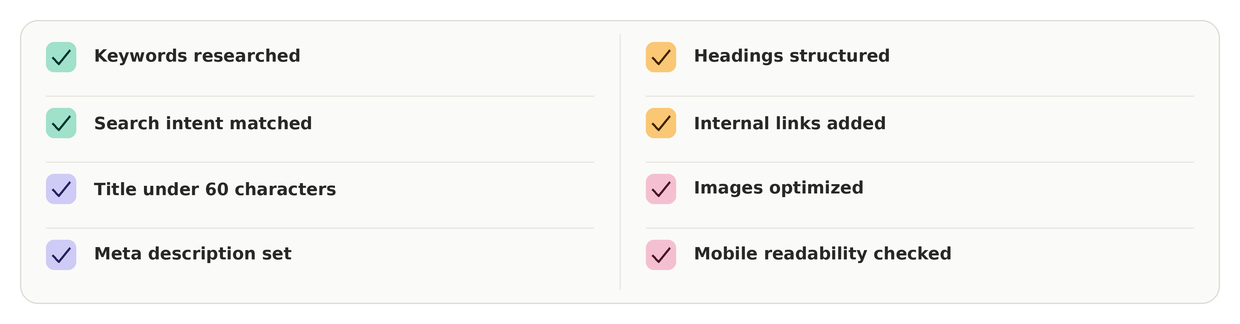
- Primary and secondary keywords researched and confirmed
- Search intent matched to content format
- Title tag under 60 characters with the primary keyword
- Meta description between 150–160 characters
- Proper heading hierarchy (H1, H2, H3)
- Short paragraphs and scannable formatting
- Internal links added to relevant pages
- External links to credible sources included
- SEO-friendly URL created
- Images optimized with alt text and compression
- Content reviewed for E-E-A-T and originality
- FAQs added where relevant
- Mobile readability checked
- Content proofread for grammar and clarity
Conclusion
Ranking on the first page isn’t luck it’s the result of doing the fundamentals well, consistently. From keyword research and matching search intent, to structuring your content, optimizing images, and keeping everything fresh, each of these 10 steps plays its own role in building content that both people and search engines love.
The brands that win at SEO content writing aren’t necessarily the ones producing the most content they’re the ones producing the most helpful, well-optimized content, backed by a clear strategy. If you’re ready to build (or rebuild) your SEO content strategy but don’t have the bandwidth to do it all in-house, that’s exactly the kind of work Social Pill helps brands with every day. Whether you need a single optimized blog post or a full content roadmap, getting the strategy right from the start makes all the difference.
FAQs
1. How long does it take to see results from SEO content writing?
Most businesses begin seeing noticeable ranking and traffic improvements within 3–6 months, depending on competition, domain authority, and content quality.
2. What is the difference between SEO content writing and copywriting?
SEO content writing focuses on ranking and attracting organic traffic, while copywriting is designed to persuade users to take action such as buying or signing up.
3. How much does SEO content writing cost?
SEO content writing costs vary based on content length, research depth, and the writer’s or agency’s expertise, so pricing can range from basic blog posts to comprehensive optimization packages.
4. What tools are used for SEO content writing?
Popular tools include Google Keyword Planner, Ahrefs, Semrush, Google Search Console, Ubersuggest, and WordPress SEO plugins like Yoast.
5. How often should you publish SEO content?
A consistent publishing schedule of 2–4 high-quality articles per month is generally more effective than publishing large volumes of low-quality content.
6. Is SEO content writing still relevant with AI search (like GEO/AI Overviews)?
Yes, SEO content writing remains highly relevant because Google AI Overviews, GEO, and AEO rely on clear, well-structured, and trustworthy content to generate answers.
7. What is the ideal keyword density for SEO content?
A natural keyword density of around 1–1.5% is a useful guideline, but readability and search intent matter more than hitting an exact percentage.
8. Do you need a blog to do SEO content writing, or does it apply elsewhere too?
No, SEO content writing also applies to service pages, product descriptions, landing pages, FAQs, and other searchable web content, not just blogs.