Every founder we talk to at Social Pill starts with some version of the same sentence: “Our product is good, so why aren’t sales coming in?” It’s a fair question, and it usually has an uncomfortable answer: having a good product stopped being enough a long time ago. In 2026, Indian buyers research on Google, compare options on Instagram, ask AI chatbots for recommendations, and check WhatsApp reviews long before they ever speak to a salesperson.
This is exactly where lead generation comes in. It’s the discipline of turning strangers on the internet into people who’ve raised their hand and said: “tell me more.” Done well, it gives a business something rare: a predictable, repeatable flow of people who actually want to buy. Done badly, even a great product ends up depending entirely on referrals and luck.
Digital marketing is what makes modern lead generation work at scale, whether that’s an SEO campaign quietly compounding for two years or a performance ad running today. Before we get into channels and tactics, though, it helps to get the fundamentals right, starting with what lead generation actually means.
What is Lead Generation?
Lead generation, in plain terms, is the process of attracting people who don’t know your brand yet and getting them to share their contact details a phone number, an email, a WhatsApp number because they’re genuinely interested in what you offer. That’s the entire lead generation meaning in one line. The moment someone fills a form, books a demo, or replies to a WhatsApp campaign, they’ve become a lead: someone with a name attached to their interest, not just an anonymous website visitor.
Not every lead is ready to buy, though, and this is where two terms matter. Say a Mumbai-based interior design firm runs an ad offering a free renovation checklist. Someone who downloads it is a Marketing Qualified Lead (MQL); they’ve shown interest, but they might just be curious. Once the sales team calls and confirms they have a real budget and a three-month renovation timeline, that same person becomes a Sales Qualified Lead (SQL), someone worth actively pursuing.
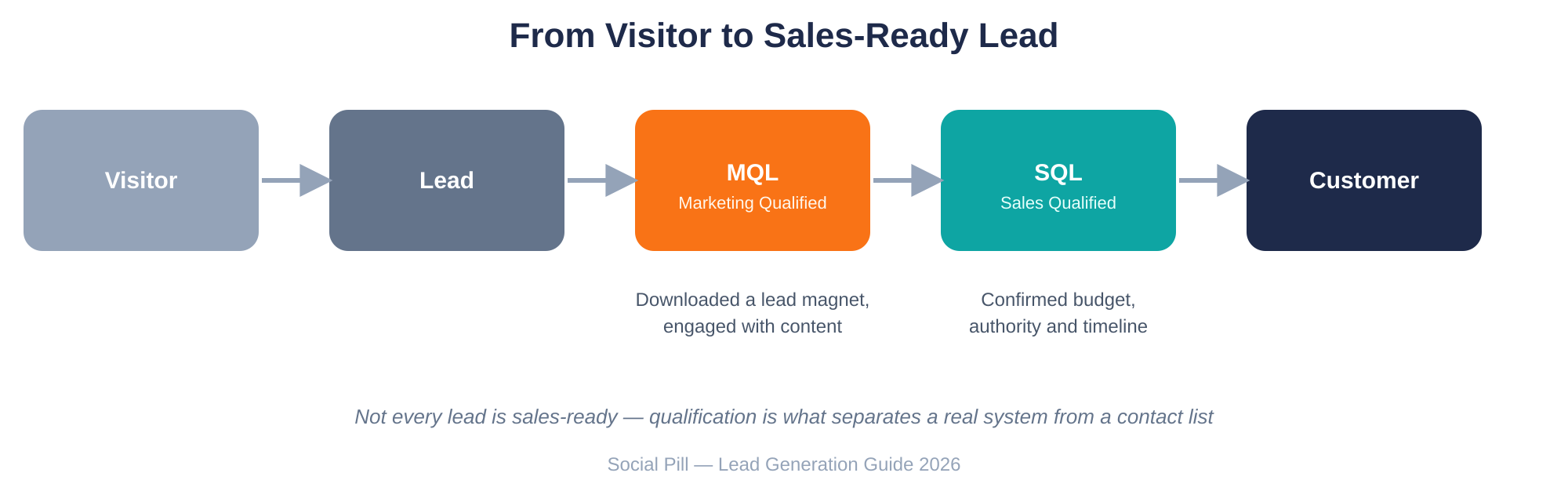
This distinction is what separates real lead generation from simply collecting names. A list of 10,000 email addresses means nothing if none of them was ever qualified. What matters is a system that consistently pulls in the right people and tells you, with reasonable confidence, who’s actually close to buying.
Why Lead Generation Matters
Ask any CMO what keeps them up at night, and “where’s next quarter’s revenue coming from” is usually near the top. Lead generation is the answer to that question; it’s what keeps a sales pipeline predictable instead of feast-or-famine. Businesses that treat lead gen as an ongoing system, not a one-off campaign, get to plan hiring, inventory, and cash flow with far more confidence.
It also does more than fill a pipeline. Every piece of content or landing page built for lead generation quietly builds brand awareness too; people remember you even when they don’t convert immediately. This compounds over time: companies that blog consistently generate around 13 times more leads than those that don’t, according to HubSpot, and leads sourced through organic search close at roughly 14.6%, compared to just 1.7% for outbound efforts, per SeoProfy’s 2026 benchmarking.
Strong lead generation also improves customer relationships from day one, since someone who found you through helpful content or a relevant ad arrives already trusting you a little. It’s how businesses scale; you can’t grow revenue 3x by relying only on referrals. And in competitive categories like fintech, ed-tech, or real estate, whoever builds the better lead engine usually wins the category, regardless of who has the technically “better” product. It’s no coincidence the global lead generation industry itself is projected to cross $295 billion by 2027, growing at nearly 17% a year (Business Wire).
The Lead Generation Process
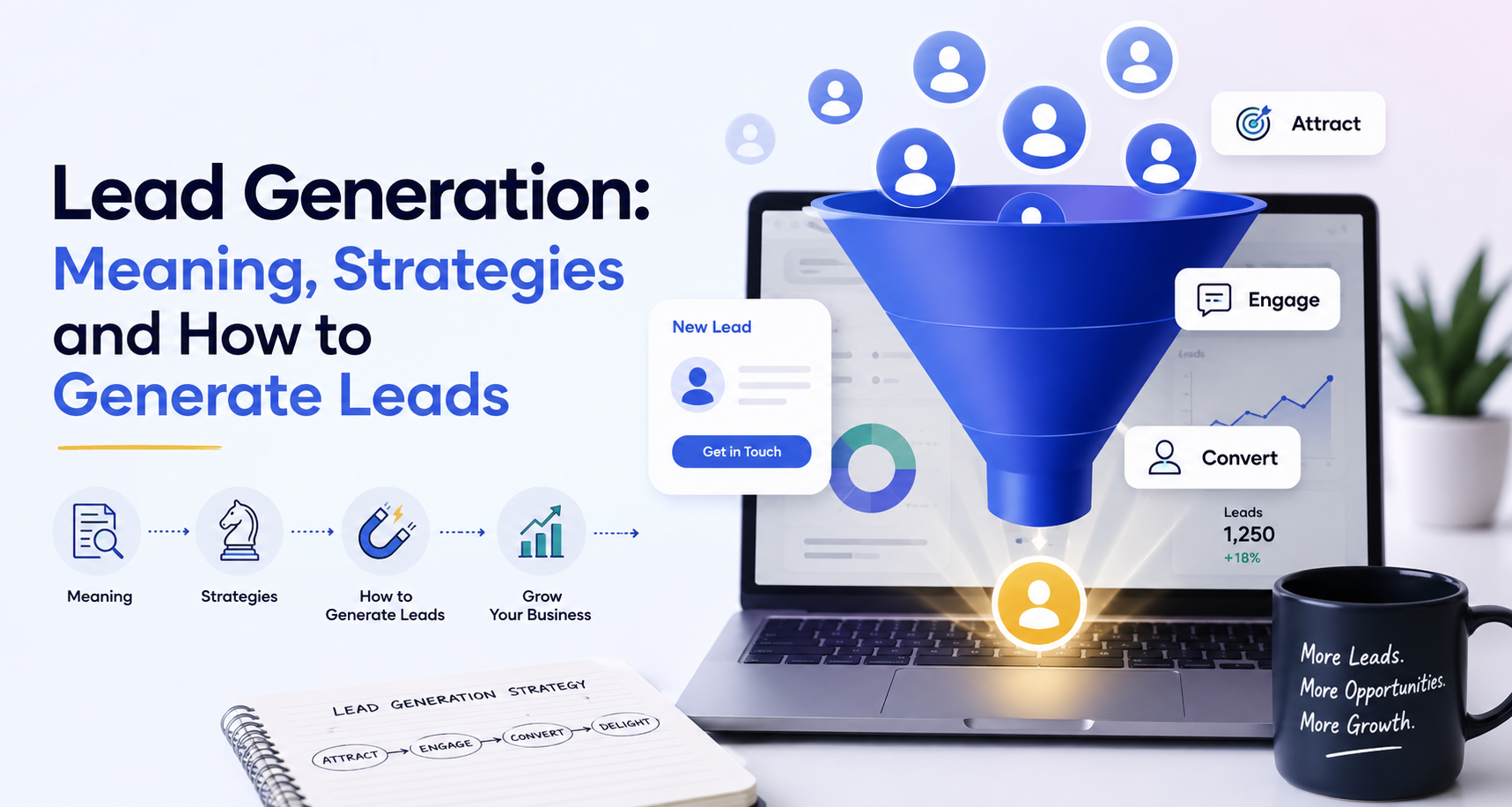
Think of lead generation less as a single action and more as a journey a stranger takes before becoming a customer. It usually moves through seven stages, and skipping any one of them is why so many campaigns underperform.
It starts with Awareness: someone sees your brand for the first time, maybe through a reel or a Google search. Interest follows when they engage further, reading a blog or following your page. Consideration is where they compare you against alternatives, checking reviews and pricing. Intent shows up when they take an action that signals real buying interest, like booking a callback.
Conversion is the moment they actually become a lead or customer. But the process doesn’t end there. Nurturing keeps the relationship warm through emails or WhatsApp updates for leads not ready to buy yet, and Retention, often the most ignored stage, is what turns a one-time buyer into a repeat customer and eventual referral source.
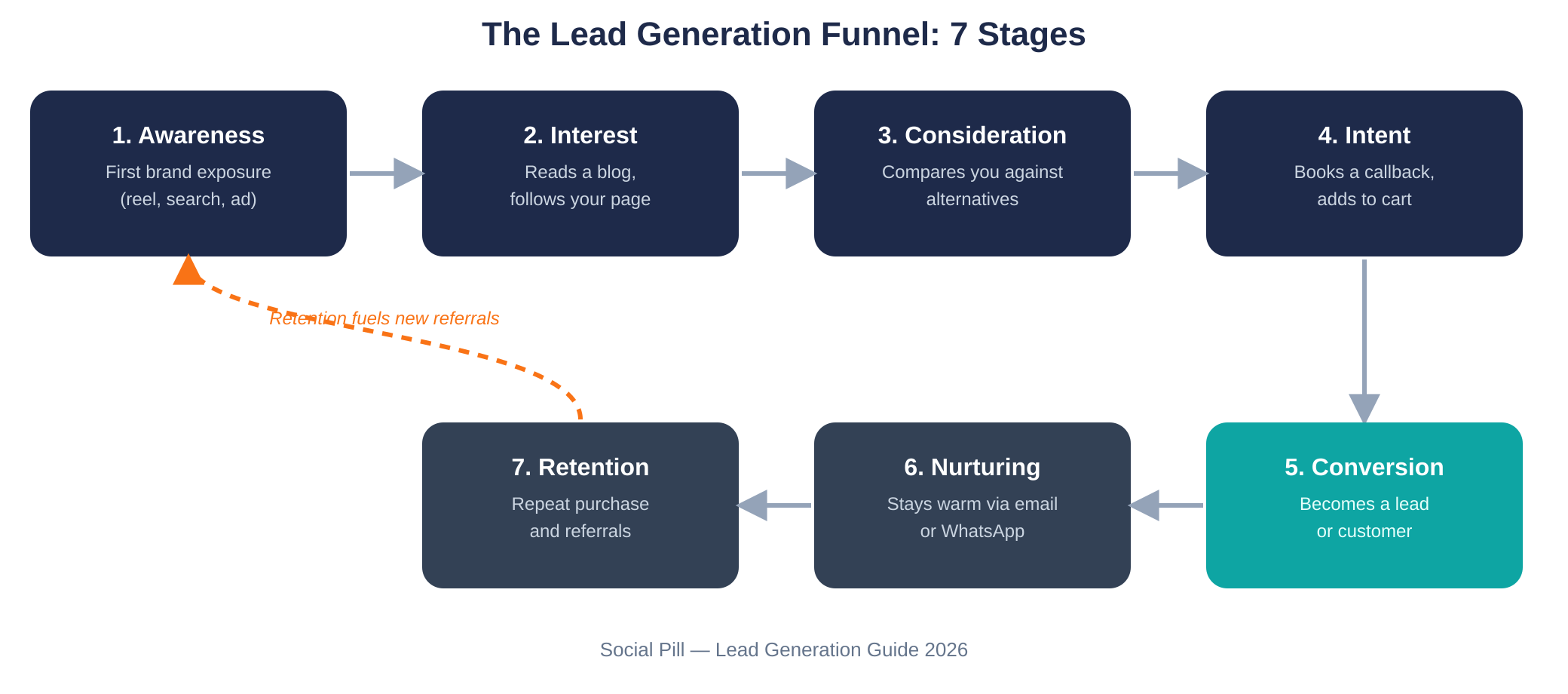
Most businesses pour all their energy into the middle of this funnel and wonder why leads go cold. A lead generation campaign strategy that ignores nurturing and retention is really only half a strategy.
Inbound vs Outbound Lead Generation
Inbound lead generation is about earning attention; SEO, content, and organic social bring people to you because they’re already looking for answers. Outbound is about going after attention directly: cold calls, cold emails, and paid ads that reach people who weren’t necessarily searching for you. Neither is inherently better; they solve different problems at different speeds.
Inbound builds trust and compounding value: a blog post written today can keep generating leads two years from now. Its downside is speed: inbound takes months to build real momentum. Outbound is the opposite: it can generate leads within days of launching, which makes it useful for new businesses or time-bound offers, but it typically costs more per lead and needs constant refreshing to stay effective.
Here’s how the two compare across the metrics that actually matter:
| Factor | Inbound | Outbound |
| Cost | Lower cost per lead long-term | Higher, ongoing ad/list spend |
| ROI | Compounds over time | Immediate but tapers off |
| Lead Quality | Higher self-selected interest | Mixed; needs more qualification |
| Time to Results | Slow (months) | Fast (days to weeks) |
| Scalability | Scales with content and SEO authority | Scales with budget |
| Trust | Close attention is earned | Lower often interruptive |
| Best Channels | SEO, blogs, social, YouTube | Cold email, telecalling, paid ads |
| Best For | Long sales cycles, B2B, brand building | Quick launches, time-bound offers |
In practice, the businesses that grow fastest in India rarely pick one over the other. They lean on outbound and paid ads to generate leads while their inbound engine SEO and content is still being built, then gradually shift budget as organic channels start pulling their own weight.
How to Generate Leads: Step-by-Step
If you’re asking what the way to do lead generation properly is, it isn’t really one tactic; it’s a sequence. Here’s the roadmap we walk brands through at Social Pill.
Lay the Foundation
Before touching any channel, understand your audience: know who you’re selling to and what problem you actually solve for them. Turn that understanding into buyer personas: two or three detailed profiles covering goals, objections, and where they spend time online. Then set clear goals, deciding what success means: a target number of leads, a cost-per-lead ceiling, or an MQL-to-SQL rate. Finally, choose the right channels; not every business needs every platform, so pick where your buyers actually are.
Create and Capture
Start creating valuable content: blogs, videos, and guides that answer real questions your audience is searching for. Pair this with high-converting landing pages: a page with one offer and one call to action outperforms a generic homepage every time. Then design lead magnets: checklists, calculators, or free consultations valuable enough to trade an email for.
Drive Traffic and Convert
Use SEO to rank for what buyers search, so leads keep coming without paying for every click. Run paid campaigns on Google and Meta to accelerate results while your organic channels are still growing. Together, these two engines one slow and compounding, one fast and scalable cover both ends of the timeline.
Nurture, Automate and Improve
Most leads don’t buy on day one, so nurture through email to stay top of mind. Add marketing automation so follow-ups and lead scoring happen without anything falling through the cracks. Track the right KPIs: cost per lead and MQL-to-SQL rate matter more than vanity metrics like impressions. And optimise continuously: treat every campaign as version one, since the real results usually show up by version three.
Lead Generation Strategies
A lead generation strategy is simply the specific method you use to execute the roadmap above. Most businesses need a mix of these, not just one.
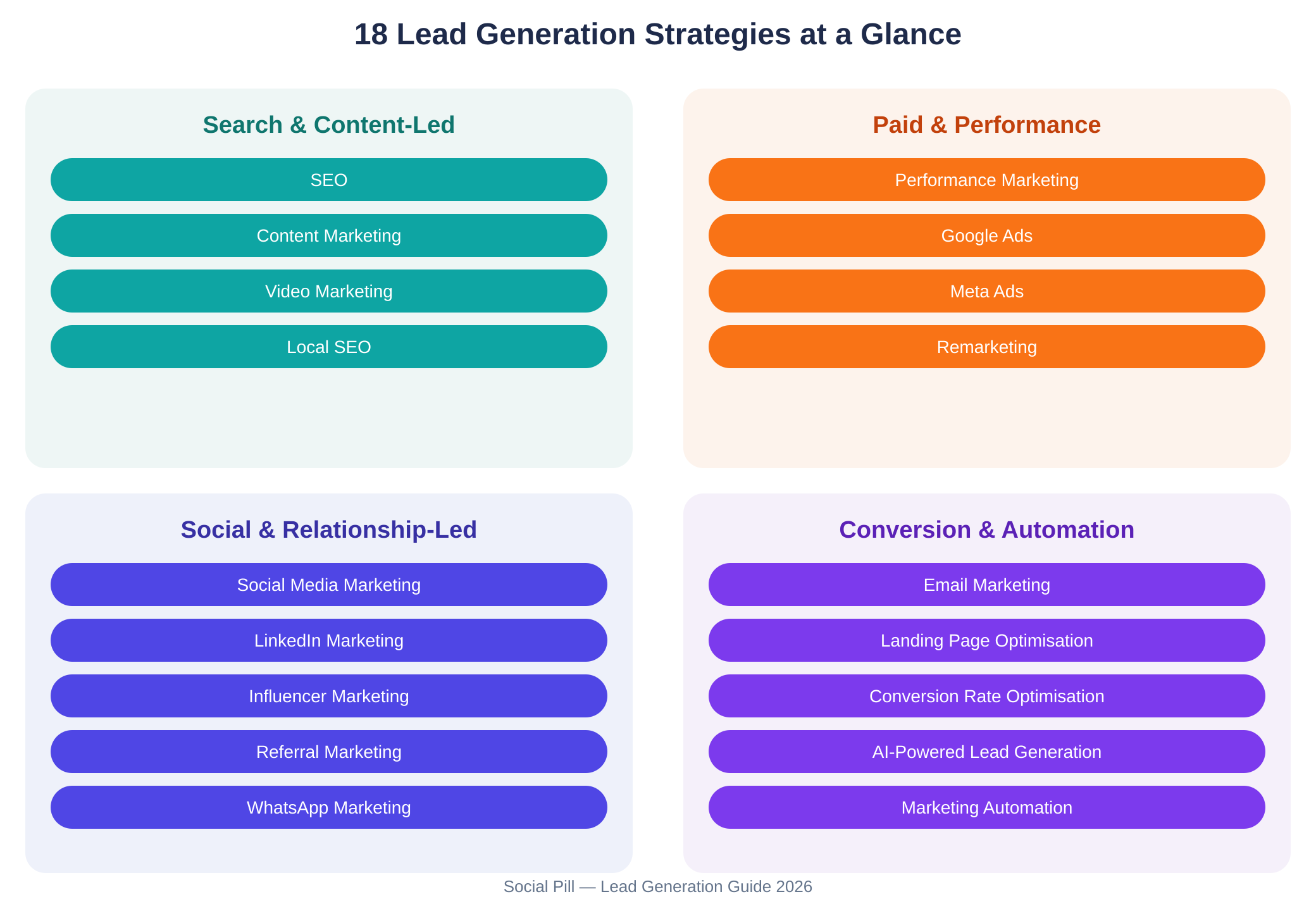
Search & Content-Led Strategies
SEO: Ranking on Google for what buyers are already searching. Works because it captures intent and compounds instead of stopping when budget does. Best for long-term, low-cost lead flow.
Content Marketing: Blogs, guides, and videos answering real questions. Works because it builds trust before the sales conversation starts. Best for considered purchases like B2B software or finance.
Video Marketing: Reels, YouTube Shorts, and long-form video. Works because video now drives the highest engagement of any format in India. Best for founder-led trust and product demos.
Local SEO: Optimising for “near me” and location-based searches, including Google Business Profile. Works because it captures high-intent local buyers. Best for retail, clinics, and service businesses with a physical presence.
Paid & Performance Strategies
Performance Marketing: Paid campaigns measured strictly against ROI. Works because every rupee spent is trackable. Best for businesses needing fast, measurable results.
Google Ads: Search and display ads shown to active searchers. Works because it captures high-intent traffic instantly. Best for services with clear commercial search terms.
Meta Ads: Facebook and Instagram ads with granular targeting. Works because it reaches people by interest and behaviour, not just search. Best for visual, impulse-driven categories.
Remarketing: Showing ads to people who’ve already visited your site or engaged with content. Works because it targets warm audiences who already know you. Best for longer consideration cycles.
Social & Relationship-Led Strategies
Social Media Marketing: Building presence on Instagram, LinkedIn, and Facebook. Works because it reaches people during discovery, not just search. Best for D2C and lifestyle brands.
LinkedIn Marketing: Organic content and ads targeting professionals by role and industry. Works because it’s where B2B decision-makers spend time. LinkedIn drives close to 80% of all B2B social media leads. Best for B2B and high-ticket services.
Influencer Marketing: Partnering with creators whose audience trusts them. Works because it borrows credibility instantly. Best for D2C, beauty, and fashion brands targeting younger audiences.
Referral Marketing: Turning existing customers into a source of new leads. Works because people trust recommendations far more than ads. Best for service businesses and subscriptions.
WhatsApp Marketing: Using WhatsApp Business for catalogues, automated replies, and direct lead capture. Works because India has one of the world’s largest WhatsApp user bases, and it feels personal rather than promotional. Best for D2C brands and tier-2/tier-3 markets.
Conversion & Automation Strategies
Email Marketing: Direct nurturing through a subscriber list. Works because it’s owned media; no algorithm decides who sees it. Best for nurturing leads not yet ready to buy.
Landing Page Optimisation: Designing pages built to convert, not just inform. Works because a focused single-CTA page consistently beats a busy homepage. Best for every paid or organic campaign.
Conversion Rate Optimisation (CRO): Testing and improving what happens after someone lands on your page. Works because doubling conversion rate has the same revenue impact as doubling traffic, at a fraction of the cost. Best for sites already getting decent traffic but weak conversions.
AI-Powered Lead Generation: Using AI for lead scoring, chatbot qualification, and predictive targeting. Works because it cuts time spent chasing unqualified leads. AI-driven scoring alone can improve conversion accuracy by 25–30%, per Gartner. Best for high lead-volume businesses.
Marketing Automation: Software that handles nurturing, scoring, and follow-ups automatically. Works because no lead sits untouched for days. Best for businesses running multiple campaigns at once.
Role of Digital Marketing in Lead Generation
Digital marketing isn’t one channel; it’s the connective tissue between everything covered above. SEO and content bring people in through search. Paid ads accelerate reach when you need results faster than organic growth allows. Social media builds the top-of-funnel awareness that eventually turns into search demand.
Email and WhatsApp handle nurturing once someone’s in your system, while analytics tells you which channel is actually working versus which just feels like it’s working. A CRM keeps every lead and conversation in one place instead of scattered across inboxes and notebooks, and marketing automation takes the repetitive parts of nurturing off a human’s plate entirely.
AI now touches almost every part of this stack, from writing ad variations to predicting which prospects are likely to convert in the next 90 days. None of these pieces works particularly well in isolation, though. A brilliant SEO strategy with no CRM to track leads is just traffic, and a great paid campaign with no landing page built for conversion is wasted spend. This is exactly why digital marketing and lead generation need to be treated as one integrated system, not a collection of disconnected vendors.
Why Work With a Digital Marketing Agency for Lead Generation
Running all of this in-house is possible, but it usually means hiring five or six specialists: an SEO person, a paid ads manager, a content writer, and a CRM admin before a single lead comes in. A digital marketing agency compresses that into one team that has already done this across dozens of businesses in your category or an adjacent one.
The real advantage isn’t just expertise, though that matters. It’s speed: campaigns launch faster and with fewer expensive mistakes when someone’s already tested what works for a similar audience. It’s technology: most agencies run marketing automation, CRM, and AI tools that would be costly for a single business to license and learn alone. And it’s accountability: proper reporting on cost per lead and MQL-to-SQL rate, not just impressions and reach.
At Social Pill, this is exactly how we approach digital marketing agency lead generation for brands across India, building an integrated strategy across SEO, performance marketing, social media, and AI-powered tools, rather than running channels in silos. We’re not going to pretend every business needs an agency. But if lead generation has become a full-time job nobody on your team has time for, that’s usually the sign it’s time to bring one in.
Conclusion
Lead generation isn’t a single tactic you switch on; it’s a system that connects your audience, your channels, your content, and your follow-up into one repeatable process. The businesses winning in 2026 aren’t necessarily generating the most leads; they’re generating the right ones, qualifying them faster, and following up before a competitor does.
If there’s one thing to take from this guide, it’s that quality beats quantity every time. A hundred qualified leads with real budget and intent will always outperform ten thousand names that never open your emails. Whether you’re building a lead generation strategy from scratch or fixing one that’s stopped working, the fundamentals audience clarity, the right channel mix, consistent nurturing, and continuous optimisation don’t really change.
If you’d rather have a team build and run this system for you, that’s exactly the kind of work we do at Social Pill every day for brands across India.
FAQs
Why is lead generation important for business growth?
Lead generation helps businesses attract qualified prospects consistently, driving predictable growth and revenue.
What is the difference between lead generation and sales?
Lead generation attracts and qualifies prospects, while sales converts those qualified leads into customers.
Which lead generation channels deliver the best ROI?
SEO and content marketing offer the best long-term ROI, while Google Ads, LinkedIn, and Meta Ads excel based on business type.
How is AI changing lead generation?
AI improves lead generation by automating qualification, personalising interactions, and identifying high-intent prospects faster.
What is a good lead conversion rate?
A good lead conversion rate is typically between 2% and 5%, depending on your industry and marketing channel.