If you’ve got a marketing budget to spend you’re going to be faced with this exact dilemma at some point: should you go with Google Ads or should you go with Meta Ads (Facebook and Instagram)?
Ask three different marketers and you will likely get three conflicting answers. An e-commerce brand manager might tell you that Instagram ads are the only channel that matters. A B2B software founder will swear that Google Search is the only platform that brings in real revenue. Meanwhile, your finance team simply wants to know one thing: which platform will turn every rupee or dollar spent into actual profit the fastest?
The confusion happens because businesses often treat Google and Meta as direct competitors offering the exact same service. In reality, they are two fundamentally different marketing tools built for two completely different human mindsets. Choosing between them or knowing how to use both together is not about picking the “better” platform. It is about understanding how your specific customers make buying decisions.
As a performance marketing agency in Mumbai, we have seen firsthand that real growth doesn’t come from picking a ‘favorite’ channel, but from matching the right platform to the right stage of your customer’s journey. In this guide, we break down how both platforms actually work, where your money will go furthest, and how to make the right call for your business.
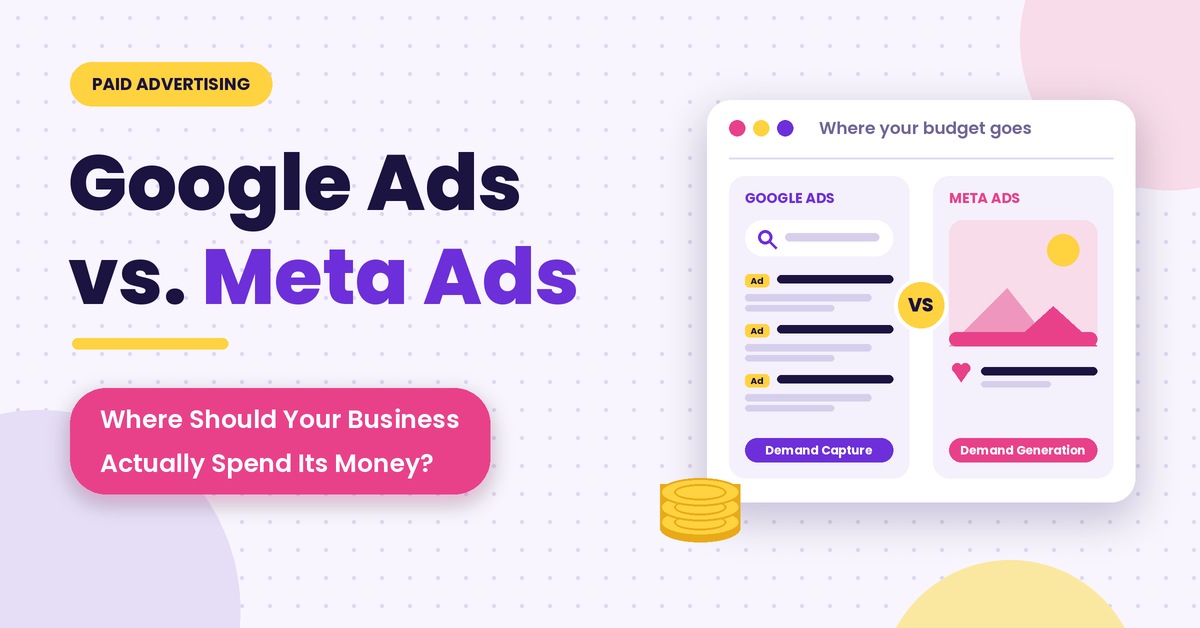
The Core Difference: Demand Capture vs. Demand Generation
To understand where your ad budget belongs, you only need to understand one basic concept: the difference between walking into a hardware store and browsing a shopping mall.
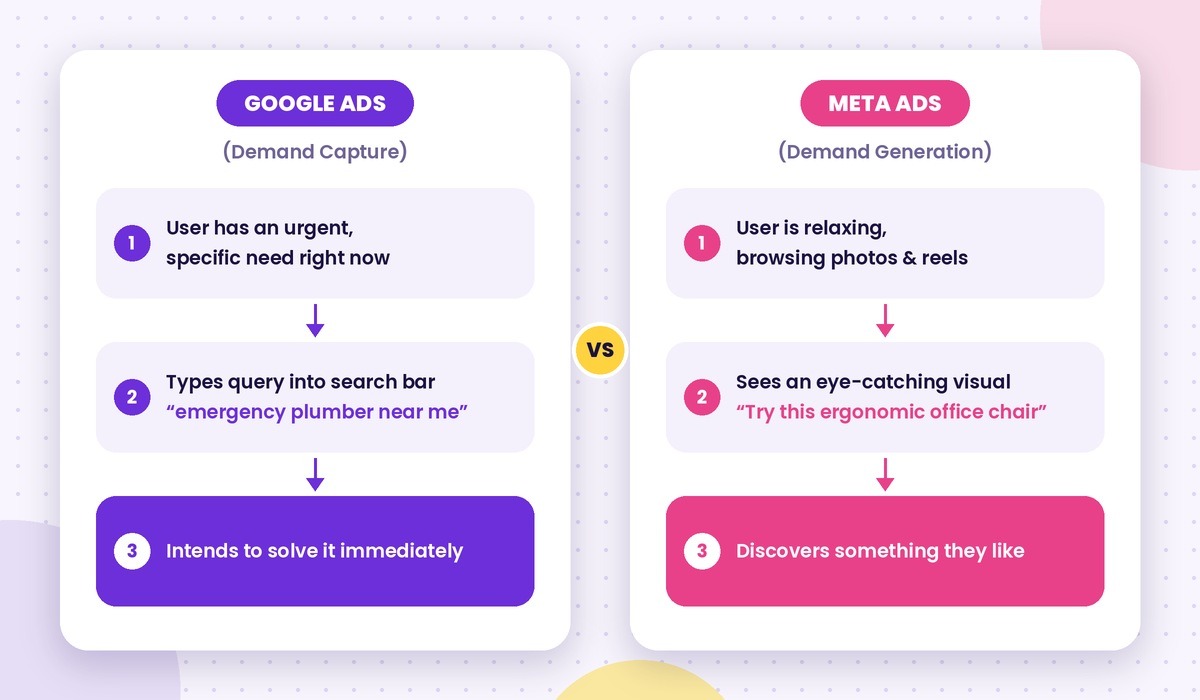
Google Ads Captures Existing Demand
When you open Google you’ve got a problem and you’re actively looking for an answer.
- “Best corporate health insurance provider”
- “Commercial real estate lawyer in Mumbai”
- “Buy running shoes size 10”
These aren’t people browsing for pleasure. They have high intent. They’re actively raising their hands and looking for someone to take their money or fix their problem. Google Ads lets you put your business right in front of them at the precise moment they’re in the market to buy.
Meta Ads Generates New Demand
No-one logs onto Instagram or Facebook because they desperately need to hire a tax consultant. People go on to the Meta apps to be entertained, to catch up with friends, to watch the short videos and to just have a mental break.
When you run ads on Meta you’re doing interruptive marketing. Your ad appears in their feed or stories as they’re scrolling. The user wasn’t looking for you, your visual, your headline or your video has interrupted them and introduced the idea:
- ‘I didn’t know a portable espresso maker existed, but that looks absolutely incredible.’
- “That clothing brand is exactly my thing.”
- Our team actually do waste a lot of time on manual invoicing so I’ll have a look at this software.
Meta doesn’t wait for you to be searched for. It goes out and finds the people that match your ideal customer profile and then tells them why they should care.
Deep Dive: When Google Ads Wins
Google Ads is hands down the king of intent driven sales. If you’re selling a product that people are actively searching for by name, or if you’re solving a problem that people have an immediate need for, Google is your go to.
1. High-Intent Local & Emergency Services
If a pipe bursts in someone’s kitchen they don’t go on Instagram and start scrolling through home improvement reels. They go to Google, type in “emergency plumber near me” and click on the first two results. They then call the number and hire the first person who answers.
If you’re in a business that provides urgent, essential or location based services (locksmiths, repair services, clinics, legal aid, towing etc) then Google Ads should be getting the vast majority of your budget.
2. High-Ticket B2B and Professional Services
When a CFO is looking for enterprise payroll software or an industrial warehouse lease they’ll start with a targeted search. They’ll be comparing features, they’ll be looking at vendor lists and they’ll be booking demos. You only want to spend your money on people who are actively in the market for that type of solution so getting to them via search terms is the way to go.
3. Clear Competitor Targeting
Google will let you bid on the brand names of your direct competitors. So if a customer is unhappy and searches for your competitor’s name in the hope of finding their customer support, you can have an ad displayed which promotes your own solution (your own alternative), your faster turnaround time or your better price.
Deep Dive: When Meta Ads Wins
Meta (Facebook and Instagram) is hands down the leader in visual discovery and audience profiling. If your product is visually stunning, taps into a particular lifestyle or addresses a problem your audience didn’t even know they had then Meta is where your money will go the furthest.
- Products with Strong Visual Appeal (D2C and E-Commerce)
Fashion, home goods, food and beverage, fitness equipment and consumer electronics all do very well on Instagram. You wouldn’t expect a customer to be looking for ‘bamboo fibre bedsheets’ when they wake up, yet if you’ve got a short, sharp video showing them as incredibly soft and breathable on a hot night then you’ve got an instant purchase. - Innovative Products Nobody Is Searching For
If you’ve invented a completely new product or created a service that has never existed before then your search volume on Google will be effectively zero. No-one will search for a solution they don’t know exists. Meta enables you to target your exact audience (by age, job title, interests, life events etc) and educate them via video. - Lower Cost of Entry for Testing
In a competitive B2B space a single click on Google Search can cost you anywhere from ₹500 to ₹2,500 ($10 to $50+). If you’re on a tight daily budget you may only be able to afford two or three clicks a day which makes it very difficult to get any real data at all. Meta is generally a lot cheaper in terms of cost per impression so you can actually afford to test a number of different headlines, videos and offers without necessarily burning through your entire monthly budget in 48 hours.
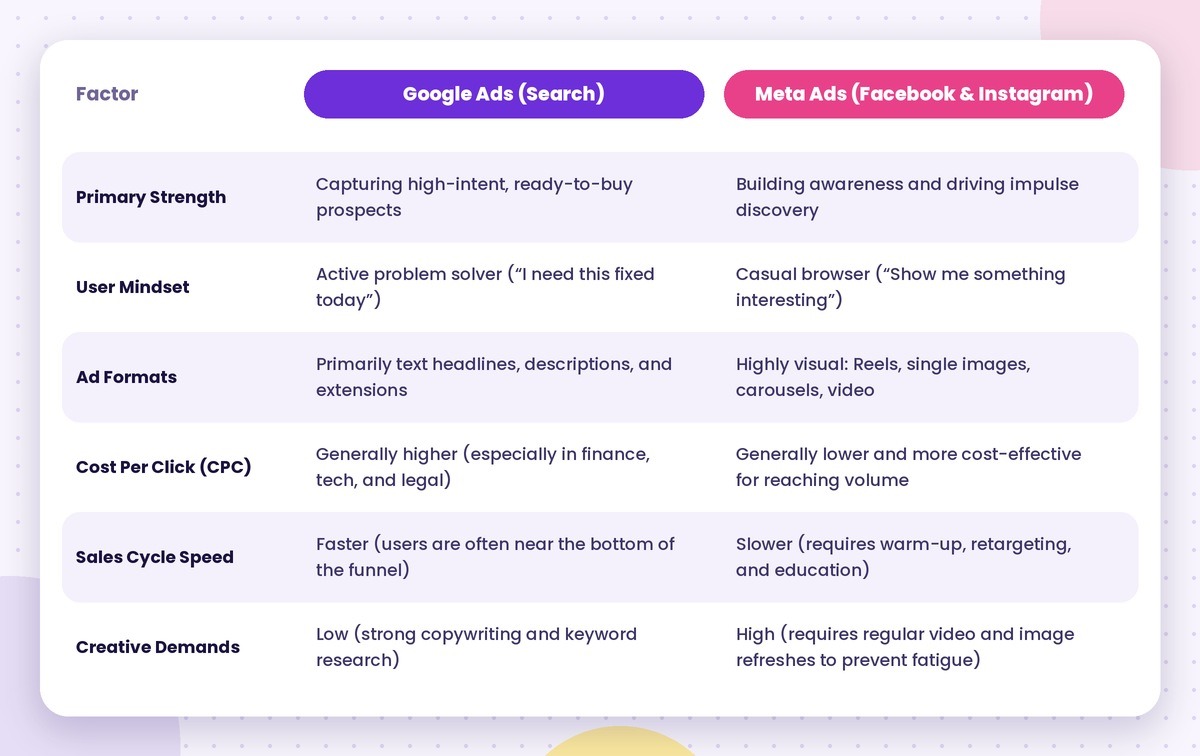
Head-to-Head Comparison: Google Ads vs. Meta Ads
To make the right operational choice, compare how both platforms stack up across the metrics that impact your bottom line:
A Practical Decision Framework: Where Should You Start?
Instead of guessing, use these three simple questions to decide where your next marketing allocation should go:
1. Does your product have search volume?
Open up a free keyword tool. Are people actually typing your service’s keywords at a reasonable volume every month?
- If so then get on with Google Ads. Pick up the low hanging fruit of people who already want what you’re selling before you start spending money trying to convert a cold audience on social media.
- If there’s no (as your concept is new or hyper-niche) then start on the Meta Ads to build awareness from scratch.
2. Is your product visually driven?
Can you communicate the value of what you sell in a three second video or a clean photo?
- If the customer needs to see the food, the dress, the interior design or the before and after to really get the value of it then Meta Ads will deliver a significantly higher return on your creative spend.
- If your offering is more abstract (e.g. auditing, tax consultancy, industrial components etc) then text based Google Search Ads will be the way to go and will prevent you from spending money on design assets that simply don’t convert.
The Pro Strategy: Using Google and Meta Together
The most profitable businesses don’t pick one platform and leave the other. They connect them into a single closed loop conversion system.
Here is how a balanced performance marketing funnel operates in practice:
- Top of Funnel (Discovery on Meta): You’re running engaging Instagram Reels and carousel ads which highlight a real customer problem and then introduce your product. That’s the way to build brand awareness with a very large number of the relevant audience at a very low cost.
- Middle of funnel (intent on Google) – after they’ve seen your social ads they’re not going to buy straight away. A week or so later they’re sitting at their laptop and searching for your brand or your service category on Google. Your targeted Google Search ad is there at the top of the page so you’ve got them and no competitor can take that traffic.
- Bottom of funnel (retargeting on Meta): If someone comes to your site via your Google Search ad and then just leaves without making a purchase or filling in the form, you haven’t lost them. You can simply run a Meta retargeting campaign the following day which will show them a very subtle reminder or an exclusive offer in their Instagram feed to come back and complete the action.
Maximize Your Advertising ROI with Social Pill
Getting into paid advertising without a strategy is a recipe for high ad spend, confusing analytics and ultimately missing your revenue targets. That’s why increasingly more growing brands are choosing to work with Social Pill.
Social Pill is a full service digital marketing agency in Mumbai and we specialise in the design and execution of high performing paid campaigns (both Google Ads and Meta Ads). We don’t just look at the vanity metrics of clicks and impressions. We build full customer acquisition funnels.
From custom landing page design and conversion rate optimisation through to compelling creative production, deep audience segmentation and full funnel attribution, we build the systems that ensure every marketing pound is working towards tangible, bottom line business growth. We can help you capture the ready to buy searcher on Google or scale your brand across Meta’s visual ecosystem. We build the systems that turn your ad spend into predictable revenue.