Most brands genuinely believe they know their customers. Ask any marketing team to describe their audience, and you’ll hear something like: 25 to 40 years old, urban, shops online, active on Instagram, interested in quality products. That description fits roughly 200 million people in India alone. Here’s the uncomfortable truth: two people can share identical demographics and make completely different purchasing decisions. One buys on price. The other won’t compromise on brand reputation. One researcher for weeks. The other decides in seconds on a recommendation from a friend.
Demographics tell you who is in the room. A buyer persona tells you why they’re there and what it will take to earn their business. The problem most brands face isn’t that they skip creating buyer personas. It’s that they build them in a conference room, based on gut instinct, and then treat them as finished documents. The result is marketing that speaks to nobody in particular, ad spend that evaporates without return, and content that generates impressions but no meaningful action. When built correctly from real data, real conversations, and genuine customer insight, a buyer persona becomes the most useful strategic asset a marketing team can own. Every content decision, every campaign brief, every channel choice becomes faster, sharper, and more likely to convert.
What Is a Buyer Persona and Why Does It Matter?
Buyer Persona Meaning Explained
A buyer persona is a research-backed representation of your ideal customer. It captures not just who they are, but what drives their decisions, their goals, frustrations, motivations, objections, information sources, and the triggers that push them from consideration to purchase.
It is not a target audience segment. “Marketing managers at mid-sized FMCG companies” is a segment. A buyer persona goes further: it describes what keeps that marketing manager up at night, what success looks like in their role, what risks they’re afraid to take, and what kind of proof they need before recommending a vendor to their CMO.
A target audience tells you who to reach. A buyer persona tells you what to say.
Why Buyer Personas Shape Every Marketing Decision
The influence of a well-built buyer persona extends across the entire marketing function:
• Content marketing: What topics matter? What format works? What stage of the funnel does this piece serve?
• SEO: Which search queries actually reflect buying intent? What questions is your persona trying to answer?
• Paid advertising: Which platforms does your buyer use? What messaging triggers a click vs. a scroll?
• Email marketing: What subject lines resonate? What call-to-action fits where they are in the decision journey?
• Sales enablement: What objections will the sales team hear? What materials close the deal?
• Product positioning: Which features matter most? Which benefits are irrelevant noise to this buyer?
Without persona clarity, every one of these decisions defaults to opinion. With it, they’re informed by evidence.
Why Most Buyer Personas Fail Before Marketing Even Begins
Mistake #1: Building Personas Around Assumptions
The most common persona-building process looks like this: a cross-functional team sits in a room, someone opens a whiteboard or a slide deck, and the team collectively describes who they think their customer is. The output feels authoritative because multiple people agreed on it.
But consensus isn’t research. If no one in that room has spoken to an actual customer recently or reviewed real behavioural data, the persona is fiction dressed up as strategy. We’ve seen brands spend six figures on campaigns built on assumptions that a single round of customer interviews would have completely dismantled.
Mistake #2: Confusing Demographics with Customer Understanding
Age, gender, income, and location are useful filters, not insights. They can help you identify where to show up. They cannot tell you why someone buys. Two marketing managers at retail brands in Mumbai might have identical demographic profiles. One is under pressure to justify every rupee of spend and needs data before making any agency decision.
The other has full budget authority and is motivated primarily by speed and creative quality. The same campaign message will not work for both. Demographics are the starting point of customer understanding, not the destination.
Mistake #3: Creating One Persona for Every Customer
Not every customer buys for the same reason. A brand selling B2B software might have three entirely different buyer types: the end user concerned about daily usability, the IT manager focused on security and integration, and the CFO evaluating total cost of ownership.
A single composite persona averages out the differences and ends up representing no one accurately. Effective persona work identifies distinct segments and builds a clear profile for each.
Mistake #4: Treating Personas as One-Time Exercises
Customer behaviour evolves. The buyer who was researching independently in 2021 is now heavily influenced by peer communities and short-form video. Market conditions shift. Competitive landscapes change. New product categories emerge. A persona built two years ago and never updated is a liability. It creates confidence in a customer model that no longer exists.
The Difference Between Demographics and Real Buyer Insights
Demographics Tell You Who They Are
Demographic data includes: age range, gender, income bracket, city tier, job title, industry, and company size. These are table-stakes filters for targeting. They help you eliminate the obviously wrong audiences.
Buyer Insights Tell You Why They Buy
Real insights go deeper. They surface the frustrations a buyer is trying to escape, the aspirations driving their decisions, the risks they’re trying to avoid, the outcomes they’re accountable for, and the specific circumstances that trigger a purchase.
A retail brand owner doesn’t buy a marketing agency’s services because they want “brand awareness.” They buy because their last campaign underperformed, their sales team is under pressure, they’re about to launch a new product line, and they need results before the Q3 review. That context changes everything about how you pitch, what you say, and which channels you use to say it.
How to Build Buyer Persona Profiles Using Real Customer Data
A buyer persona is not a creative writing exercise. It is a research project. Here’s where the real work happens.
Analyse Existing Customer Data
CRM data reveals purchase patterns, deal sizes, sales cycle length, and customer lifetime value. Support tickets reveal recurring pain points. Website analytics reveal what your best customers searched for, which pages converted them, and how long the decision journey took.
Most brands have more useful customer data than they’re using. Start there.
Conduct Customer Interviews
No dataset replaces a 30-minute conversation with an actual customer. Direct interviews surface motivations, language, and nuance that numbers simply cannot.
Useful questions to ask:
• What problem were you trying to solve when you first started looking for a solution like ours?
• What other options did you consider before choosing us?
• What almost stopped you from moving forward?
• How did you evaluate whether we were the right fit?
• What would you tell someone in a similar position who was considering working with us?
Eight to ten interviews with your best customers will surface patterns that reshape your entire marketing approach.
Speak to Sales and Customer Success Teams
Frontline teams hear objections, concerns, and competitor comparisons daily. They know which messages land and which fall flat. They understand what customers say publicly versus what actually drives the decision privately.
If your marketing personas have never been stress-tested against sales team feedback, they haven’t been tested at all.
Identify Patterns Over Individual Opinions
A single customer saying they care about pricing doesn’t make it a persona insight. When seven out of ten customers cite the same concern, that’s a signal worth building around. Persona work is about finding recurring patterns, not cataloguing one-off anecdotes.
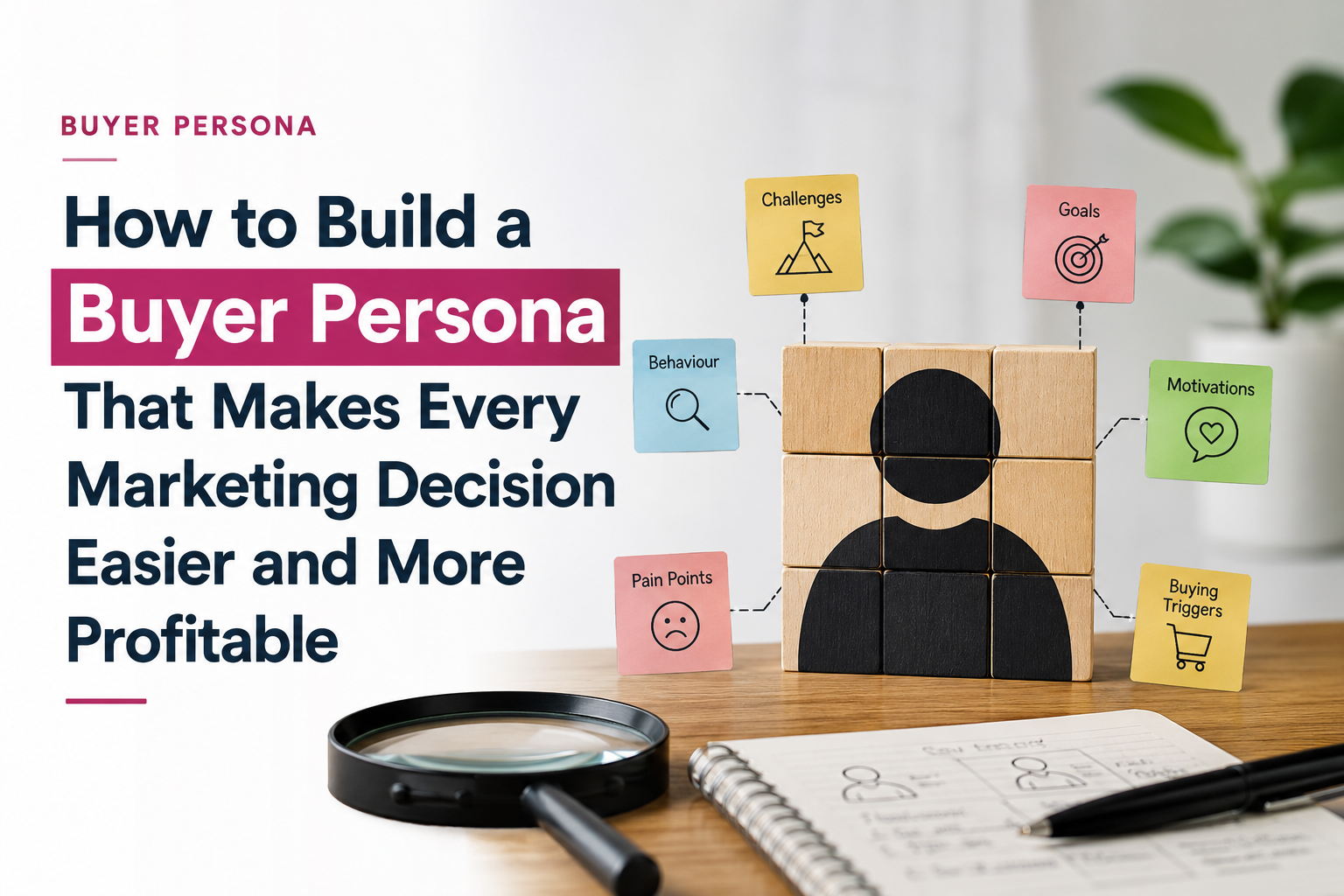
The Essential Components of an Effective Buyer Persona
Background Information
Role, industry, company size, seniority, and scope of responsibility. This is the demographic layer necessary context, but not the substance.
Goals and Objectives
What is this person accountable for? What does success look like in their role? Understanding their KPIs helps you position your offering as a path to their professional goals, not just a product feature list.
Pain Points and Challenges
What problems are they actively trying to solve? Where are their current solutions failing them? Pain points are the clearest signal of buying motivation. Address them directly, and you immediately differentiate.
Buying Triggers
What specific circumstances push this buyer into active consideration? A new financial year, a failed campaign, a competitive threat, a new leadership mandate? Knowing the trigger helps you show up at exactly the right moment with exactly the right message.
Objections and Concerns
What reasons will this buyer give for not moving forward? Budget constraints, internal approval processes, doubts about ROI, risk aversion? Map these explicitly and build counter-narratives into your content and sales materials.
Preferred Information Sources
Where does this buyer go when they want to learn or evaluate? LinkedIn, industry publications, peer networks, YouTube? This directly informs your distribution strategy.
A Practical Buyer Persona Example
Meet Priya, Marketing Manager at a growing D2C retail brand.
Role & Responsibilities: Priya manages a team of four, oversees performance marketing, content, and social media. She reports to the CMO and is responsible for driving monthly revenue targets through digital channels.
Goals: Improve ROAS on Meta and Google campaigns. Build a content engine that drives organic growth. Demonstrate marketing’s contribution to revenue in board-level reviews.
Challenges: Her agency relationships have been inconsistent, with good strategy and poor execution. She’s spending significant time managing vendors rather than focusing on strategy. Her internal team lacks the bandwidth to produce high-quality creative consistently.
Buying Triggers: A poor campaign performance review. A competitor outperforms her brand on social. Pressure from leadership to reduce cost-per-acquisition before peak season.
Objections: Concerned about onboarding time. Worried a new agency won’t understand the brand’s tone quickly enough. Needs to justify the spend to a CFO who’s sceptical of agency ROI.
Preferred Content: Case studies with specific metrics. Concise LinkedIn posts from founders and strategists. Short-form video breakdowns of campaign strategies. Monthly industry benchmarks.
Decision Factors: Responsiveness, proof of category experience, clear reporting structure, and a team that communicates like a strategic partner — not just an executor.
This profile doesn’t just describe a customer. It tells us exactly what to say to her, where to say it, and why she’ll trust us over a competitor.
How Buyer Personas Improve Marketing ROI
Better Content Marketing Decisions
When you know exactly what your buyer is struggling with, you stop producing content that performs well in analytics but drives no pipeline. Every brief starts with the persona’s real concerns, not with what your team finds interesting to write about.
More Effective Advertising Campaigns
Persona clarity eliminates wasted impressions. You know which platforms your buyer uses, what messaging resonates with their specific concerns, and which creative formats prompt action. Targeting becomes more precise. Messaging becomes more compelling. CAC drops.
Improved SEO Performance
SEO stops being about keywords and starts being about intent. When you understand what your buyer is searching for at each stage of their decision journey, you can create content that ranks for the right queries the ones that actually lead to conversion.
Higher Conversion Rates
When landing pages, sales decks, and email sequences speak directly to a buyer’s specific situation their goals, their objections, their preferred proof points conversion rates improve. Not because the design changed, but because the message finally fits the audience.
Better Sales and Marketing Alignment
Shared persona documentation means sales and marketing are operating from the same customer understanding. Marketing produces content that addresses real objections. Sales uses messaging that reflects what marketing has already seeded. The handoff becomes seamless and the pipeline accelerates.
Signs Your Current Buyer Persona Needs an Update
A persona is never truly finished. If any of the following are true, it’s time to rebuild:
• Campaign performance is declining without a clear tactical explanation
• Your sales team regularly encounters objections your content doesn’t address
• You’ve entered a new market segment or launched a new product category
• Customer behaviour has shifted channels they use, content they consume, how long they take to decide
• The assumptions in your persona are more than 18 months old
• Marketing and sales are in constant disagreement about lead quality
Persona updates don’t require starting from scratch. A round of customer interviews and a review of recent behavioural data is usually enough to recalibrate.
Stop Guessing and Start Understanding Your Customers
The biggest mistake brands make isn’t skipping buyer personas. It’s creating personas on assumptions and then treating them as strategic truth. When your buyer persona is built on real data customer interviews, behavioural analytics, sales team insight, and honest pattern recognition, it becomes the foundation that everything else rests on. Better targeting. Sharper content. More efficient ad spend. Stronger conversion rates. Faster sales cycles.
Every successful marketing strategy starts with understanding the customer. When brands invest the time to build accurate buyer personas, every subsequent decision becomes easier, more focused, and ultimately more profitable. At Social Pill, we help brands move from assumption-based marketing to insight-driven strategy. If your current personas were built in a boardroom rather than validated by customers, we should talk.