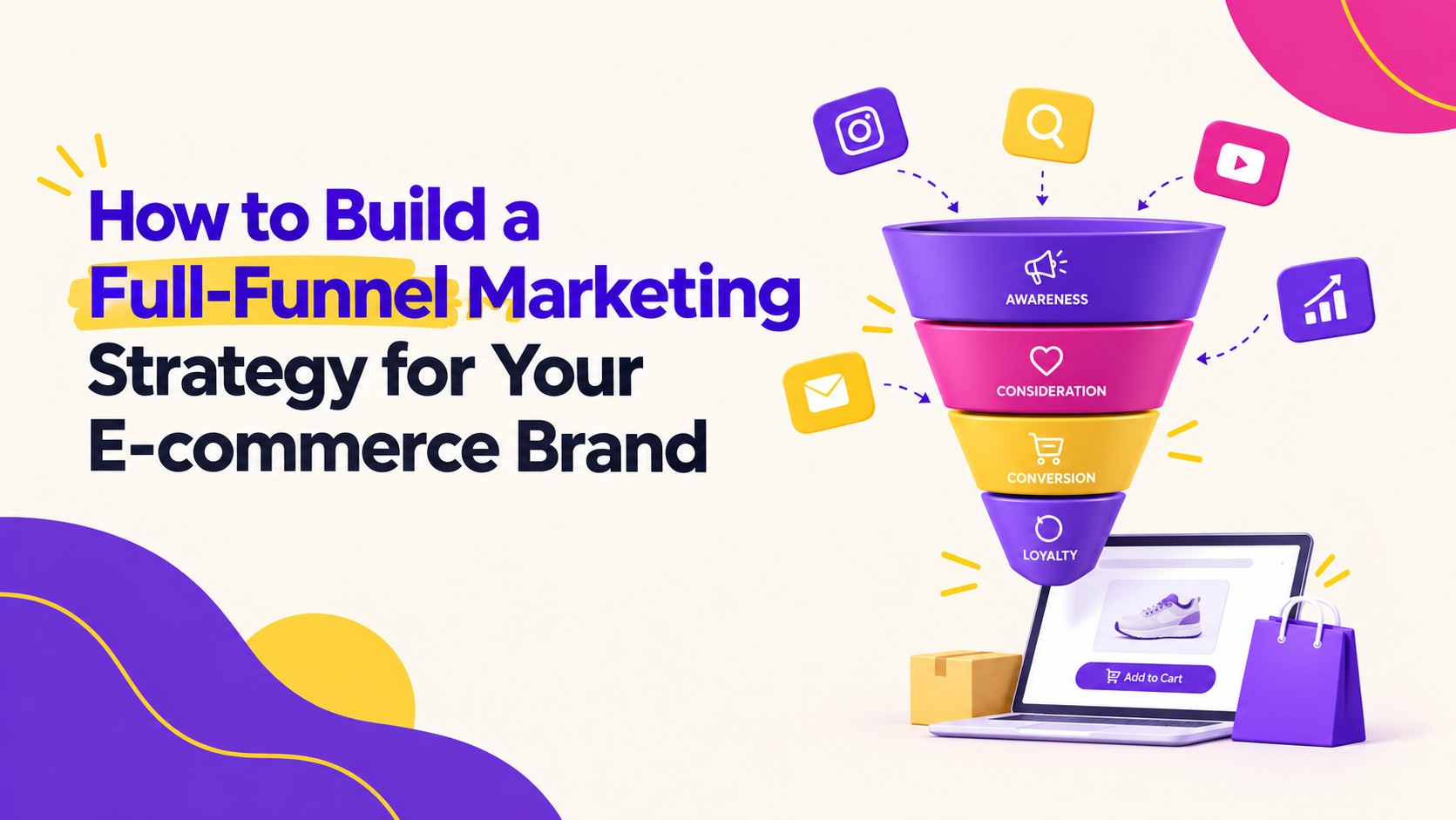
Full-funnel marketing for ecommerce means designing distinct messages and channels for every stage a customer moves through, from first discovering your brand to buying from you again. Performance marketing alone can capture demand that already exists, but it can’t create new demand or bring lapsed customers back. Indian ecommerce is scaling fast enough that relying on capture alone is getting expensive, since more brands are now bidding for the same auction inventory and search terms.
A shopper might see your brand in an Instagram Reel, search for reviews a week later, and compare you against two competitors. They abandon a cart, return through a retargeting ad, and finally buy three weeks after that first Reel. A full-funnel ecommerce marketing approach treats this as one connected journey instead of eight unrelated campaigns fighting for the same performance budget. This article breaks down how to map that journey, assign the right channel to each stage, and measure the whole system instead of just the last click.
What Is Full-Funnel Marketing (And Why E-commerce Brands Get It Wrong)
Most Indian D2C brands start with performance marketing because it’s measurable and fast. Meta and Google Ads show a clean ROAS number, so budgets flow there first. The mistake isn’t running performance ads; it’s assuming they can also build awareness and earn loyalty, two jobs they weren’t designed to do.
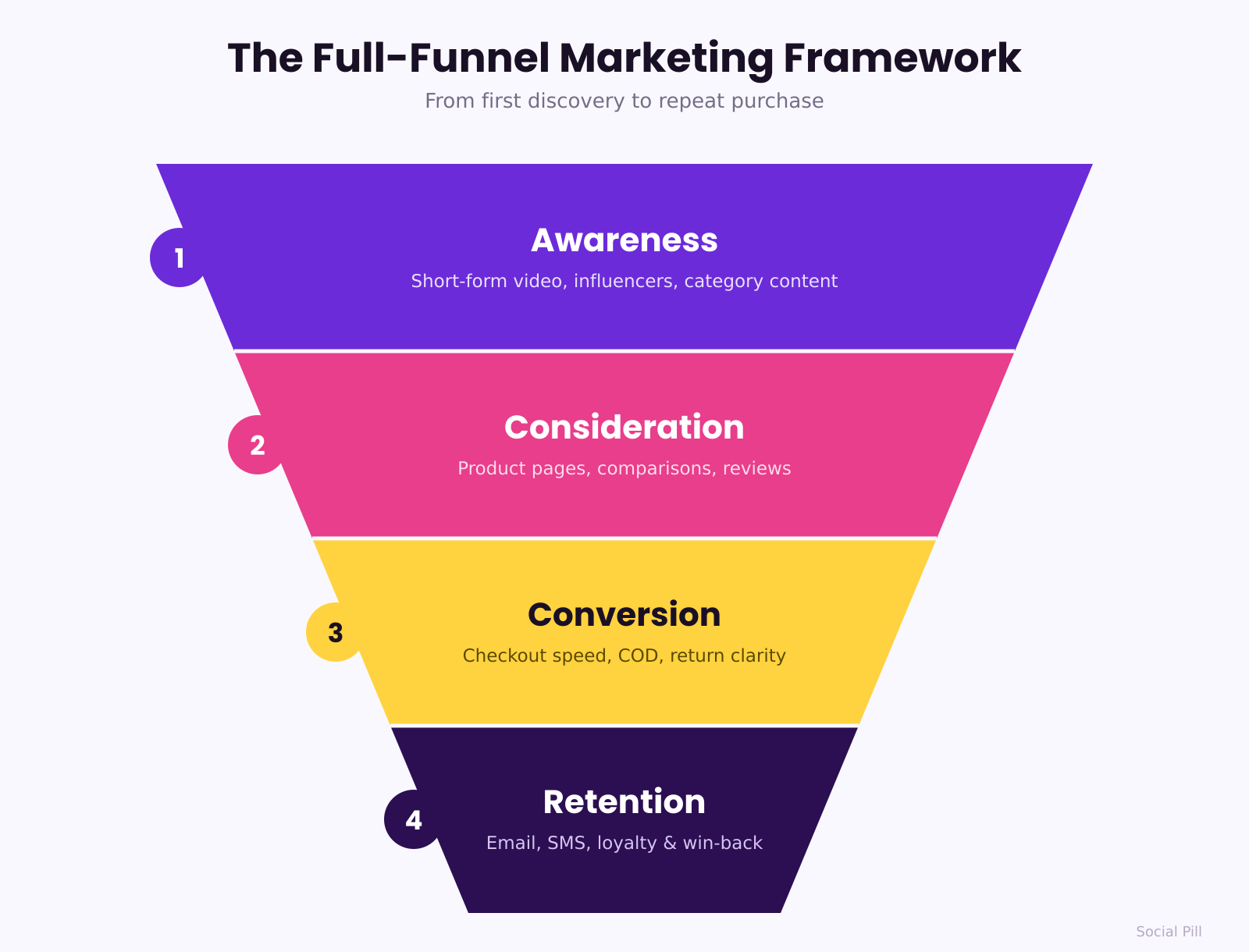
A full-funnel marketing strategy assigns a specific role to each stage of the ecommerce customer journey: awareness, consideration, conversion, and retention. Get one stage wrong, and the others quietly compensate for it, usually by burning budget on an audience that was never going to convert at that price.
Awareness
Awareness marketing introduces your brand to people who have a relevant need but no reason yet to think of you specifically. For ecommerce, this usually means short-form video, influencer seeding, and category-relevant content that doesn’t ask for a sale outright.
A wellness brand selling magnesium supplements might run Reels about sleep quality rather than product shots, because the goal is entering the conversation before the purchase decision even starts.
This week: Pull your last 90 days of Meta and Google Ads data and check what share of spend sits in prospecting versus retargeting. If retargeting is above 60%, your top of funnel is likely underfed.
Consideration
Consideration marketing moves someone who now knows your brand toward actively comparing it against alternatives. This is where product pages, comparison content, reviews, and email capture matter more than ad creative.
An electronics D2C brand might publish a detailed comparison between its earbuds and two popular competitors, because that’s exactly what an undecided shopper searches for at this stage. Thin product pages leak the hardest here.
This week: Open your five best-selling product pages and check whether a genuinely undecided shopper would find enough reason to pick you over a marketplace listing of the same category.
Conversion
Conversion marketing removes the friction sitting between intent and payment. For Indian ecommerce, this often means checkout speed, visible COD availability, clear return policies, and urgency that doesn’t rely purely on discounts.
A fashion D2C brand that shows exact delivery windows and a visible return policy at checkout typically loses fewer carts than one that buries this in an FAQ page.
This week: Run your own mobile checkout on a real 4G connection and count how many taps it takes from cart to a confirmed order.
Retention and Loyalty
Retention marketing turns a one-time buyer into a repeat customer worth more than their first order suggested. This is where most ecommerce marketing budgets simply stop, even though a customer who has already bought once costs far less to sell to again.
Research popularised by Harvard Business Review builds on work by Bain & Company’s Frederick Reichheld. It found that a 5% improvement in customer retention can lift profits by 25% to 95%, depending on the industry. That’s the kind of leverage most ecommerce retention marketing budgets never get a chance to use.
This week: Pull your repeat purchase rate for customers who bought in the last six months and compare it against the rest of your customer base.
Signals You Need a Full-Funnel Strategy (Not Just Performance Marketing)
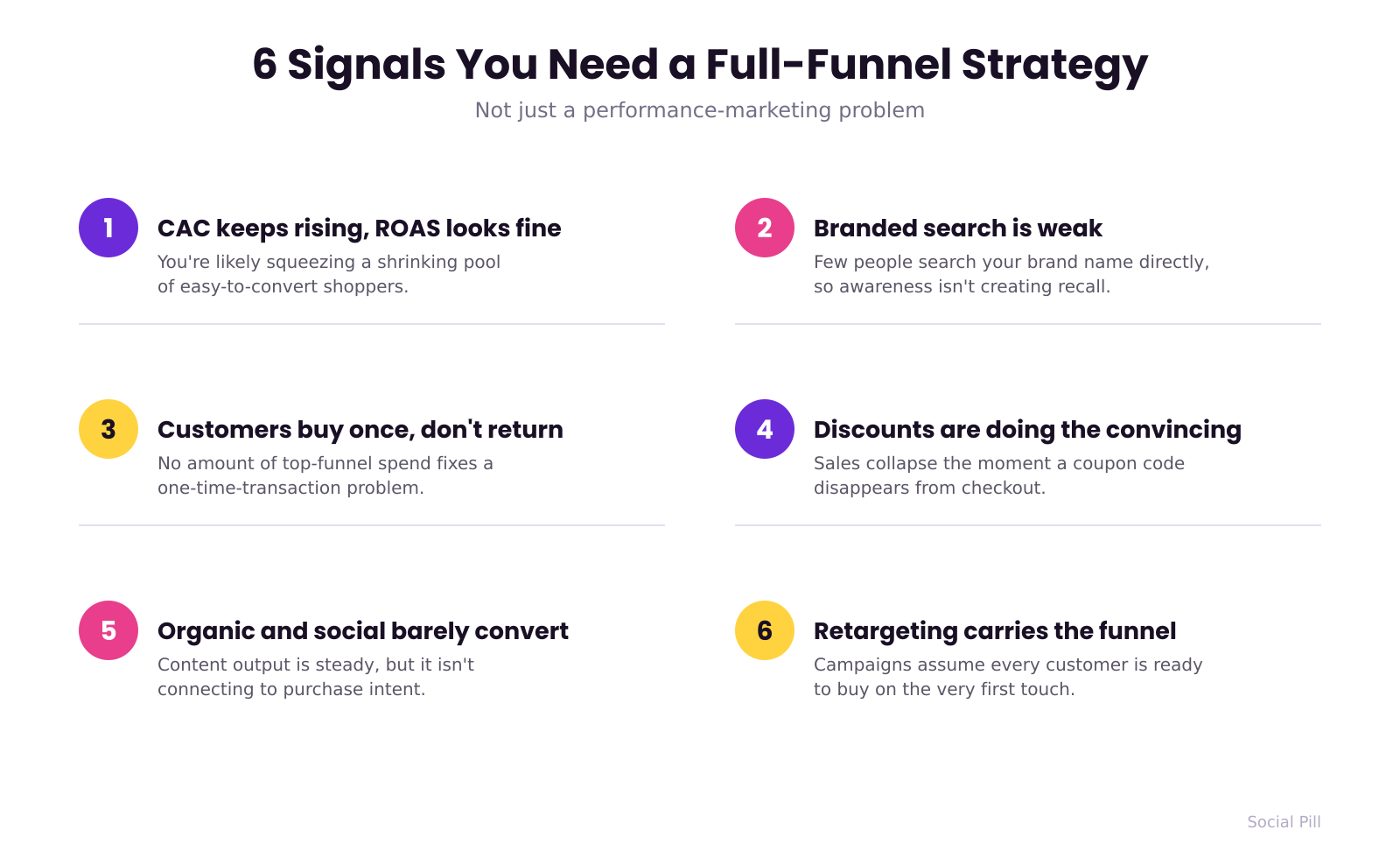
Not every brand needs to rebuild its marketing around four funnel stages immediately. But certain patterns point at a funnel problem rather than a performance-marketing problem. Rising CAC alongside a steady ROAS is one such signal. India’s D2C market is on track to cross $100 billion in scale, which means more brands are bidding for the same search terms and ad inventory every quarter. If your CAC keeps climbing while you protect the same ROAS target, you’re likely just squeezing a shrinking pool of easy-to-convert shoppers.
Weak branded search volume is another. If people rarely search your brand name directly, your awareness spend isn’t translating into recall. Compare this against a category competitor on Google Trends and the gap usually becomes obvious fast. Customers who buy once and never return point to a retention gap that acquisition spend cannot fix on its own. No amount of upper-funnel content changes an economics problem where every customer is treated as a single transaction.
Conversion that depends heavily on discounting is a consideration-stage failure wearing a pricing-strategy disguise. If sales collapse the moment a coupon disappears, the product never actually won the customer over. Finally, look at how much revenue comes from organic and social versus paid. If that share is near zero despite steady content output, your ecommerce sales funnel isn’t connecting content to intent, and it’s worth checking whether your product pages and email flows pick up where that content leaves off.
4. Step-by-Step: Building Your Full-Funnel Strategy
This is where strategy becomes execution. Each step builds on the last, and skipping one usually measurement is why most full-funnel efforts quietly collapse within two quarters.
Step 1 — Map the Customer Journey
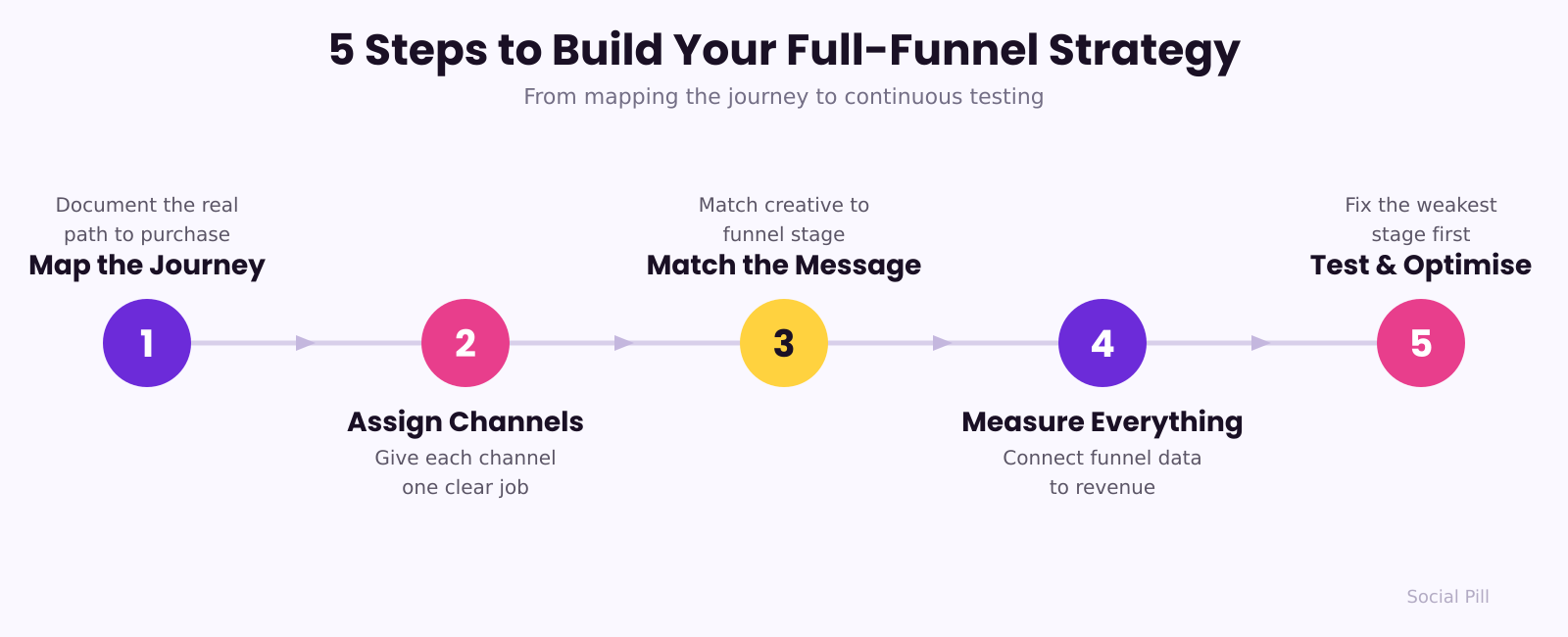
Journey mapping means documenting what a real customer does before, during, and after they buy from you, not what you assume they do.
Pull data from Google Analytics, your CRM, and post-purchase surveys to understand the actual sequence customers follow. A skincare brand might discover that most buyers visit the site three times over 12 days before converting a pattern no single-touch dashboard shows on its own.
This week: Survey your last 50 customers with one question: “Where do you first remember hearing about us?” Tally the answers by channel.
Step 2 — Assign Channels to Funnel Stages
Channel assignment means deciding which platform does which job, instead of pointing every channel toward direct conversion. SEO and influencer content typically build awareness and long-term consideration.
Mapping that content against search intent is what keeps the traffic compounding, and it’s worth reading before you lock this mix in: [INTERNAL LINK: Search Intent and Topical Authority for Ecommerce Brands]. Paid social captures both awareness and retargeting depending on the campaign objective, and Google Search mostly captures intent that already exists rather than creating it. Email, SMS, and CRM own retention and win-back, while affiliate and referral partnerships extend consideration and conversion by borrowing trust from someone the customer already follows. A home decor D2C brand might use Pinterest and SEO for discovery, Google Shopping for intent capture, and WhatsApp for post-purchase care.
This week: Label every active campaign by the funnel stage it’s actually serving, not the stage you intended when you launched it.
Which channels deserve the biggest share of this mix depends on specifics: product category, average order value, purchase frequency, consideration time, brand maturity, existing traffic, margins, and current CAC. A ₹499 impulse snack brand and a ₹15,000 skincare device brand will need entirely different channel mixes, even inside the same “ecommerce” label.
Step 3 — Match the Message to Intent
Message matching means showing different creative and copy depending on how much a person already knows about your brand.
Someone seeing your brand for the first time needs a hook, not a discount code. Someone who abandoned a cart needs a reminder of what they left behind, not a generic brand video. Running one ad set across cold and warm audiences wastes budget on the wrong message at the wrong moment.
This week: Audit your three highest-spend ad sets and check whether the creative assumes the viewer already knows who you are.
Step 4 — Build a Measurement Framework
A measurement framework connects top-of-funnel metrics to revenue, instead of judging every campaign by ROAS alone.
This means reviewing assisted conversions, not just last-click ones, and checking awareness and consideration metrics on a monthly cadence separate from daily performance reporting. If you’re still unsure where SEO fits against paid search in this framework, that trade-off is worth mapping against funnel stage first:
This week: In GA4’s path exploration or Multi-Channel Funnels, check your top five conversion paths and note how many involve more than one channel.
Step 5 — Test and Optimise
Testing means using funnel-stage data to fix the specific weak point in your funnel, not running generic A/B tests on ad copy alone.
If awareness reach is strong but consideration is weak, test product-page content before testing more ad variants. If conversion is strong but retention is weak, test post-purchase email sequences before another discount code. Optimisation only compounds when it targets the stage that’s actually broken.
This week: Identify your single weakest funnel stage from the data gathered in Steps 1 and 4, and run one focused test against it before touching anything else.
How to Measure Full-Funnel Performance
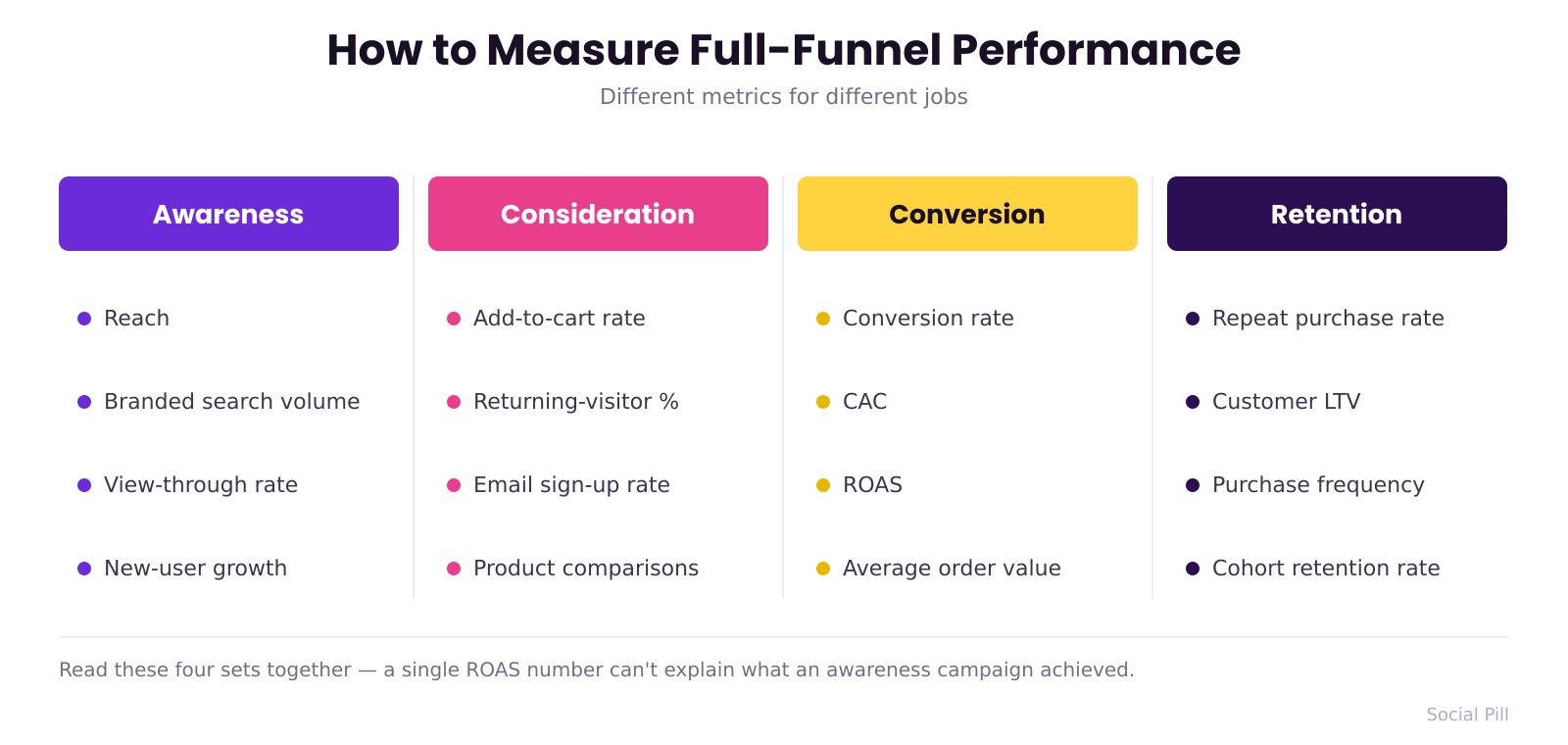
ROAS answers one question well: did this specific campaign generate more revenue than it cost. It can’t tell you whether your brand is growing, whether customers trust you enough to search for you by name, or whether your best customers are coming back. Full-funnel performance marketing needs different metrics for different jobs.
Awareness Metrics
Reach, branded search volume, video view-through rate, and new-user growth show whether more people are entering your funnel. These won’t move revenue immediately, and shouldn’t be judged as if they will.
Consideration Metrics
Add-to-cart rate, returning-visitor percentage, email sign-up rate, and product-comparison behaviour show whether prospects are moving toward a decision. A high add-to-cart rate with weak conversion usually points to pricing or checkout friction, not a consideration problem.
Conversion Metrics
Conversion rate, CAC, ROAS, and average order value belong here the metrics most brands already track closely. The missing piece is context: strong ROAS built entirely on retargeting an audience your awareness spend created isn’t purely a performance-marketing win.
Retention Metrics
Repeat purchase rate, customer lifetime value, purchase frequency, and cohort-based retention rate show whether the funnel keeps working after the first sale. Excellent conversion metrics paired with falling retention often mean a product or fulfilment issue is being masked by acquisition spend.
The real skill is reading these four sets together, not separately. An awareness campaign shouldn’t be paused for a mediocre same-day ROAS; it should be judged on whether branded search and direct traffic rose over the following weeks. This is also where attribution gets misleading: last-click reporting assigns full credit to whichever channel closed the sale, usually retargeting or branded search, even when a Reel or an organic post started the journey weeks earlier. Treat last-click data as a partial view of what happened, not a full explanation of what worked.
Common Mistakes E-commerce Brands Make
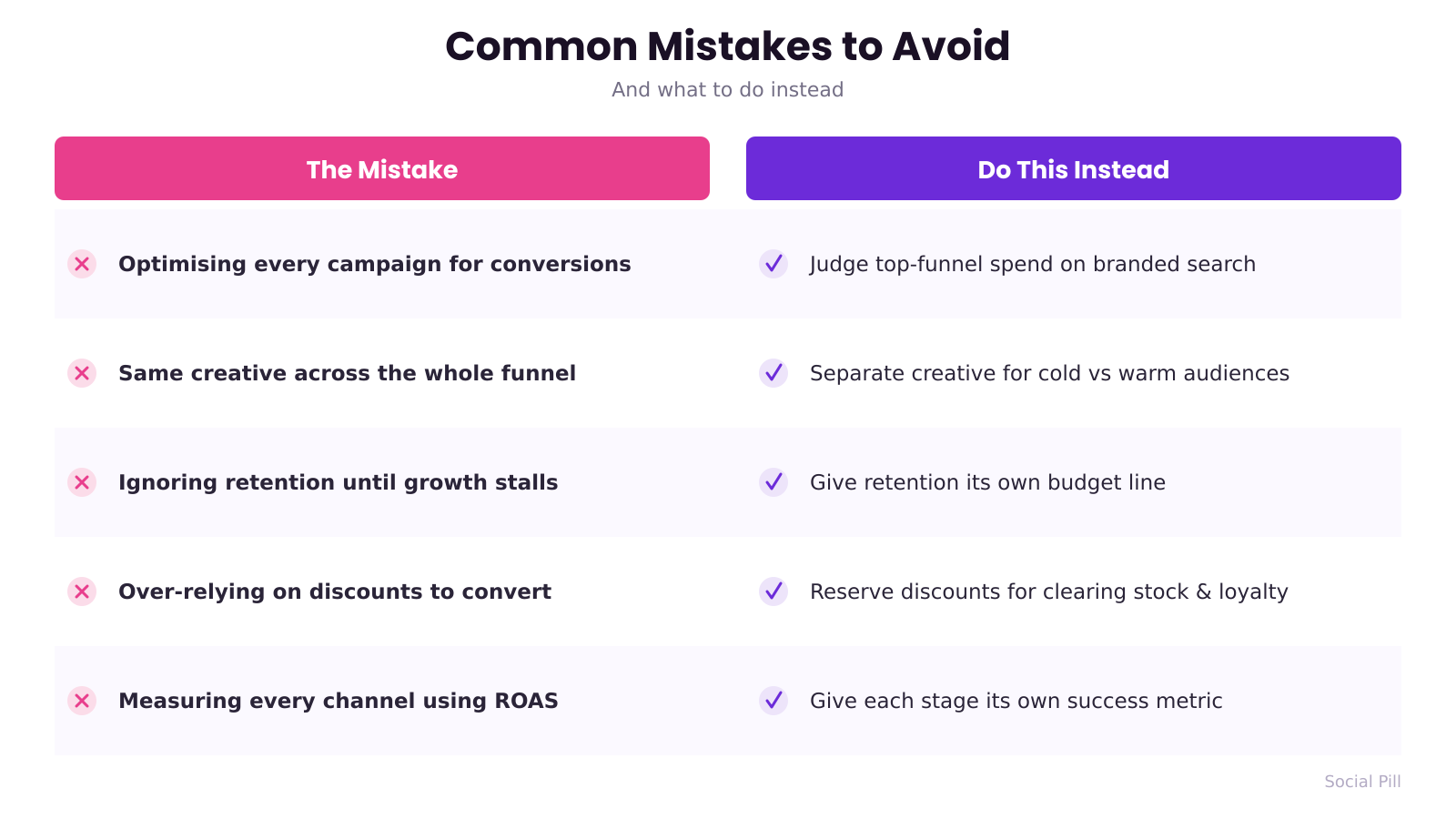
Optimising every campaign for immediate conversions. This forces awareness content to justify itself on same-day sales, so brands cut it before it has time to work. Judge upper-funnel spend on downstream signals like branded search and returning traffic instead.
Running ads without building brand demand. Performance campaigns eventually exhaust the warm audience available to retarget, and CAC climbs as a result. Pair paid acquisition with a steady content or influencer presence that keeps feeding new prospects into the top of the ecommerce marketing funnel.
Using identical creative throughout the funnel. A cold audience and a cart-abandoner need different messages, yet many brands run one ad set everywhere to save production time. Build at least two creative variants one for discovery, one for a warm audience before scaling spend further.
Ignoring retention until growth stalls. Retention is usually the last function to get budget, even though it holds the cheapest revenue a brand already owns. Give retention its own budget line, separate from acquisition, before the funnel forces that conversation.
Over-relying on discounts to drive conversion. Discounts train customers to wait for the next sale instead of building genuine preference. Reserve discounts for specific goals, like clearing inventory or rewarding loyalty, instead of using them as the default conversion lever.
Measuring every channel using ROAS. Applying a bottom-funnel metric to an awareness campaign makes it look like it failed, so it gets cut first. Give each funnel stage its own success metric before deciding its budget.
Failing to connect CRM data with acquisition campaigns. Without this link, brands keep spending to acquire customers who look identical to ones who already churned. Feed your best-customer profile back into lookalike audiences at least once a quarter.
When NOT to Go Full-Funnel Yet
Full-funnel marketing is a scaling strategy, not a starting-point strategy. Brands without product-market fit should fix that first, since no amount of awareness content converts customers who don’t want the actual product.
The same applies to a website with real conversion issues. Slow load times, confusing navigation, or a clunky checkout suppress results at every funnel stage simultaneously, which makes it impossible to tell which stage is actually underperforming. Fix the website before diagnosing the funnel.
If your acquisition economics don’t work CAC consistently higher than what a customer is worth over their lifetime adding awareness spend just accelerates the losses. Solve the unit-economics problem at the bottom of the funnel before investing further up it.
Brands with limited traffic or historical data face a different issue: there isn’t enough signal yet to know which stage is genuinely weak. Spend a few months building basic volume and clean tracking before layering in a full-funnel strategy for ecommerce brands of this size.
A full-funnel approach also assumes a budget that can support more than one stage meaningfully. A brand spending ₹1–2 lakh a month is usually better served concentrating on one or two channels done well, rather than spreading thin coverage across four stages. Brands weighing whether to build this capability in-house or bring in outside support at this stage should read. If you’re also confused about in-house marketing teams and Digital Marketing Agency, check out our blog on Digital Marketing Agency vs. In-House Team
Finally, if analytics tracking isn’t configured properly, or inventory and fulfilment problems are already hurting customer experience, fix those fundamentals first. A full-funnel strategy amplifies whatever is already happening in your business, good or broken.
Conclusion
Full-funnel marketing for ecommerce isn’t about running campaigns on every channel available. It’s about matching the right message, channel, and metric to where a customer actually stands in their journey with your brand.
Most Indian D2C and ecommerce brands don’t have a channel problem they have a sequencing problem, running every campaign as if every customer is ready to buy today. Start by mapping where your funnel genuinely leaks, fix that one stage with a proper measurement approach, then expand from there. Treating the customer journey as connected rather than transactional is what separates brands paying more each quarter for the same growth from ones that compound it.
FAQs
1. What is full-funnel marketing for ecommerce?
Full-funnel marketing connects awareness, consideration, conversion, and retention into one connected ecommerce customer journey.
2. What are the stages of a full-funnel marketing strategy?
The four key stages are awareness, consideration, conversion, and retention.
3. How do you create a full-funnel marketing strategy for ecommerce?
Map the customer journey, assign channels to each stage, match messages to intent, measure performance, and optimise weak points.
4. How do you measure full-funnel marketing performance?
Use stage-specific metrics such as reach, add-to-cart rate, CAC, ROAS, repeat purchase rate, and customer lifetime value.
5. What is the difference between full-funnel and performance marketing?
Performance marketing focuses mainly on measurable conversions, while full-funnel marketing covers the entire customer journey.