Picture a content meeting. One person says lets do a 10 best kind of post, those always get clicks. Someone else says no, no, let us do a real in depth guide, we need to do something that builds trust. They are both right, but also both wrong.
The truth is, you can’t decide on your content type in a vaccum, you have to start by thinking about what it is the person reading it wants to accomplish. Once you know that, the choice is simple, but get that wrong and you will inevitably fall into one of two traps. A listicle that drives traffic but no enquiries, or an incredible guide that took six weeks to produce that no one finishes reading.
As a content writing agency in Mumbai, we see this choice come up in almost every content plan. This blog is yours, it has been created for founders, CEOs and marketing directors who commission content, but who have better things to do than learn about SEO.
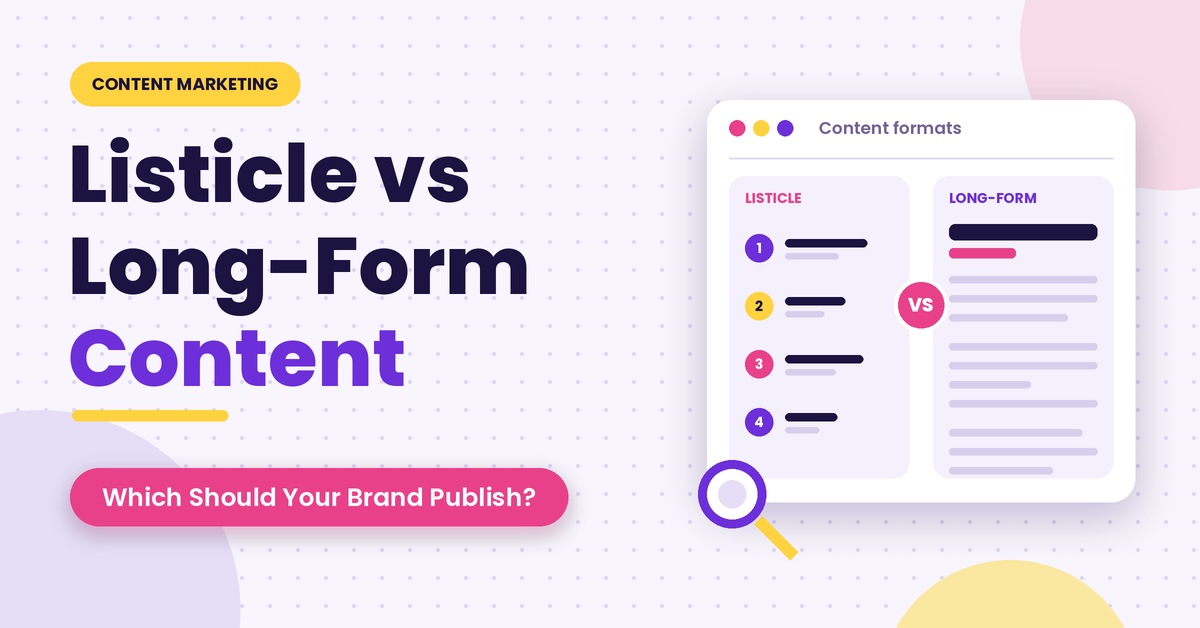
What is the difference between a listicle and long-form content?
A listicle is an article organized as a list. “7 mistakes to avoid when hiring an agency” is a listicle. Each item on the list is a self-contained piece of writing. You can probably skip one and not miss anything.
Long-form content is something longer than a short-form piece. This could take the shape of a descriptive essay, a detailed guide, or a long-formatted persuasive essay. The text is meant to be read sequentially, meaning that one has to follow it from start to finish to truly follow what’s being said.
It has nothing do with length, actually. As mentioned above, a listicle can easily be two thousand words long. The format is different, and so are the reading patterns of the audiences. One reads a listicle by scanning down the list and stopping on the one that interests them. One reads a long-form content by engaging in the text and following it wherever it goes.
Keep that in mind as you proceed with the rest of this blog. Everything else you see here is explained in that first piece of content.
Which one ranks better on Google?
Neither wins every time, so Google will return results that it thinks users will want to see for a particular search query. Your first task is to look at the search results and see what formats are popular for the type of search being done.
Do a Google search for the keyword and look at the first page of results. If you see a number of list posts, such as 9 best or 6 most common, then the user is likely looking for a comparison of the different options. If you see a lot of in-depth guides, then the user is looking for more information on the subject. The most common mistake people make is to select a post type based on what they think the user wants, instead of what the user clearly wants.
The other thing to consider when searching is that whichever post type you choose should be better than what is already there. Being a little more useful or informative won’t hurt either! If you’re working with an SEO agency in Mumbai, or building this in-house, make the page-one check the first step of every content brief. It takes ten minutes and saves weeks of guessing.
Which one brings in better leads?
This one is the absolute favourite with business owners, so listen closely.
Visualize your customer’s buying process. What are they likely to do first? Pose broad questions like ‘what are my options’ or ‘what should I not do’. A numbered list is a perfect tool to scratch those itchis; it’s scannable, easy on the eye, and helps the reader to create a short, punchy wish list. If you appear on there with a helpful listicle you’ve created people are more likely to remember you. But later on in their buying journey they’re going to become more serious. This is when customers are about to make an expensive commitment or they’ve entered the risk reduction phase.
An easy way to remember it is that listicles help people to find you, and long-form helps people to trust you. But this is a trend. Your audience may do the opposite, so remember to track your analytics and see which type of guest post is getting engagement and not just visits.
When should you choose a listicle?
Go for a list when:
- People are comparing. They may use words such as “best”, “top”, “tools” or “mistakes”.
- The first page of Google is full of lists. The market has already told you what it needs.
- The topic breaks down into distinct points that can be discussed individually
- You want people to share it. It’s a listicle, so it’s easy to forward to a colleague.
- Speed matters: a new regulation, a change in platform or a trend that you want to talk about this week.
When should you choose long-form content?
Consider crafting a guide or a lengthy article when:
- Information requires contextualization: when you think one idea follows another, a simple list won’t do.
- You have to make a meaningful choice or take a big step, which requires further elaboration and explanation.
- You need to demonstrate your expertise on a subject, requiring that you lay out a method, system or provide a case study.
- Your audience needs background information before they can evaluate your argument, compare items or understand much of anything at all.
- You want to write multiple pieces that build on one another, which is infinitely easier if you have one large post to excerpt and repurpose.
Can you use both together?
Yes. For most businesses, that’s the best answer.
The easiest solution is to create a pair of them. One will be a list of answers to briefly introduce what you’re planning to say in the detailed guides. The second one will be a list of articles covering different areas of the same topic. You can also use the first piece to attract some traffic and engage people with more in-depth content.
Let’s take an example. An agency that specializes in measuring the effectiveness of content has to publish something like “7 metric categories to evaluate your content results.” They need to provide a thorough explanation of how to introduce and read each metric category. So that they can publish additional guides and attract a bigger audience. One article will have brief explanations, while others will give comprehensive advice for those who are interested.
One important thing is to avoid creating two pieces on the same subject for the same search query. It will lead to cannibalization, meaning that your content will compete against itself.
How can a business leader decide? Ask these five questions
Before approving your content brief, ask your team these questions:
- What does page one of Google look like? A list of articles, guides, or a mix?
- Who is searching and how far are they from buying? Curious browsers or ready to make a decision?
- Do we have a topic that requires separate points or a story? Avoid lists without a story if possible.
- What should we have the reader do next? A list can lead to a free checklist. A guide can lead to a conversation.
Can we do this right with the time and people we have? A rushed guide is worse than a strong list. The opposite is also true.
Conclusion
The listicle versus long-form question is not a question about copywriting style. It is a question about your reader. Who are they, what are they seeking to accomplish, and what do they need from you in order to make the leap from reader to customer?
Once you understand who you are writing for, the format will typically select itself. When it doesn’t, use both: write a listicle to attract attention, and follow up with a longer-form piece to establish trust. No matter which format you select, apply the same stringent standards to your writing. Support every statement, use only verifiable examples, and ensure that the reader always walks away with more information than they had when they arrived.
Not sure which formats your content marketing plan requires? Our experts at Social Pill, a digital marketing agency in Mumbai, can help you select and develop them. We specialize in doing the research, the analysis, and the writing, so that you can focus on the results. Contact us today.