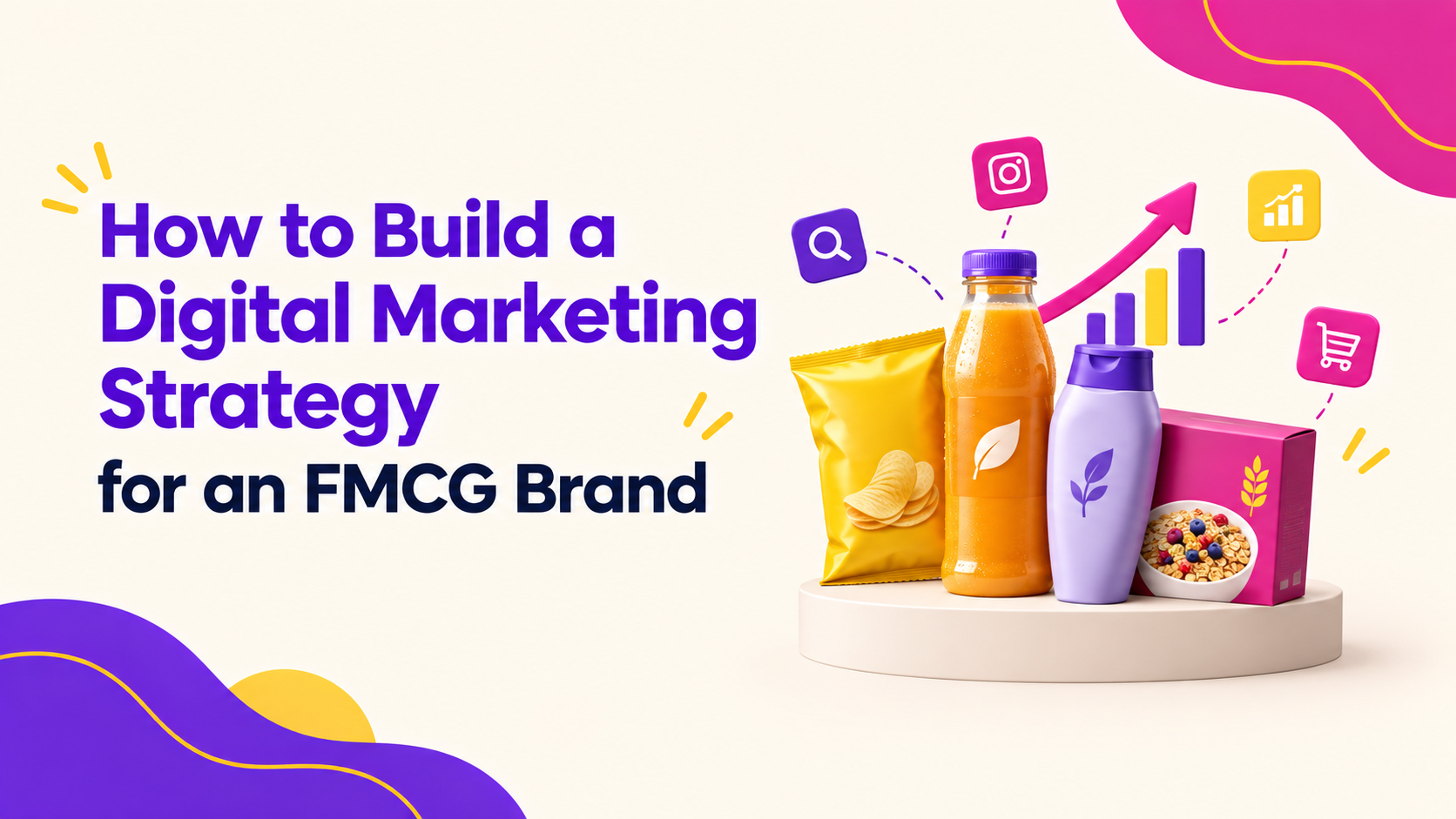
A digital marketing strategy for an FMCG brand links activity to product availability, first purchase and repeat buying. FMCG stands for fast‑moving consumer goods which’re everyday items such as snacks, beverages and personal care. Each unit earns an amount shelves are crowded and many shoppers now find products on their phones before they buy..
Most guides list tactics without showing a starting point. This guide gives you an order of work. It covers seven steps from audit, to measurement and digital marketing strategy shows how to connect effort to online and offline sales.
What Is a Digital Marketing Strategy for an FMCG Brand?
A digital marketing strategy for an FMCG brand is a plan that brings together channels what customers need how products are distributed and what the business wants to achieve through awareness trying the product buying it and buying it again. It helps the team know where to be, who to target and how to measure success. Strategy and tactics are not the same. Strategy is about setting the goal choosing the audience and making sure all activities fit together. Tactics are the steps taken to make the strategy happen like running ads posting Reels or working with creators.
FMCG products are sold in kirana stores, supermarkets, marketplaces and quick-commerce apps. So the digital work you do needs to help people find the product and see that it is available, on all those platforms. Working with a Digital marketing agency for FMCG brands in India can help connect these pieces, but the plan should start with your own goals.
Why Is FMCG Digital Marketing Different From Other Industries?
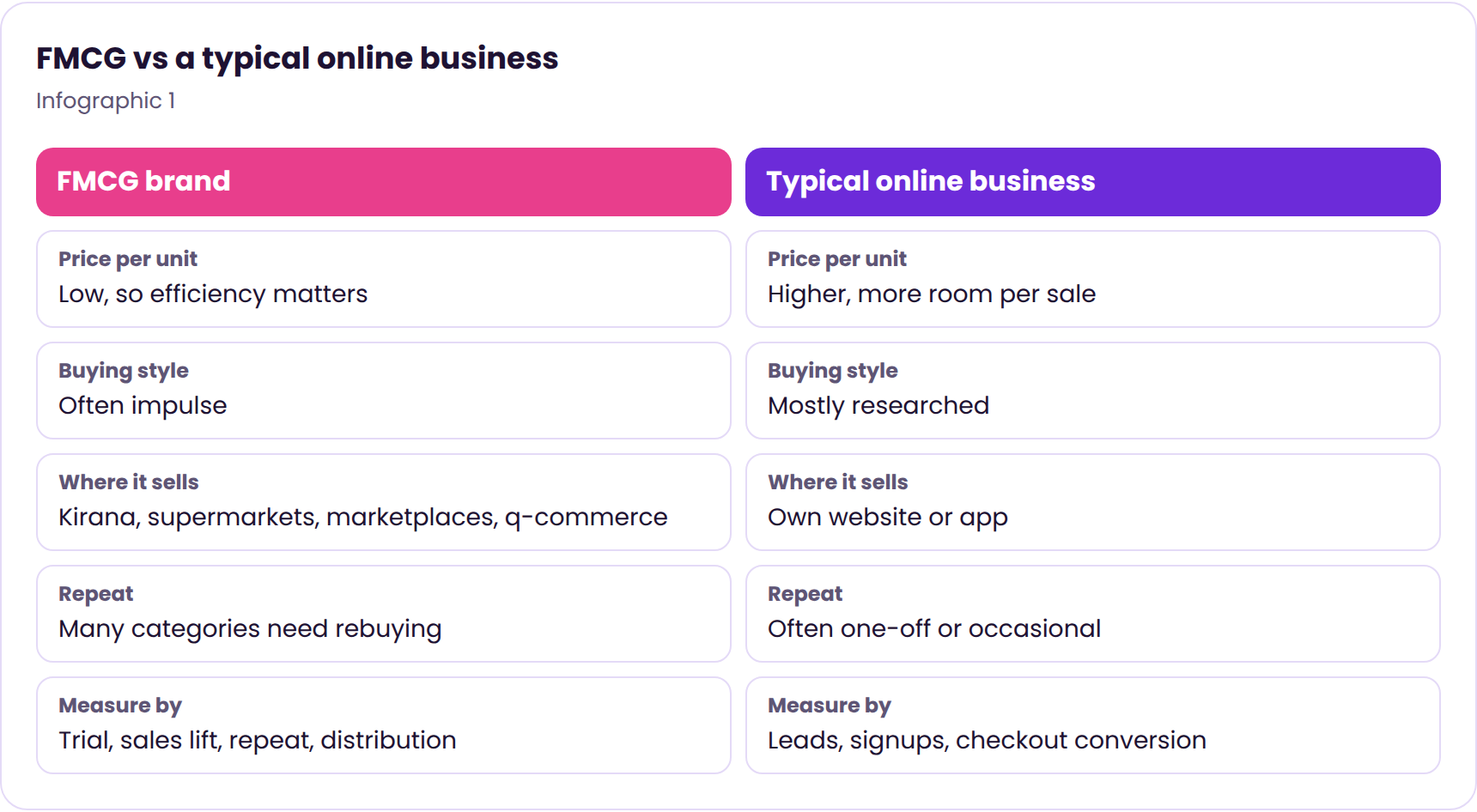
Because FMCG brands sell low-priced products, often on impulse, through shops they do not control. Four traits shape the strategy:
- Low price per unit. Revenue per sale is small, so marketing efficiency matters.
- Impulse buying. Visibility, packaging, availability and offers can swing quick decisions.
- Retail dependence. Online interest does not become sales if the product is missing from the local shelf or app.
- Repeat purchase. Many categories need customers to buy again, not just try once.
These traits change the way you measure. Clicks, followers and video views do not tell the story of traits. Look at trial sales lift, repeat purchase, distribution and cost where reliable data exists. Packaged food, beverages, personal care and household goods can behave differently so do not assume one buying cycle fits all.
How Do You Build a Digital Marketing Strategy for an FMCG Brand? (7 Steps)
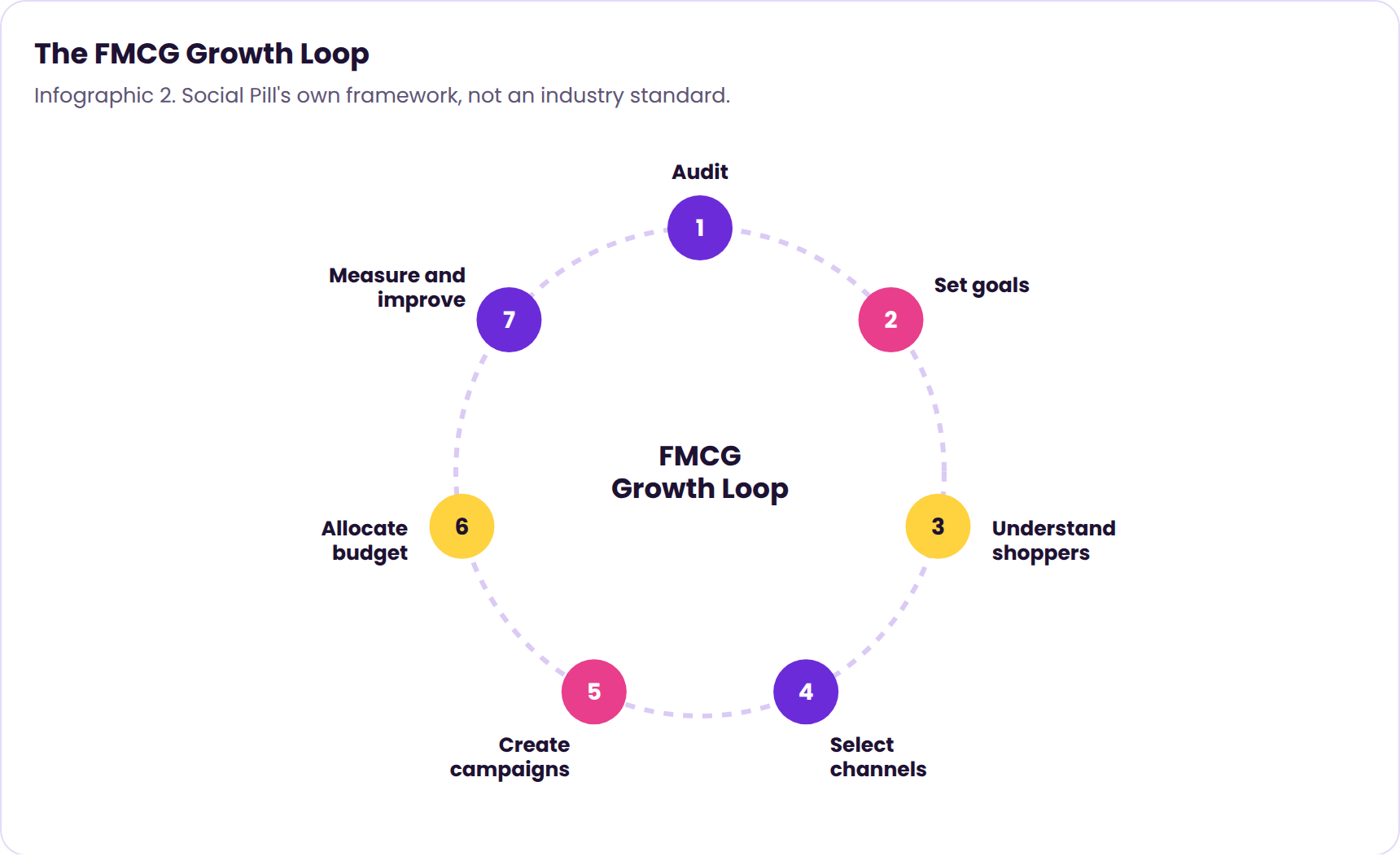
An effective approach begins with an assessment of where your brand is right now. It finishes with checking the outcomes and using that information to build the plan.
We refer to this method as the FMCG Growth Loop: Audit, Set Goals, Understand Shoppers, Choose Channels Make Campaigns, Assign Budget, Check and Get Better. It is Social Pills way of structuring the work not a recognized industry system.
Step 1: Audit Where Your Brand Stands Today
An audit shows what already works and where you lose visibility or sales. Check five areas:
- Website, mobile experience and organic search visibility. An SEO agency in Mumbai or your in-house specialist can review this quickly.
- Marketplace listings, images, descriptions and ratings.
- Quick-commerce listings, availability and discoverability.
- Social profiles, content, creators and past campaign results.
- Distribution coverage, stock and known sales trends.
Mark each area as strong, needs improvement or not yet measured. This sets a baseline before you spend more on advertising. Not every brand has full retailer-level data, so note the gaps too.
Do this week: ask your team to complete this one-page audit.
Step 2: Set Sales-Linked Goals
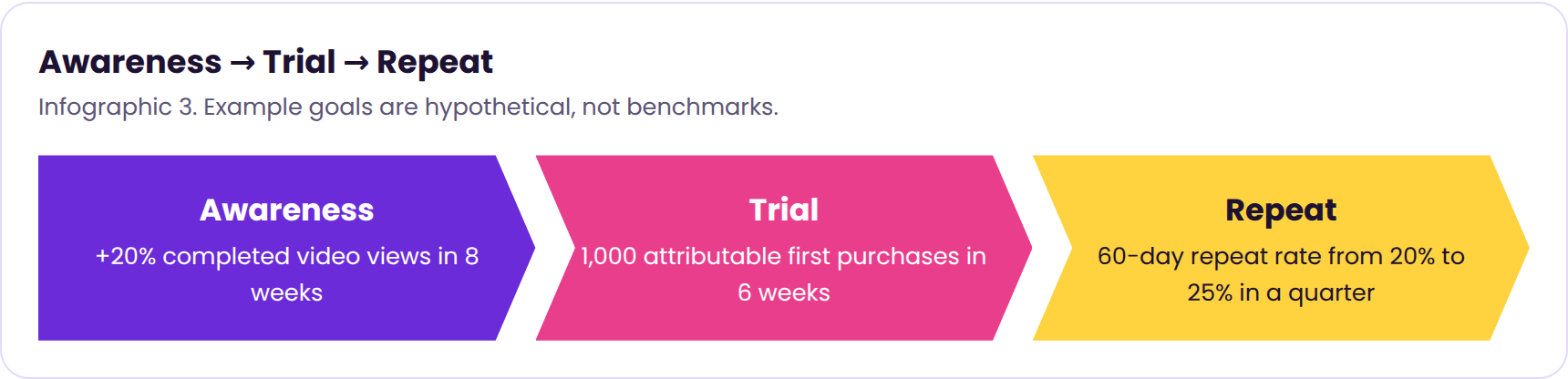
Goals must connect marketing to a business result. Provide three types of goals. Each goal should be written as a SMART goal. A SMART goal is one that’s specific, measurable, achievable, relevant and time‑bound.. These figures are hypothetical examples, not benchmarks:
- Awareness: increase completed video views among your target audience by 20% over eight weeks.
- Trial: generate 1,000 attributable first-time purchases in six weeks, where purchase tracking exists.
- Repeat purchase: lift the 60-day repeat rate of an eligible customer group from 20% to 25% in one quarter.
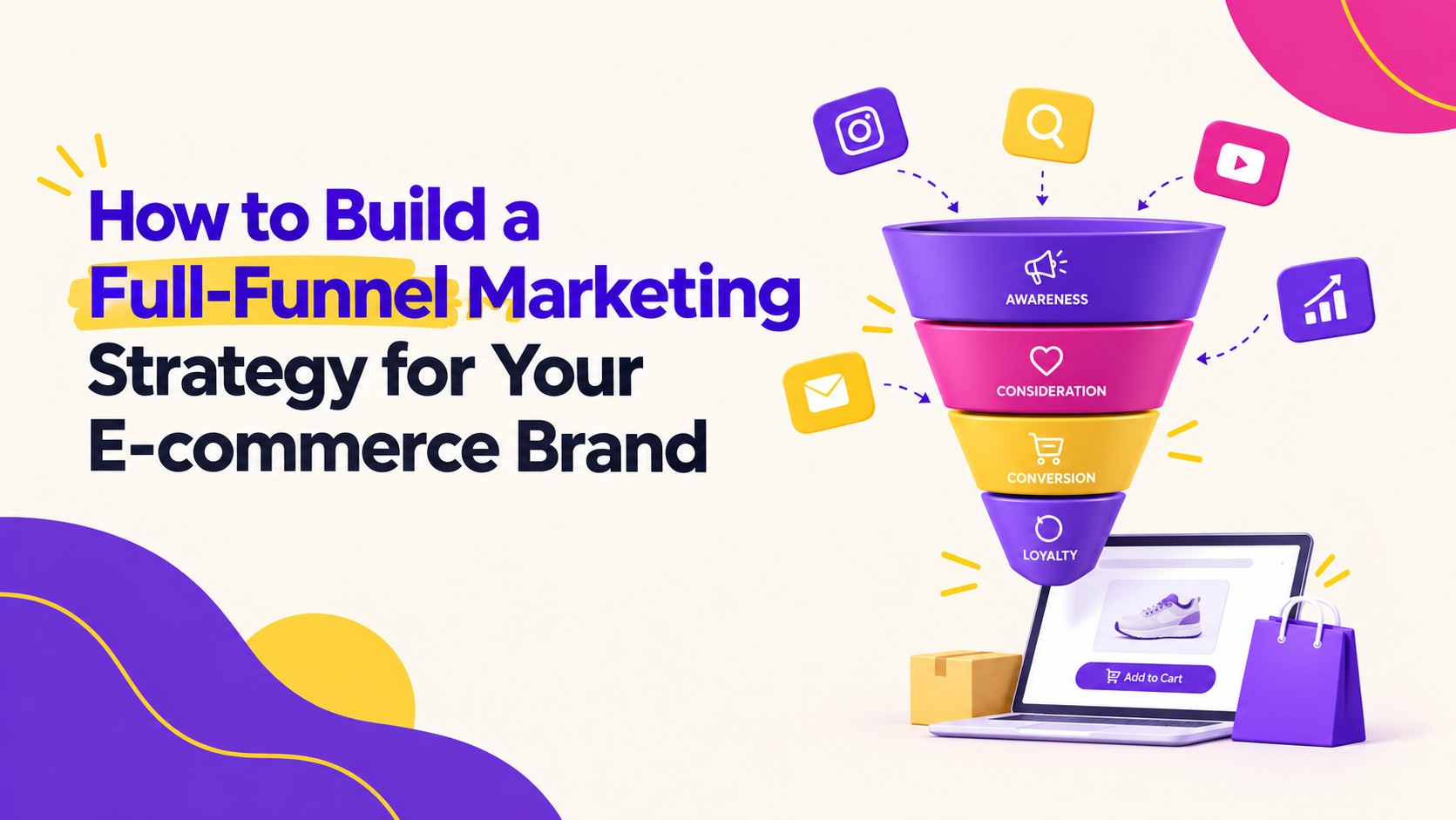
Your real targets should match what you’ve done before your budget, the category you’re in and how well you can track results. Saying “Gain 10,000 followers” is not strong, on its own. It doesn’t show if people actually tried the product or bought it. You need goals that prove customer action, not just numbers. Our guide to a full-funnel marketing strategy explains the funnel logic in more depth.
Do this week: write one goal for each stage.
Step 3: Understand Your Shopper
The buyer is not always the consumer. A parent might buy a snack that a child picked out or one person in a household could choose detergent for everyone. There are differences between kirana store shoppers and online shoppers between metro city customers and those in Tier 2 or Tier 3 towns. There are also differences between people who use content and those who prefer regional languages.. There’s a big gap between impulse buys and purchases that are planned in advance. Never assume that all people in a city income group or language group are the same.
Create two or three shopper profiles. Include what motivates them to buy what stops them how they find products, their language or location needs and how the product fits into their life. Our post, on building a buyer persona gives one way to do this.
Do this week: interview a few existing customers, or review available research, to find common purchase triggers.
Step 4: Choose Channels by Funnel Stage
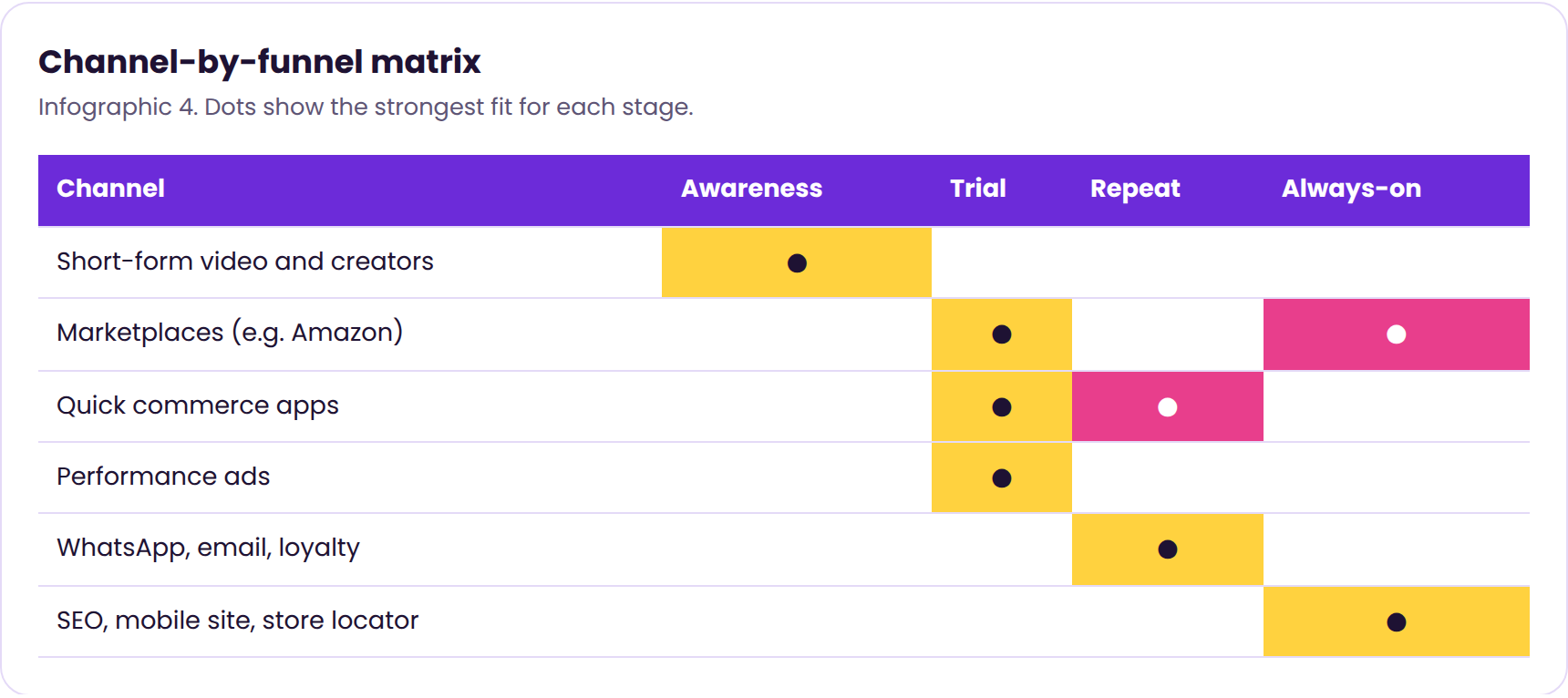
Pick channels by goal, audience, category and distribution. You do not need every platform.
- Awareness: short-form video, creator collaborations and reach campaigns. A social media marketing agency in Mumbai can plan and run these.
- Trial: marketplace and quick-commerce placements, sampling and performance advertising where conversion tracking exists. Judge every campaign by the outcome it was built for, whether you run it in-house or with a Performance marketing agency in Mumbai.
- Repeat purchase: opt-in WhatsApp messages, email, loyalty programmes and careful retargeting.
- Always-on discovery: SEO, a fast mobile site, a store locator and accurate marketplace listings, so people can find and buy you.
Quick commerce refers to apps such as Blinkit, Zepto and Swiggy Instamart that deliver food and goods within minutes. Industry reports call these apps growing advertising platforms where shoppersre almost ready to buy. A quick commerce marketing strategy therefore begins with basics: titles and images, accurate stock and correct delivery locations.
Marketplaces such, as Amazon fit planned, wide‑catalogue shopping. Quick commerce fits local small‑basket orders so availability matters even more. Ad products and reports differ by platform so check each platform’s options. Quick commerce supports discovery and purchase intent. Quick commerce does not replace distribution.
Do this week: pick one channel per funnel stage, then check your top three products’ listings and stock on each q-commerce app.
Step 5: Plan Content and Campaigns
FMCG content should make products relevant to daily life and give people a reason to try them. Use four pillars:
- Product use: demonstrations, benefits and everyday applications.
- Recipes and tips: food ideas, usage and storage tips, household advice.
- Creator and consumer content: creator partnerships, demonstrations and user-generated content. Get permission before reusing customer posts.
- Offers and campaigns: launches, bundles and festive promotions.
Create a calendar for your category. Add versions in languages when they make sense. Keep the message the same across creators, social media, marketplaces and ads. Place QR codes on packs that open recipes, demos or product details. Show that creator partnerships are paid as the Indian advertising rules say. To get ideas look at our guide to social media strategies, for FMCG brands.
Do this week: plan one week of content around a single product benefit and adapt it for two or three channels.
Step 6: Allocate Your Budget
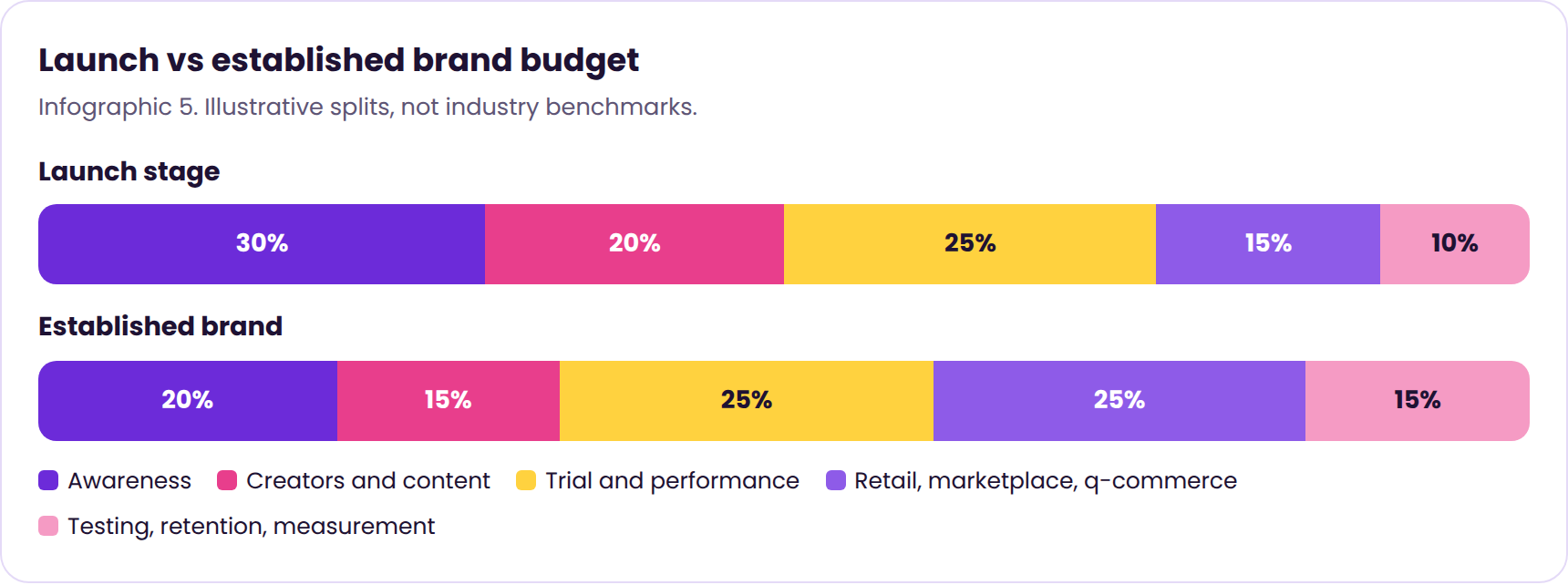
Budgets should reflect your stage, distribution, goals, current results and ability to measure. Here are two illustrative splits for planning discussions. They are not industry benchmarks.
| Budget area | Launch stage | Established brand |
| Awareness and brand building | 30% | 20% |
| Creators and content production | 20% | 15% |
| Trial, performance and conversion | 25% | 25% |
| Retail, marketplace and q-commerce activity | 15% | 25% |
| Testing, retention and measurement | 10% | 15% |
A new brand might require time and effort to be discovered and tried by customers. An established brand can focus more on channels that have already proven effective and on keeping existing customers. It’s important to set aside some budget to test new ads, new groups of people and new places where ads can appear. If the product isn’t widely available don’t spend much on advertising in places where people can’t actually buy it. Our comparison of SEO vs paid ads can help you weigh organic and paid spend.
Step 7: Measure and Optimise
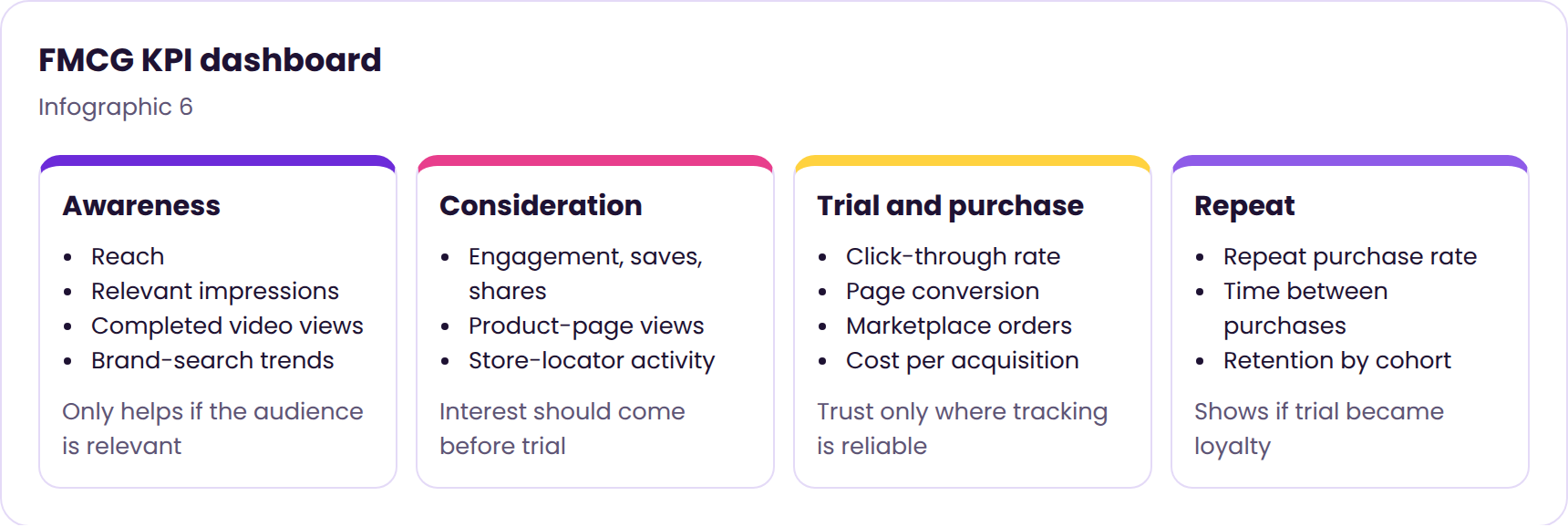
Measurement links marketing activity to business results.
| Funnel stage | Main objective | KPIs | How to read them |
| Awareness | Reach the right people | Reach, relevant impressions, completed video views, brand-search trends | Growth only helps if the audience is relevant |
| Consideration | Build interest | Engagement, saves, shares, product-page views, store-locator activity | Rising interest should come before trial |
| Trial and purchase | Win the first sale | Click-through rate, product-page conversion, marketplace orders, attributable purchases, cost per acquisition | Trust these only where tracking is reliable |
| Repeat purchase | Bring buyers back | Repeat purchase rate, time between purchases, retention by cohort | Shows whether trial became loyalty |
Also track business impact: sales, regional sales lift and return on advertising spend. But only if measured correctly. You need to know the difference between two ideas. Attributed sales are the ones credited to a campaign by a measurement system. Incremental sales are the sales that would not have happened otherwise.
To connect offline and online use QR codes on packs UTM-tagged links (these tags show where a click came from) store locators, retailer or marketplace reports regional comparisons and controlled tests. Regional comparisons can be distorted by season, distribution, pricing and stock. A simple, before-and-after jump does not prove a campaign caused the change. On commerce review the SKU-level and city-level data each platform provides.
Hold a monthly review:
- Compare results with your goals.
- Find the best channels and creatives.
- Investigate weak results and tracking gaps.
- Check product availability and distribution.
- Move budget based on evidence.
- Document the next tests.
What Does a Sample 90-Day FMCG Digital Plan Look Like?
What Are Real Examples of FMCG Digital Strategies?
MAGGI: an idea, tailored to each city. Nestlé India’s MAGGI Ready Family Jolly platform has just spread to eight cities in Tamil Nadu, such as Chennai and Madurai. In Nestlé India’s press release MAGGI used city‑specific slogans and placements on billboards, social media and print. This effort was not just digital. The lesson from MAGGI is to start with one core idea and then change the words and references for each market. Nestlé India has not shared sales numbers so no growth claim can be made. I find this approach interesting.
Amul: a content approach. Amul’s topical ads started in 1966 as Amul’s own history page says. A 2017 YourStory report noted that Amul ran these ads on print and social media with each region getting a custom version. The lesson, from Amul is that a steady voice and a repeatable format help people remember the brand over time. No public sales data is available. No sales impact is claimed.
What Mistakes Should FMCG Brands Avoid?
- Posting without a strategy. Random posts create disconnected activity. Fix: define the shopper, goal, channel and KPI before planning content.
- Copying big-brand playbooks. Large brands have different budgets, distribution and creative resources. Fix: test smaller ideas that suit your audience, category and budget.
- Ignoring marketplaces and quick commerce. Digital discovery is wasted when listings are weak or stock is missing. Fix: review product information, stock, search visibility and conversion regularly.
- Tracking vanity metrics alone. Followers and views do not prove trial or repeat purchase. Fix: tie campaign KPIs to business outcomes and acknowledge measurement limits.
- Ignoring regional markets. Language, taste and availability vary across India. Fix: use research and small tests to find the right regional content and distribution priorities.
Conclusion
A digital marketing strategy for an FMCG brand needs to make sure that people find the product and then can easily get it try it buy it and keep buying it. The seven-step FMCG Growth Loop shows the order. The steps are audit, set goals, understand shoppers choose channels create campaigns assign budget and then check results and make improvements. Begin with an realistic audit. Pick the channels based on clear goals. Look at the results more, than how many clicks or followers you get. Quick commerce might be a channel if it works for your product the people who buy it how you get it to them and the money involved. If you want someone to look at your audit or your plan the Social Pill team is ready to help.
FAQs
- What is a digital marketing strategy for an FMCG brand?
A digital marketing strategy for an FMCG brand is a plan to promote everyday products through channels such as social media, search engines, online marketplaces and quick-commerce apps. It connects brand awareness with product discovery, first-time purchases and repeat sales. - Why is digital marketing important for FMCG brands?
Digital marketing helps FMCG brands reach relevant shoppers, build brand recall and encourage product trials. It also helps brands promote new products, adapt campaigns to regional audiences and connect online discovery with offline retail availability. - Which digital marketing channels work best for FMCG brands?
Social media, influencer marketing, search engine optimisation, paid advertising, e-commerce marketplaces and quick-commerce platforms can all support FMCG marketing. The right mix depends on the product category, target audience, distribution network and campaign objectives. - How can FMCG brands increase sales through digital marketing?
FMCG brands can increase sales by creating relevant product content, running targeted campaigns, improving marketplace listings and maintaining stock availability. Tracking first-time purchases and repeat buying helps identify which activities contribute to business growth. - How can quick-commerce platforms help FMCG brands grow?
Platforms such as Blinkit, Zepto and Swiggy Instamart help FMCG brands reach shoppers who want products delivered quickly. Brands can improve visibility through accurate product listings, relevant advertising and strong stock availability in their target locations.