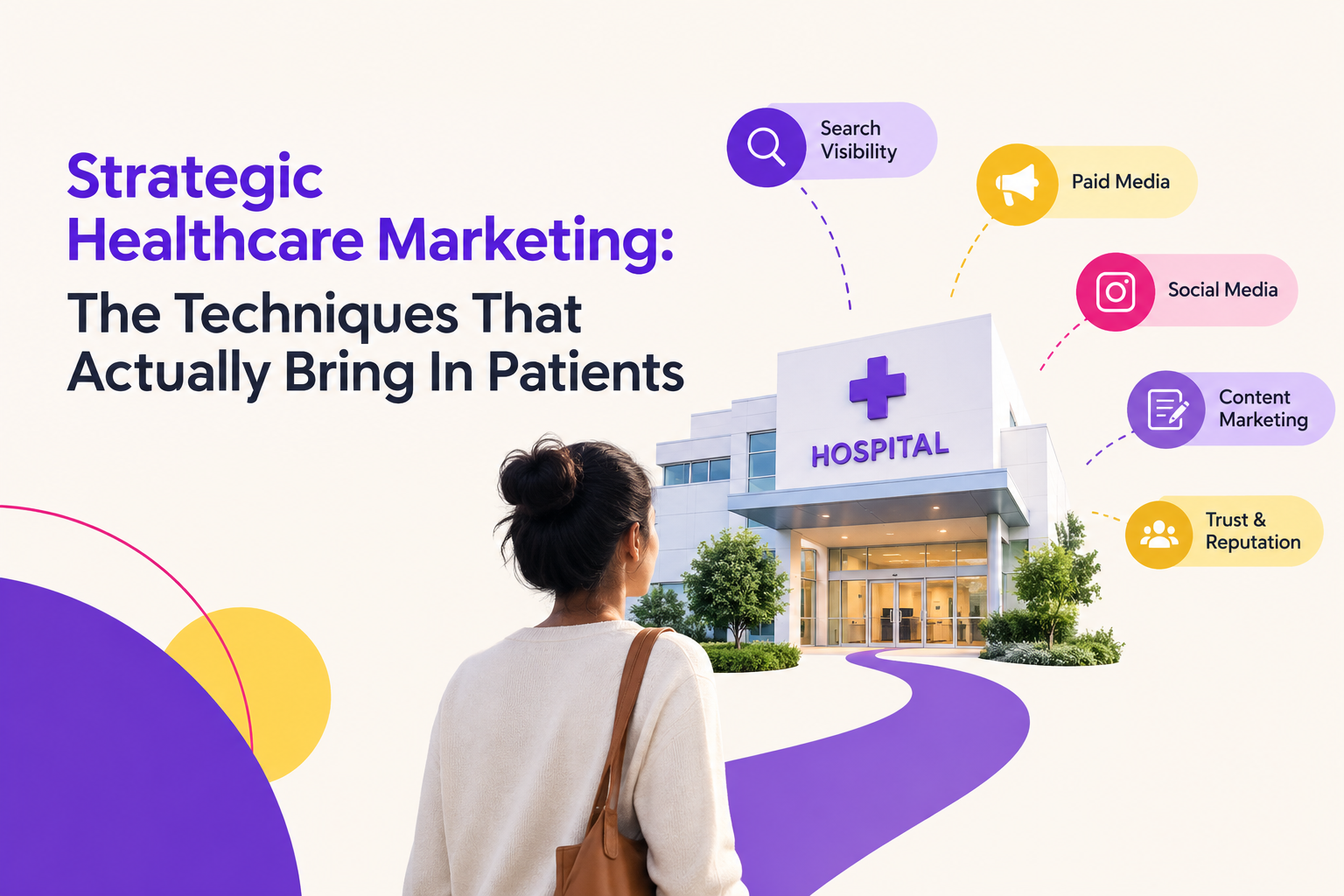
Healthcare marketing has a visibility problem. But the deeper issue is a connection problem. Most hospitals, clinics, and healthcare brands are already present everywhere that matters: Google Ads, blogs, Instagram, Google Maps, WhatsApp. Presence, though, does not create patients.
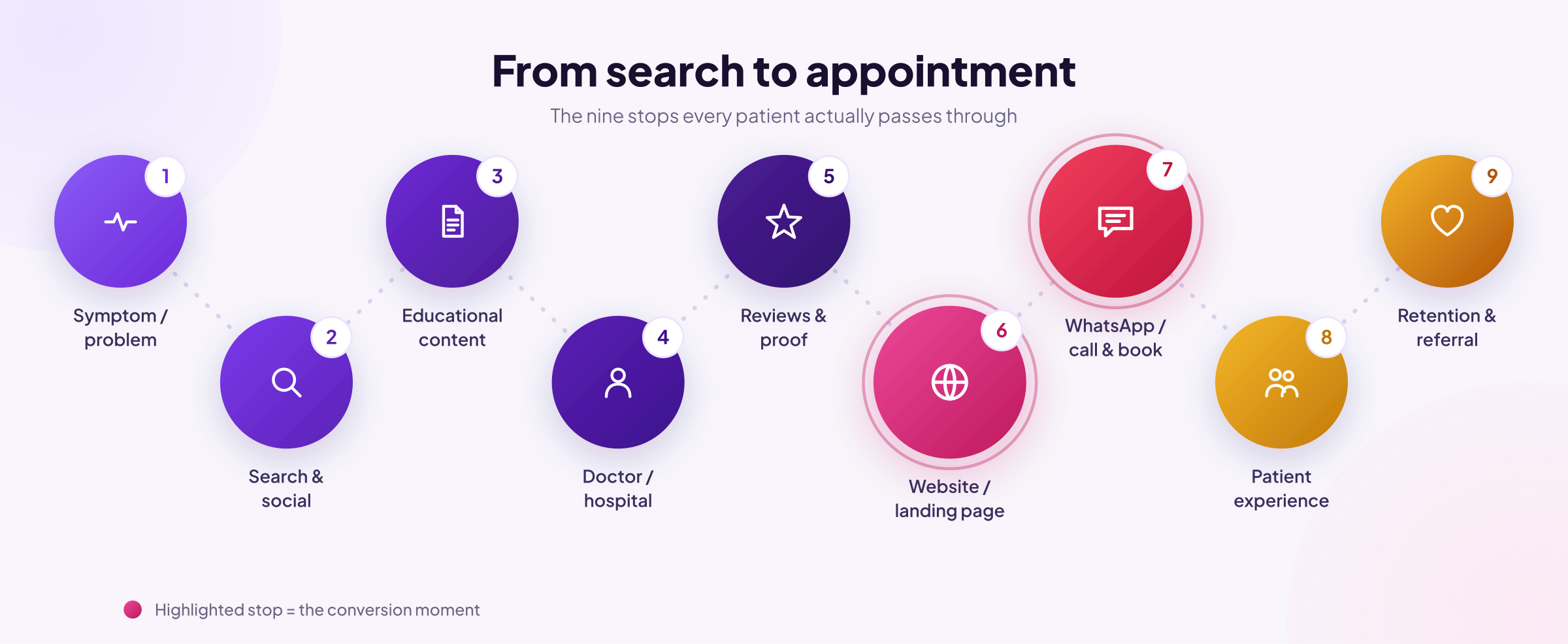
A person researching a health concern moves through a long, layered process before booking. They search symptoms, compare doctors, check hospital websites, read reviews, watch a doctor’s video, look at treatment information, and check location and availability, often over days or weeks.
This is why healthcare marketing cannot be built channel by channel. It has to be built around how a patient actually thinks, doubts, and decides. The goal is not to market everywhere. It is to make every important patient touchpoint work together, so search visibility leads to useful information, useful information builds trust, and trust turns into an enquiry that becomes an appointment. That connected system, not channel count, is what separates healthcare marketing that generates activity from healthcare marketing that generates patients.
Why Healthcare Marketing Is Different From Marketing Other Industries
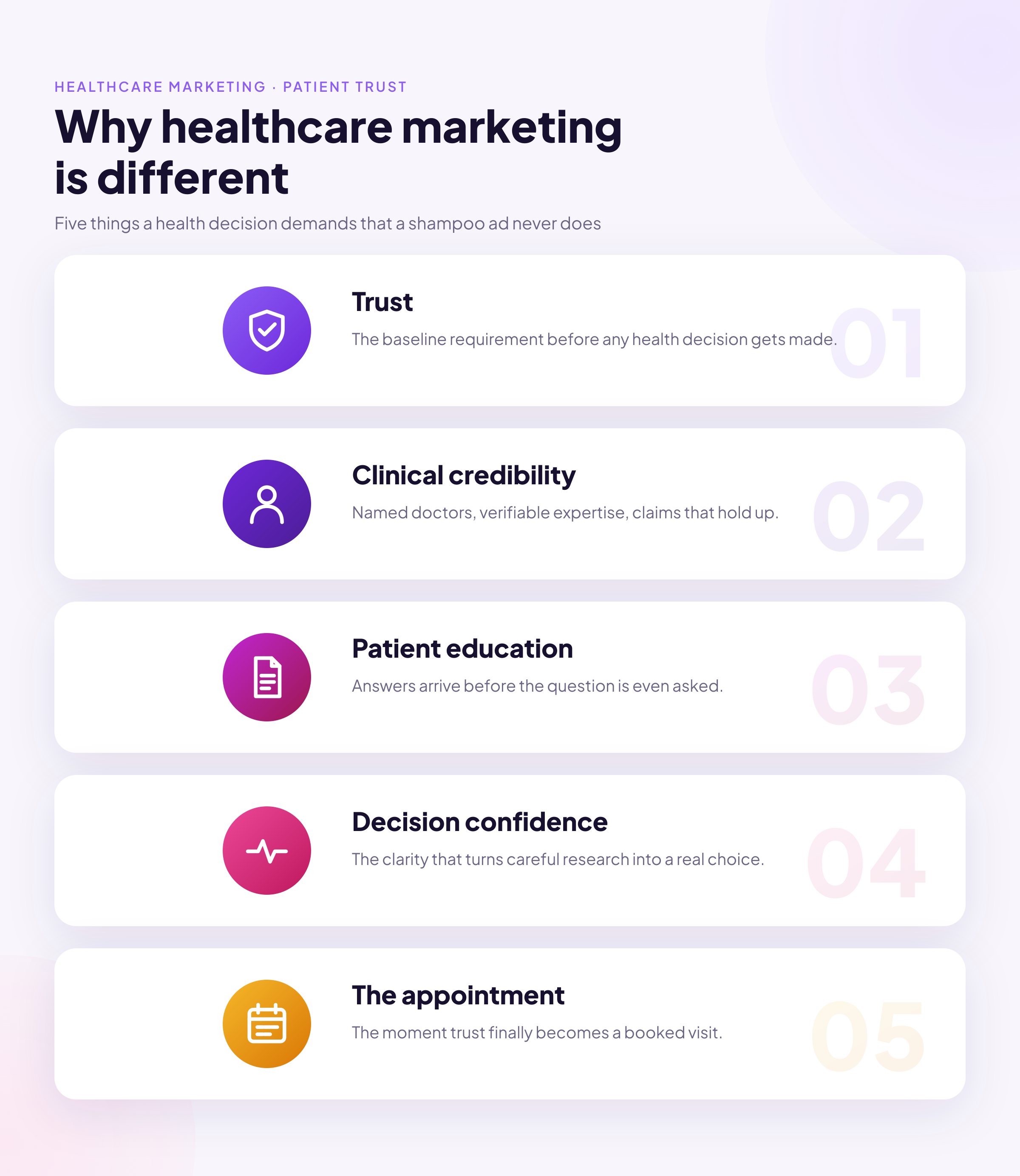
Healthcare decisions carry weight most consumer decisions do not. A patient is not choosing a snack or a subscription. They are choosing who treats their body, their parent, or their child.
That weight changes how marketing should work. Trust matters more than creativity. Clinical credibility matters more than brand tone, and the cost of a wrong decision is measured in health, not just money. Consider the contrast. An FMCG customer can switch shampoo brands after one advertisement, with little consequence if wrong. A patient choosing a cardiac hospital or cancer centre is making a decision they cannot easily reverse, often after days of research involving family and second opinions.
Healthcare also sits inside constraints FMCG marketing doesn’t face. Advertising by registered medical practitioners and institutions in India is under active regulatory review, and claims about cures or outcomes carry real legal risk. This is a marketing overview, not legal advice; confirm current requirements with counsel before any campaign makes clinical claims. This is why strategic healthcare marketing has to balance five things at once: visibility, credibility, education, conversion, and compliance. Drop any one, and the system weakens.
Start With the Patient Journey, Not the Marketing Channel
Most healthcare marketing plans start in the wrong place. They start with the channel.
“We need Instagram.” “We need Google Ads.” “We need SEO.” Each may be useful, but none is a strategy alone; they are tools waiting for a job. A stronger starting question: what does a patient need at each stage before choosing us? The patient journey typically moves through four stages.
Discovery. Patients search symptoms, conditions, doctor names, treatments, or nearby hospitals. Awareness begins here, often without brand intent.
Research. Patients compare expertise, treatment approach, infrastructure, cost, convenience, and credibility. This stage rewards depth, not slogans.
Decision. Patients need confidence, clarity, and an easy way to make contact. Friction here loses patients who were otherwise ready.
Action and retention. What happens after the enquiry, and after the visit, decides whether the patient books, returns, refers others, or reviews.
Consider a patient searching “knee pain treatment in Mumbai.” They may land on an educational article, then a doctor’s profile, then a hospital service page, then reviews, and finally reach out via WhatsApp or a call. Each asset has one job: a blog educates rather than sells, a doctor profile establishes expertise, a service page answers practical questions, and the booking step removes friction instead of adding it. Designed this way, every piece of content moves the patient one step closer to a decision.
The Healthcare Marketing Techniques That Actually Drive Patient Acquisition
Not every marketing activity deserves equal investment. Some techniques directly influence whether a patient enquires; others mostly generate activity without moving the journey forward. The techniques below aren’t a checklist to complete one by one. They are layers that work together to make a healthcare brand discoverable, credible, and easy to choose.
1. Search Engine Optimisation That Matches Patient Intent
Healthcare SEO should not stop at ranking for a hospital’s brand name; branded searches only reach people who already know the brand exists.
A Mumbai hospital building a cardiology practice should also build visibility around searches such as “cardiologist in Mumbai,” treatment questions, doctor expertise, and procedure information, through service pages, doctor pages, condition pages, and connected FAQ content.
Because health-related pages sit under Google’s stricter quality standards, healthcare content needs stronger credibility signals than most industries. Google’s own guidance notes that content is given more weight when it shows strong expertise, experience, authoritativeness, and trustworthiness on topics that could significantly affect a person’s health or safety. In practice, named doctors and clinically reviewed content tend to outperform generic, unauthored pages.
2. Local SEO and Google Business Profile
For hospitals, clinics, diagnostic centres, and dental practices, most demand is local. Someone searching “dermatologist near me,” “orthopaedic hospital in Pune,” or “diagnostic centre in Andheri” wants a provider they can reach today.
A complete, accurate Google Business Profile, with correct locations, services, photos, hours, and contact options, often decides whether that nearby demand converts. Reviews strengthen this further, but only genuine ones. Google’s own policies explicitly prohibit incentivised or manipulated reviews, and violators can lose the ability to receive new reviews for a period.
Local SEO does not create demand; it captures demand that already exists nearby.
3. Doctor-Led Content That Builds Authority
Not every piece of healthcare content needs to be about facilities. Some of the most effective content comes directly from doctors, explaining what symptoms mean, when to seek care, and what recovery involves. This works because it answers a real question before asking for anything in return. A cardiologist explaining when chest pain needs urgent attention builds more trust than a page describing infrastructure.
Named experts and references to accepted clinical guidance strengthen this further. What it should avoid is implying a doctor is automatically “the best,” or comparative claims that can’t be substantiated. Positioning should rest on clarity and expertise, not superlatives.
Build Content Around Questions Patients Actually Ask
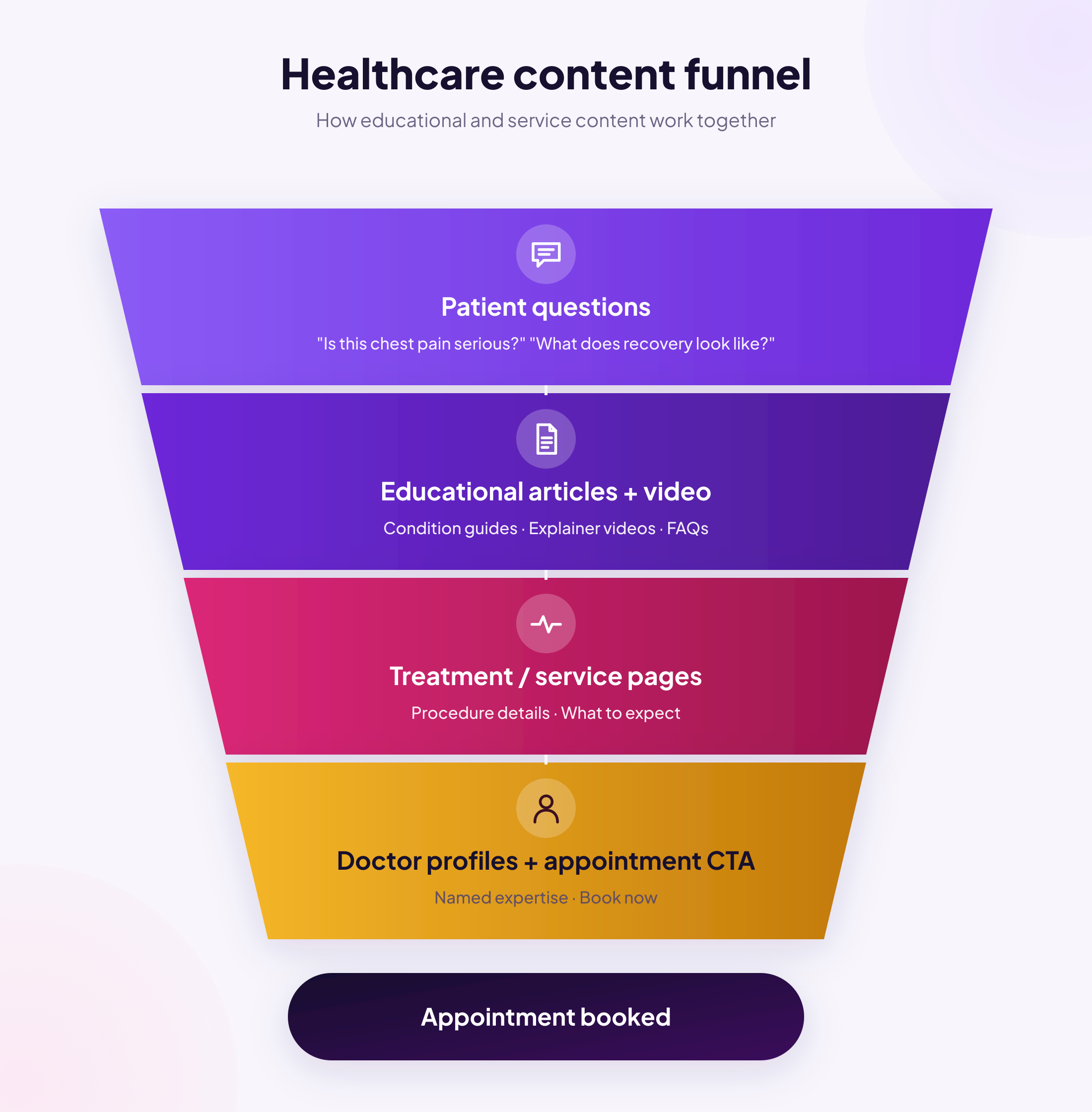
Healthcare content should not exist to fill a publishing calendar. It should answer questions patients are already asking before they book: condition pages, treatment guides, doctor profiles, FAQs, procedure explainers, recovery guides, preventive content, and short explainer videos, each serving a different point in research.
A hospital’s cardiology programme, for instance, should optimise for more than “cardiology hospital Mumbai.” It should also address when chest pain needs checking, what a cardiac stress test involves, how long bypass recovery takes, and how angioplasty differs from bypass surgery, introducing the brand as a source of clarity long before the patient is ready to enquire.
For this content to convert, it needs a clear path forward:
Condition article → Treatment page → Doctor profile → Hospital/service page → Appointment page
Each internal link should use descriptive anchor text. For example, healthcare brands should treat as a patient acquisition layer, not just a technical checklist. Without this connective structure, even well-researched content becomes a dead end: the reader learns something useful, then leaves.
Use Paid Advertising to Capture High-Intent Demand
Paid advertising has a real role in healthcare marketing. It does not have to be the entire strategy. Google Search Ads capture people already searching with intent: “fertility clinic Mumbai,” “knee replacement hospital Pune,” “dentist near me.” This is demand capture, distinct from demand creation, the slower work of building familiarity before a need exists.
What paid media cannot do is compensate for problems elsewhere in the journey. An ad drives a click; it cannot fix a confusing website, a weak doctor profile, poor reviews, or a booking process that loses patience halfway through. Ad spend performs best connected to a complete journey: a relevant landing page, clear next steps, fast follow-up. Sending high-intent traffic to a generic homepage wastes most of that intent.
| Channel | Best used for | Strength | Common mistake |
| Google Search Ads | High-intent demand | Immediate visibility | Sending all traffic to the homepage |
| SEO | Long-term discovery | Compounding visibility | Targeting only broad keywords |
| Social Media | Education and trust | Human connection | Optimising for vanity metrics |
| Email/WhatsApp | Follow-up and retention | Direct communication | Over-messaging patients |
Any remarketing used in healthcare should stay within what’s appropriate for sensitive health information, avoiding messaging that feels intrusive around a person’s medical concerns.
Social Media Should Build Trust, Not Just Reach
Healthcare social media often drifts toward being purely promotional: “Book now,” “Best treatment,” “World-class care.” None of it builds trust, and most gets scrolled past. Social platforms work better as a trust-building layer, useful for showing expertise, explaining preventive care, addressing health myths, introducing doctors as people, and sharing genuine glimpses of facility capability.
It helps to separate reach metrics from business outcomes. Follower counts and impressions describe attention, not whether that attention leads anywhere. Social media rarely drives an appointment directly; it builds familiarity before a search even happens. Someone who repeatedly sees useful cardiology content may not need cardiac care today. Months later, when a family member does, that hospital is already familiar and worth searching for by name. This is brand memory, not instant conversion, and should be valued as such.
For India, this content needs to stay within what regulators consider appropriate. Current guidance for registered medical practitioners restricts how individual doctors can discuss treatment publicly or solicit testimonials on social media, so healthcare social content works best staying factual, verifiable, and free of exaggerated outcome claims.
Reputation Management Is a Patient Acquisition Strategy
Reviews are often treated as a reputation exercise, handled after marketing is done. In healthcare, they function closer to an acquisition channel: patients routinely check Google reviews and sentiment online alongside, not after, the marketing that brought them there.
A structured approach means generating genuine reviews consistently, responding professionally to feedback, and keeping listed information consistent across platforms. What it should never include is manufactured trust. Fake reviews, incentivised reviews, and fabricated patient stories are not shortcuts, they are risks: Google’s own policies prohibit offering incentives for reviews and selectively soliciting positive feedback. In India, current guidance for medical practitioners goes further, restricting how individual doctors can share or request patient testimonials at all.
Marketing can create the first impression. Patient experience creates the lasting one; no campaign can permanently outrun poor reviews rooted in real service gaps. The healthiest reputation systems close the loop between marketing and operations, so what’s promised is what patients actually experience.
Make the Final Step Frictionless: From Enquiry to Appointment
Many healthcare marketing strategies stop measuring success at the lead. But a lead is not a patient, and an enquiry is not an appointment. Between the two sits practical friction that quietly costs hospitals real patients: slow response times, long forms, unclear numbers, no visible availability, confusing booking steps, or an unanswered WhatsApp message. These aren’t marketing problems in the traditional sense; they’re operational gaps that undo marketing’s work. A well-ranked article can bring a patient to the door, but what happens next decides whether they walk through it.
A simple framework helps teams think this through:
See → Understand → Trust → Contact → Book
At each stage, something specific has to happen, and this is where marketing and operations need to work as one team, not two. A plan that generates enquiries the front desk can’t handle quickly isn’t actually generating patients.
To manage this, teams should track enquiries, qualified enquiries, appointment bookings, show-up rates, cost per qualified enquiry, and cost per booked appointment, not just raw lead volume. What counts as a strong number varies by specialty, city, and channel, so a single universal benchmark rarely applies.
Measure Healthcare Marketing by Patient Outcomes, Not Vanity Metrics
Followers are not patients. Impressions are not appointments. Traffic is not revenue, and leads are not booked consultations.
| Marketing metric | What it tells you |
| Organic search visibility | Whether patients can discover you at all |
| Website engagement | Whether your content is actually relevant |
| Qualified enquiries | Whether traffic arriving has real intent |
| Appointment conversion rate | Whether the journey from click to booking works |
| Cost per booked appointment | How efficiently paid acquisition performs |
| Patient retention | Long-term value of each acquired patient |
| Review volume and sentiment | Health of your reputation over time |
Attribution in healthcare is rarely simple. A patient’s path might be: search, a blog article, an Instagram post, a doctor’s profile, a Maps listing, then a WhatsApp message that becomes an appointment. The last click often gets full credit in basic reporting, but earlier touchpoints did real work. CMOs benefit from assisted-conversion thinking over last-click attribution, especially for longer consideration cycles.
A Strategic Healthcare Marketing Framework for Indian Brands
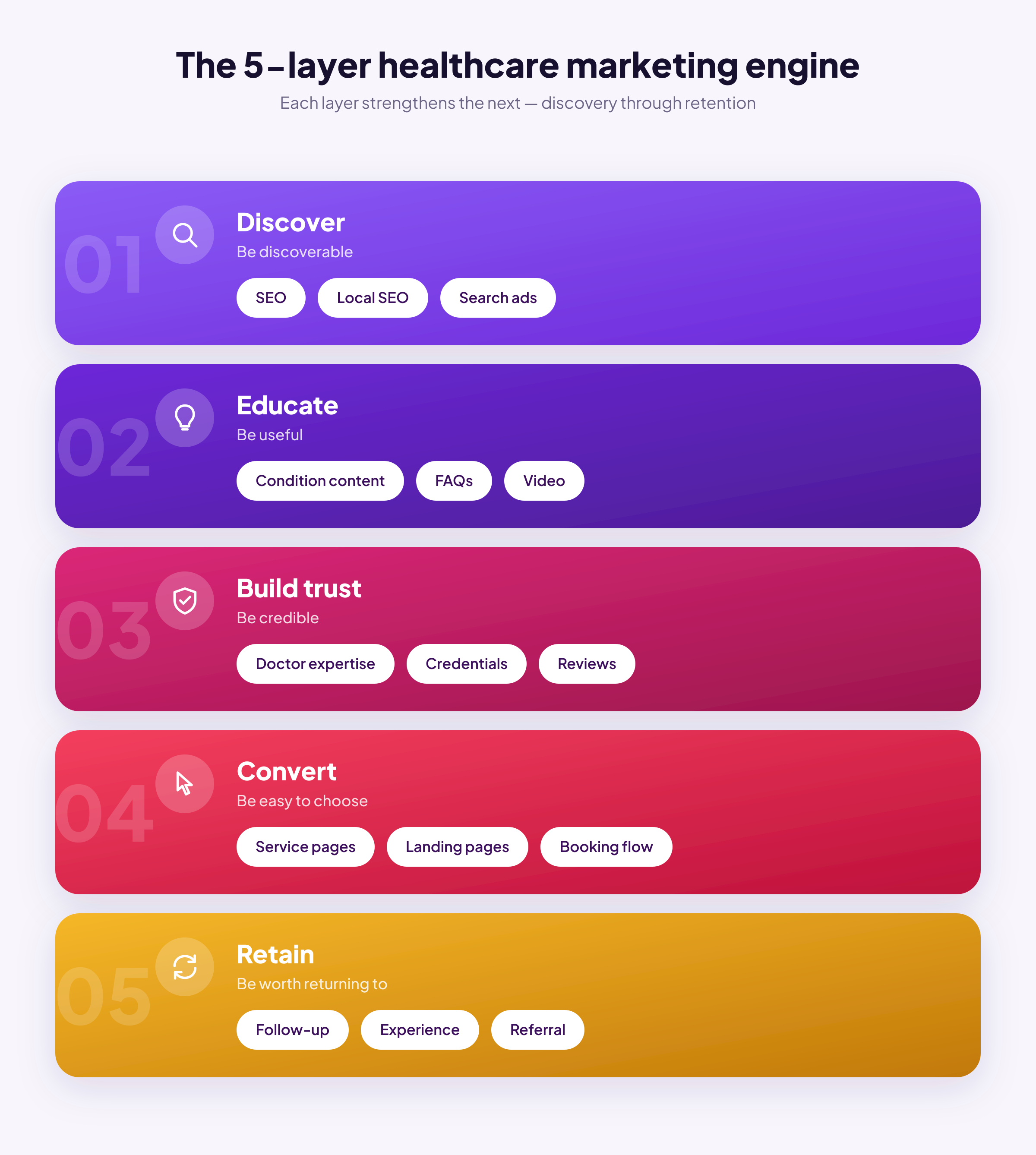
Every technique above fits into one connected system.
1. Be Discoverable. SEO, local SEO, and search ads let patients find you by condition, treatment, doctor, or location.
2. Be Useful. Educational content, FAQs, and video answer real questions before a patient is ready to enquire.
3. Be Credible. Doctor expertise, visible credentials, and a genuine review base build confidence in an unfamiliar brand.
4. Be Easy to Choose. Clear service pages, focused landing pages, and a simple booking journey remove friction.
5. Be Worth Returning To. Patient experience, timely follow-up, and retention turn one appointment into ongoing care and referrals.
These layers are sequential for a new patient and cyclical for a returning one; a patient with a good experience under layer five often skips straight back into layer three, already trusting the brand. This is what strategic healthcare marketing looks like in practice: not channels running in parallel, but a system where each layer strengthens the next.
What Healthcare Brands Should Stop Doing
- Posting daily without any connection to the patient journey.
- Running ads without first fixing the landing pages they point to.
- Publishing generic health blogs that ignore actual search intent.
- Optimising only for branded keywords, missing condition searches entirely.
- Chasing followers instead of qualified enquiries.
- Publishing exaggerated “best” or outcome claims that can’t be substantiated.
- Treating reviews as an afterthought instead of an ongoing system.
- Ignoring how the site and booking flow perform on mobile.
- Measuring leads without tracking how many became appointments.
- Running marketing and patient experience as disconnected functions.
Each is fixable. Fixing most costs attention and accountability, not necessarily a bigger budget.
Conclusion
Healthcare marketing does not win by being visible everywhere. It wins by being visible at the right moment, with the right information, in a credible environment, with a frictionless path to action.
That means connecting search, content, reputation, paid media, social media, conversion, and patient experience into one system, instead of separate, disconnected efforts, each piece handing the patient off to the next rather than competing for the same attention.
This is the real difference between marketing activity and patient acquisition. A hospital with modest followers but a well-connected journey will often outperform a louder brand with a broken path to booking. Strategic healthcare marketing is, at its core, a discipline of removing friction and building trust at every step a patient takes. The healthcare brands that win will not necessarily be the ones that market the loudest. They will be the ones that make the patient’s decision easier.
FAQs
- What is healthcare marketing?
Healthcare marketing helps patients discover, evaluate, and choose healthcare providers through search, content, reputation, paid media, and conversion strategies. - What are the most effective healthcare marketing techniques?
Effective techniques include SEO, local SEO, doctor-led content, paid campaigns, and reputation management aligned with the patient journey. - Why is SEO important for healthcare marketing?
Healthcare SEO helps patients find credible hospitals, doctors, and treatment information when they are actively researching their health needs. - How can hospitals attract more patients online?
Hospitals can attract more patients by combining local visibility, SEO, content, paid campaigns, reputation management, and a frictionless booking journey. - What is strategic healthcare marketing?
Strategic healthcare marketing connects search, content, reviews, advertising, and patient conversion into one system focused on measurable patient acquisition and retention.