For years, the FAQ section sat at the bottom of a webpage doing very little. Most brands added it as an afterthought. Ten generic questions, ten generic answers, mostly written to catch a few extra keywords. That approach is losing relevance fast. Something else is taking its place.
Search behaviour has changed. People no longer type short, clipped phrases into a search box. They ask full questions, the way they would ask a knowledgeable friend. A shopper researching skincare may no longer search “best skincare brand India.” They may ask: “What should I look for in a face serum if I have oily skin and live in Mumbai?” That single shift explains why FAQ content is relevant again. Not because Google suddenly favours FAQ pages. Because clear, direct answers now match how people actually search, and how AI systems process language.
This article breaks down what FAQ page SEO really means in 2026, where FAQs genuinely help, where they don’t, and how Indian D2C brands should approach FAQ content in a search landscape shaped by AI.
Why FAQs Are Suddenly Relevant Again
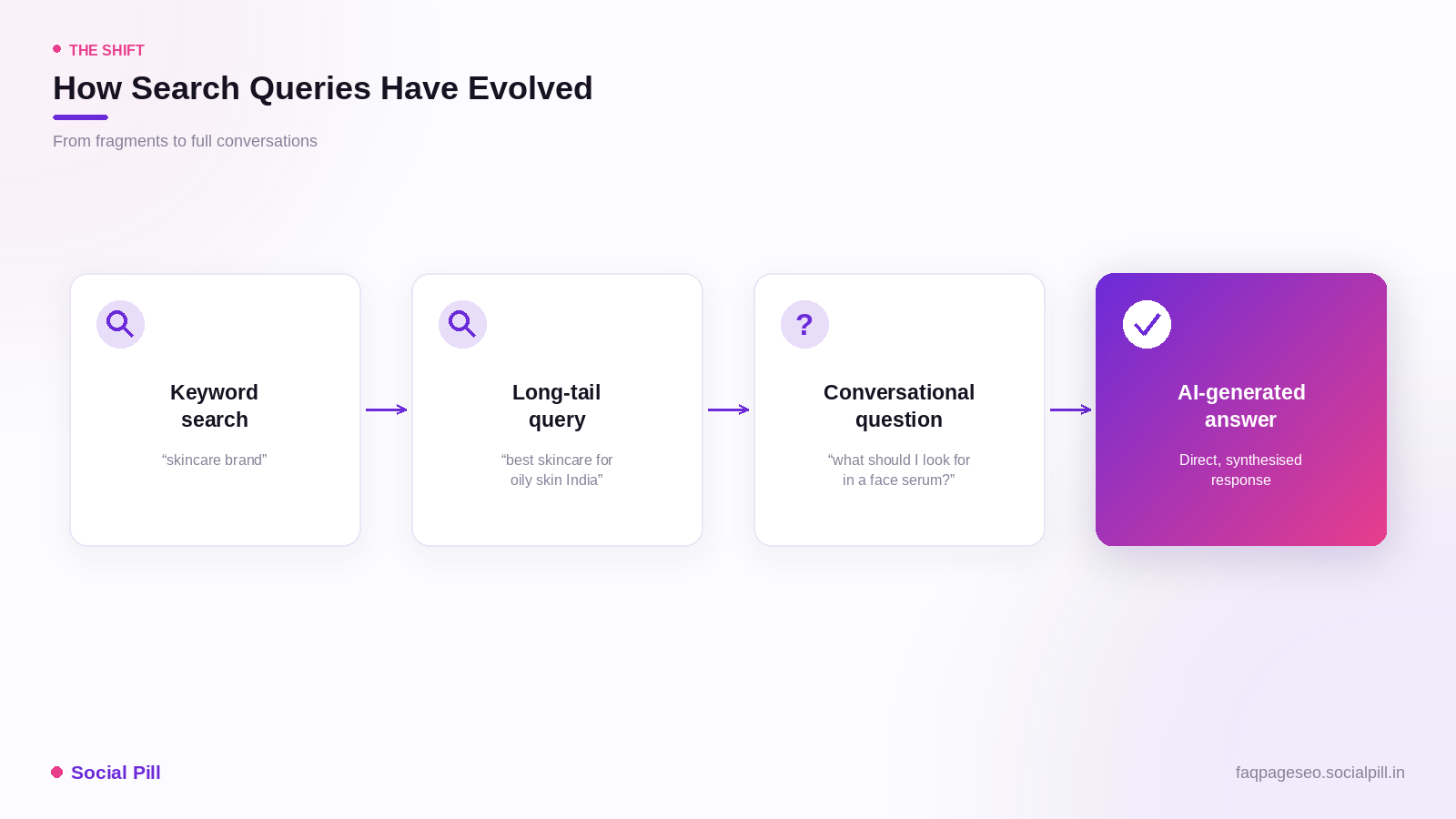
Search queries have grown longer and more specific over the past few years. Instead of typing fragments, people type complete thoughts.This shift has three drivers. Voice search normalised speaking full sentences to a device. Google’s own systems got better at handling natural language. And AI-powered tools like ChatGPT, Gemini, and Perplexity trained an entire generation of users to ask questions the way they’d ask a person.
Consider an Indian D2C brand selling apparel online. A few years ago, a customer might search “D2C return policy India.” Today, that same customer is more likely to ask: “Can I return a product bought online if the package is opened?” The second query is longer, more specific, and closer to the customer’s actual concern. A generic returns page buried in policy language won’t answer it well. A direct, clearly written FAQ can.
This is also tied to zero-click search behaviour, where a growing share of queries get answered directly on the search results page, without a click through to any website. Question-based content increases the odds that a brand’s information shows up in that first layer of the search experience, even if the click doesn’t always follow.
What Changed With AI Search?
Traditional search engines rank pages. AI-powered search systems, including Google AI Overviews, ChatGPT, Gemini, and Perplexity, work differently. They try to understand a question, pull relevant information from multiple sources, and generate a synthesised answer.
To do this well, these systems need to identify a few things: what the user is actually asking, which content answers that question, which sources are credible enough to draw from, and how different pieces of information connect to each other. Clear question-and-answer structure helps with the first two of those tasks. When a page states a question plainly and answers it directly, it becomes easier for any system, human or machine, to match that content to a real query.
This does not mean AI systems only look for FAQ-formatted content. Product pages, guides, comparison articles, and support documentation all get used as sources. FAQ formatting is one useful structure among several, not a shortcut that outranks everything else.
The Real SEO Value of an FAQ Page
FAQ page SEO isn’t about the FAQ format itself. It’s about what a well-built FAQ section can do that other page types often can’t.
Long-Tail Search Intent
Commercial landing pages are built to sell. They rarely have room for niche, specific questions. A protein powder product page won’t naturally explain “Is this suitable if I have lactose intolerance?” A dedicated FAQ can carry that weight without disrupting the sales page.
Topical Coverage
Real customer questions reveal gaps in a website’s content. If a healthcare brand keeps getting asked “Can I take this supplement with blood pressure medication?”, that question points to a subtopic worth covering properly, not just mentioning in passing.
Better User Experience
A shopper comparing two skincare brands may want to know if a product suits sensitive skin. A direct, specific answer on the product page can resolve that doubt before the shopper leaves to search elsewhere.
Content Discoverability
When a question is phrased clearly and answered directly, it becomes easier to scan, easier to summarise, and easier to find again later. This matters whether a human is skimming the page or a system is parsing it for a specific answer.
Traditional FAQ SEO vs AI-Era FAQ SEO
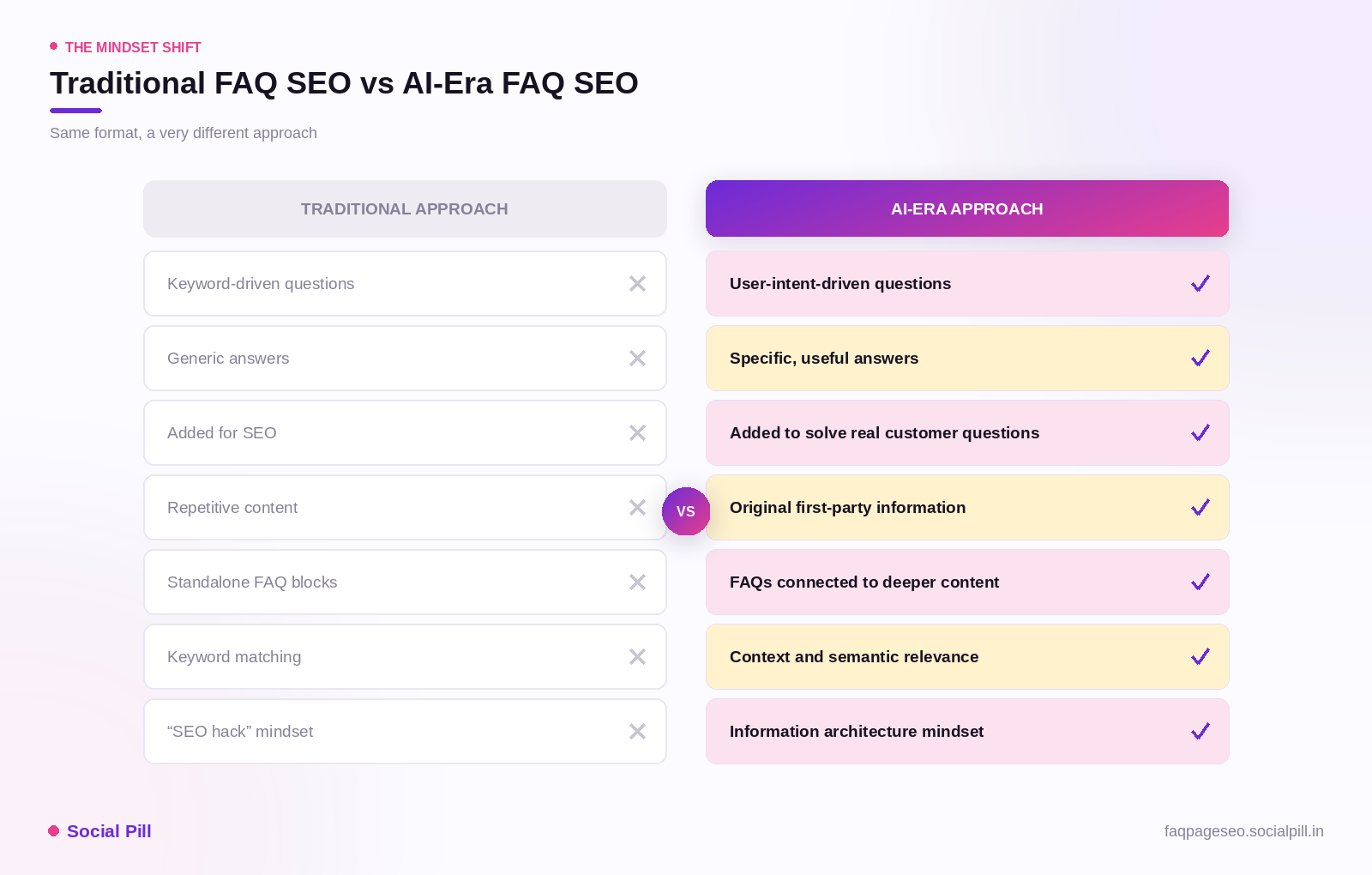
The mindset behind FAQ content has shifted. The table below captures the difference.
| Traditional FAQ Approach | AI-Era FAQ Approach |
|---|---|
| Keyword-driven questions | User-intent-driven questions |
| Generic answers | Specific, useful answers |
| Added for SEO | Added to solve real customer questions |
| Repetitive content | Original first-party information |
| Standalone FAQ blocks | FAQs connected to deeper content |
| Keyword matching | Context and semantic relevance |
| “SEO hack” mindset | Information architecture mindset |
FAQ Page Best Practices for 2026
Good FAQ content follows a discipline. Here’s what that discipline looks like in practice.
Start With Real Customer Questions
The best FAQ questions rarely come from a brainstorm. They come from sales call notes, customer support tickets, product reviews, Google’s “People Also Ask” results, autocomplete suggestions, and a brand’s own internal site search data.
A D2C nutrition brand, for instance, might find that its support team gets the same three questions every week: “Does this cause bloating?”, “Can I take it on an empty stomach?”, and “How long before I see results?” Those three questions belong on the FAQ page before any invented ones do.
Answer the Question First
Use an inverted-pyramid structure. The first sentence should directly answer the question. Context and nuance can follow after.
Question: Does a D2C website need a return policy?
Answer: Yes. A clear return policy tells customers what they can return, within what timeframe, and under which conditions.
Keep Answers Specific
Vague answers waste the reader’s time and add little value for search systems trying to extract a useful fact.
Weak: “We offer high-quality products designed for modern consumers.”
Better: “Our return window is 7 days from delivery, provided the product is unused and remains in its original packaging.”
The second version gives a real, checkable fact. That’s the standard every FAQ answer should meet.
Write for Humans Before Search Engines
An FAQ answer stuffed with keyword variations reads badly and helps no one. Write the way you’d explain the answer to a customer on a call, then check that it’s accurate and complete.
Use Questions as H3s
Framing each question as its own heading makes the page easier to scan. It also gives both readers and search systems a clean way to jump straight to the part they need.
Link FAQs to Deeper Content
An FAQ should answer the immediate question, then point toward more detail where relevant. If a customer asks “Is this protein suitable for beginners?”, the answer can close with a link to a beginner’s guide or comparison page.
Avoid Creating FAQs Just for Keywords
A question nobody actually asks adds thin content and dilutes the page. If a “question” exists only because it contains a target keyword, it’s the wrong question.
Keep Information Fresh
FAQs involving pricing, shipping timelines, return windows, product specifications, or regulatory claims need regular review. An outdated FAQ answer is worse than no FAQ at all, since it actively misleads a customer or a support conversation that follows it.
FAQ Schema Markup: What It Actually Does
FAQ content and FAQ schema markup are not the same thing. This distinction matters more now than it used to. FAQ schema is structured data, a way of labelling questions and answers in a page’s code so that search systems can parse them more precisely. It doesn’t change what a reader sees. It changes what a machine can extract.
For years, adding FAQ schema could earn a website an expandable FAQ dropdown directly in Google’s search results. That visible feature has been steadily narrowed since 2023, when Google restricted it mainly to well-known government and health websites, and it has since been phased out entirely as a visible search feature for essentially all sites, including the ones that had retained it.
This does not mean FAQ schema is pointless. Google has said structured data, including FAQ markup, can still help its systems and AI features understand a page’s content, even without producing a visible rich result. The value has shifted from “winning a SERP feature” to “making content machine-readable.”
The practical takeaway: implement FAQ schema accurately, and only on pages where genuine question-and-answer content already exists. Don’t add it expecting a rich result, and don’t treat it as a ranking lever. It’s a comprehension aid, not a growth hack.
How to Optimise FAQs for AI Search
This is where FAQ page SEO connects most directly to AI search optimisation. A few principles make the difference between an FAQ that helps and one that gets ignored.
Match the Question to Real Search Intent
A question can be informational (“What is COD?”), commercial (“Which brand has the best COD support?”), or transactional (“Can I place a COD order right now?”). Write the answer with that intent in mind, not as a generic definition.
Give a Direct Answer Before the Explanation
Question: Does a D2C website need a return policy?
Answer: Yes. A clear return policy tells customers what they can return, within what timeframe, and under which conditions.
Only after that direct answer should the explanation expand, covering exceptions, process, or context.
Add Context Instead of Fluff
AI-era content should add genuinely useful detail: an example, a number, a condition. It should not repeat the same claim in five different keyword phrasings.
Demonstrate First-Hand Knowledge
This is where most brand FAQs fall short. Generic definitions copied from competitors add nothing that a search system, or a customer, can’t find ten other places.
Real delivery timelines, actual product specifications, specific warranty terms, and precise support processes are far more valuable. A healthcare brand explaining its actual consultation process will always outperform one that copies a generic definition of telemedicine.
Connect FAQs to Supporting Pages
An FAQ answer that stands completely alone misses an opportunity. Linking it to a category page, guide, or comparison article strengthens both the FAQ and the destination page.
Cover Follow-Up Questions
Real conversations rarely stop at one question. They branch. “Do you offer cash on delivery?” leads naturally to “Which locations support COD?”, then “Is there a COD fee?”, then “Can I return a COD order?”
Building FAQ clusters around this kind of natural progression mirrors how a real customer actually thinks, and how conversational search tends to unfold.
AEO vs GEO vs Traditional SEO: Where Do FAQs Fit?
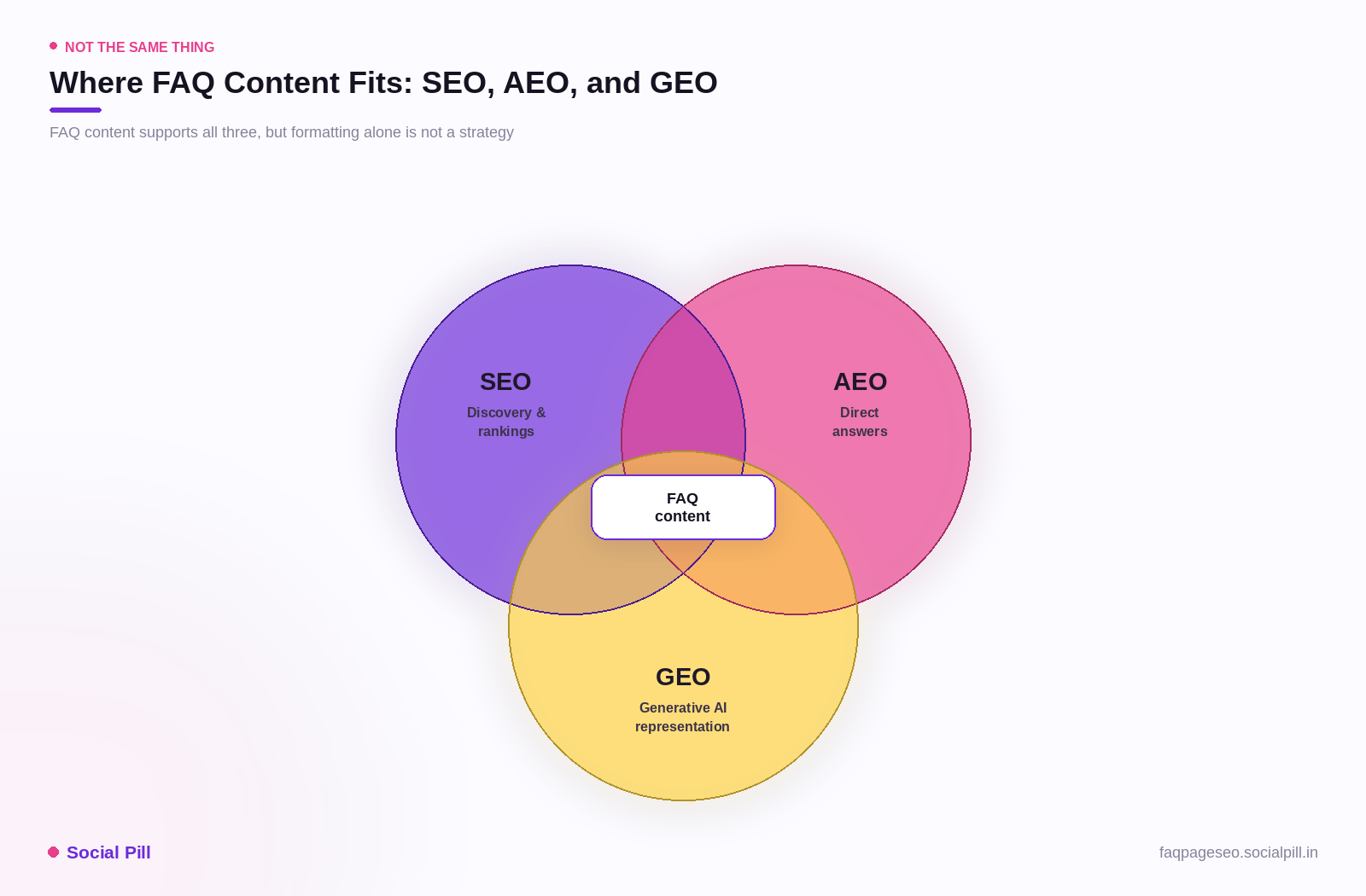
These three terms get used loosely, and the differences matter for how a brand plans its content. SEO optimises content so search engines can discover, index, and rank it in traditional results.
Answer Engine Optimization (AEO) focuses on making content useful for systems that provide direct answers to specific questions, such as featured snippets or voice assistants.
Generative Engine Optimization (GEO) focuses on increasing the likelihood that a brand’s information gets represented, summarised, or cited inside generative AI experiences like AI Overviews, ChatGPT, or Perplexity.
FAQ content can support all three. A clearly structured, well-answered FAQ helps traditional crawling and indexing, gives answer engines a direct response to extract, and gives generative systems clean, attributable information to draw from. But FAQ formatting alone is not an AEO or GEO strategy. Both disciplines depend on broader factors: site authority, content accuracy, how information is structured across the whole site, and whether a brand is a credible source on the topic at all.
When an FAQ Page Is a Bad Idea
FAQ pages aren’t universally useful. Sometimes they add clutter instead of clarity. An FAQ adds little value when the questions are already answered clearly elsewhere on the site, when the answers are painfully obvious, or when the page exists purely to work in a few extra keywords.
It’s also a poor fit when the questions have nothing to do with the brand’s actual offering, when a business genuinely doesn’t have many real customer questions, or when the content is lifted from a competitor’s FAQ page with minor edits.
An FAQ that never gets updated is arguably worse than no FAQ. Wrong pricing, outdated shipping timelines, or old policy terms erode trust faster than a missing answer would. In many of these cases, the better fix isn’t a new FAQ page. It’s improving the product, service, or category page that should have answered the question in the first place.
How Indian D2C Brands Can Build Better FAQ Content
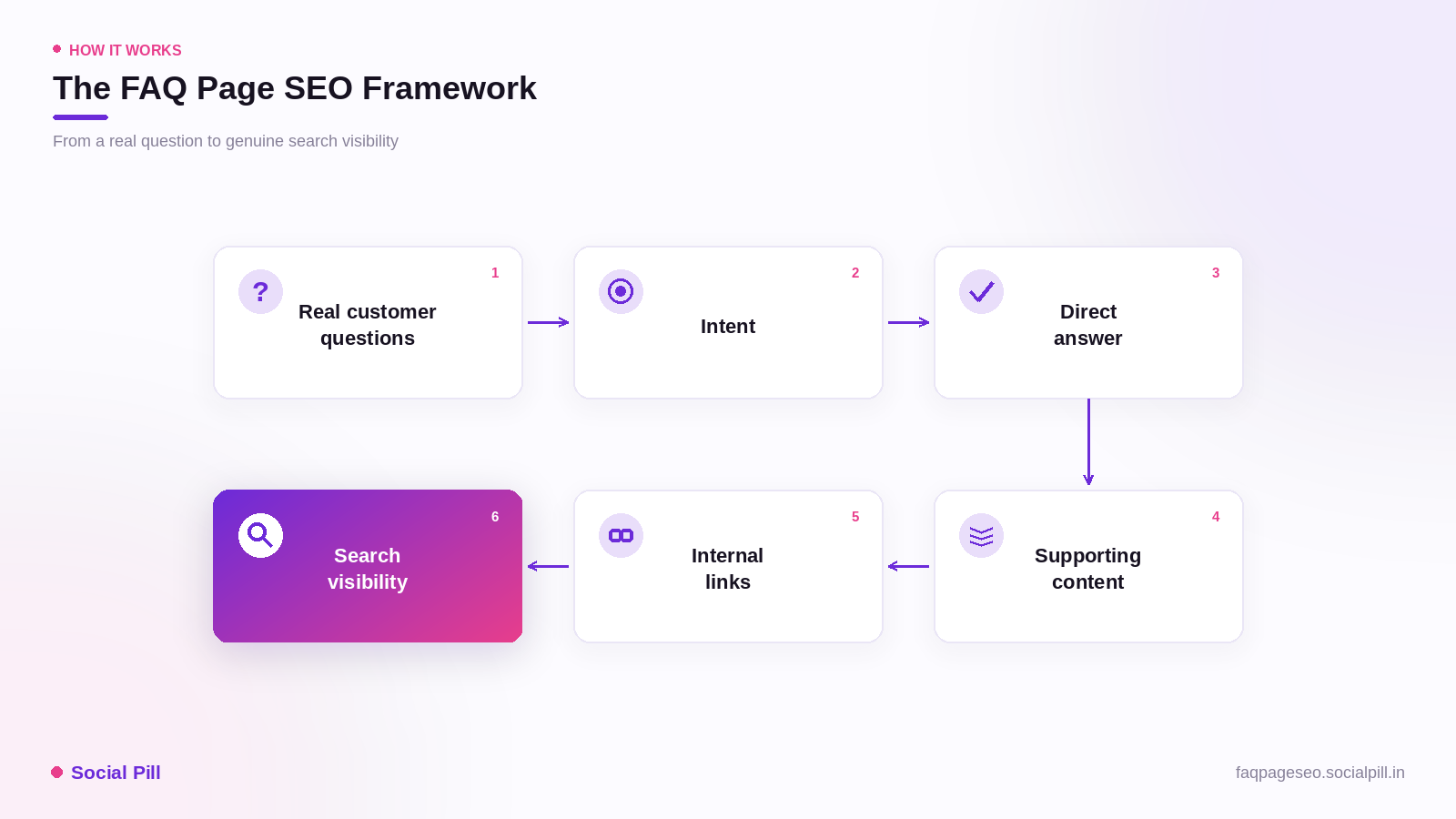
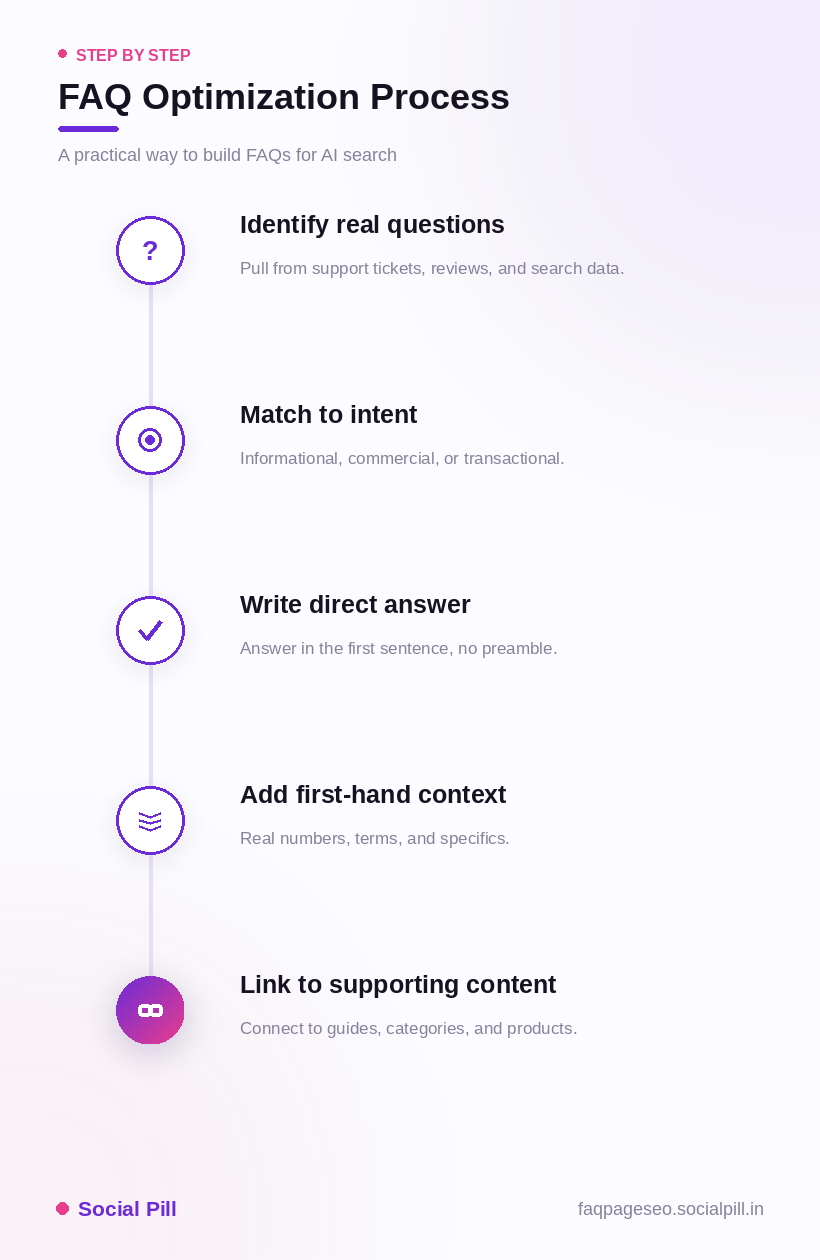
Building useful FAQ content follows a fairly simple discipline, even if executing it well takes work. Start by collecting real customer questions from support tickets, reviews, and sales conversations. Group those questions by intent, remove duplicates, and prioritise the ones that actually influence purchase decisions.
From there, write direct answers first, add context that reflects real product or service knowledge, and link each answer to a deeper resource where one exists. Add structured data only where the format genuinely fits, then monitor how the FAQ performs and update it as customer behaviour shifts.
This process looks similar across categories, but the questions differ. An ecommerce apparel brand deals with sizing and returns. An FMCG brand fields questions about ingredients and shelf life. A beauty brand gets asked about skin type suitability. A healthcare brand faces questions about dosage, safety, and consultation process. A consumer services brand answers questions about pricing, turnaround time, and service area. The process stays consistent. The substance has to come from the brand’s own operational knowledge, not from a generic template.
FAQs Are Becoming Part of the Information Architecture
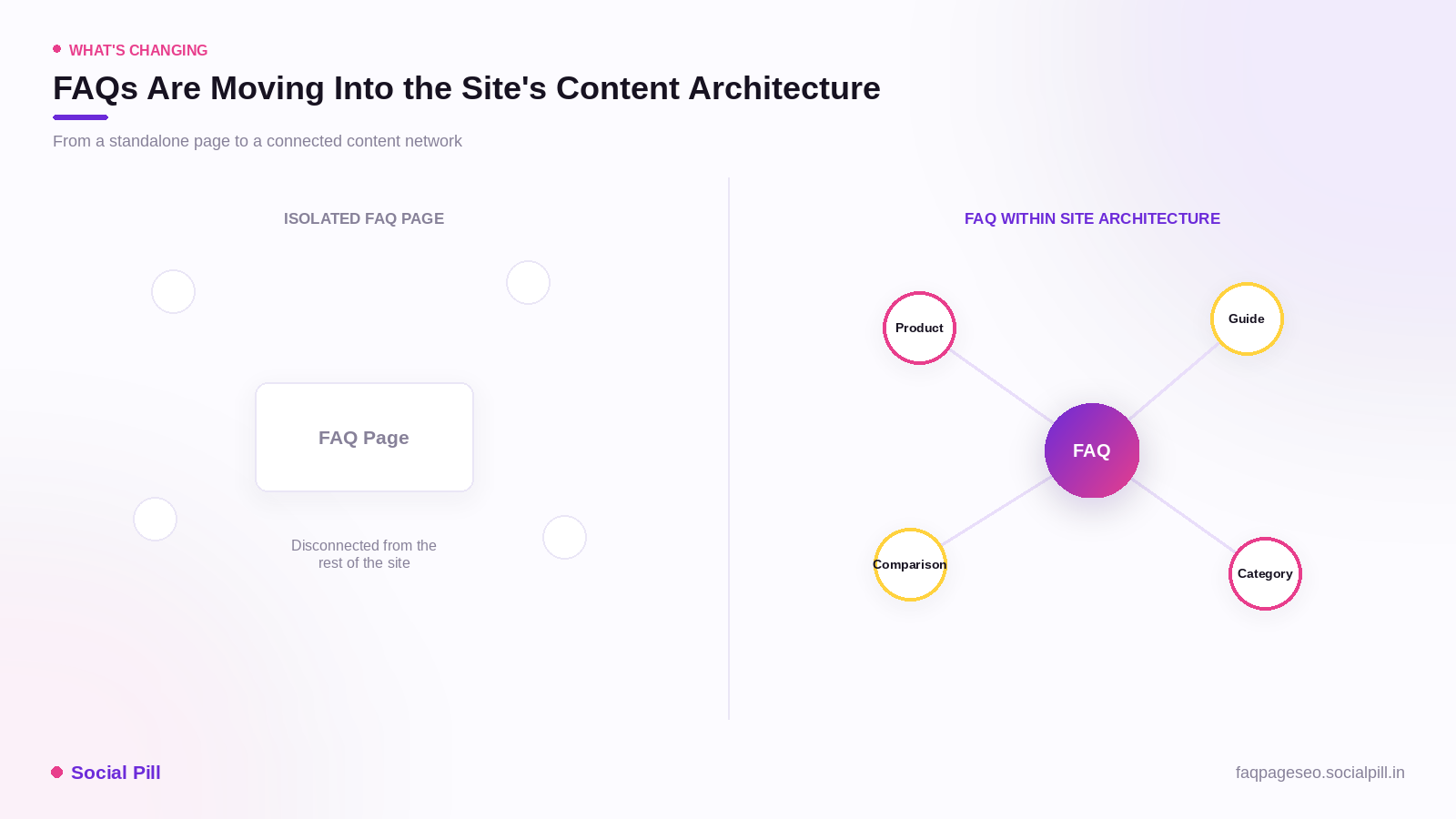
The old model treated FAQs as an isolated block, usually sitting at the bottom of a homepage or a single dedicated page. That model is fading. Customer questions now inform far more than one page. They shape product pages, category pages, service pages, blog content, comparison articles, and buying guides. They also shape how those pages link to each other.
Take a protein powder brand that repeatedly gets asked, “Is this suitable for beginners?” That single question can appear on the product page, anchor a beginner’s buying guide, feature in a comparison article against other brands, sit inside the FAQ section, and connect all of those pages through internal links.
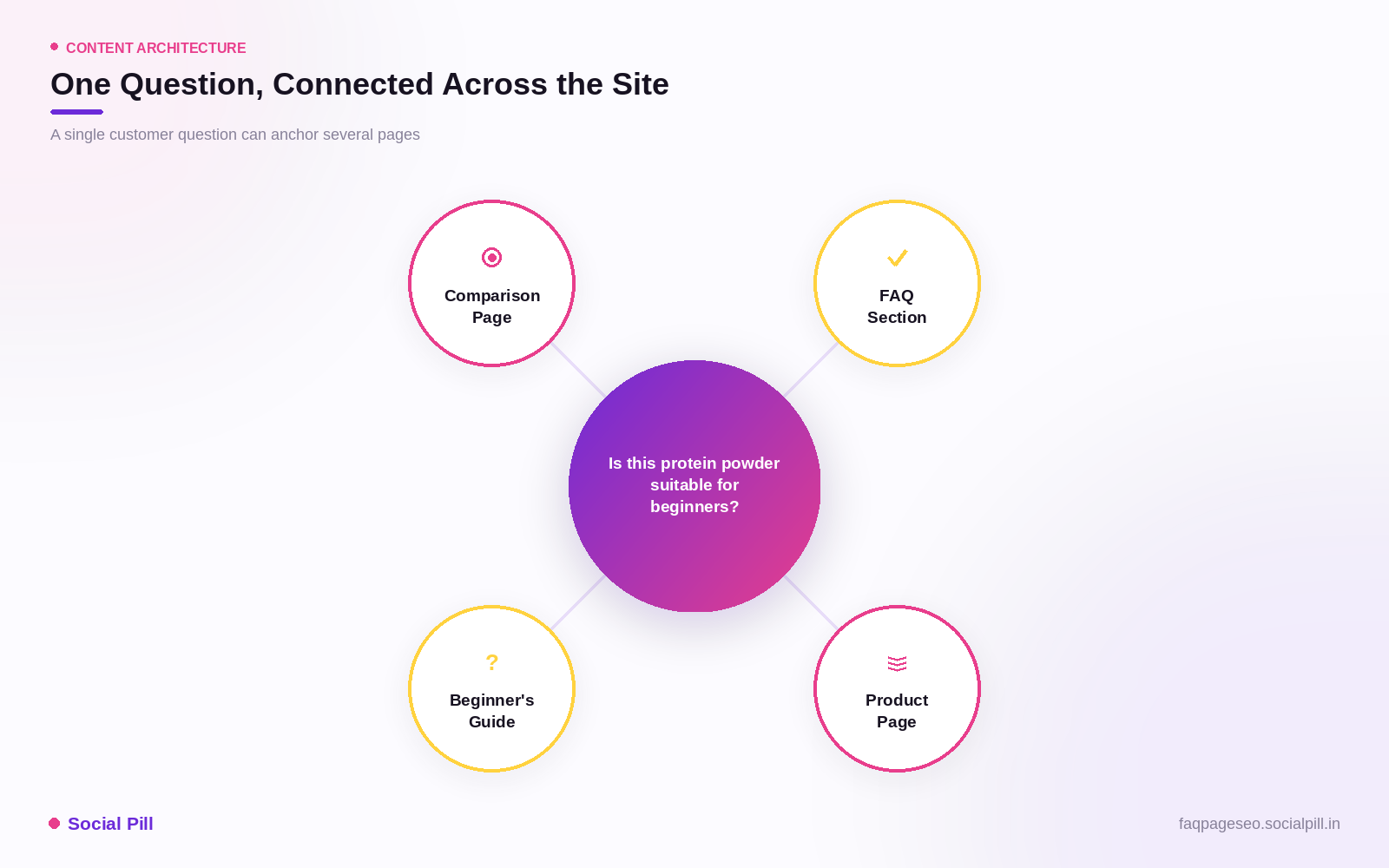
The bigger shift is this: a customer question isn’t just content for one page anymore. It’s an entry point into the site’s broader content ecosystem, and a signal for what that ecosystem is missing.
The Future of FAQ SEO
Search will keep getting more conversational. That trend isn’t reversing. The future of FAQ page SEO looks less like maintaining one enormous FAQ page and more like understanding what customers genuinely ask, structuring information clearly across the site, and keeping answers accurate as products, policies, and markets change.
The real competitive question for brands isn’t “how many questions can we publish?” It’s “which questions can we answer better than everyone else?”
How Social Pill Can Help
Getting FAQ content right takes more than writing a few extra questions. It requires understanding actual search intent, structuring a site’s content architecture properly, and knowing where AI search optimization, AEO, and GEO genuinely apply versus where they’re just buzzwords.
Social Pill works with Indian D2C, ecommerce, and consumer brands on exactly this kind of content strategy: identifying the questions that matter, structuring answers that hold up for both readers and search systems, and connecting that content across a site so it compounds over time.
Conclusion
FAQ pages aren’t making a comeback because Google suddenly favours FAQ formatting, or because AI systems have a special preference for question-and-answer blocks. They’re becoming relevant because search itself has become more conversational, more specific, and more question-led than it used to be. Good FAQ page SEO isn’t about publishing more questions. It’s about identifying the questions customers actually ask, answering them with real, specific, first-hand information, and connecting those answers to the rest of a site’s content.
Brands that treat FAQs as a keyword-stuffing exercise will keep seeing thin results. Brands that treat them as an honest, well-structured extension of customer conversations will build content that holds up across traditional search, answer engines, and generative AI experiences alike. For CMOs and founders planning to scale a D2C channel in 2026, that’s the real opportunity: not adding an FAQ section because a checklist says so, but building one that reflects what customers are actually trying to figure out.
FAQ’s
- Are FAQ pages still good for SEO?
Yes, when they answer real customer questions clearly and add genuine information. An FAQ built purely for keywords adds little value and can dilute a page’s quality. - How do you optimize an FAQ page for SEO?
Base questions on real customer queries, answer them directly in the first sentence, keep answers specific, and link to deeper supporting content where relevant. - Does FAQ schema still help SEO?
FAQ schema no longer produces the visible expandable rich result it once did, but Google has indicated structured data can still help its systems understand and interpret page content. - Are FAQs useful for AI search?
Clearly structured question-and-answer content can be easier for AI search systems to interpret and summarise, though FAQ formatting is one useful structure among several, not a guaranteed path to visibility. - How should FAQs be written for AI search?
Answer the question directly first, add specific first-hand context, and avoid vague or repetitive phrasing that adds no real information. - Can adding FAQs improve Google rankings directly?
Not on its own. FAQ content can support topical coverage, user experience, and content structure, all of which contribute to SEO, but there’s no direct ranking boost simply for having an FAQ section.