Your business just launched a massive paid advertising campaign. The clicks are pouring in. Traffic is up 40%. Everyone’s celebrating. Three months later? Your revenue hasn’t budged. This is the most frustrating reality in modern marketing: traffic without conversions is just expensive attention.
Most businesses obsess over vanity metrics, clicks, impressions, and website visits, while their marketing funnel silently bleeds potential customers at every stage. They celebrate traffic numbers while conversion rates plummet. The painful truth: a marketing funnel that isn’t designed to convert is nothing more than a leaky bucket. No matter how much water you pour in from the top, most of it drains out before reaching the bottom.
In this guide, we explore exactly how to build a marketing funnel that doesn’t just attract eyeballs, it turns attention into customers and revenue. We’ll show you where your funnel is likely losing customers, how to plug those leaks, and the exact strategy that high-converting businesses use to predictably grow revenue. Because here’s the core truth: Traffic doesn’t grow businesses. Customers do.
What Is a Marketing Funnel?
Marketing Funnel Meaning Explained Simply
A marketing funnel is a system that guides potential customers through a journey from the moment they become aware of your brand to the point where they become paying customers. Think of it like a literal funnel. It starts wide at the top (many people) and becomes narrow at the bottom (fewer, but qualified buyers). Not everyone who enters your funnel will reach the bottom. That’s expected and normal. The goal is to move as many qualified people as possible through each stage without losing them.
Here’s the key insight most businesses miss: people don’t buy on the first interaction. A customer might discover your brand on social media on Monday, read a blog post on Wednesday, receive an email on Friday, and finally buy on the following Tuesday. Without a proper funnel, you lose them somewhere in between. A marketing funnel creates a structured path that keeps prospects engaged, builds trust, and moves them toward a purchase decision.
Why a Funnel in Digital Marketing Matters
Customer journeys today are no longer linear. In the past, marketing was simple: awareness → consideration → purchase. Done. Now, a customer might discover your brand on Instagram, Google your name, read three blog posts, leave your site, see a retargeting ad a week later, return to your site, and still not buy yet. People need multiple touchpoints and interactions before they trust you enough to spend money.
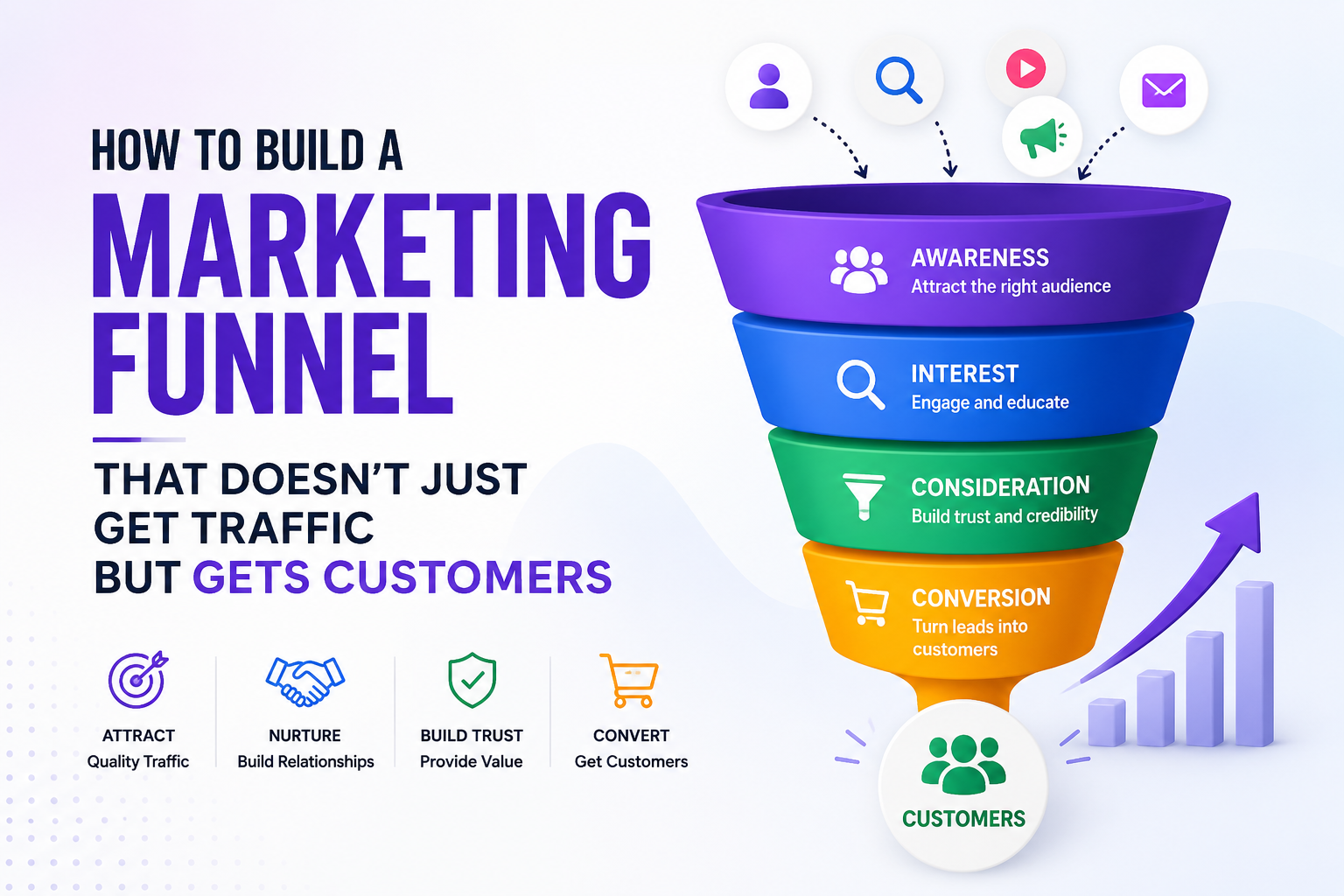
A proper funnel creates predictability. Instead of hoping visitors convert, a well-designed funnel ensures that each stage of the customer journey has a clear purpose: at the top, you build awareness; in the middle, you build trust; at the bottom, you drive conversions; and after the sale, you build loyalty. This structure allows you to measure, optimise, and scale. You know exactly where you’re losing customers and where you need to improve.
Understanding the Marketing Funnel Stages
Most marketing funnel stages follow a simple framework: TOFU, MOFU, and BOFU (top, middle, and bottom of funnel). Each stage has distinct objectives, channels, and metrics. Understanding what happens at each stage and how to optimise it is critical to building a conversion machine that grows revenue predictably.
Top of Funnel (TOFU): Building Awareness
At the top of the funnel, your goal is simple: reach people who don’t yet know your brand exists. These are cold audiences with no prior knowledge. They might not even know they have a problem you can solve. Your job is to introduce your brand, establish credibility, and plant the seed that you can help them. Use SEO and content marketing to reach people searching for educational content. Use paid advertising on Google and social media to reach broad audiences interested in topics related to your business. Use social media to build familiarity and demonstrate expertise through educational posts and industry insights. The metrics that matter at TOFU include reach, impressions, brand awareness, and click-through rates.
Middle of Funnel (MOFU): Building Trust and Consideration
Someone found you and clicked through. Now what? In the middle of the funnel, people are interested but not yet ready to buy. They’re evaluating options, comparing you to competitors, and deciding if you’re worth their money. Your goal is to build trust and nurture the relationship. Use email marketing to stay in touch with valuable content, case studies, and insights. Implement retargeting ads to keep prospects top-of-mind while they research. Share customer testimonials and case studies to show that businesses like theirs have succeeded. Create educational content and host webinars to help prospects understand their problem better. Offer lead magnets free resources like checklists, templates, or audits that give immediate value in exchange for an email address.
Bottom of Funnel (BOFU): Driving Conversion
The prospect is ready to make a decision. They’ve consumed your content, understand your approach, and have seen social proof from other customers. Now you need to remove the last barriers to purchase. Use high-converting landing pages that clearly explain what they get when they buy. Offer product demos so they can experience your solution firsthand. Provide testimonials and customer success stories that people want to hear from actual customers before committing to a purchase. Make your CTA obvious, compelling, and friction-free. For higher-ticket offerings, schedule sales calls where you address objections and seal the deal.
Social Media Across the Entire Funnel
Here’s something most marketers get wrong: social media isn’t just a top-of-funnel channel. Brands treat social as a brand awareness tool and then wonder why it doesn’t drive revenue. The truth is, social media influences every single stage of your marketing funnel, from awareness all the way through customer retention.
At the top, educational content on social media introduces your brand to cold audiences. A LinkedIn post about industry trends, a TikTok about productivity hacks, or an Instagram carousel about common mistakes can reach people who don’t yet know you exist. In the middle, founder content, customer testimonials, and FAQs build trust with interested prospects. At the bottom, product demos, customer success stories, and customer testimonials drive conversions. After the sale, community building, user-generated content, and referral campaigns turn customers into advocates.
Here’s how a real customer journey looks: They discover you on LinkedIn through an educational post (Day 1). They click through to your website but don’t convert (Day 3). They see a retargeting ad on Instagram (Day 5). They read your blog post about solving their problem (Day 8). They receive your nurture email with a case study (Day 12). They see a customer testimonial on social media from a trusted peer (Day 15). They watch a product demo video (Day 18). They book a demo call (Day 21). They convert (Day 25). That’s a 25-day journey with multiple touchpoints across channels. Traffic brings people into the funnel. Social keeps them moving through it.
The Three Places Where Marketing Funnels Leak
Your funnel is broken at one (or more) of these three critical points. Identifying where you’re losing customers is the first step to fixing it.
Leak #1: Attracting the Wrong Traffic
You can have millions of visitors, but if they’re not qualified prospects, your funnel will leak everywhere. Many businesses target too broadly, attracting low-intent visitors who are just casually browsing. They focus on cheap clicks instead of qualified leads. They celebrate 100,000 impressions without considering whether those 100,000 people actually need what they sell. This is the vanity metrics trap. The fix: Be ruthless about who enters your funnel. Quality beats quantity every single time.
Leak #2: Failing to Nurture Interested Prospects
Someone visited your site and showed genuine interest. Then you ignored them. This leak happens when you don’t capture email addresses from interested visitors, have no email nurturing workflows, or don’t retarget ads to people who showed interest. Without a nurturing system in place, interested prospects drop off because you didn’t stay in front of them regularly. The fix: build a system that automatically nurtures prospects with valuable content until they’re ready to buy.
Leak #3: Losing Customers Right Before Conversion
This is heartbreaking. A prospect is ready to buy and then doesn’t. This happens because of poor landing pages that don’t clearly explain the value proposition, weak CTAs that aren’t compelling enough, excessive friction in the checkout process, lack of trust signals like testimonials or security badges, or unclear pricing that leaves questions unanswered. The fix: make conversion as easy and obvious as possible. Remove every single barrier.
Social Pill’s Take: What Agencies Know About Marketing Funnels That Most Businesses Don’t
Here’s the perspective from agencies that have worked with hundreds of brands: most businesses are solving the wrong problem. They bring us in and say, ‘We need more traffic. We need to spend more on ads.’ So we dig deeper. We analyse their funnels. What we find is predictable and devastating.
A brand gets 10,000 visitors a month but only 100 leads. They think they need better SEO or more ad spend. Actually, their lead magnet is weak. Their landing page is confusing. Their CTA is unclear. Another brand gets 1,000 leads a month but converts only 2 into customers. They think they have a sales problem. Actually, their nurture sequence is broken. They’re not building enough trust before asking for a sale. Another brand’s conversion rate suddenly drops by 30%. They panic and increase ad spend. The real culprit? A competitor launched a more compelling offer. They didn’t need more traffic; they needed a better positioning strategy.
From an agency perspective, here’s what separates the brands that grow revenue from those stuck in the hamster wheel of increasing ad spend with stagnant returns:
- They treat the funnel as one interconnected system. A leak at the bottom affects everything. They optimise for conversion, not just traffic.
- They invest in MOFU content heavily. Most brands ignore the middle of the funnel, but that’s where trust is built and where most prospects drop off.
- They measure everything. We see brands without proper tracking, without conversion pixels, without email metrics. You can’t optimise what you don’t measure.
- They iterate constantly. Successful brands run A/B tests on landing pages, email subject lines, and CTAs. Small improvements compound into massive revenue gains.
- They understand the cost of attrition. Fixing a 2% leak at each funnel stage is easier and cheaper than acquiring new traffic. They stop obsessing over vanity metrics and focus on unit economics.
Building Your Funnel Marketing Strategy
Start with customer intent, not channels. Ask: What is your ideal customer trying to solve when they search for your solution? Build your entire funnel around satisfying that intent at each stage. Define specific metrics for every stage: track website traffic and cost per click for TOFU, email open rates and engagement for MOFU, conversion rates and cost per acquisition for BOFU. Create targeted content for all three stages: educational blogs and videos for TOFU, case studies and webinars for MOFU, and product demos and testimonials for BOFU.
Automate lead nurturing through email sequences that work 24/7 without your involvement. Continuously optimise conversion rates based on data; a 1% improvement in each stage compounds significantly. Continuously A/B test your landing pages, email subject lines, and CTAs. Small improvements add up to massive revenue gains.
The harsh truth: Most businesses think they have a traffic problem when they actually have a conversion problem. They hire growth hackers and launch ads while their broken funnel leaks customers at predictable points. Fixing the funnel is often faster and cheaper than buying more traffic. If your funnel is broken, scaling traffic just amplifies the problem. You’re pouring more water into a leaky bucket.
Types of Marketing Funnels
Different businesses need different funnel structures. Here are the main types:
- Lead Generation Funnel: Captures emails and nurtures prospects through educational content before sales involvement. Best for B2B companies with long sales cycles.
- Sales Funnel: Direct personal selling for high-ticket B2B offerings where a sales rep manages the entire process from initial contact to close.
- E-commerce Funnel: Quick purchase journey for online retail, where the entire process happens in minutes from discovery to checkout.
- Webinar Funnel: Uses educational webinars to establish authority, build trust, and nurture prospects before presenting a pitch.
- Subscription Funnel: Guides users through free trial sign-up, onboarding, value realisation, and conversion to paid plans with ongoing retention.
Conclusion: Traffic Doesn’t Grow Businesses. Customers Do.
A marketing funnel isn’t a machine for generating traffic. It’s a system for turning attention into customers and revenue. The best-performing brands understand this distinction. They measure every stage of their funnel, ruthlessly optimise for conversions, and treat their funnel as a living, breathing system that needs constant attention and improvement.
A million clicks from people with no interest is worthless. But 100 qualified prospects moving through a well-designed funnel? That’s a revenue machine. Where is your funnel leaking the most customers? Which stage has the lowest conversion rate? Are you truly turning traffic into customers, or just into impressions? The answer might be uncomfortable. But fixing it will transform your business.