Most Indian brands are having the same conversation in their quarterly reviews. Ad spend is up. Traffic is up. But revenue growth has slowed. The problem isn’t that you need more traffic. It’s that you’re not converting enough of the traffic you already have.
This is where conversion rate optimization enters the picture not as another marketing tactic, but as the foundation that determines how effective every other marketing investment becomes.
What Is Conversion Rate Optimization and Why Does It Matter?
Conversion Rate Optimization (CRO) is the process of increasing the percentage of website visitors who take a desired action, such as making a purchase, filling out a form, signing up for a newsletter, or downloading a resource.
For example, if your website receives 10,000 visitors per month and 100 of them make a purchase, your conversion rate is 1%. By improving that rate to 1.5%, you would generate 150 sales instead of 100 an additional 50 customers without spending more on acquiring traffic.
In reality, CRO goes far beyond tweaking website buttons or layouts. It involves understanding why visitors fail to convert and removing friction across the entire customer journey from search results and ads to landing pages, checkout processes, and even post purchase communication. From a business perspective, CRO ensures that every rupee spent on driving traffic delivers maximum revenue and return on investment.
Why Conversion Rates Matter More Than Traffic
A 10% traffic increase without conversion improvement doesn’t match a 10% conversion rate increase with same traffic. Consider: An Indian D2C brand with ₹50 lakh monthly revenue, 1 lakh visitors, 5% conversion rate faces two choices:
Option A: Spend ₹5 lakh on ads to reach 1.5 lakh visitors = ₹25 lakh revenue increase but higher ongoing CAC.
Option B: Invest ₹3 lakh to improve UX and increase conversion to 6% = ₹5 lakh revenue increase with lower ongoing cost.
Option B pays for itself in one month. Option A requires perpetual increased spending to maintain growth. A brand converting at 3% will always lose to one converting at 5%, regardless of traffic levels. This difference compounds over time.
Why Most Indian Brands Focus on Traffic Instead of CRO
The Traffic Obsession
Growth looks like numbers. More impressions, more visits, more followers. It’s visible and feels like progress. Improving checkout flow by 0.3% doesn’t sound impressive in a board meeting. Increasing traffic by 40% does even if it doesn’t drive revenue.
Additionally, the marketing industry is incentivised toward traffic. SEO agencies promise rankings. Paid specialists promise clicks. Social teams promise followers. None are paid for revenue. They’re paid for metrics that are easiest to report. This creates a blind spot where brands optimize for vanity metrics instead of business metrics.
Scaling a Broken Funnel
Many brands respond to declining growth by increasing marketing spend. But if your funnel is broken, more traffic just means more losses. A brand with ₹500 CAC but ₹400 average customer value loses money at scale. Increasing ad spend doesn’t fix this it accelerates the problem. CRO asks a different question: Is our funnel healthy before we scale?
The Spending Threshold
There’s a point where more marketing spend stops working. You can always buy more traffic, but you can’t buy better experiences or customer trust. When brands hit this threshold, CRO becomes the most effective growth lever.
A D2C brand spending ₹10 lakhs monthly on Instagram with 2% conversion faces diminishing returns. Increasing to ₹15 lakhs might only add 20% conversions, not 50%. But fixing checkout friction and adding reviews could increase conversion to 3% a 50% improvement with zero additional spend.
Why CRO Should Come Before Any Growth Strategy
Every Marketing Channel Depends on Conversion
Every marketing channel SEO, paid ads, social, influencer, WhatsApp is essentially a traffic driver. The value of that traffic depends entirely on what happens after someone arrives. A perfect Google ranking that drives 1,000 visitors to a confusing website generates no revenue. A ₹5 lakh influencer campaign driving followers to a 0.5% conversion page is wasteful. WhatsApp marketing to a broken checkout tanks customer lifetime value.
The channel isn’t the problem. What happens when people arrive is. Conversion rate optimization is the common denominator across all channels. It determines whether your investment in each channel generates revenue or just costs money.
Scale What Works, Don’t Scale What Leaks
Before you increase marketing spend, ensure your conversion funnel is healthy. A 1.5% conversion rate isn’t perfect, but it’s healthy. Scale traffic to it. A checkout flow losing 40% of customers is broken. Fix it before spending more on acquisition. A landing page that doesn’t match your ad promise is misaligned. Address it before increasing ad spend.
Most brands do the opposite. They identify a problem and respond by pouring more budget into the channel, hoping volume overcomes quality issues. CRO inverts this logic: make the funnel work first, then scale it.
Conversion Rate Optimization Is Not a Standalone Marketing Function
Why CRO Fails When Treated as a Website-Only Exercise
Many brands hire a CRO consultant, ask them to “improve the website,” and expect revenue to increase. When it doesn’t, they assume CRO doesn’t work. The problem is that conversion doesn’t happen in isolation. It happens across an entire customer journey. Consider a potential customer’s path:
They search for “best running shoes for flat feet” and find your website through Google. The search result (SEO) is relevant and clicks are good. They land on your product page (website). The page is well-designed and they’re interested. They add shoes to their cart. But the shipping cost is high, so they abandon it. They see your retargeting ad on Instagram a few days later. The ad is relevant and they click back. But this time they go to your homepage instead of the product page, so they start browsing from scratch.
Frustrated, they WhatsApp your customer service to ask about shipping. The response takes 6 hours. They decide to buy from a competitor instead. Where did conversion optimization fail? Everywhere. On the website, across channels, in your response systems. If you only optimize the website and ignore the SEO messaging, the ad experience, and the WhatsApp responsiveness, you’ve only solved part of the problem. Effective CRO requires coordination across teams and channels. It’s not a website problem. It’s a business problem.
How Customer Journeys Influence Conversion Rates
Modern customer journeys are non-linear. People don’t move through a simple funnel. They bounce between channels, research across devices, and make decisions based on multiple touchpoints.
A customer might:
- See your brand mentioned in an influencer’s Instagram story
- Research you on Google
- Read reviews on your website
- Message a friend on WhatsApp asking for feedback
- Check your TikTok to see how others use your product
- Return to your website and make a purchase
Each of these moments influences whether they convert. If any part of this journey is broken if your reviews are missing, if your TikTok content is outdated, if your website is slow conversion rates suffer.
CRO that ignores this reality will always underperform. You can optimize your product page perfectly, but if your Google reviews are terrible, people won’t convert. You can run a brilliant influencer campaign, but if your website messaging doesn’t match the influencer’s positioning, conversion rates drop. This is why effective CRO requires insight into how customers actually discover and evaluate your brand. It requires understanding which channels matter most, which messaging resonates, and which friction points are actually preventing conversions.
Why Marketing Channels Must Work Together
Most brands operate in silos. The SEO team optimizes for keywords. The paid ads team optimizes for ROAS. The social team optimizes for engagement. The influencer team optimizes for reach. Each team is good at their job. But they’re not working toward the same outcome. Imagine your SEO team ranks for “best organic skincare products for sensitive skin.” Someone clicks through and lands on your homepage, which emphasizes luxury packaging. Your messaging is misaligned with the search intent. They bounce.
Or your paid ads team runs a campaign highlighting your products’ affordability. But your website talks about premium quality and high price. The cognitive dissonance kills conversion.
Or your influencer partner emphasises product benefits for professional use. But your website positions the product for personal use. Mixed signals tank conversion rates.
CRO forces alignment. It says: everyone is responsible for conversion. Your SEO keywords should match your landing page copy. Your ads should match your website experience. Your influencer messaging should match your brand story. This coordination doesn’t happen naturally. It requires a team that understands customer journeys and can work across channels. This is the perspective that separates effective CRO from vanity metric optimisation.
How CRO Makes Every Marketing Channel More Effective
CRO and Paid Advertising: If your ads send people to non-converting pages, you’ve wasted money. CRO improves landing page experience, which improves economics. A page converting at 3% instead of 2% decreases CAC by 33% without additional spend.
CRO and SEO: High-intent search traffic is wasted if pages don’t convert. SEO + CRO together ensure keywords convert. A #1 ranking for a keyword is only valuable if it drives revenue.
CRO and Social Media: Social builds awareness, but only matters if it converts. Track conversions from social, not just engagement. Measure how effectively social drives business outcomes.
CRO and Influencer Marketing: Influencer campaigns are expensive. CRO ensures they convert. Track actual revenue impact, not just reach or engagement.
CRO and WhatsApp Marketing: WhatsApp is personal and direct. CRO means using it to address objections and guide decisions, not broadcast offers.
What Conversion Rate Optimisation Actually Looks Like
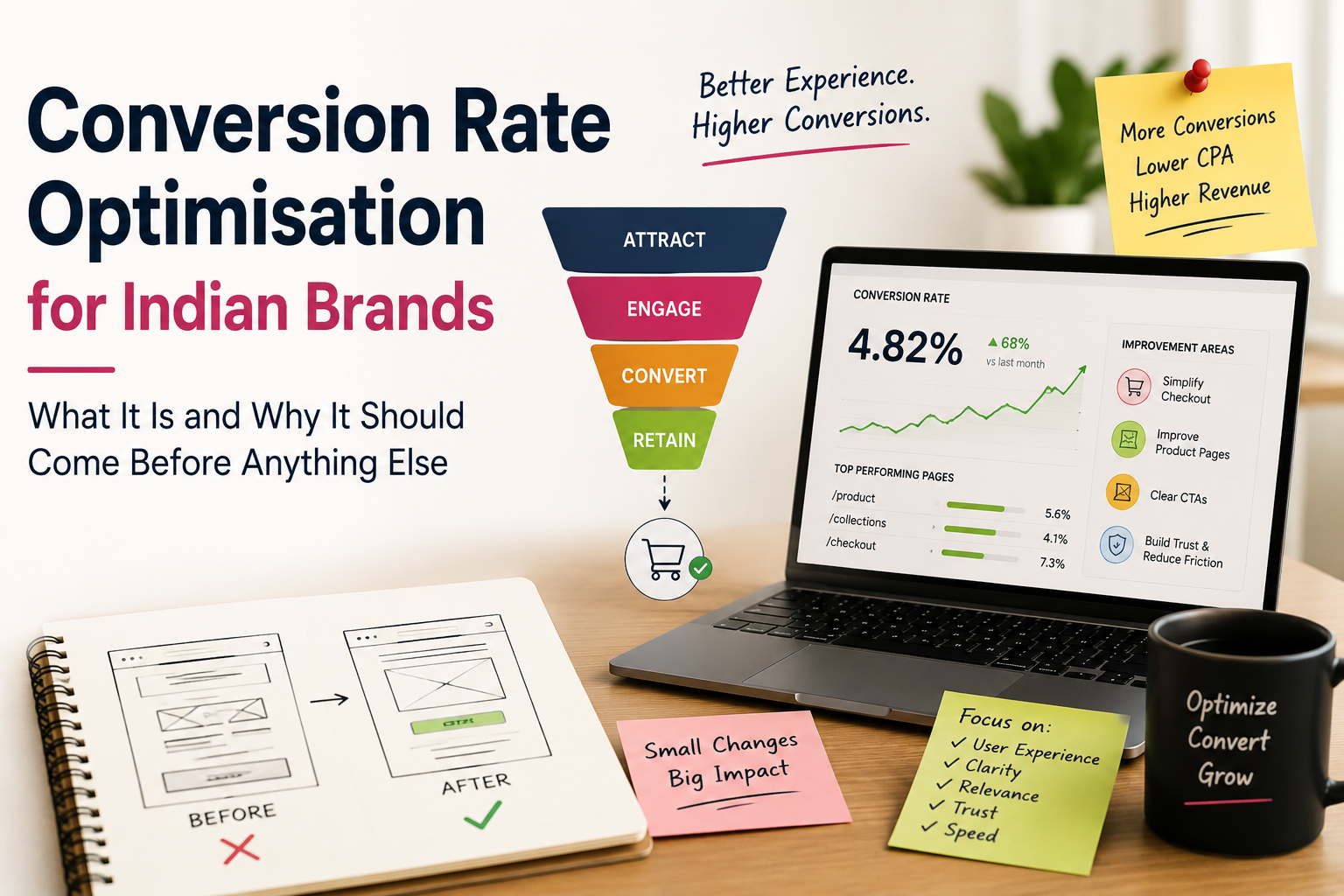
The foundation of CRO is understanding how people actually interact with your brand. Use heatmaps, session recordings, and surveys to reveal where people get confused or abandon. Common friction points: important information below the fold, unclear payment options, missing trust signals, slow websites, confusing navigation, unclear value propositions, and hesitation about quality. Effective CRO removes this friction through: simplifying product pages, adding reviews, reducing form fields, transparent shipping info, live chat options, clear guarantees, strong CTAs, and optimised page speed.
Key Misconceptions About CRO
CRO is not just A/B testing. A/B testing is a tactic within CRO. CRO is understanding why people don’t convert and removing barriers. Testing button colours without addressing unclear value propositions is pointless.
CRO is not just for websites. Conversion happens across SEO, ads, influencer messaging, and customer service. Optimising only your website while ignoring other touchpoints wastes opportunity.
CRO applies to all business models. Service businesses, B2B, SaaS, education all benefit. A conversion might be a lead, signup, application, or purchase. The principle is the same: remove barriers to desired actions.
CRO is ongoing. Markets change. Customer preferences shift. Competitors innovate. Excellent conversion rates today might be mediocre tomorrow. Continuous testing is essential.
How to Increase Conversion Rate Without Spending More
Improve existing traffic performance. Analyse where people drop off and why. Fix obvious problems—confusing checkout flows, missing information, unclear pricing, and a lack of trust signals. Remove specific barriers: Information gaps, trust issues, friction in the process, price hesitation, timing mismatches, and comparison confusion.
Align messaging across channels. Ad headlines should match landing page headlines. Value propositions should align. Influencer positioning should match the brand story. This costs nothing but requires coordination. Match content to user intent. Someone searching “how to choose” wants education. Someone searching “buy product” wants to purchase. Serve the right content to the right intent.
Why CRO Matters Now More Than Ever
CAC is rising across platforms. Competition means you can’t outspend indefinitely. Efficiency becomes the primary lever. Every category has more competitors. Compete on efficiency, not just budget, and you win despite smaller ad spend.
Boards demand marketing ROI. Justify spending on revenue, not awareness alone. CRO ensures investments generate revenue. In commoditised markets, conversion efficiency is the primary competitive advantage.
Conversion Rate Optimisation Is the Foundation of Profitable Growth
Traffic growth without conversion improvement doesn’t equal revenue growth. A doubled audience with halved conversion rates nets the same revenue. Smart brands target both: 20% traffic growth plus 5% conversion improvement. Best brands optimise before they scale testing economics on small budgets, then scaling what works. CRO compounds. A 10% improvement in year one, 8% in year two, 6% in year three creates a 30-40% advantage versus non-CRO competitors.
Conclusion
Most brands believe growth comes from getting more traffic, but sustainable growth often starts with converting more of the visitors you already have. Before increasing ad budgets, launching new campaigns, or expanding into more channels, it’s worth asking a simple question: are you getting enough value from the traffic you already attract?
If the answer is no, the issue usually isn’t traffic it’s conversion. Conversion Rate Optimization (CRO) helps businesses turn existing visitors into more customers, leads, and revenue without increasing acquisition costs. That’s why CRO isn’t just another marketing tactic; it’s the foundation that makes every other marketing investment work harder.