Someone visited your website yesterday. They looked at three products. They added one to their cart. Then they left. Your marketing team’s response is predictable: retarget them everywhere. Show them ads on Facebook, Google, Instagram. Follow them across the internet until they convert or become so annoyed they block your ads. This is why most retargeting campaigns waste money.
Effective retargeting isn’t about showing more ads. It’s about showing the right ads to the right people at the right time. Most brands chase every visitor equally, wasting budget on low-intent audiences while failing to capitalize on high-intent ones. The best retargeting strategies focus on precision, not volume.
What Is Retargeting and Why Does It Matter?
Retargeting is the practice of showing ads to people who have previously visited your website but didn’t convert. That’s the simple definition. But it’s worth understanding what’s actually happening. When someone visits your website, a pixel (a small piece of code) tracks them. This pixel allows you to identify them later on other websites and show them ads. The goal is to remind them of your brand and convince them to come back and complete the action they didn’t finish.
Retargeting is not brand awareness. It’s not reaching new people. It’s specifically about re-engaging people you already know are interested in your product because they’ve already visited your website. This distinction matters. It means retargeting budgets should be measured differently. Success isn’t defined by reach or impressions. It’s defined by bringing people back and converting them.
How Retargeting Works
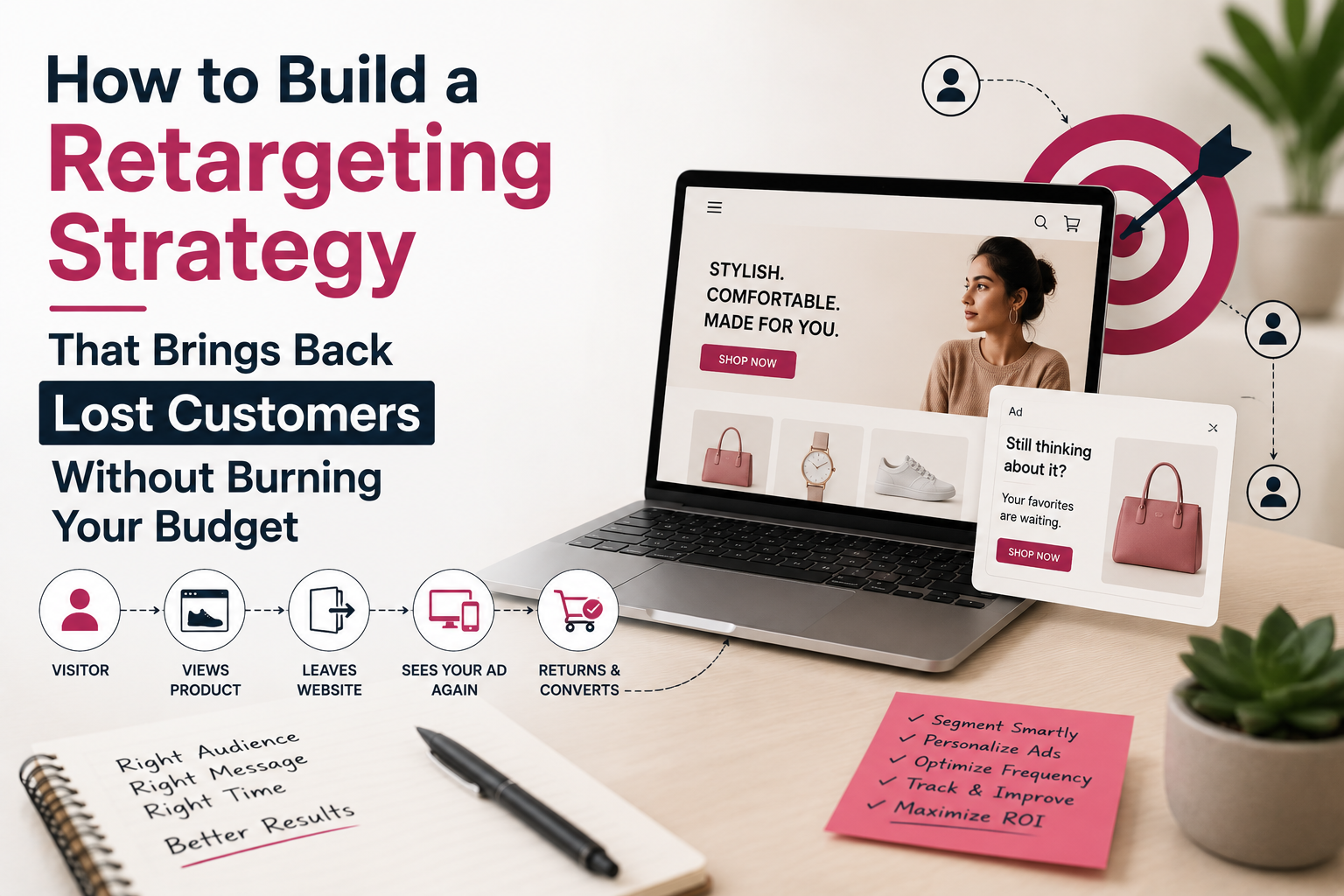
Here’s how retargeting actually works: A person discovers your brand through a Google search. They click your ad and land on your website. They spend a few minutes looking at products. They don’t buy, and they leave. At that moment, the pixel you’ve placed on your website sends information to Meta, Google, or another ad platform. It tells them: “This person visited my website but didn’t convert.”
The ad platform files this information. It tags this person as part of your website audience. Now, when this person goes to Facebook, Instagram, Google Search, YouTube, or any other platform where you’re running ads, they see your ads. Not because you’re paying to reach them individually (though you could), but because you’re paying to show ads to your “website visitors” audience.
If your retargeting campaign is set up properly, the ads they see are specifically designed for people who have already visited your website. They’re not generic brand ads. They’re personalised to the specific products they looked at or the actions they didn’t complete.
The person sees the ad, clicks it, comes back to your website, and potentially converts. That’s retargeting.
Why Most Visitors Do Not Convert on Their First Visit
Most purchases don’t happen on the first interaction. Someone discovers your brand, visits your website, and leaves while still researching or comparing options. This is completely normal. This is why retargeting exists. It keeps you in front of someone during their research phase. For high-intent visitors, this is valuable. For low-intent visitors, it’s wasteful.
Why Retargeting Is One of the Most Efficient Advertising Strategies
Retargeting is fundamentally efficient because you’re not convincing cold audiences. You’re re-engaging warm audiences who already know what you sell. Someone who visited your website already decided your brand was relevant enough to visit. The sales work is partially done. The cost per acquisition for retargeting is typically 40-60% lower than cold traffic, and ROI is measurable and trackable.
Why Most Retargeting Campaigns Waste Budget
The Mistake of Retargeting Everyone
The fundamental mistake: retargeting everyone who visits your website equally. Someone who spent 3 seconds on a page and bounced gets the same retargeting treatment as someone who abandoned a cart. The result is showing ads to low-intent users who are unlikely to convert, wasting ad spend.
Not everyone deserves equal ad budget. Someone who abandoned a cart yesterday is very likely to convert. Someone who visited 3 months ago is unlikely to convert. Yet both might be in the same retargeting audience.
Why Low-Intent Visitors Rarely Come Back
Not everyone who visits is actually interested in buying. Someone might have clicked the wrong link, been comparing prices, or landed by accident.
For these people, retargeting is an interruption. They’re more likely to block your ads or ignore your messages. This trains your audience to ignore your ads across your entire campaign. When you show ads to low-intent users, you’re wasting budget with low conversion probability.
The Hidden Cost of Poor Audience Segmentation
Without segmentation, you never know if your budget is going to high-intent or low-intent users. If you segment your audience by behavior (cart abandoners, product viewers, one-time browsers), you can see which audiences convert and allocate budget accordingly. Cart abandoners might convert at 8%, while one-time visitors convert at 0.5%. Reallocating budget from low-converting to high-converting audiences dramatically improves ROI.
How Excessive Ad Frequency Hurts Performance
Frequency is how many times someone sees your ad in a given time period. There’s a psychological phenomenon at play: initial impressions are valuable. Repeated impressions have diminishing returns. The first time someone sees your retargeting ad, they notice it. Maybe they think “Oh, I remember this brand.” The second and third time, they’re reminded. They might even click. By the fifth time in a week, they’re annoyed. By the tenth time, they’re actively avoiding your brand. This is ad fatigue. And it destroys retargeting performance.
When ad fatigue sets in, your click-through rates decline, your conversion rates decline, and your cost per acquisition increases. You’re paying more to show ads to people who increasingly dislike seeing them. Many brands don’t realize this is happening. They see declining performance in their retargeting campaigns and respond by increasing budget, not realizing the issue is frequency, not budget. The fix is frequency capping: limiting how many times someone sees your ad. But most brands don’t implement this properly, if at all.
Remarketing vs Retargeting — What Is the Difference?
| Aspect | Retargeting | Remarketing |
| Definition | Retargeting is the practice of showing paid ads to people who have already visited your website or interacted with your brand but didn’t convert. These ads appear on platforms like Meta, Google Display Network, YouTube, and other websites they browse later. | Remarketing is the practice of reconnecting with past visitors or customers through owned communication channels such as email, WhatsApp, SMS, or push notifications after they have shared their contact information. |
| How It Works Differently | Uses tracking pixels and cookies to create audience segments and serve ads across third-party platforms. Brands pay per impression or click, allowing them to reach thousands of potential customers at scale. | Uses customer data such as email addresses or phone numbers to send direct, personalised messages. The communication is permission-based and usually costs only the platform subscription fee rather than a per-click advertising cost. |
| How It Helps Conversions | Keeps your brand visible after a visitor leaves your website, reminding them about products they viewed or actions they didn’t complete. Multiple ad exposures increase the chances of bringing users back to convert. | Delivers highly personalised reminders, abandoned cart messages, special offers, and follow-ups directly to interested prospects, making it easier to move high-intent users toward conversion. |
| Typical Performance | Generally delivers lower engagement rates, with click-through rates often ranging between 0.5% and 2%, but offers significant reach and audience scale. | Usually generates much higher engagement, with email open rates of 20-40% and WhatsApp open rates exceeding 80%, though the audience size is limited to your contact database. |
| Best Use Case | Ideal for creating broad awareness and re-engaging large groups of non-converting website visitors. | Ideal for nurturing leads, recovering abandoned carts, and building stronger relationships through direct communication. |
The Audience Segments Every Retargeting Strategy Should Prioritise
Not all visitors deserve equal budget. Prioritize:
Cart Abandoners (Highest Budget): Showed the strongest intent. Most likely to convert with a reminder or small incentive.
Checkout Abandoners (Highest Budget): Even closer to converting. Hesitated at the price or payment. Respond well to reassurance or incentives.
Product Page Visitors (High Budget): Showed interest in specific product. Retarget with that product plus reviews and comparisons.
High-Intent Visitors (Medium-High Budget): Spent significant time on site, viewed multiple products. Genuine purchase consideration.
Repeat Visitors (Medium Budget): Visited multiple times. Re-engagement campaigns work well for these audiences.
Previous Customers (Medium Budget): Already bought once. Low friction for repeat purchases. Target with new products.
Which Platforms Work Best for Retargeting Ads?
Meta Retargeting
Meta (Facebook and Instagram) is the dominant retargeting platform in India. Large audiences, precise targeting, and engaging formats. Cost per click is typically lower because audiences are warm. The challenge is ad fatigue since everyone retargets on Meta.
Google Display and YouTube
Google Display Network reaches thousands of websites, but with lower click-through rates. YouTube retargeting works better for storytelling and product demonstrations.
Choosing the Right Platform
The best platform depends on the customer journey stage. Cart abandoners need direct Meta offers. Researchers need educational YouTube content. Re-engagement might work better on Google Display.
The strongest strategies use multiple platforms with different messages for different segments.
What Makes Retargeting Ads Actually Convert?
Matching Creative to User Intent
Effective retargeting matches the creative to what people actually did. Show specific products to those who looked at them, product categories to those who browsed categories, and related content to those who viewed videos.
Generic ads showing the same product to everyone have low conversion rates because they’re not relevant to individual behaviour.
Using Different Messages for Different Audiences
Cart abandoners need urgency: “Complete your order and get ₹500 off.” Browsers need education: “Discover why 10,000+ customers love our products.” Repeat visitors need newness: “New products you might like.” Each audience is at a different decision stage and deserves different messaging.
Offers, Urgency, and Social Proof
Effective retargeting combines:
- Small discounts or free shipping as conversion pushes
- Urgency (“Limited stock” or “Sale ends in 2 days”) to drive immediate action
- Social proof (“Join 10,000+ customers”) to reduce hesitation
The most effective ads combine all three elements strategically.
Why Landing Pages Matter
An effective ad is worthless if the landing page doesn’t match. Don’t send people to your homepage. Send cart abandoners to the product page they looked at. Send people who saw an offer to a landing page showing that offer.
This requires multiple landing pages but dramatically improves conversion.
How to Control Frequency Without Annoying Potential Customers
What Ad Fatigue Looks Like and Why Frequency Caps Matter
Ad fatigue occurs when people see your ad so many times that they ignore it. Signs include declining click-through rates, rising cost per acquisition, and people marking ads as spam.
A frequency cap limits impressions per person per period. Without one, someone might see your ad 20+ times weekly. With a cap of 3-5 daily impressions, they remember you without annoyance. For cart abandoners, 3-5 impressions are optimal. For low-intent audiences, 1-2 per day works better.
When to Stop Retargeting Someone
At some point, you should stop showing ads to someone. If someone has seen your ad 30 times and hasn’t converted, they’re probably not going to convert. You’re wasting budget. Most platforms allow you to set retargeting window limits. For example, you might retarget someone for 30 days. After 30 days, if they haven’t converted, they’re removed from the audience.
Smart brands have different windows for different audiences:
- Cart abandoners: 7-14 days (short window, high urgency)
- Product viewers: 21-30 days (medium window)
- Homepage visitors: 7 days (short window, low intent)
A visitor who hasn’t converted after seeing your ad for 30 days probably won’t convert. Move on and invest in other audiences.
How to Build a Cost-Effective Retargeting Strategy
Prioritise High-Intent Audiences
Allocate budget based on intent. Cart abandoners convert at 8-10%, product viewers at 3-5%, and homepage visitors at 0.5%. If you have a ₹2 lakh monthly budget, allocate 50% to cart abandoners, 30% to product viewers, 20% to others. This simple prioritisation dramatically improves ROAS.
Segment Before You Scale
Don’t create one large audience. Segment by behaviour (cart abandoners, product viewers), purchase history, and engagement level. Each segment needs tailored creative and messaging.
Align Creative With Customer Journey Stages
Cart abandoners: “Complete your order now.” Researchers: “Here’s why customers love this product.” Browsers: “Discover products you might love.” Previous customers: “New products arrived. Welcome back.”
Continuously Refine Audience Lists
Old audiences perform worse than fresh ones. Remove people who’ve converted, set expiration dates, and clean regularly.
Measure Incremental Performance
Most brands measure total conversions, which is misleading. Some conversions would happen anyway. Measure incremental impact using control groups.
Why the Best Retargeting Strategies Focus on Relevance, Not Reach
The Difference Between Following Customers and Helping Them Decide
There’s a psychological difference between these two scenarios:
Following: You see an ad for a product on your feed. You ignore it. A day later, you see the same ad again on YouTube. You ignore it. The next day, you see it on Google News. You’re annoyed. The company is following you everywhere.
Helping them decide: You look at a product. You think about it. The next day, you see an ad showing customer reviews of that product. It helps you make a decision. You buy. The difference is relevance and helpfulness. Effective retargeting feels helpful, not intrusive. You’re giving someone information that helps them make a decision, not forcing them to see ads they’ve already ignored.
Why Precision Beats Volume
A brand could reach 100,000 people with retargeting ads at a low cost. But if only 1% of those are actually interested, they’re wasting 99,000 impressions. Alternatively, they could focus on 10,000 people who showed strong intent (cart abandoners, product viewers, repeat visitors). If 5% convert, they generate more revenue with fewer impressions. Precision beats volume. Target fewer people more effectively, not more people less effectively.
Retargeting as Part of a Broader Growth Strategy
The best retargeting strategies don’t operate in isolation. They’re part of a broader customer journey strategy that includes:
- Better product pages that reduce initial friction
- Better checkout flows that reduce abandonment
- Better email/WhatsApp remarketing that complements paid retargeting
- Better analytics that reveal why people are leaving in the first place
Retargeting is the band-aid. The real fix is removing the reason people leave in the first place. This is why retargeting should never replace conversion rate optimisation. It should complement it. A brand that improves its conversion rate from 2% to 3% doesn’t need to increase retargeting spend. It can maintain the same spending and generate more revenue. A brand that doesn’t address conversion barriers and just increases retargeting budgets is treating the symptom, not the disease.
Conclusion
Most brands assume retargeting is simply about showing more ads to more people. In reality, successful retargeting is about showing the right message to the right audience at the right time. The brands that see the best results don’t increase budgets blindly; they focus on better audience segmentation, more relevant messaging, stronger creatives, and aligning retargeting efforts with the overall customer journey.
Ultimately, effective retargeting isn’t about chasing potential customers across the internet. It’s about reconnecting with interested prospects and giving them a compelling reason to return, take action, and convert.
When you get this right, retargeting becomes one of your most efficient marketing channels. When you get it wrong, it becomes an expensive waste. The difference is strategy, not spending.