Most Indian businesses today are publishing more content than ever: blogs every week, social posts every day, email newsletters every month. Yet a lot of marketing teams still ask the same question: why isn’t this working? Website traffic isn’t growing, leads aren’t coming in, and search rankings haven’t moved despite months of content creation.
The answer usually has nothing to do with how much content is going out. It has everything to do with how good that content actually is. Google’s Helpful Content updates were built specifically to reward pages that genuinely satisfy user intent, and AI Overviews now pull answers from sources that demonstrate real expertise and clarity, not just keyword coverage. Content that’s written to satisfy a search engine, rather than the person actually searching, keeps getting pushed further down the results page.
This shift matters more for founders, CMOs, and marketing managers than most SEO trends, because it changes what doing content marketing well actually means. Publishing volume used to be a reasonable strategy. It isn’t anymore. This article breaks down what content writing actually means, what separates quality content from the rest, and six practical tips your team can start using today to write content that ranks, builds reader engagement, and converts visitors into customers.
What Is Content Writing?
Content writing is the process of researching, planning, and writing text with a specific business goal to inform, engage, or persuade a reader and guide them toward an action, whether that’s signing up for a newsletter, requesting a demo, or making a purchase. That’s the simplest way to answer what is content writing: it’s writing with a purpose attached to it, not writing for its own sake. It’s also a broader discipline than copywriting, which focuses specifically on short, persuasive, sales-driven text, though the two overlap heavily on landing pages and ads.
This is where content writing differs from general writing. An essay or a novel can exist purely to inform or entertain. Content writing always has a business objective sitting behind it: brand awareness, lead generation, customer education, or SEO visibility. Every piece is built around a target reader, a specific search intent, and a measurable outcome the business cares about.
In practice, content writing meaning extends across several formats: blog writing that answers customer questions, landing pages that convert visitors into leads, email campaigns that nurture prospects, website content that explains a product clearly, social media captions that build engagement, and case studies that prove results. A SaaS company in Bangalore might use blog writing to rank on Google, while a D2C skincare brand in Mumbai might lean on landing page copy and email content to drive repeat purchases.
Businesses invest in content writing because it’s one of the few marketing channels that keeps working long after the money is spent. A well-written blog can bring in organic traffic for years that’s evergreen content at work, unlike a paid ad that stops the moment the budget runs out. That compounding value is why content creation has become a core line item in every serious content strategy today, not a nice-to-have.
What Makes Content High-Quality?
Not all content is equal, even when it’s well-written. The difference between average content and truly quality content comes down to ten specific factors that both readers and Google’s algorithms look for.
Originality means the content offers a perspective, insight, or example the reader hasn’t already seen on five other websites. Accuracy means every fact, statistic, and claim is verified and current, not copied from an outdated source. Relevance and search intent mean the content answers the exact question the reader typed into Google, not a loosely related topic. Readability means the writing is easy to scan and understand, even for a reader who’s in a hurry.
The remaining factors are about credibility. Expertise shows through when the writer clearly understands the subject, not just the surface-level talking points. Trustworthiness comes from honest claims, clear sourcing, and no exaggerated promises. Freshness and depth mean the content is updated regularly and covers the topic thoroughly, without padding it with filler. And ultimately, everything comes back to usefulness: valuable content that gives the reader something they can actually use, not just engaging content that’s pleasant to read but forgettable.
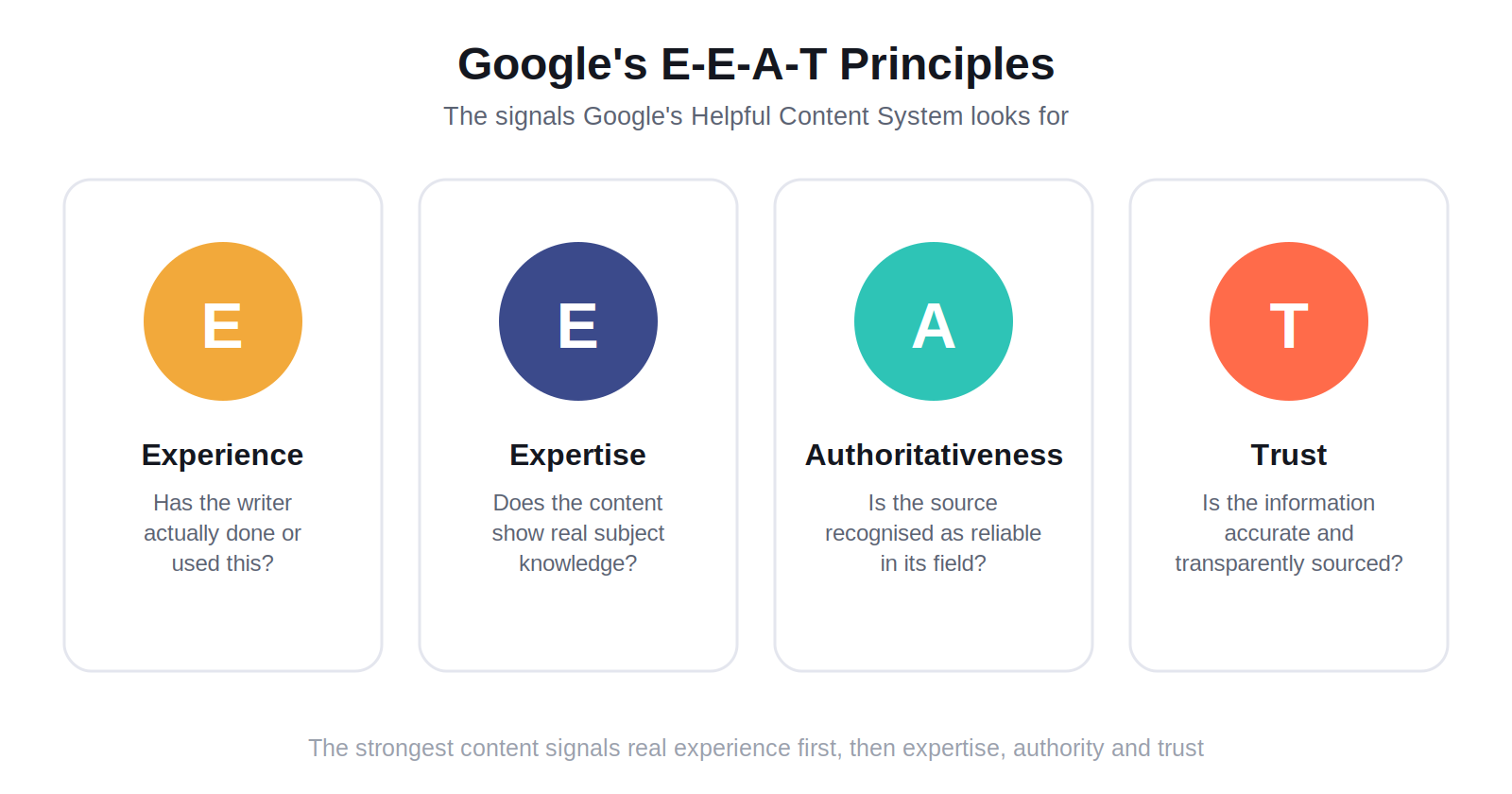
These ten factors map almost exactly to what Google calls its Helpful Content System, built around E-E-A-T: Experience, Expertise, Authoritativeness, and Trust. Google doesn’t rank SEO content because it’s well-formatted or keyword-optimised. It ranks content because real signals show the piece was written by someone who knows the subject and genuinely helps the person searching for it.
Why High-Quality Content Matters for Businesses
Quality content isn’t just a writing preference; it directly affects business outcomes that CMOs and founders are already tracking. The connection between content quality and revenue is closer than most marketing teams realise.
Better Google rankings are the most direct benefit. Search engines are built to surface the most helpful result for a query, so content that genuinely satisfies search intent naturally climbs higher over time. This same quality now determines whether a brand gets pulled into AI Overviews, the summarised answers Google shows at the top of search results. A financial services company in Pune that publishes a genuinely clear explainer on tax-saving investments has a real shot at being cited in an AI Overview; a thin, generic version of the same article does not.
Quality content also builds brand authority in a way advertising can’t. When a homegrown FMCG brand consistently publishes accurate, informational content around ingredients, usage, and health claims, customers start trusting that brand’s opinion over a random influencer’s. That trust translates directly into reader engagement, longer time on site, and better conversion rates, because readers who find real answers are far more likely to explore what else the business offers.
For lead generation specifically, quality content does the heavy lifting before a sales conversation even starts. A B2B software company that publishes detailed, well-researched guides on industry problems ends up with prospects who arrive already educated and further along the buying journey. This is also why quality content compounds into long-term organic growth: a well-optimised blog written two years ago can still bring in steady organic traffic today, something a paid campaign can never do once the budget stops.
6 Tips for Writing High-Quality Content
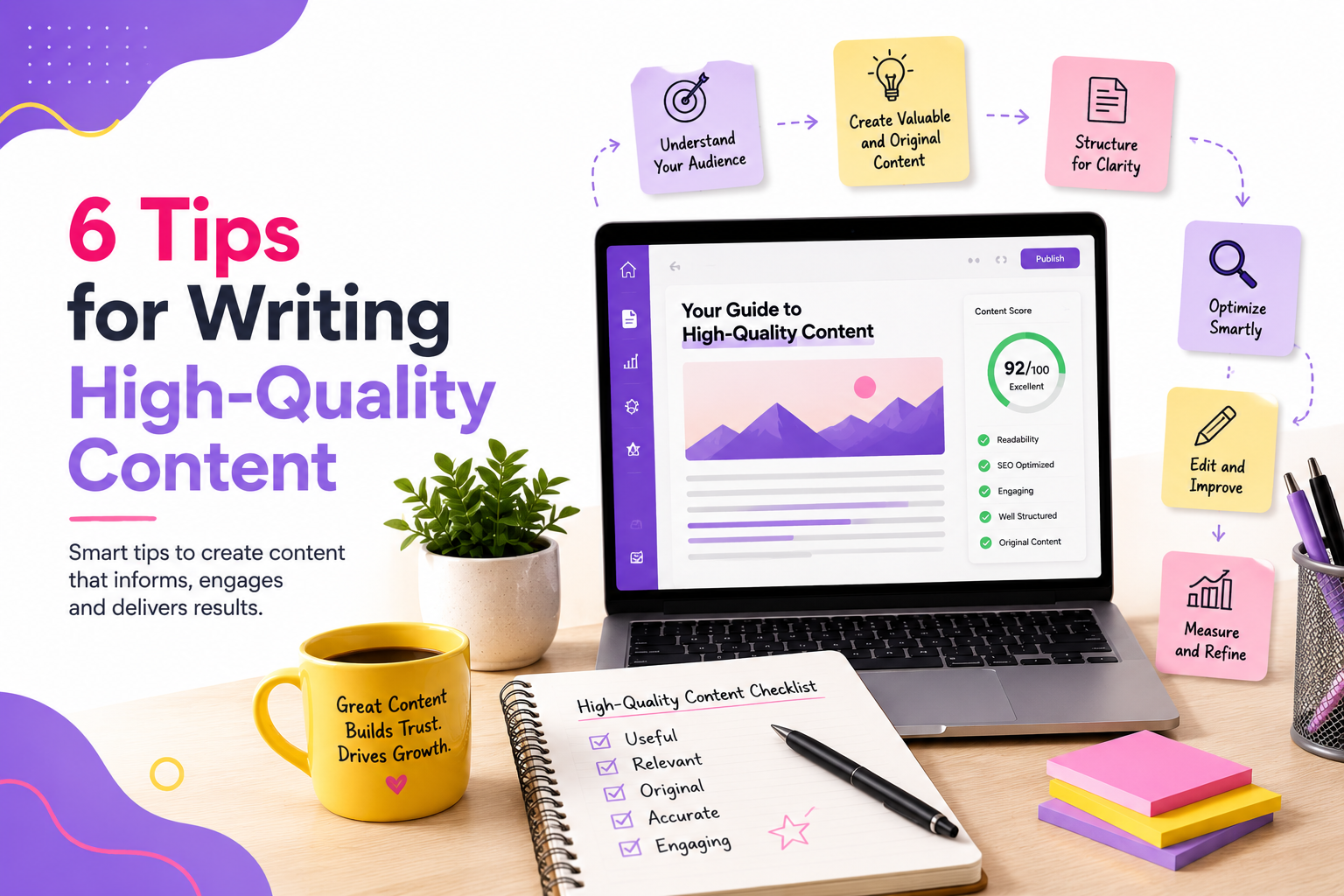
If you’re wondering exactly how to write quality content that consistently performs, here’s a repeatable process with six specific habits your team can apply to every piece you publish.
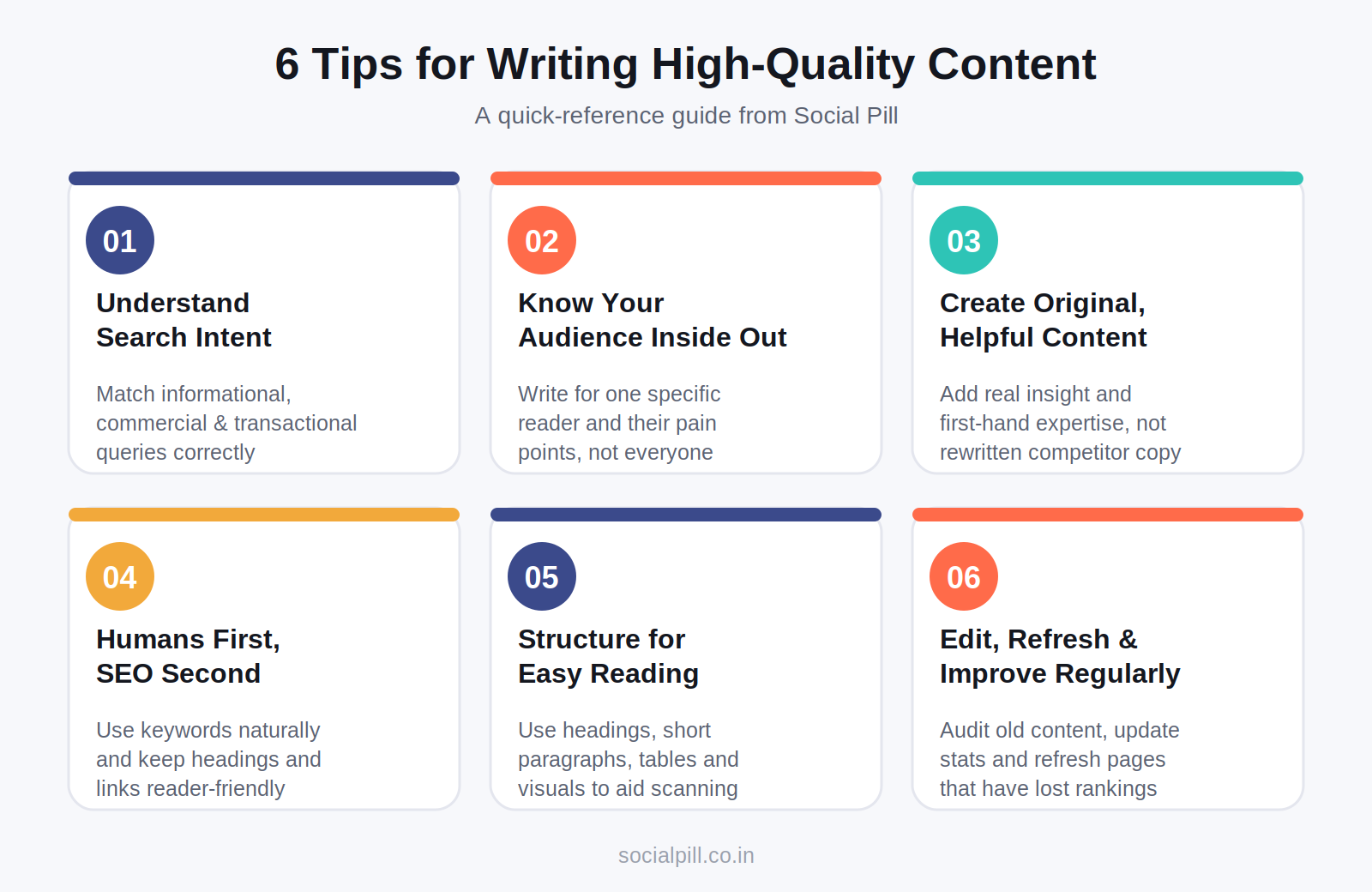
1. Understand Search Intent Before You Write
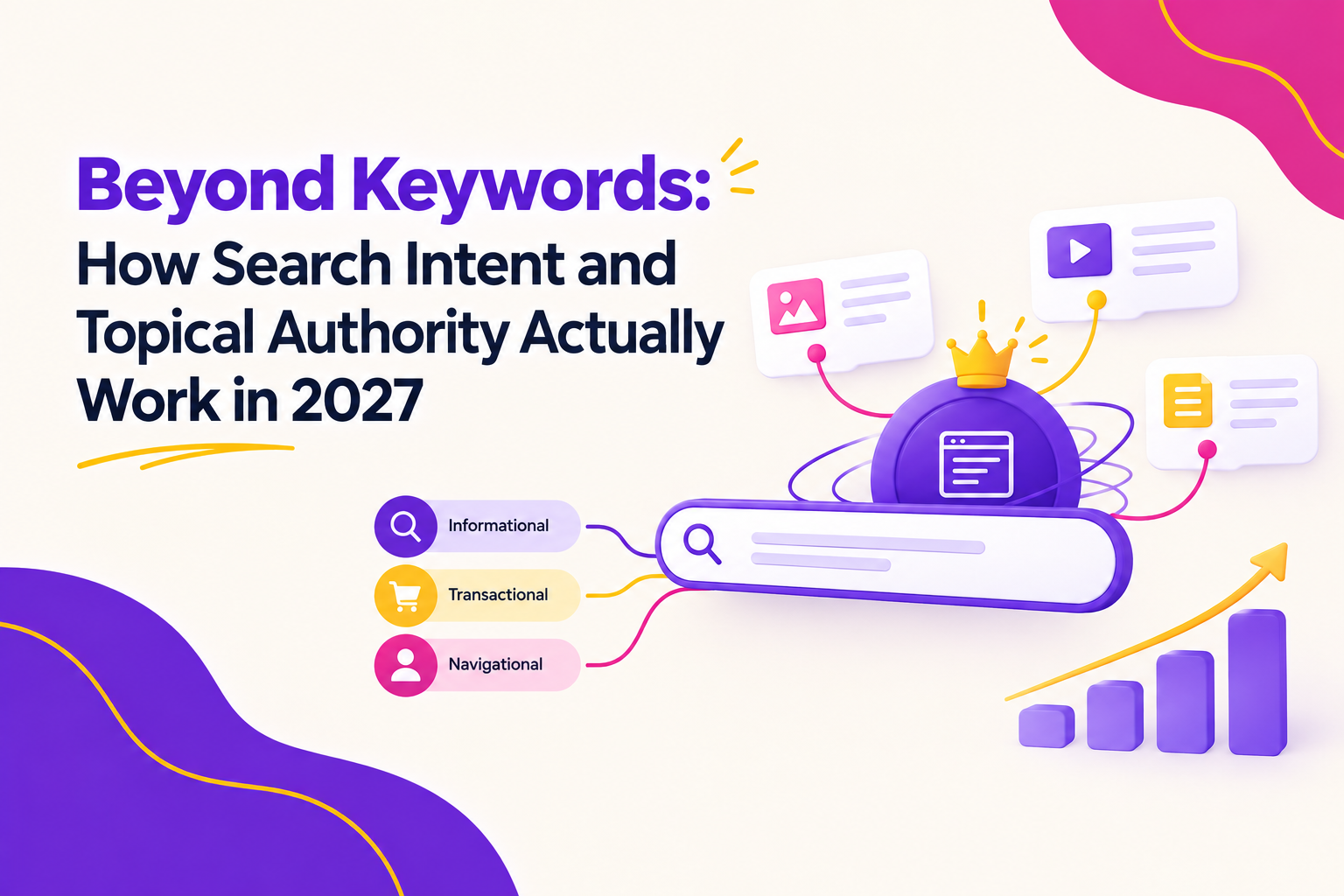
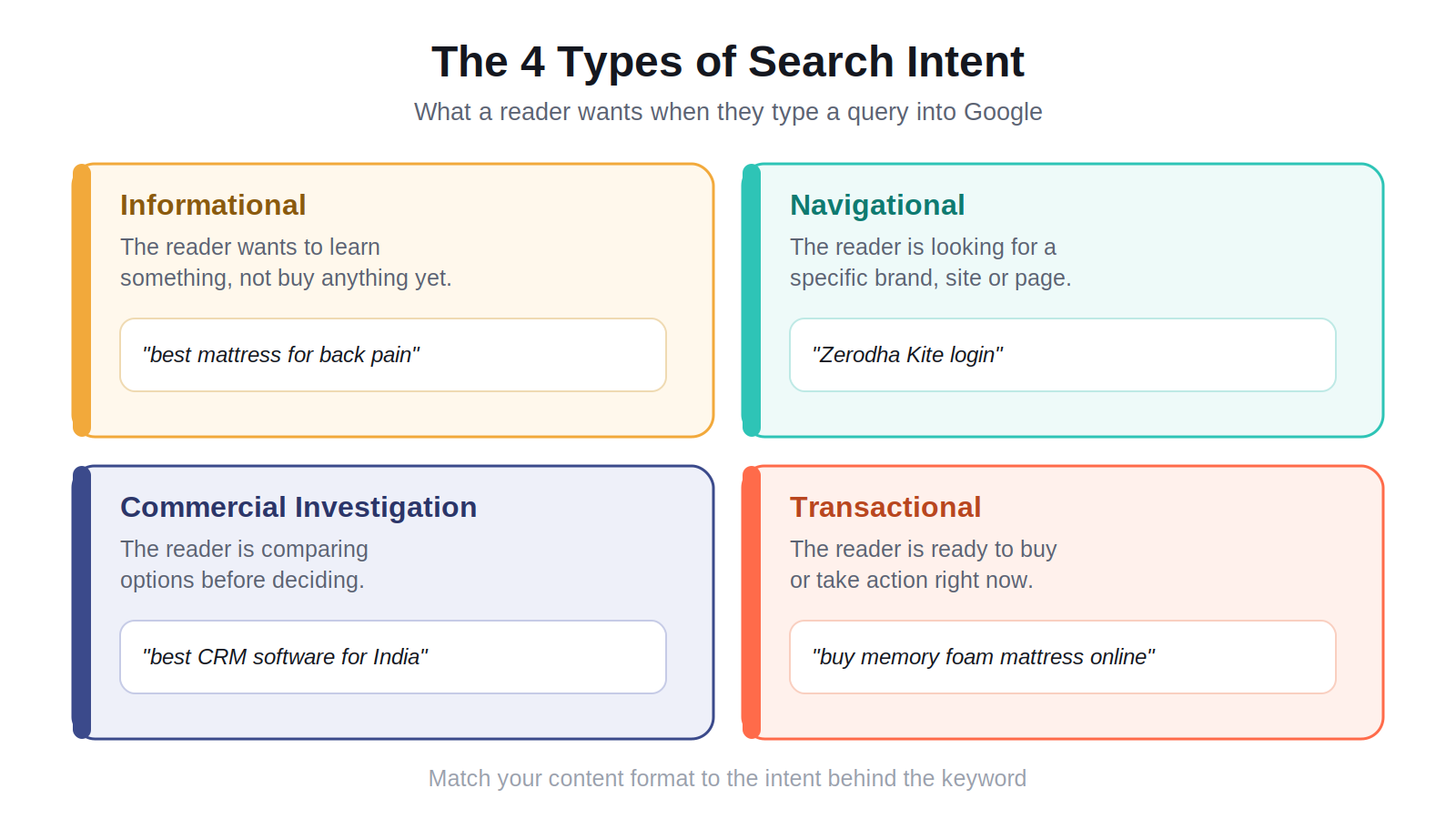
Every search query falls into one of four categories: informational (the reader wants to learn something), navigational (they’re looking for a specific website or brand), commercial investigation (they’re comparing options before buying), or transactional (they’re ready to buy). Writing content that matches the wrong intent is one of the fastest ways to lose rankings, no matter how well the piece is written.
Take a mattress brand targeting “best mattress for back pain.” That’s an informational query, so the ranking content needs to educate by comparing mattress types, explaining spine support, and citing genuine research, not push a hard sell. The same brand’s page for “buy memory foam mattress online” can be transactional, with pricing, offers, and a clear purchase path. Before writing a single word, check what type of results currently rank for your target keyword, and match that format. The common mistake is writing a sales-heavy page for a query where readers are still in research mode.
2. Know Your Audience Inside Out
Writing for everyone means writing for no one. A message built around vague, general appeal ends up connecting with nobody, because it never speaks to a specific person’s specific problem. Before writing anything, define your audience clearly: their pain points, their stage in the buying journey, and the language they actually use to describe their problem.
An Indian edtech platform selling to anxious Class 12 parents needs a completely different tone and vocabulary than the same platform selling working-professional upskilling courses to 28-year-olds. The parent audience responds to reassurance and outcomes; the professional audience responds to career ROI and time efficiency. Build simple customer personas even three or four bullet points on goals, objections, and vocabulary and refer back to them before every piece of content. The common mistake is reusing one generic version of content across completely different audience segments.
3. Create Original and Helpful Content
A huge amount of content online is simply a reworded version of whatever already ranks on page one. This is exactly the kind of content Google’s Helpful Content System is designed to push down, because it adds no new value for a reader who already read four other versions of the same article.
Original content comes from first-hand expertise a founder’s real experience solving a problem, a consultant’s actual client examples, or fresh statistics pulled from real data rather than recycled from someone else’s blog. A chartered accountancy firm writing about GST filing mistakes has far more authority quoting real, anonymised client scenarios than repeating generic compliance checklists available on twenty other websites. The mistake most teams make is opening five competitor articles, combining their points, and calling it original research.
4. Write for Humans First, SEO Second
SEO best practices should support good writing, not replace it. Keywords need to appear naturally, in the same way a person would actually say them, not forced into every second sentence. The moment a sentence sounds awkward because a keyword had to fit into it, the reader notices before Google ever does.
Good SEO writing still needs structure: a logical heading hierarchy that breaks the topic into scannable sections, and internal links that guide the reader to genuinely related pages rather than random ones stuffed in for SEO value. A travel booking platform writing about “visa requirements for Indian travellers” should link naturally to its visa assistance service, not force the keyword five extra times to hit a density target. The common mistake is optimising so heavily for search engines that the writing becomes stiff and repetitive.
5. Structure Content for Easy Reading
Readers today skim before they commit to reading. Content that arrives as one long wall of text loses most of its audience within the first ten seconds, regardless of how good the information actually is. Structure is what keeps a reader engaged long enough to get value from the piece.
Break content into clear headings every 200-300 words, keep paragraphs to four or five sentences, and use bullet points, tables, or short examples wherever a list of information appears. A fintech company explaining mutual fund taxation benefits enormously from a simple comparison table instead of three paragraphs of dense explanation. Bold key terms, add relevant visuals where they clarify a point, and make sure the content flows logically from one idea to the next. The common mistake is treating structure as a design afterthought, added at the end instead of planned from the first outline.
6. Edit, Refresh and Improve Content Regularly
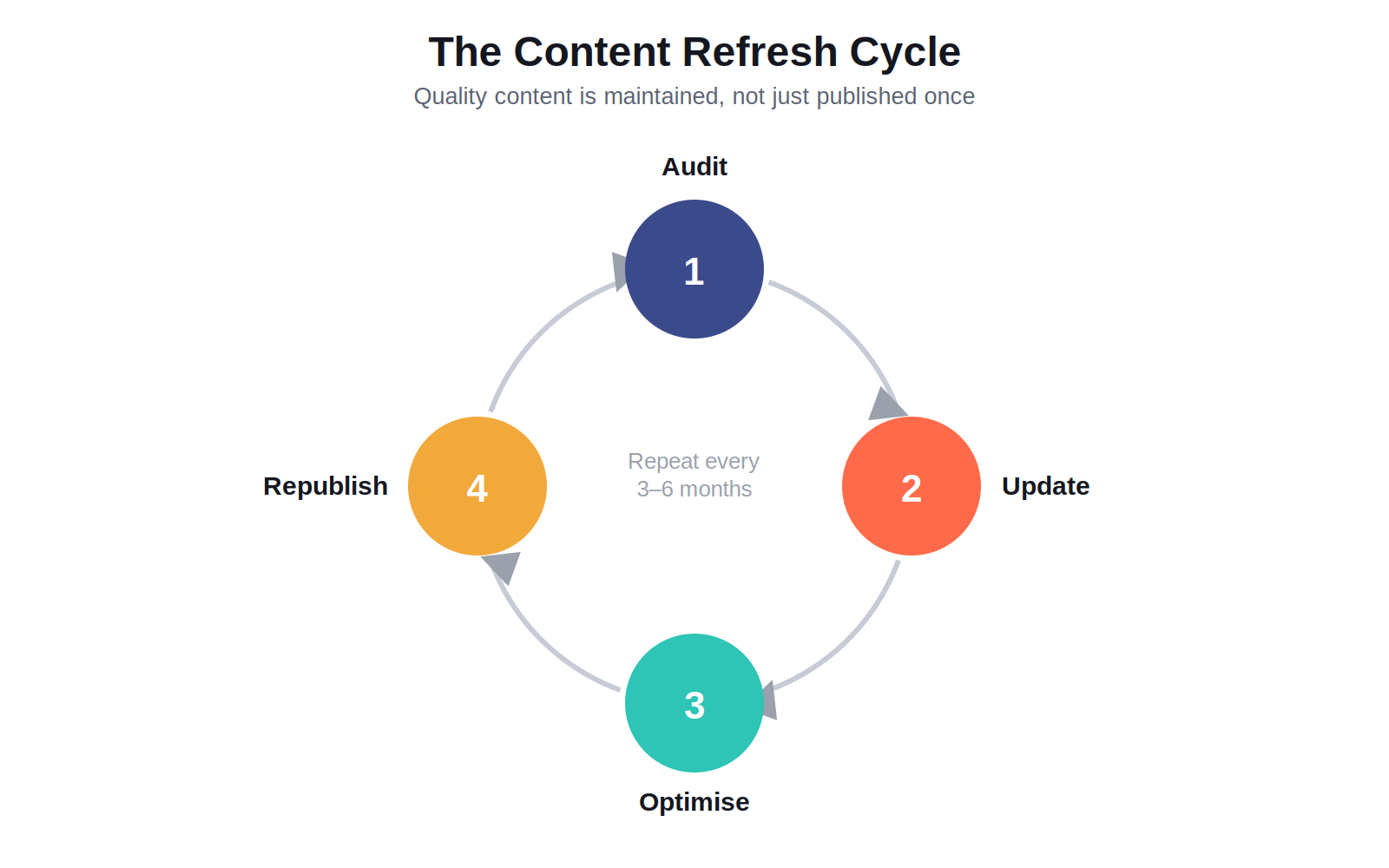
Content is never actually “finished” the day it’s published; that’s just the starting point. Search rankings shift, statistics go outdated, competitors publish better versions, and reader expectations evolve, which means even a well-performing blog needs regular attention to keep its position.
A practical content audit every six months should check three things: is the information still accurate, does it still match current search intent, and are the internal links still pointing to relevant, live pages? An edtech company that published an exam pattern guide in 2023 needs to update it with the current year’s syllabus changes, or risk losing rankings to a competitor with fresher information. The common mistake is treating content as a one-time deliverable rather than an ongoing asset.
Common Mistakes That Reduce Content Quality
Even experienced marketing teams fall into patterns that quietly damage content performance over time. Recognising these mistakes early saves months of wasted publishing effort.
Keyword stuffing remains one of the most common issues; forcing a keyword into every paragraph makes writing sound robotic and triggers exactly the kind of low-quality signal Google’s algorithms are built to detect. Publishing AI-generated content without proper editing is a newer version of the same problem: unedited AI output often contains generic phrasing, factual errors, and a complete absence of first-hand expertise, all of which hurt E-E-A-T signals. Writing without research produces exactly what it sounds like: surface-level content that repeats common knowledge instead of adding genuine value.
Weak introductions lose readers in the first few seconds, before they ever reach the useful part of the article. Clickbait headlines might drive an initial click, but they spike bounce rates the moment the content fails to deliver what the headline promised, which search engines register as a poor experience. Outdated information and poor formatting both signal neglect; a reader who spots a statistic from three years ago starts questioning the accuracy of everything else on the page.
Ignoring search intent means writing content that’s well-researched and well-written but still fails to rank, simply because it answers the wrong question. And finally, content with no clear takeaway or call-to-action leaves the reader with nowhere to go next, which wastes all the work that went into earning their attention in the first place.
Should You Hire Professional Content Writing Services?
The right content setup depends entirely on how much content a business needs and how strategic that content has to be. Freelancers work well for occasional, well-defined projects a one-off landing page, a single guest post, or a short burst of blog content when there’s no ongoing strategy required.
An in-house content team makes more sense once a business needs deep product or industry knowledge baked into every piece, and has the volume to justify a full-time hire. This works well for larger companies with a steady content calendar and enough internal expertise to guide the writing. Where in-house teams often struggle is with the strategic and technical SEO layer: keyword research, content optimisation, search intent mapping, and measuring what’s actually driving organic traffic, on top of the writing itself.
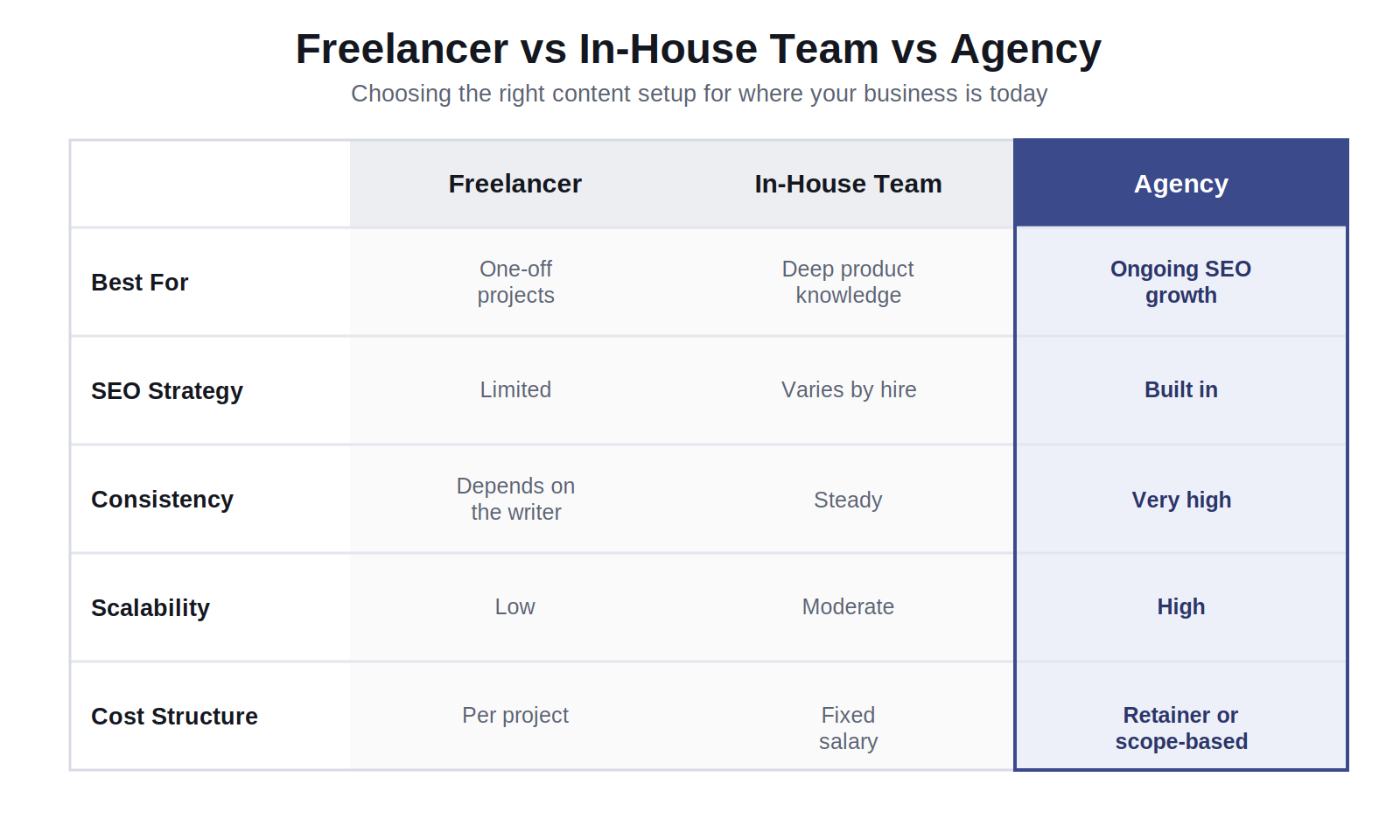
This is exactly where quality content writing services from an experienced agency become the better option. Agencies bring SEO expertise, editorial consistency, and the ability to scale output up or down based on business needs, along with the industry research and measurement systems that turn content into a genuine growth channel rather than a recurring expense. Social Pill works with Indian brands at precisely this stage, building a content strategy around real search intent, writing content that satisfies both readers and Google’s Helpful Content System, and tracking content performance against actual business goals like leads and organic traffic. For businesses that have outgrown ad hoc content and need it to consistently perform, that combination of strategy and execution is usually what freelancers and small in-house teams can’t fully replicate on their own.
Conclusion
Publishing more content was never really the goal; it was always a proxy for the real goal, which is earning a reader’s trust and attention. Google’s Helpful Content System and AI Overviews have simply made that truth impossible to ignore. Content that answers the right question, backed by real expertise and written for an actual person, will consistently outperform content built purely around volume or keyword coverage.
The six tips covered here matching search intent, knowing your audience, writing original insights, prioritising readers over algorithms, structuring for readability, and refreshing content regularly aren’t complicated ideas. They’re disciplines that need to be applied consistently, piece after piece, which is exactly where most content strategies fall apart over time.
If your business is publishing content without seeing the rankings, traffic, or leads to show for it, the fix usually isn’t publishing more. It’s raising the quality bar on what already goes out. Social Pill helps Indian brands build SEO-driven content that genuinely helps readers, ranks consistently, and compounds into long-term visibility, trust, and growth the kind of content foundation that keeps working long after it’s published.
FAQs
1. What is content writing?
Content writing is the process of creating valuable, audience-focused content that informs, engages, or converts readers.
2. What makes content high quality?
High-quality content is original, relevant, accurate, and genuinely helpful while meeting Google’s E-E-A-T standards.
3. How do you write high-quality content?
Write high-quality content by understanding search intent, offering original insights, and prioritising readability over keyword stuffing.
4. Why is quality content important for SEO?
Quality content improves search rankings, builds trust, and increases visibility in Google Search and AI Overviews.
5. How often should website content be updated?
Review and update website content every 6–12 months to keep it accurate, relevant, and SEO-friendly.
6. Should businesses hire professional content writing services?
Businesses should hire professional content writing services when they need consistent, strategic, and SEO-driven content at scale.