Imagine two competing sites. Same content, same backlink profile, same keyword focus and yet one is at position 3 on Google and the other is at position 7. That’s a scenario we see all the time as a web development company in Mumbai and the difference is almost never in the content itself. It’s in the experience of the site.
That’s what Core Web Vitals are. Most people treat them as a developer checklist. We believe they’re one of the most underutilised competitive advantages in digital marketing. Your competitors are likely to be completely ignoring them and that’s your opportunity.
The Tiebreaker Nobody Talks About
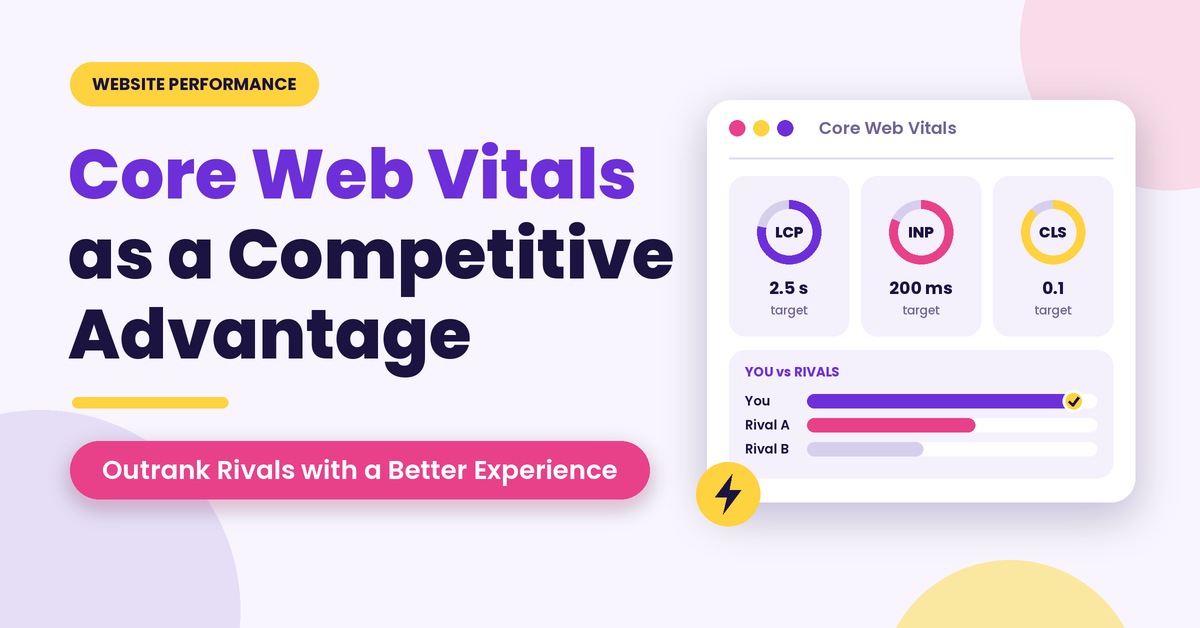
Core Web Vitals are Google’s way of measuring real-world user experience on your pages. There are three:
- Largest Contentful Paint (LCP): how quickly the main content loads. Good is 2.5s or less.
- Interaction to Next Paint (INP): how quickly the page responds when you click, tap or type. Good is 200ms or less.
- Cumulative Layout Shift (CLS): how much the layout shifts whilst loading. Good is 0.1 or less.
Google have confirmed these as part of their Page Experience signals. To be perfectly honest, they’re not a magic ranking switch. A fast site with thin content won’t beat a slow site with great relevant content. But if you’ve got two pages that are very similar in terms of relevance and quality (which is the norm in many competitive markets), experience can be the deciding factor.
That’s because the vast majority of the SEO competition occurs in the ‘good enough’ to ‘slightly better’ space. If you’re in that space then a tangible advantage in terms of experience is something you want to have.
Why Most Websites Leave This Advantage on the Table
If Core Web Vitals are so useful then why don’t more businesses get on and fix them? A few reasons.
- No-one owns the problem. The marketers are all about content and links. The developers are all about features and design. Speed is somewhere in between so no-one really owns it.
- It’s only visible when you actually measure it. Your site may be absolutely fine on your office Wi-Fi and on a fairly recent laptop. Your customers however, browsing on a range of mid-range phones over a pretty poor mobile connection are going to have a very different experience.
- Websites get heavier as time goes on. Each new plugin, chat widget, tracking pixel, popup and high res banner adds to the weight. No one sets out to make the site slow. It’s a gradual process of adding one small thing at a time.
- Mobile is typically an afterthought. The bulk of the traffic in India comes via smartphone so mobile is often the last thing to be thought about when it comes to design and testing. Mobile is frequently where the Core Web Vitals are going to fail.
The result is a gap. A significant proportion of sites across pretty much every industry are struggling with at least one of those metrics. If you’ve passed, you’re ahead of them before you’ve done a thing else.
How Core Web Vitals Create a Real Competitive Edge
1. Rankings
As per the above, Core Web Vitals act as a tiebreaker in the search results. In highly competitive markets such as real estate, healthcare, e-commerce and finance (where you have lots of sites all targeting the same keywords and same type of content) a tiny ranking bump can equate to a huge amount of extra clicks. Position 3 gets vastly more traffic than position 7.
2. Conversions
This is where the advantage becomes revenue. A page that loads quickly, responds instantly and just sits there is much easier to use. People don’t abandon it half way through. They don’t mis-tap a button because the page has moved. They complete forms and checkouts with far less friction.
Two businesses can get the same traffic and end up with very different results from it. One of them will have a far smoother experience and will therefore convert a far greater proportion of the traffic it already has.
3. Ad Efficiency
If you’re running Google Ads or Meta Ads you’re paying for every click. If that click lands on a slow page then a portion of that spend is being wasted on people who simply abandon the page before it has even loaded. A faster landing page doesn’t just improve the user experience, it can improve your conversion rate and reduce your cost per acquisition. Your competitor who’s spending the same amount on a slower page is in effect paying more per lead than you are.
4. Brand Perception
Speed is felt not measured. A site that loads instantly feels like a professional, credible site. A site that is slow, laggy and stuttering creates a very small amount of doubt in the user’s mind (is this a proper business? is this checkout secure?). People don’t articulate that doubt, they just act on it.
The Compounding Effect
The big thing about that advantage is that it compounds.
A better experience leads to lower bounce rates. Lower bounce rates and higher engagement are much healthier signals to the search engines about your pages. Better conversions mean you’re making more revenue which you can then reinvest in content, ads and development. The other guy on the other side of the aisle who completely ignores performance is just going to be losing a little bit of traffic and a little bit of conversion every month and that gap is going to keep growing.
There’s no one fix that creates dominance. What you do end up with is a site that is consistently faster, more stable and easier to use than your competition and that’s what builds up the advantages in terms of rankings, conversions and ad spend.
How to Benchmark Against Your Competitors
This is the step that most businesses simply don’t do and it’s the point at which the strategy becomes practical. Rather than simply making improvements to your site in isolation, you need to benchmark it against the sites you’re up against.
Step 1: List your real search competitors. These won’t necessarily be your business competitors. They’ll be the sites that appear alongside you for your key search terms.
Step 2: Test their key pages. Run their homepage, their key service or product pages and their main landing pages through PageSpeed Insights. Where it’s available it will show you the real user (field) data from the Chrome UX Report (which is what Google uses) as well as the lab data for diagnosis.
Step 3: Record the results. Build a simple comparison table like this:
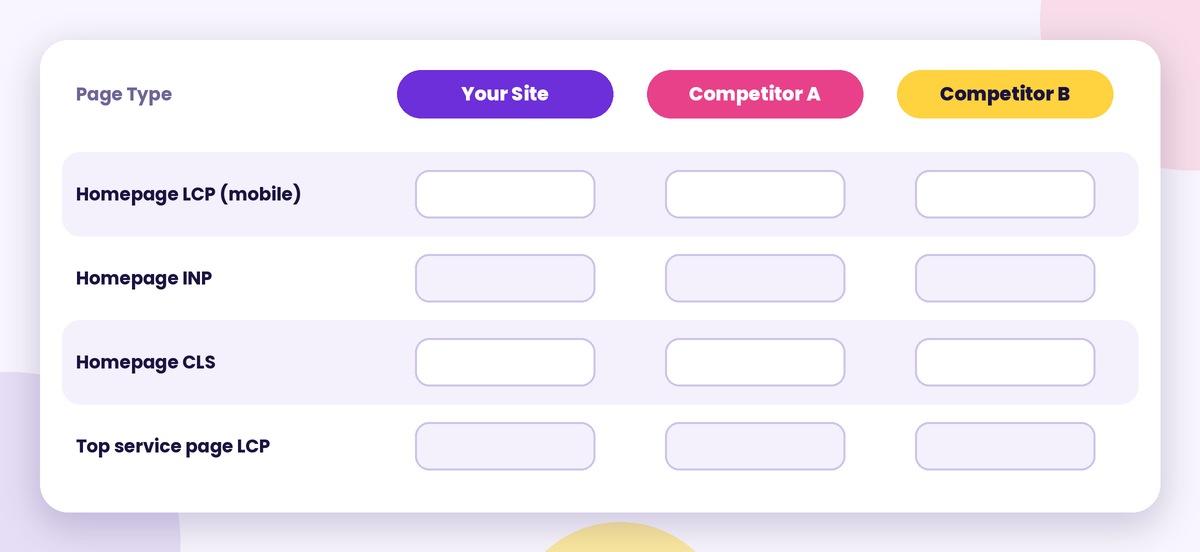
Step 4: Find the gaps. Look out for competitors with excellent content but poor mobile performance. Those are the ones you can easily overtake. Also be aware of where your competition are beating you as that’s a gap you’ll need to close.
Step 5: Turn the gaps into priorities. Your improvement plan should be derived from that analysis rather than some generic checklist.
If you’re after expert level support with this type of analysis then an SEO agency in Mumbai can take competitor benchmarking and combine that with keyword, content and technical audits to show you exactly where the biggest opportunities for ranking are. Core Web Vitals are most effective when they’re part of a broader SEO strategy rather than being treated as a standalone solution.
So, where do you need to focus first?
You don’t need to fix every page. Start with those closest to revenue:
- Homepage: usually your highest-traffic entry point
- Top landing pages: especially those receiving paid traffic
- Product or service pages: where buying decisions happen
- Checkout, enquiry, and contact forms: where small frictions cost real leads
Quick wins that often make the biggest difference:
- Compress and size images properly using modern formats like WebP or AVIF
- Don’t lazy-load your hero image and prioritize it to appear fast
- Remove unused third-party scripts, such as old chat widgets and abandoned tracking tags
- Set width and height on images and videos so the layout doesn’t jump
- Reserve space for ads, banners, and embeds to prevent shifts
- Improve hosting and caching, since a slow server undermines everything else
These are low-effort changes that often deliver the biggest improvements.
Core Web Vitals in the Age of AI Search
Search is changing. We’re seeing AI generated summaries and answer engines in the search results and that’s fundamentally altering the way people go about finding information. It’s entirely reasonable to ask whether page experience still has any relevance in that context.
Our view is a cautious one. No-one can say for certain that Core Web Vitals have any direct impact on the quality of AI-generated answers. The fundamentals still apply though: a fast, stable, well-structured and trustworthy site is a far better basis for visibility regardless of what form search takes in the future. The user who does click through will still judge your site on the experience they have and a bad experience is simply a wasted visit.
Think of Core Web Vitals as protecting the value of every visitor you attract whatever way they find you.
Common Mistakes That Waste the Advantage
Chasing a perfect Lighthouse score. Lighthouse is a lab test. Real user (field) data is what actually reflects the user experience and what Google looks at. A perfect lab score is meaningless if real users on slow connections are going to be having a very poor experience.
Fix it once and forget. Performance drifts. A new plugin, a popup or a marketing tag can quietly undo all the work you’ve done over the last few months. You need to build performance checks into your release process and you need to be monitoring Search Console on a regular basis.
Ignore mobile. Mobile and desktop are assessed separately and mobile is generally the harder one to pass. Prioritise it.
Treat it as just a developer task. The marketing teams are the ones that go in and add the big images, the embedded videos and the tracking scripts. Performance is a shared responsibility.
Sacrificing usability for speed. The aim is a better experience not just a better score. You don’t strip out features that customers care about in order to get a number.
Final Thoughts: Experience Is a Competitive Weapon
Content and backlinks will always be fundamental to SEO. They’re also the areas in which everyone is fighting the hardest. Experience is the area where so many businesses are still behind and that’s where you can actually get ahead.
A faster, more stable website can improve your ranking, your conversion rate, the efficiency of your ad spend and the perception of your brand as a trustworthy entity. It won’t happen overnight and it won’t in any way replace good content. It is however a tangible, measurable and fixable advantage that a lot of your competitors haven’t yet got.
The first step is actually quite simple: work out where you are and where your competitors are.
That’s where Social Pill, the digital marketing agency in Mumbai, can come in. We work across social media, performance marketing, SEO, website development, app marketing, video production and AI. We can do a site audit, benchmark against your competitors and show you exactly where the opportunities are to improve your Core Web Vitals, make your site faster etc. etc.