At some point, every marketing team comes to the difficult realisation that they have to choose between investing the budget in brand development or performance marketing. The former has an almost impossible-to-measure impact, while the latter provides a steady stream of leads and sales but is relatively low-effort. Businesses often fall to the pressure and abandon one area altogether in favour of the other.
In truth, the most successful companies are those that manage to balance out both approaches, using performance marketing to generate leads and brand marketing to turn them into loyal customers. This article will give an in-depth explanation of the concepts, their differences, areas of application, advantages and disadvantages, and offer advice on budget distribution and measurement of results.
What Is Brand Marketing?
Brand marketing definition encompasses a firm’s efforts to influence consumer perception. This comprises the branding pyramid, ranging from brand positioning and strategy, content creation, social media interaction, influencer marketing, video production, press releases, and online reputation management, to website design and SEO optimisation.
In other words, brand marketing includes all activities that make consumers remember and recognise the brand and affect their behaviour in choosing the company’s products or services over competitors’. Put differently, brand marketing’s ultimate objective is to shape a preference for the firm in the eyes of the market.
What Is Performance Marketing?
Unlike performance, in terms of speed and measurement, you pay for performance-based results like clicks, form fills, app installs, sign-ups, and sales. Every rupee and dollar spent is measured and converted into specific results, which is why finance and leadership departments love this type of marketing.
The channels that fall under this designation are Google Ads, PPC advertising, paid social media, remarketing, retargeting, affiliate marketing, email marketing, marketing automation, and conversion rate optimisation (CRO). The primary aim is lead generation and sales at a measurable cost. If you want expert help planning and tracking these campaigns, a performance marketing agency in Mumbai can build a strategy around your goals and budget.
Key Differences at a Glance
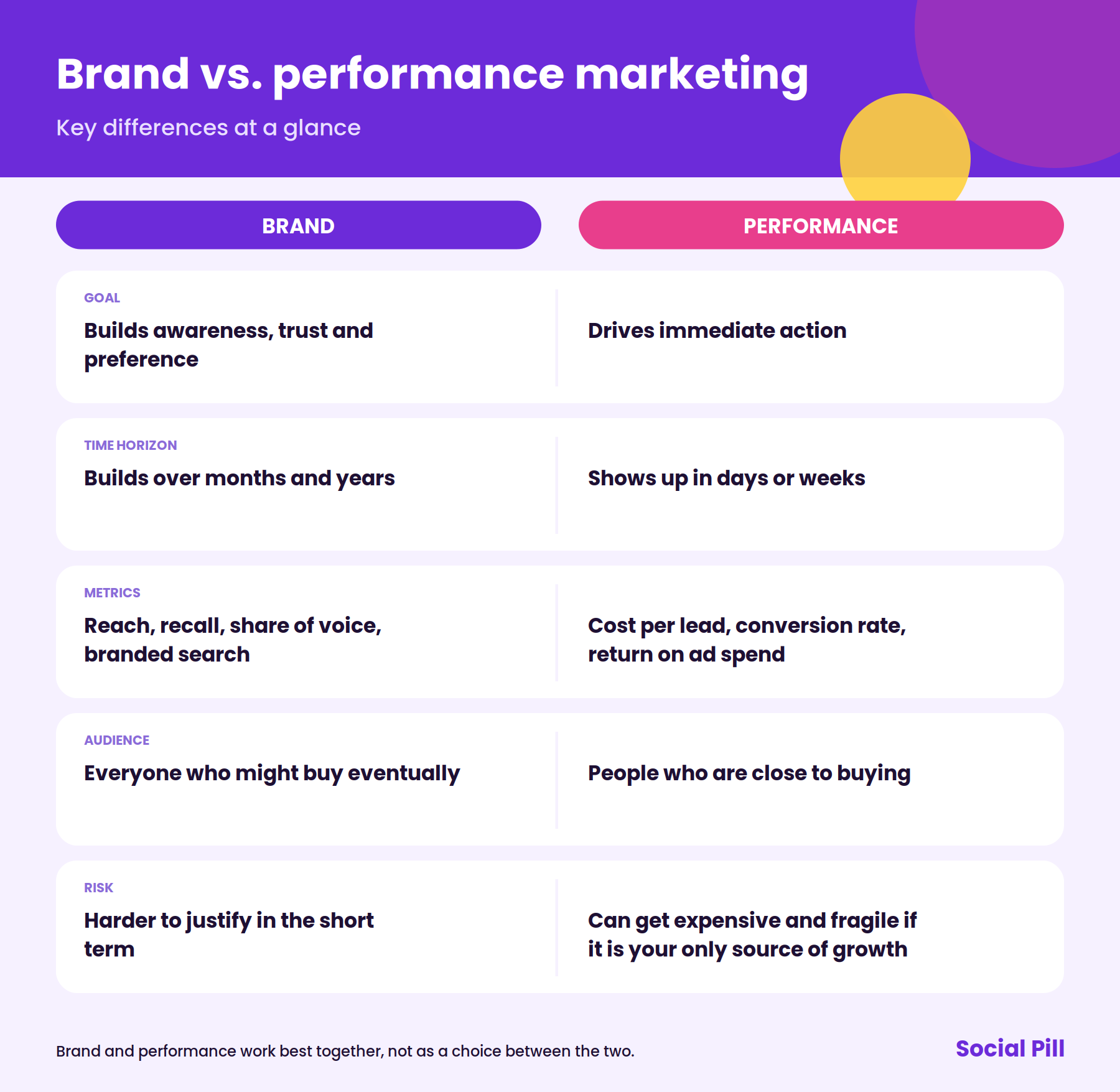
- Goal: Brand marketing builds awareness, trust, and preference. Performance marketing drives immediate action.
- Time horizon: Brand effects build over months and years. Performance results show up in days or weeks.
- Metrics: Brand uses reach, recall, share of voice, and branded search. Performance uses cost per lead, conversion rate, and return on ad spend.
- Audience: Brand speaks to everyone who might buy eventually. Performance targets people who are close to buying.
- Risk: Brand spending is harder to justify in the short term. Performance spending can become expensive and fragile if it is your only source of growth.
Why Performance Marketing Alone Stops Working
There are three reasons that explain why many businesses turn from performance marketing to branding.
First of all, as a company begins to use performance-based methods, its expenses will exponentially increase. The more competitors bid for the same keywords and audiences, the higher the cost per click becomes. For instance, a business that spends heavily on pay-per-click advertising and paid social media might see a rise in the cost per lead by several percentage points each quarter. A skilled PPC agency in Mumbai can help you slow this rise by improving targeting, quality scores, and landing pages.
Secondly, most performance marketing activities are aimed at reaching a targeted audience of potential customers. However, the bigger your following is, the less relevant it is. In other words, as you get more customers in the beginning, it becomes increasingly difficult to acquire new ones. A brand that does not have a substantial following cannot expect to gain grounds among people who have never heard of it.
Lastly, it becomes a price competition as everyone goes after the same clients. Unless there is a significant difference between your offer and that of your competitors, marketing activities will no longer produce desirable outcomes. Simply put, nobody will be interested in buying from you unless you provide a discount, which severely impacts your profits.
An existing brand image can solve many of those issues. A company known by its name, its logo, and its tagline has a considerable advantage over competitors. A recognized brand can attract customers and generate revenues even without heavy discounts or advertising. Furthermore, brand marketing usually leads to better engagement, quicker conversions, and cheaper customer acquisition rates than any other marketing type.
Why Brand Marketing Alone Is Not Enough
The reverse mistake is no less grave. Companies sometimes invest significantly in developing a brand and brand marketing only to neglect the bottom-line business metrics that reflect a marketing asset’s true value. As a result, when questioned by executives, marketing leaders cannot provide a satisfactory explanation of how the ROI on brand marketing expenditures is being calculated.
Brand awareness without sales is a failed exercise. Any brand marketing campaign should have a conversion pathway, a sales channel, a value proposition, a website, landing pages, and email marketing campaigns that can drive revenue and customer acquisition.
How Brand and Performance Work Together Across Channels
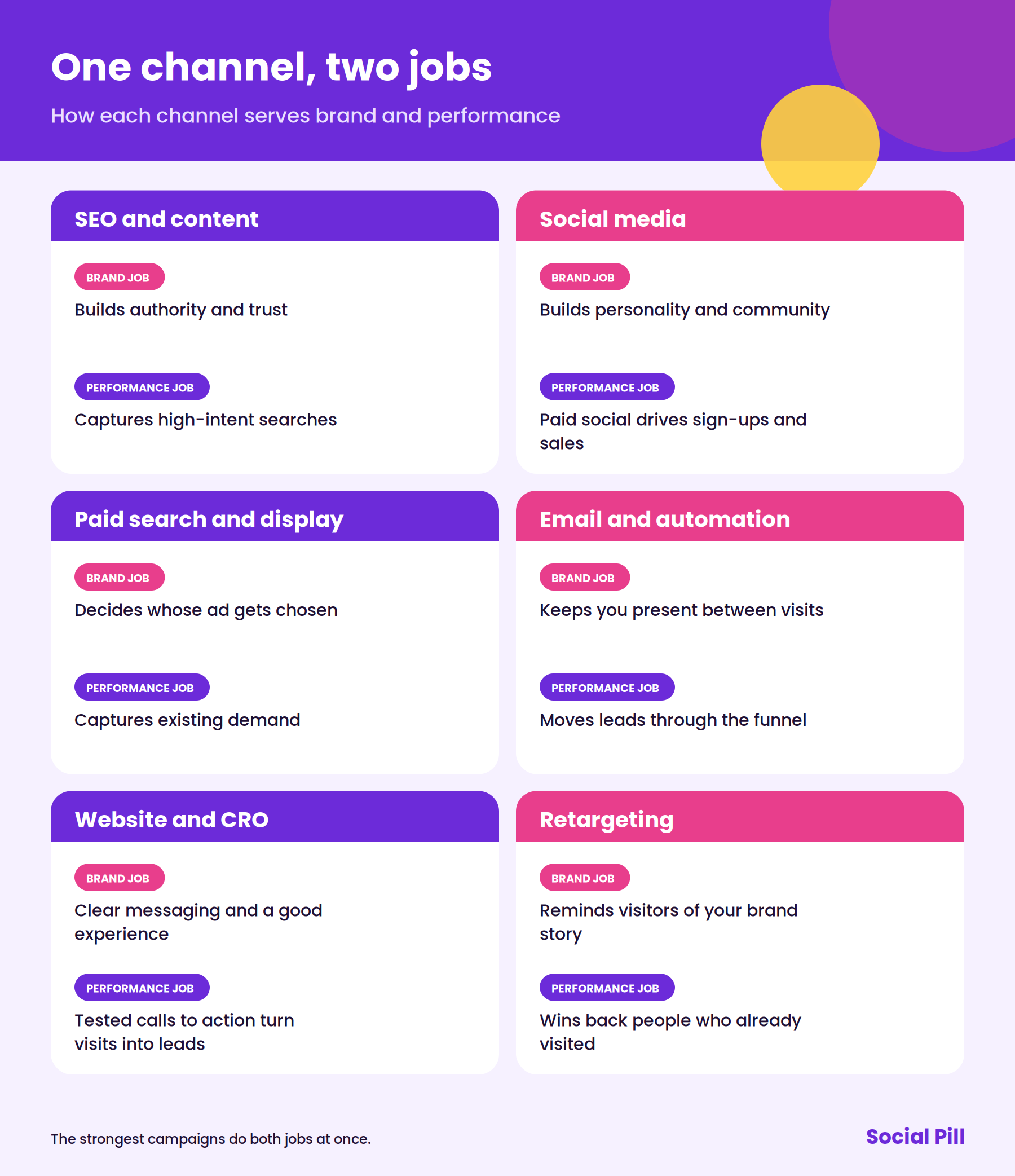
The best way to balance the two is to see how each digital channel can serve both goals.
SEO and Content Marketing
Search engine optimization is one of the clearest places where brand and performance meet. Helpful blog posts, guides, and case studies build authority and trust, which is brand work. The same pages capture high-intent searches and bring in leads, which is performance work. A strong content marketing strategy, supported by keyword research, on-page SEO, technical SEO, and link building, serves both goals at once. Refreshing old blogs with current information and expert insight also strengthens your reputation while recovering lost traffic.
Social Media Marketing
Organic social media marketing builds personality, community, and recognition. Paid social campaigns then use that familiarity to drive sign-ups and sales. Brands that post consistent, valuable content usually find their paid ads perform better, because audiences have already seen and trusted them.
Paid Search and Display Advertising
Google Ads and display advertising capture demand, but your brand decides whether people choose your ad over a competitor’s. Strong branded search is a sign that your brand work is paying off. Running ads on your own brand terms also protects your market position.
Email Marketing and Marketing Automation
Email marketing and marketing automation keep your brand present between the first visit and the final purchase. Thoughtful nurture sequences educate prospects, reinforce your message, and move leads through the funnel without feeling pushy.
Website and Conversion Rate Optimization
Your website is where brand promises meet performance goals. Clear messaging, fast loading speed, a good user experience, and well-tested calls to action make every visitor more likely to convert. Ongoing CRO testing makes sure the traffic you earn is not wasted.
Retargeting and Remarketing
Retargeting and remarketing campaigns follow up with people who have already visited your site. They work best when the creative reminds visitors of your brand story, not just a discount. This is a simple way to turn a performance tactic into a brand-building moment.
How to Split Your Budget Between Brand and Performance
There is no ideal ratio, as it depends on the business’s maturity, industry, and strategic goals. Here are some guidelines:
- Startups or lead-hungry companies: A 70%-30% allocation to performance vs. brand is appropriate, as a business needs to generate leads and sales constantly. However, the company must have brand-centric activity to build brand equity at an early stage.
- Growing firms with a solid market presence: A 60%-40% division favors lead generation as brand sales contribute to a more considerable percentage of total lead generation. It means that brand-specific buying preferences let one acquire customers at a cheaper cost. However, the company must start building brand value to enjoy the benefit of a well-known name attracting clients at a lower price.
- Mature organizations with strong market presence: A 50%-50% division indicates that a firm has achieved the status of a market leader. As such, it should focus on maintaining the brand’s strength and benefiting from its prestige to generate sales.
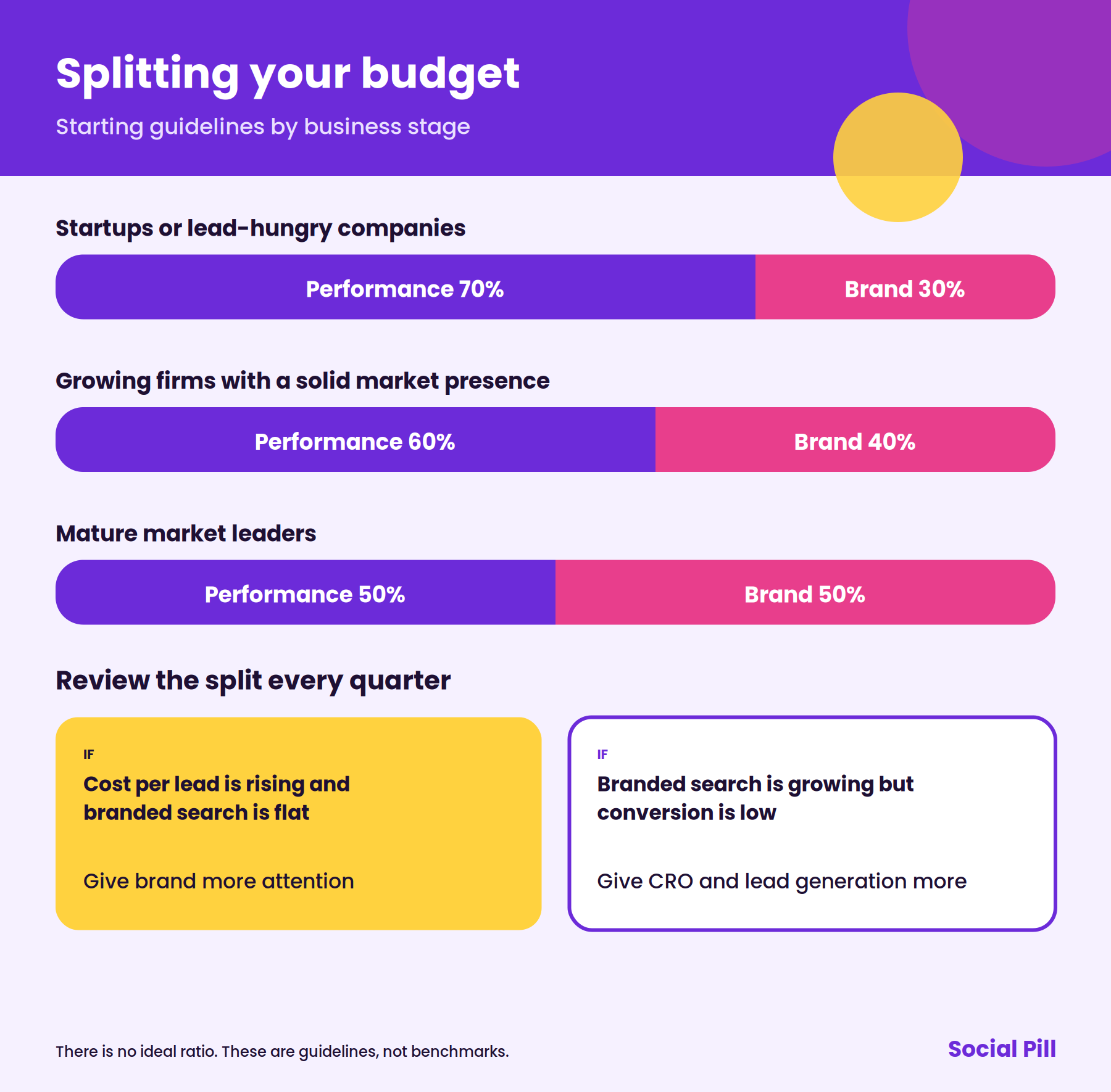
Remind yourself of the division every quarter. If the firm’s cost per lead rises and the brand’s share of total searches remains steady, the brand needs more attention. On the other hand, if branded search volume is increasing, but the conversion rate is low, CRO and lead-generation activities deserve more resources.
How to Measure Both Without Confusion
One reason why brand expenditure gets cut is that it is measured incorrectly. Assess each metric on its own merit and analyze their interrelation.
Brand-specific metrics to measure:
- The number of branded searches in Google
- Direct traffic
- The size of share of voice against competitors
- The reach, engagement, and followers’ growth on social media
- Brand’s awareness and recall surveys
- Online reviews and mentions
Performance-based metrics to measure:
- The cost per lead and customer acquisition
- Conversion rate
- Return on ad spend
- The amount of pipeline and revenue generated
- Emails’ open rate, click-through rate, and conversion
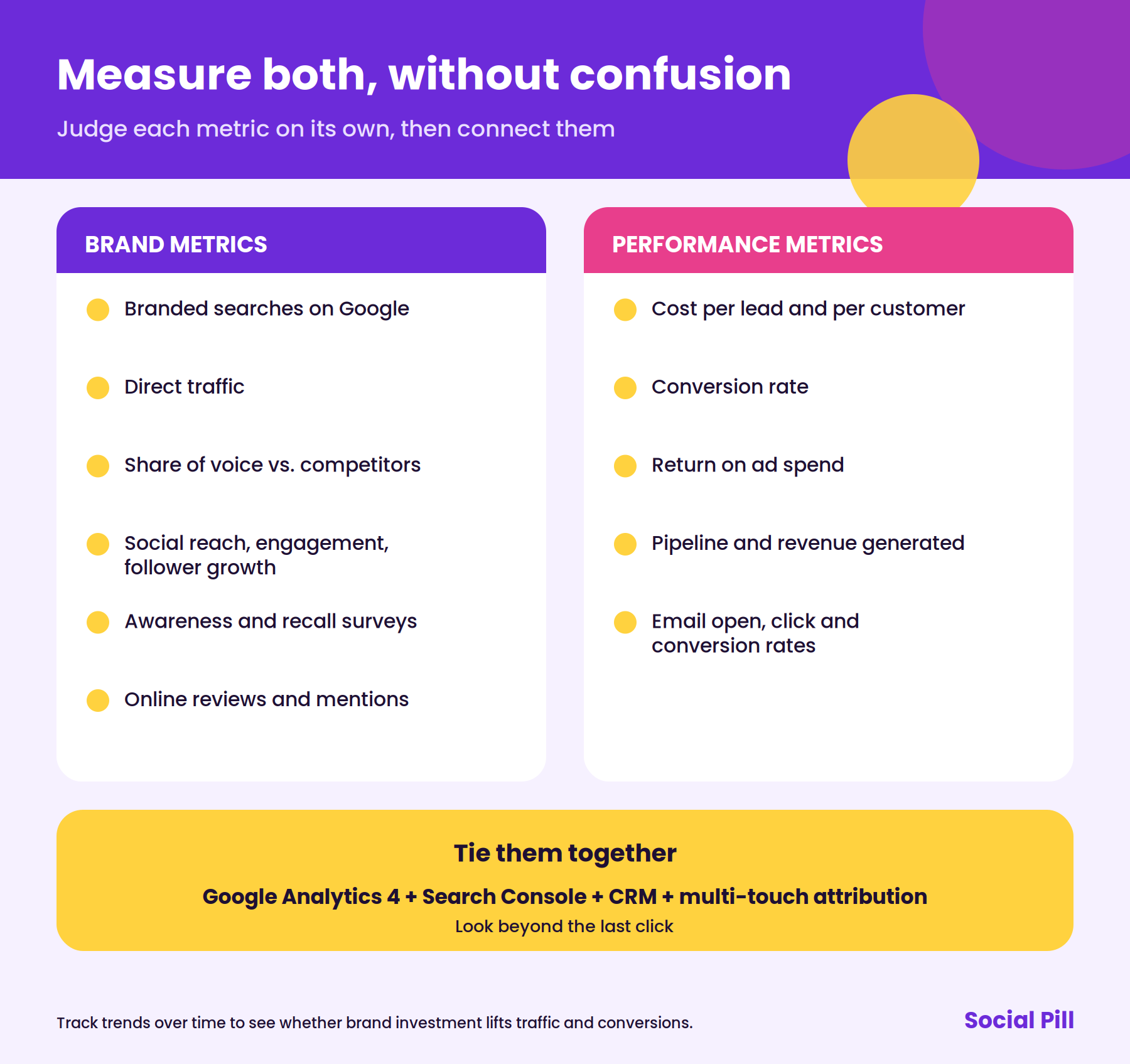
Apply Google Analytics 4, Google Search Console, and a reliable CRM system to tie these metrics together. Establish the marketing attribution model that will help you understand the interrelation between different channels, not just the last click. Then, analyze the trends to find out if the increase in brand-related investments will bring relevant improvements in traffic, conversion, and customer acquisition rate.
Common Mistakes to Avoid
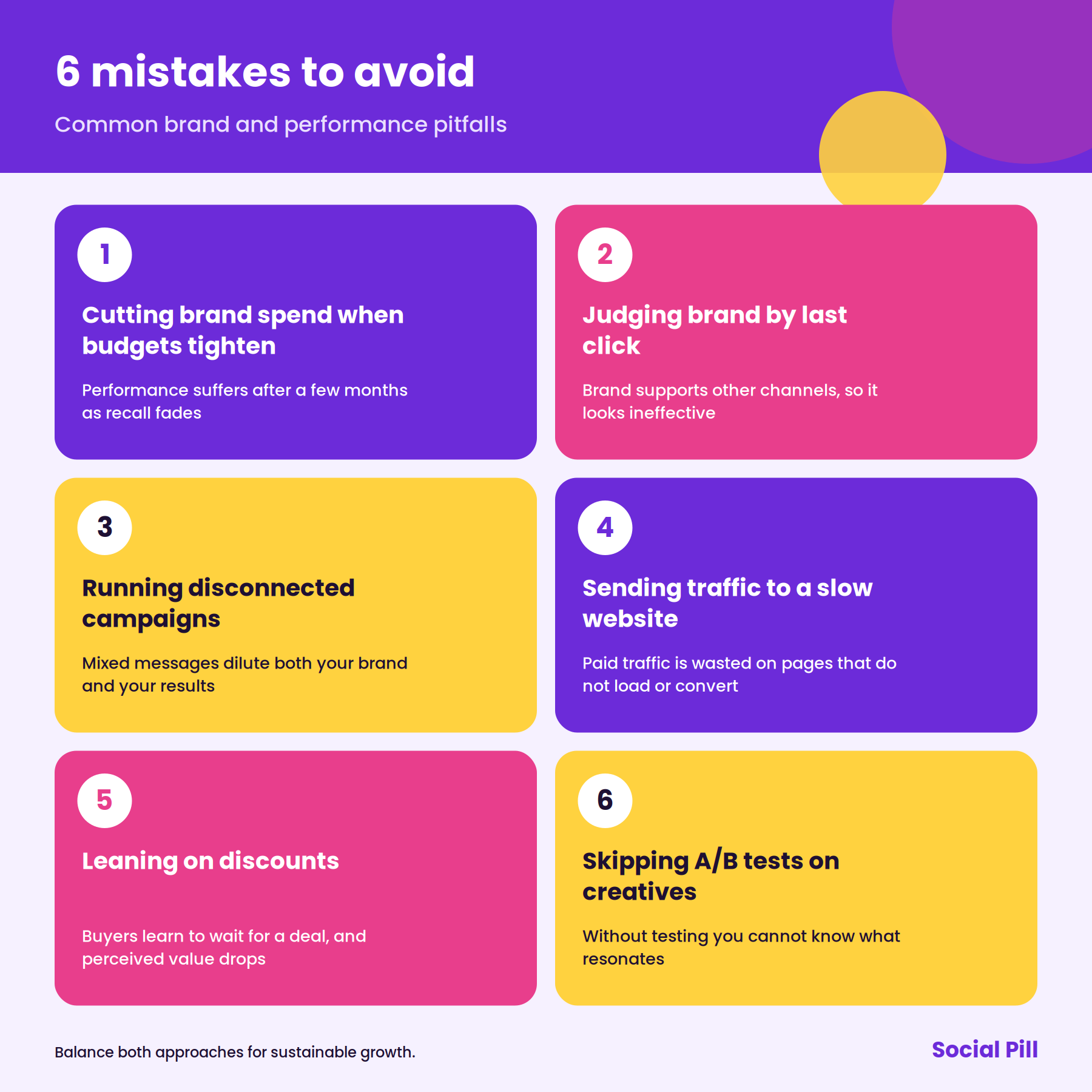
- Cutting brand spend when budgets are squeezed. Performance tends to suffer after a few months due to reduced awareness and brand recall.
- Judging brand campaigns by last-click, thus rendering them ineffective when they should be complementing other channels of marketing.
- Running disconnected campaigns. Brands that use different advertising and email marketing messages end up diluting their brand image and performance.
- Neglecting the website – wasting spend by driving traffic to a slow or unresponsive page.
- Promoting discounts – undermining the perceived value of your brand by encouraging buyers to always wait for a deal.
- Not A/B testing creatives – without testing it’s impossible to know what resonates best.
Conclusion
Brand and performance marketing are not mutually exclusive. Performance marketing focuses on leveraging demand to generate leads and revenue, while brand marketing helps to amplify that demand, making everything else more efficient and cost-effective. The most successful companies invest in both to drive sustainable growth, rather than one-time bursts of interest. Whatever the marketing activities you are planning, whether you want to grow your SEO, Google Ads, social media marketing, or email marketing, you need to answer these two questions:
Can it help people remember and trust us? Can it help them take action? If the answer is yes to both, you have brand and performance in one marketing activity.
Contact us to discover how we can combine SEO, content creation, performance marketing, and conversion rate optimization to deliver a complete marketing solution up and down the funnel.