Real estate marketing strategies are the channels, content, targeting choices and follow-up systems a property business uses to attract buyers and convert interest into enquiries, site visits and bookings. In India, the combination that works usually includes local search, a fast mobile website, WhatsApp conversations, social video, paid media and honest project information.
The reason is simple. Nobody books a home the way they buy a phone. A buyer in Pune or Hyderabad spends weeks comparing configurations, checking commute times, discussing budgets with family and verifying project documents before speaking to a sales team.
Effective real estate marketing strategies account for that entire journey. They create discovery, build trust during research, and give the buyer an easy way to start a conversation when they are finally ready.
Why Real Estate Marketing in India Needs a Different Playbook
Property is a high-ticket, high-risk, slow-moving purchase. A buyer is committing years of income, a home loan and often their family’s primary financial asset. That changes how marketing has to behave.
Demand is also intensely local. Someone looking in Wakad is not automatically interested in Hinjawadi, even though they are minutes apart. Price expectations, builder reputation and infrastructure plans shift from one locality to the next. A single booking may also need a spouse, parents, a broker and a loan officer to agree, and each has different questions. Documentation matters too. RERA registration, approvals, carpet-area disclosures and possession timelines are part of the buying conversation, not fine print buyers ignore. Projects covered under the Act must be registered with the relevant state authority, and buyers increasingly check those records themselves.
Visibility alone does not produce sales. A campaign can generate a thousand form fills and still deliver very few qualified buyers. A lead is a contact detail. A qualified property buyer has budget, locality intent, configuration intent and a realistic timeline.
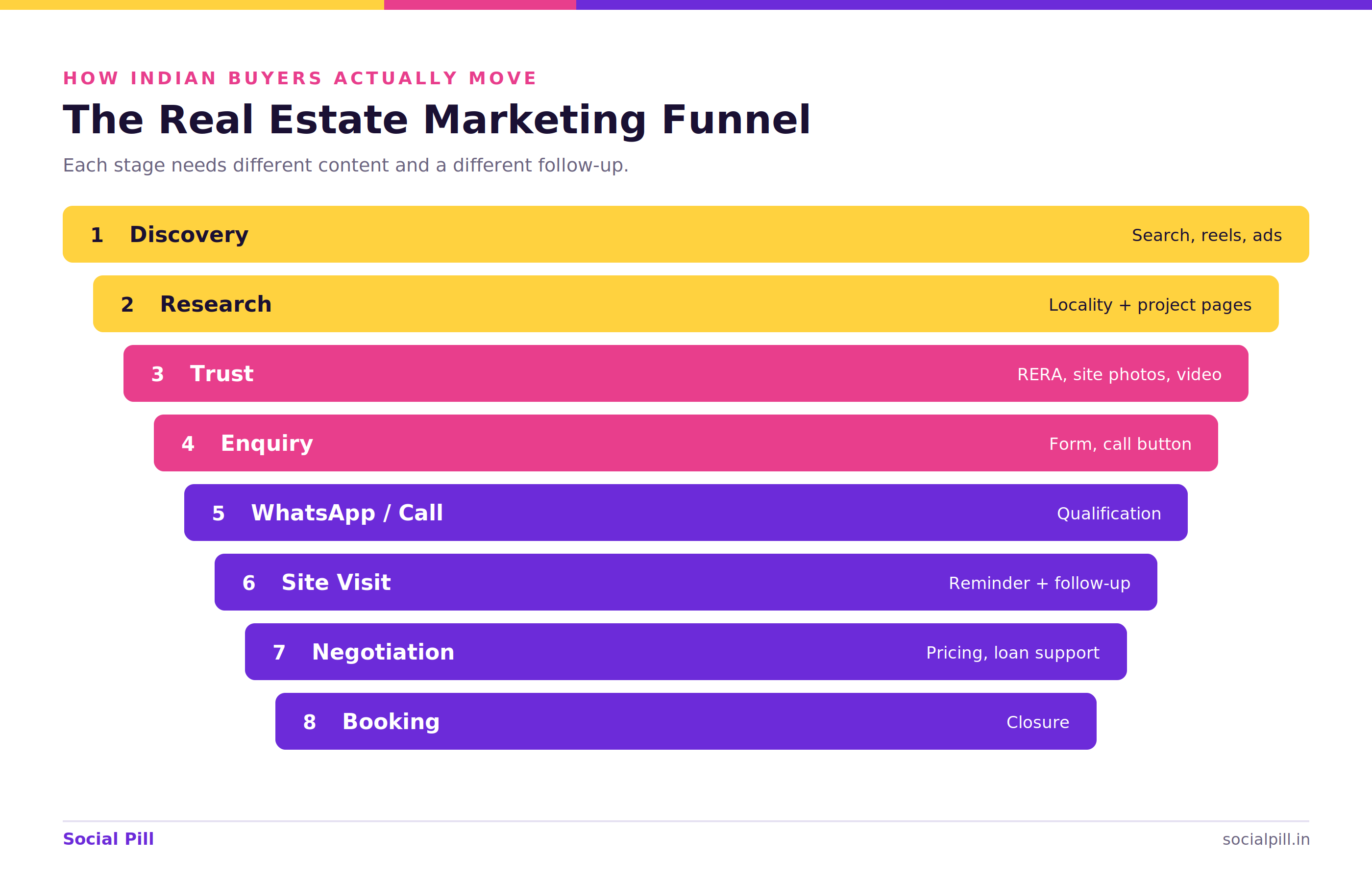
Definition: A real-estate marketing funnel is the sequence a property buyer moves through — Discovery → Research → Trust → Enquiry → WhatsApp/Call → Site Visit → Negotiation → Booking — where each stage needs different content and a different type of follow-up.
Do this week: Take the last 50 enquiries and mark where each one dropped off. Most teams discover the leak is not at lead generation but between enquiry and site visit.
Step 1 – Understand Your Market and Buyer Segments
Segmentation comes before platform selection. If you do not know who you are selling to, every channel looks equally worth trying, and budget gets spread thin across all of them.
Two buyers with identical budgets can want completely different things. One is optimising for commute and possession date, the other for rental yield and resale. The project might be the same; the message cannot be.
Useful variables include income band, location, property type, purchase intent, financing route, family stage and decision timeline. Investment buyers respond to appreciation drivers and rental demand. End-users respond to schools, commute, water supply and builder credibility.
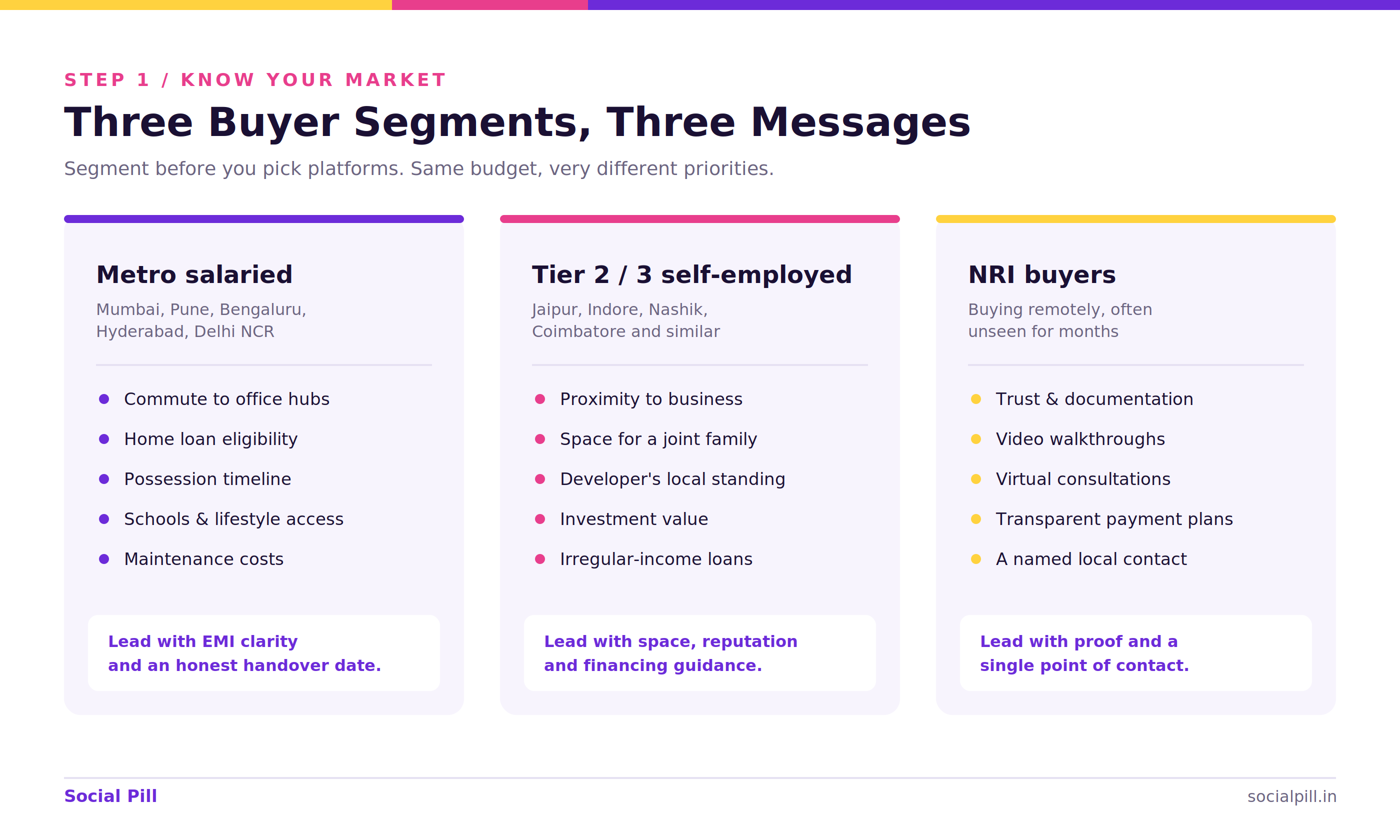
Metro salaried vs. tier 2/3 self-employed vs. NRI buyers
Definition: Buyer segmentation is the practice of grouping prospective buyers by shared needs, constraints and motivations so that messaging, targeting and follow-up can be tailored to each group.
Metro salaried buyers in Mumbai, Pune, Bengaluru, Hyderabad and Delhi NCR usually work around a fixed monthly outflow. Commute to office hubs, loan eligibility, possession timeline and maintenance costs dominate their questions. A clear EMI illustration and an honest handover date often matter more than another amenity render.
Tier 2 and tier 3 self-employed buyers in cities like Jaipur, Indore or Nashik may weigh different factors. Proximity to their business, space for a larger or joint family, and the developer’s local standing can carry significant weight. Financing may involve irregular income documentation, which makes loan guidance genuinely useful content. These are tendencies, not rules verify them against your own enquiry data.
NRI buyers are committing to something they may not see in person for months, so trust and clarity carry the deal. Detailed video walkthroughs, scheduled virtual consultations, documentation checklists, transparent payment schedules, a named local contact and consistent WhatsApp communication across time zones all reduce hesitation.
Do this week: Pick your two largest segments and write separate landing page headlines and WhatsApp opening messages for each.
Why narrowing your niche wins over broad targeting
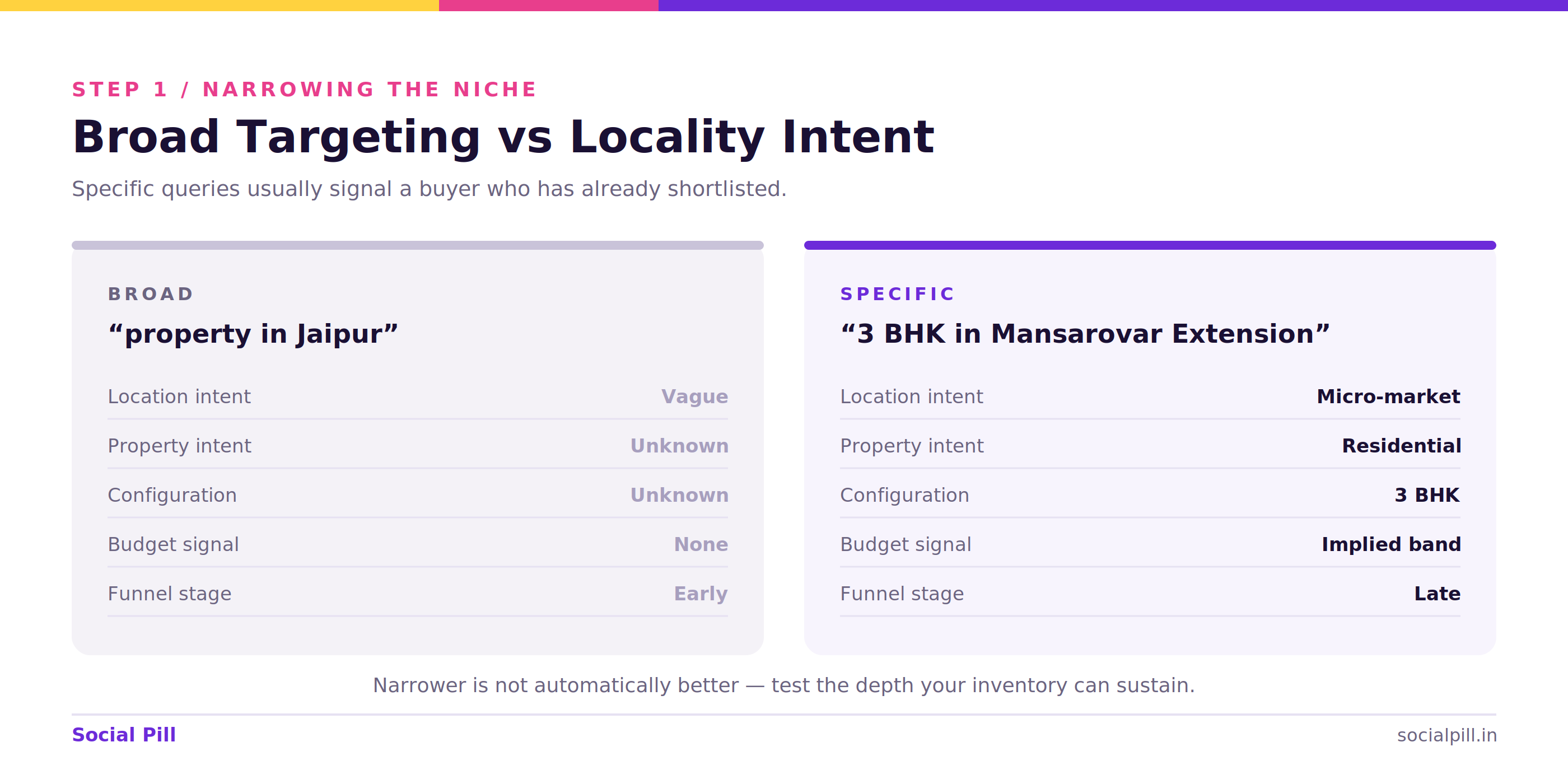
Compare two searches. “Property in Jaipur” tells you almost nothing. “3 BHK in Mansarovar Extension” tells you the locality, the configuration, a rough budget band and a buyer who has already narrowed the field.
Specific queries usually signal a later funnel stage, because the person has done the shortlisting work themselves. Broad queries still matter for reach, but they need longer nurturing. Build your content and campaign structure around the dimensions buyers actually use: locality, configuration, budget band, buyer type and intent. A locality page for Mansarovar Extension with commute times, price context and school options serves a narrower audience far more usefully than a generic city page.
Narrower is not automatically better. Very specific targeting can limit volume, and some localities simply do not have enough monthly search demand to sustain a campaign. Test the depth that matches your inventory.
Step 2 – Set Up Your Digital Foundation
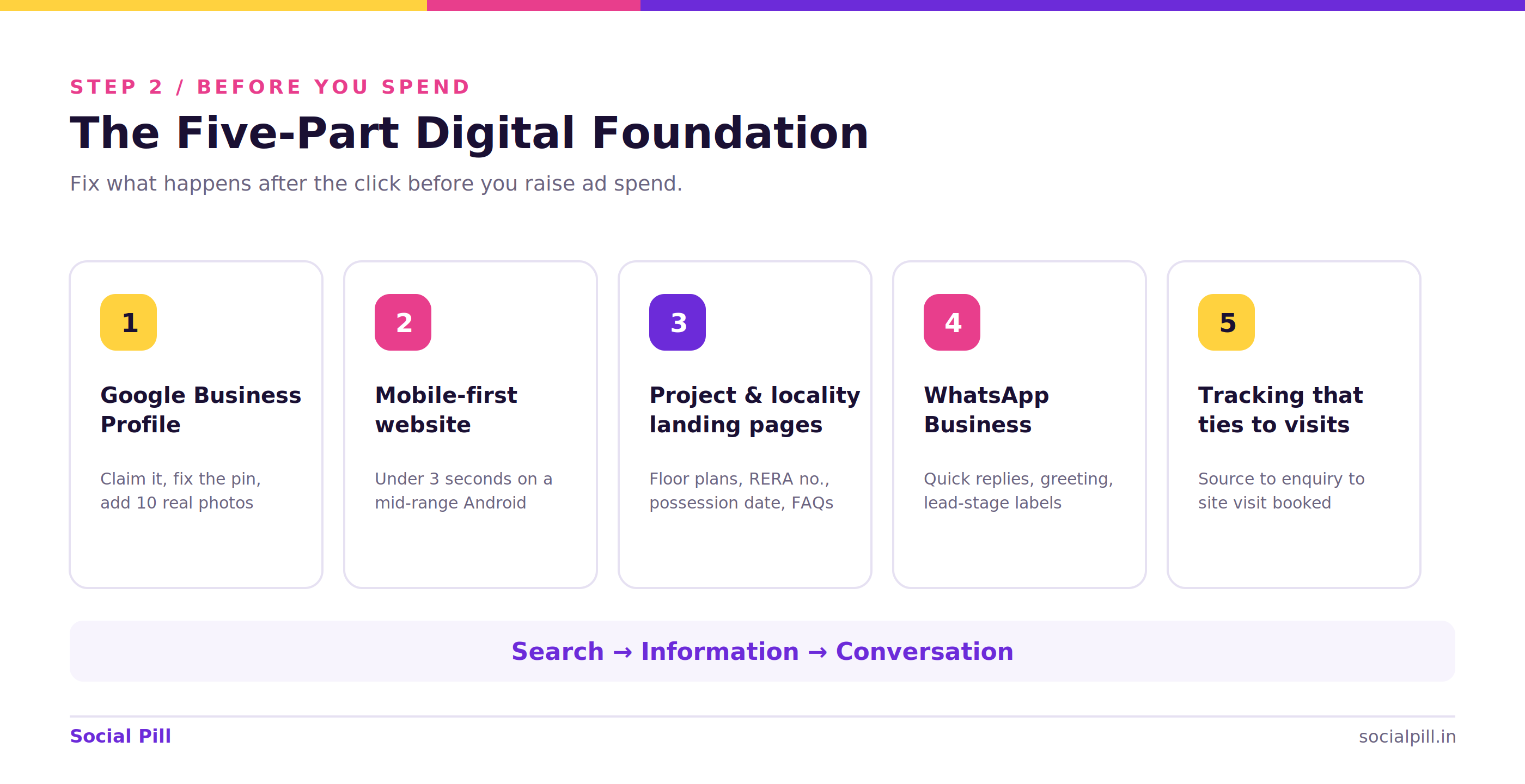
Before increasing ad spend, check what happens after the click. Most property brands lose more money to weak conversion paths than to poor targeting.
The foundation has five parts: a complete Google Business Profile, a fast mobile website with project and locality pages, WhatsApp Business set up properly, working enquiry forms, and tracking that links each source to each site visit. The goal is a short path from search to information to conversation.
Google Business Profile an underused free asset
Definition: A Google Business Profile is the free listing that controls how your business appears in Google Search and Google Maps, including directions, calls, photos, hours and reviews.
For a site office, sales gallery or brokerage, it is often the first branded impression a buyer gets free, visible on high-intent searches, and frequently left half-complete. Get the basics right: accurate business name without keyword padding, correct primary category, working phone number, real operating hours and an accurate pin location. Add genuine photos of the site office and project, post updates at construction milestones, and respond to every review including critical ones.
Do this week: Claim or audit the profile, fix the category and pin, and upload ten current photographs.
Website and landing pages mobile-first, fast, clear CTAs
Definition: A real-estate landing page is a single focused page built to convert traffic for one project, locality or configuration, rather than a brochure that describes the whole company.
Most discovery happens on a phone, often on a patchy connection. If a page takes six seconds to load, the buyer is already back on the search results. Compress images, cut heavy sliders and test on a mid-range Android device.
Each project page should carry floor plans, configurations, price band where you can disclose it, RERA registration number, possession timeline, location map and an FAQ that answers real objections. Locality pages should cover commute, connectivity, schools and infrastructure updates. Keep call, WhatsApp and a short enquiry form visible at all times five-field forms outperform twelve-field forms almost everywhere.
Do this week: Run your top project page through a page-speed test and remove the single heaviest asset.
WhatsApp Business where property conversations continue
Definition: WhatsApp Business is a messaging setup that lets a property team qualify leads, share documents, confirm site visits and follow up in a thread the buyer already checks daily.
In Indian real estate, many enquiries move to WhatsApp shortly after first contact. Floor plans, price sheets, location pins and video updates can all sit in one thread the buyer can forward to a spouse or parent. Set up quick replies for your ten most common questions, an automated greeting that sets a response-time expectation, and labels for lead stage. Use click-to-WhatsApp ads where the objective is conversation rather than form volume. Share the location pin before every visit and send a reminder the evening before.
Do this week: Write ten quick replies covering price, RERA number, possession date, loan assistance and site visit timings.
Step 3 – Choose the Right Platforms (Don’t Try to Be Everywhere)
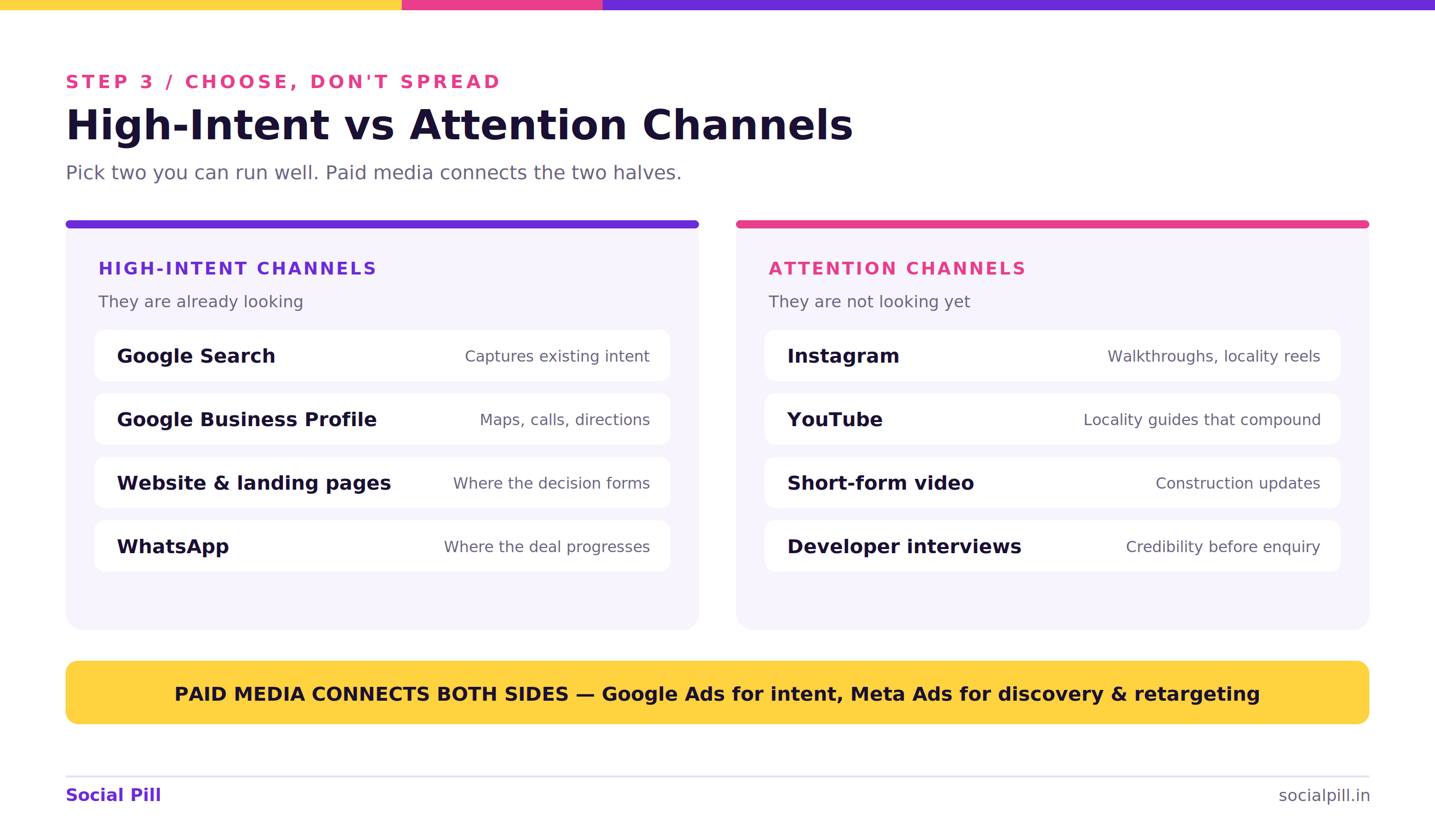
Platform choice should follow buyer behaviour, not whichever channel is being discussed most this quarter. A small team running two channels well beats a team running six badly. Split your channels into two groups. High-intent channels Google Search, Google Business Profile, your website and WhatsApp capture people already looking. Attention channels Instagram, YouTube and short-form video build familiarity before the buyer is ready. Paid media connects the two: Google Ads works the intent side, Meta Ads the discovery and retargeting side.
Google Business Profile and local search
Definition: Local SEO is the work of making your business and projects visible when people search for property, developers or consultants tied to a specific area.
Buyers search by locality, not by company name. Queries like “2 BHK flats in Kharadi” carry strong intent. Locality pages, consistent business information across directories, genuine reviews and internal links between locality and project pages all support that visibility.
Do this week: Publish one locality page for your best-selling micro-market and link it from the matching project page.
WhatsApp for follow-up and conversion
Definition: WhatsApp follow-up is the structured sequence of messages that moves a lead from first enquiry to a confirmed site visit and beyond.
Too many teams treat WhatsApp only as a lead capture button. The value is in the journey after that: qualification, project information, fixing the visit, reminding, following up, and staying useful while the buyer decides. Speed matters, and so does relevance a buyer who asked about a 2 BHK should not receive a 4 BHK price sheet.
Do this week: Set a two-hour first-response target during business hours and measure how often you meet it.
Instagram and short-form video for recognition
Definition: Short-form social video builds familiarity with a project and a developer before the buyer is ready to enquire.
Property walkthroughs, locality reels, construction updates, amenity clips, neighbourhood guides, myth-versus-fact posts, buyer FAQs and short developer interviews all work well here. The point is recognition: when your ad appears later, the name is not unfamiliar. Keep it real handheld construction footage often outperforms polished renders, because it looks like evidence rather than advertising.
Do this week: Film one 45-second site progress update on a phone and publish it with the locality name in the caption.
YouTube for locality guides and compounding content
Definition: YouTube serves the long research phase, where buyers want detail that a listing page cannot deliver.
Topics that tend to hold attention include “Living in Andheri: what buyers should know”, “3 BHK versus 2 BHK in Pune”, “What ₹1.5 crore gets you in Mumbai”, infrastructure explainers and project walkthroughs. These stay useful long after upload. Publishing does not guarantee ranking or leads, though video earns attention the same way written content does, by answering a question better than the alternatives.
Do this week: Script one locality guide using the five questions your sales team hears most.
Google and Meta Ads
Definition: Google Ads captures demand that already exists, while Meta Ads creates and captures interest through audience targeting and creative.
On Google, bid on locality and configuration queries and send traffic to the matching project page rather than the homepage. On Meta, use interest and location targeting for cold audiences, and retarget people who watched a walkthrough.
Judge campaigns by cost per qualified lead and site-visit rate, not cost per lead. A ₹200 lead that never visits is more expensive than a ₹1,500 lead that books.
Do this week: Add a site-visit-booked field to your CRM and start reporting cost per site visit by channel.
Step 4 – Build a Content Strategy That Builds Trust
Buyers are not short of listings. They are short of clarity. The principle worth holding onto is this: don’t only market the property, market the decision.
Good content answers the questions a buyer is actually stuck on. Is this locality right for my family? Is this developer credible? What should I check before I visit? What are the trade-offs I will live with? Answer those honestly and you become a source of information rather than another advertiser.
Locality content vs. listing content
Definition: Transactional content sells a specific property; non-transactional content helps a buyer make a better decision about where and what to buy.
Transactional content covers floor plans, pricing, offers, amenities and possession details. Non-transactional content covers locality guides, commute realities, infrastructure updates, neighbourhood comparisons, buyer checklists and home loan basics.
A frequently cited guideline is to keep roughly 80% of content non-transactional. Treat that as a planning heuristic, not a researched rule. The right mix depends on your funnel a launch with strong existing demand needs far more transactional content than a long-cycle project in an emerging micro-market.
Do this week: Audit your last twenty posts and count how many helped a buyer decide rather than just promoting inventory.
Publishing proof, not claims
Definition: Proof-led marketing replaces adjectives with verifiable information a buyer can check.
“Premium luxury homes with world-class amenities” says nothing. It appears in thousands of listings and carries no information. Proof looks different: the RERA registration number, dated construction photographs, floor plans with carpet areas, written specifications, realistic handover timelines, clear payment terms and a record of delivered projects.
Transparency reduces perceived risk, which is the real obstacle in a high-value purchase, and it filters out mismatched enquiries early. Keep RERA references factual; quote the registration number and point buyers to the state authority’s portal rather than making claims about what the Act guarantees.
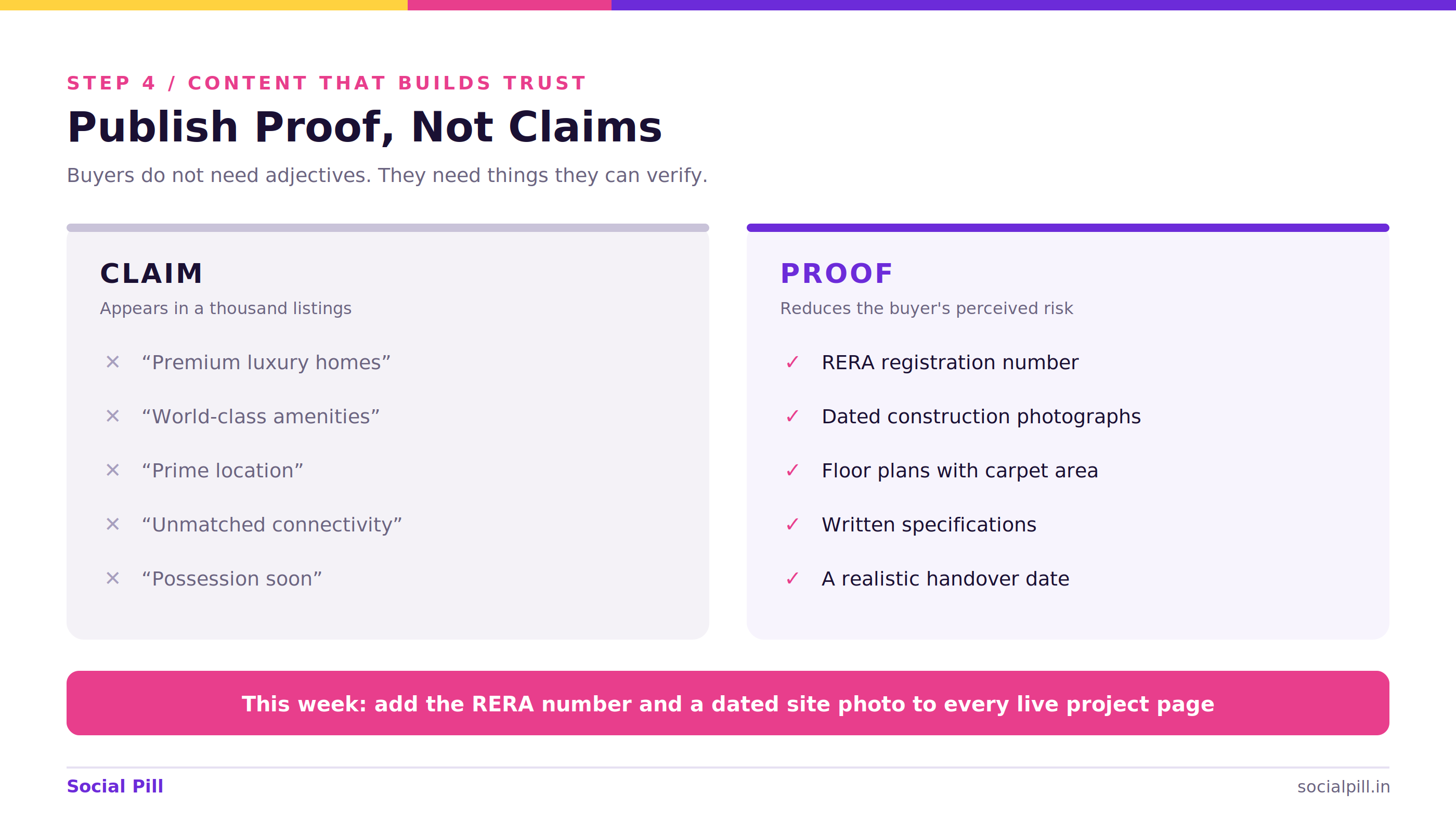
Do this week: Add the RERA number and a dated site photo to every live project page and ad landing page.
Video walkthroughs and Q&A content
Definition: Walkthrough video shows scale, light, views and finish quality in a way photographs and floor plans cannot.
Static listings hide what buyers care about most: how big the second bedroom actually is, what the balcony faces, how construction is progressing. Video answers those in ninety seconds.
Build videos around real objections, not scripts. A developer or architect explaining a design choice on camera does more for credibility than a voiceover over renders.
Do this week: Ask your sales team for their five most common objections and film one answer for each.
Making the Parts Work Together
Most real-estate marketing underperforms because the pieces run separately. SEO sits with one vendor, ads with another, social with an intern, and nobody owns what happens between the enquiry and the site visit. The gains come from connection. Local search brings intent, content builds credibility, social keeps you familiar, paid media accelerates reach, and the conversion system turns all of it into conversations. Measured together, they show which combination actually produces bookings. [INTERNAL LINK: Social Pill blog about full-funnel marketing]
Social Pill works with brands to build social media and digital marketing strategies around exactly that visibility, content, performance and measurable business outcomes, planned as one system rather than separate line items.
Conclusion
Strong real estate marketing strategies in India are built on sequence, not volume. Understand your buyer segments, fix the digital foundation, choose two or three channels you can run well, and publish content that helps people decide rather than content that only promotes.
Then measure the stages that matter. Cost per lead is a vanity metric here. Cost per qualified enquiry, site-visit rate and site-visit-to-booking rate tell you what is actually working.
None of this requires a large team or a launch budget. It requires consistency a locality page a month, a weekly site update, fast WhatsApp responses and honest project information. Do that for two quarters and the difference shows up in your pipeline, not just your dashboard.
FAQs
- What are real estate marketing strategies?
They are the channels, content and conversion systems a property business uses to attract buyers and turn interest into enquiries, site visits and bookings. In India, they typically combine local search, WhatsApp, social video, paid media and proof-led project content. - What is the best marketing strategy for real estate?
There is no single best strategy, because it depends on your inventory, city and buyer segment. Most Indian developers and brokers see the strongest results from local search plus WhatsApp follow-up, supported by video content and retargeting. - How do real estate companies generate leads?
Through locality-focused SEO and Google Business Profile visibility, Google and Meta ads, property portals, social video, referrals and channel partners. The quality varies sharply by source, which is why tracking cost per site visit matters more than cost per lead. - How can social media help real estate marketing?
It builds recognition and trust before a buyer is ready to enquire, through walkthroughs, construction updates, locality guides and buyer FAQs. It also gives retargeting campaigns an audience of people who have already engaged with the project. - Is digital marketing effective for real estate?
Yes, when it is built around the full buying journey rather than lead volume alone. Digital works well for discovery and research, but bookings still depend on follow-up quality, site visits and transparent documentation. - How do I market a property online?
Create a dedicated project page with floor plans, price band, RERA number and possession timeline, then drive traffic to it through local search, targeted ads and video. Make WhatsApp and call options visible on every screen. - What are the most effective real estate advertising channels in India?
Google Search, Meta platforms, YouTube and property portals are the most widely used, with click-to-WhatsApp campaigns performing well for conversation-led selling. The right mix depends on whether you are selling to end-users, investors or NRI buyers.