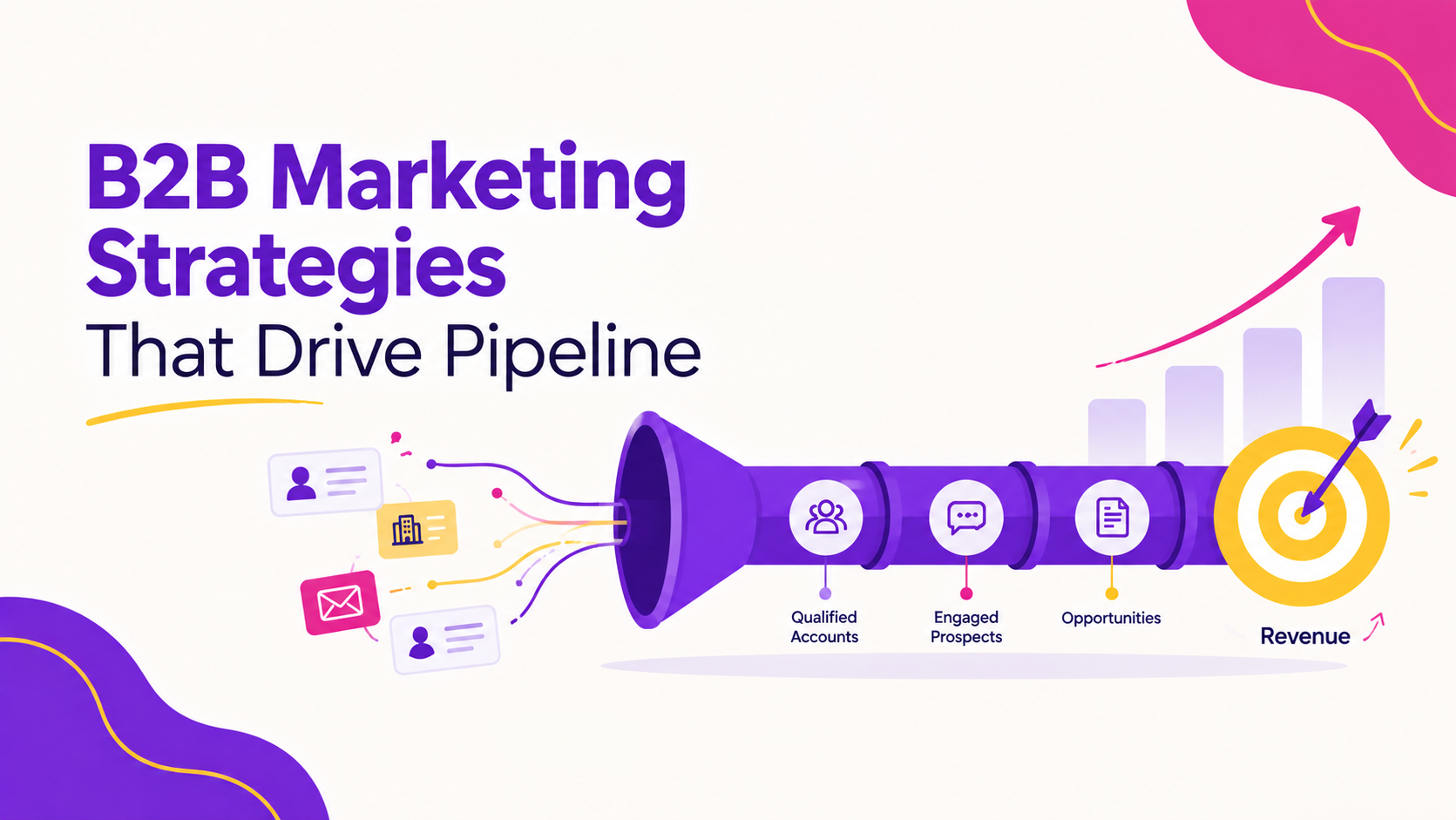
B2B marketing strategies are the set of activities a business uses to attract, educate and convert other businesses into paying customers. The strategies that actually work in 2027 are not judged by how many leads they produce, but by how efficiently they turn the right accounts into qualified pipeline. This distinction leads versus pipeline is the difference between a marketing function that looks busy and one that visibly drives revenue.
For CMOs and founders running lean teams and tight budgets, this distinction matters more than any single tactic.
What Are B2B Marketing Strategies?
B2B marketing strategies are the plans, channels and content a business uses to reach other businesses, build trust with multiple decision-makers, and move them toward a purchase. This is what “business to business marketing” means in practical terms: marketing that speaks to organisations, buying committees and procurement processes rather than individual consumers.
What is B2B marketing, then, in one line? It is the discipline of generating demand, qualified opportunities and long-term relationships with other companies not one-time transactions with individual shoppers.
The difference from B2C marketing is structural, not just stylistic. A consumer might decide to buy a pair of shoes in minutes, influenced mainly by price and design. A business buying software, manufacturing equipment or logistics services faces a longer, more scrutinised process: budget approval, internal consensus, risk assessment and often a formal evaluation against competitors.
Consider a SaaS company selling workflow automation software to Indian manufacturing firms. It rarely convinces a single buyer. It typically needs to satisfy a CFO concerned about cost, an operations head focused on downtime, an IT team assessing integration risk, and a procurement team negotiating terms. Each stakeholder asks different questions and needs different proof points.
Because of this complexity, B2B marketing strategies cannot stop at generating interest. They need to support the buyer through research, comparison, internal justification and final approval which is exactly why pipeline-focused marketing looks so different from marketing built purely to collect form-fills.
What Are the Core Elements of a B2B Marketing Strategy?
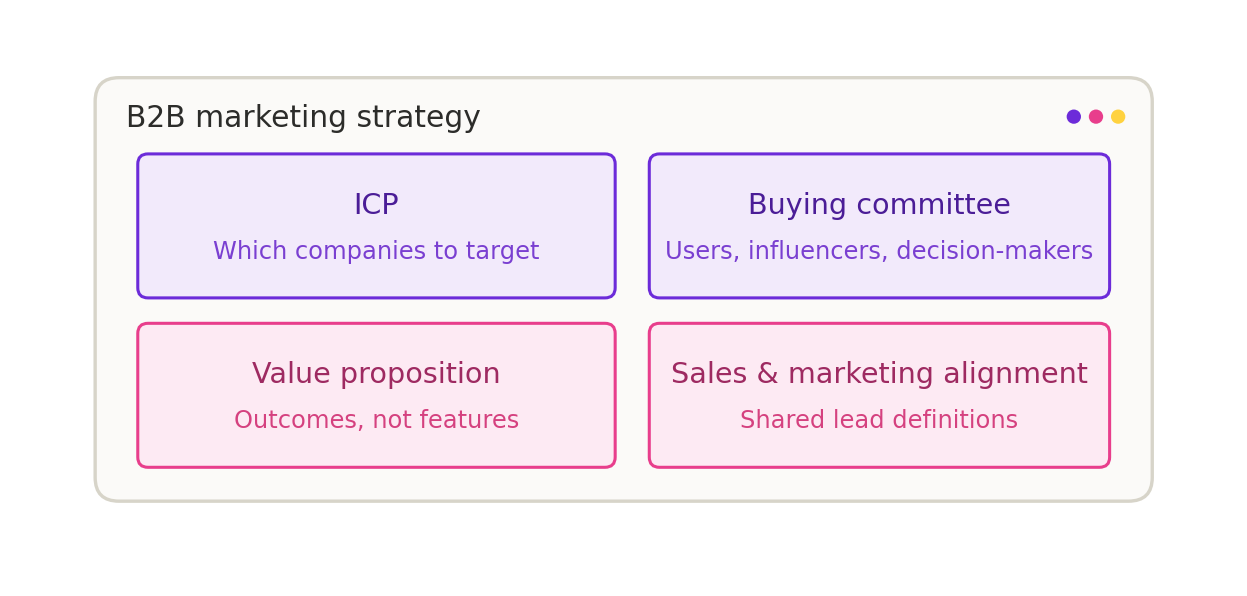
A workable B2B marketing strategy rests on four elements. Skipping any one of them tends to show up later as wasted ad spend or a sales team ignoring marketing’s leads.
Ideal Customer Profile (ICP)
An ICP is a specific description of the type of company most likely to buy, succeed with, and stay with your product. Before targeting individual leads, B2B marketers need to define which companies are worth pursuing at all.
Factors that shape an ICP include industry, company size, geography, revenue, technology stack, use case and the trigger event that pushes a company to look for a solution. A cloud accounting platform might define its ICP as mid-sized Indian retail chains with ₹50–500 crore revenue that have outgrown spreadsheet-based finance and are expanding to multiple states a trigger that creates urgency around compliance.
Buying Committee
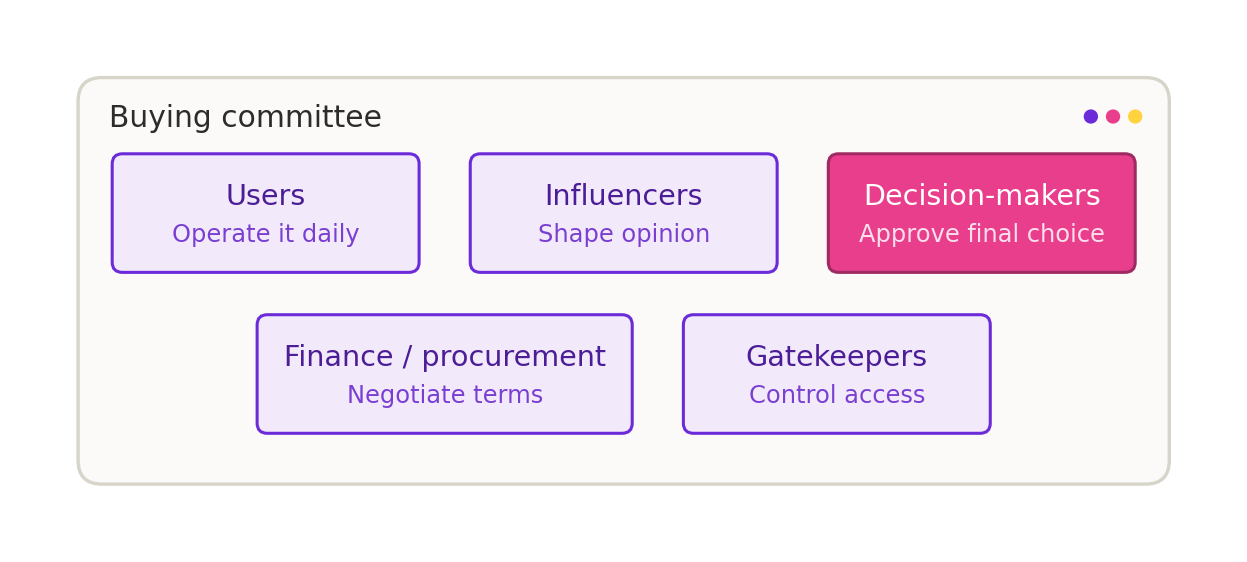
B2B purchases are rarely decided by one person. A typical deal involves users who operate the product daily, influencers who shape internal opinion, decision-makers who approve the final choice, finance or procurement who negotiate commercial terms, and sometimes gatekeepers who control access to the real decision-makers.
For an IT services firm selling cybersecurity solutions, the IT manager cares about technical fit, the CFO cares about cost, and the CISO cares about compliance risk. Content needs to address each concern separately rather than treating the committee as one audience.
Value Proposition
B2B messaging performs better when it communicates business outcomes rather than a list of features. “What the product does” describes functionality; “why the buyer should care” describes the business result reduced downtime, faster reconciliation, lower compliance risk.
A logistics-tech company should avoid saying “we offer real-time fleet tracking.” A sharper proposition says the platform helps FMCG distributors cut delivery delays and unplanned fuel costs across a multi-city fleet specific and tied to a problem the buyer already has.
Sales & Marketing Alignment
Marketing cannot optimise purely for lead volume while sales is judged purely on closed revenue the two goals pull in different directions. Both teams need a shared definition of what counts as an MQL, an SQL, an opportunity and qualified pipeline, agreed on in advance, not debated after a disappointing quarter.
Regular feedback loops where sales tells marketing which leads actually converted and why are what keep these definitions honest over time.
Why Lead Volume Isn’t the Same as Pipeline Growth
Every B2B marketer has seen a campaign that generated hundreds of leads and almost no revenue. This happens because leads and pipeline sit at different points in a longer chain:
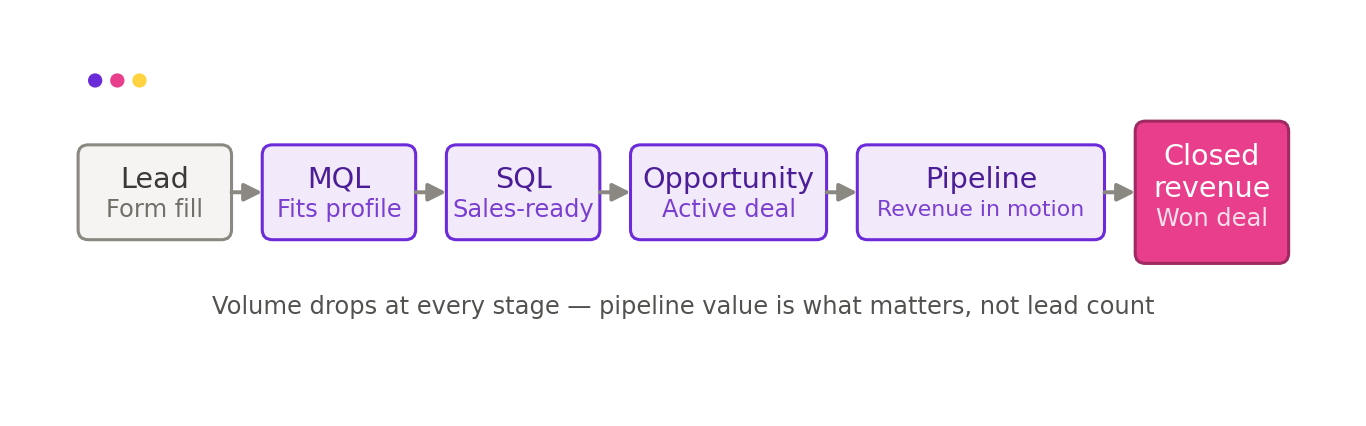
A lead is simply someone who filled a form or downloaded something. Many leads are students, job seekers, competitors or professionals with no budget or authority. Others fit on paper but show no real buying intent, or belong to a company well outside the ICP. Because B2B cycles run long, a large share of leads sit in the CRM for months without reaching sales, and many that do reach sales never become an opportunity.
This is why 1,000 low-intent leads can generate less revenue than 50 well-targeted accounts that were never counted as impressively in a monthly report.
The following numbers are illustrative only, not industry benchmarks:
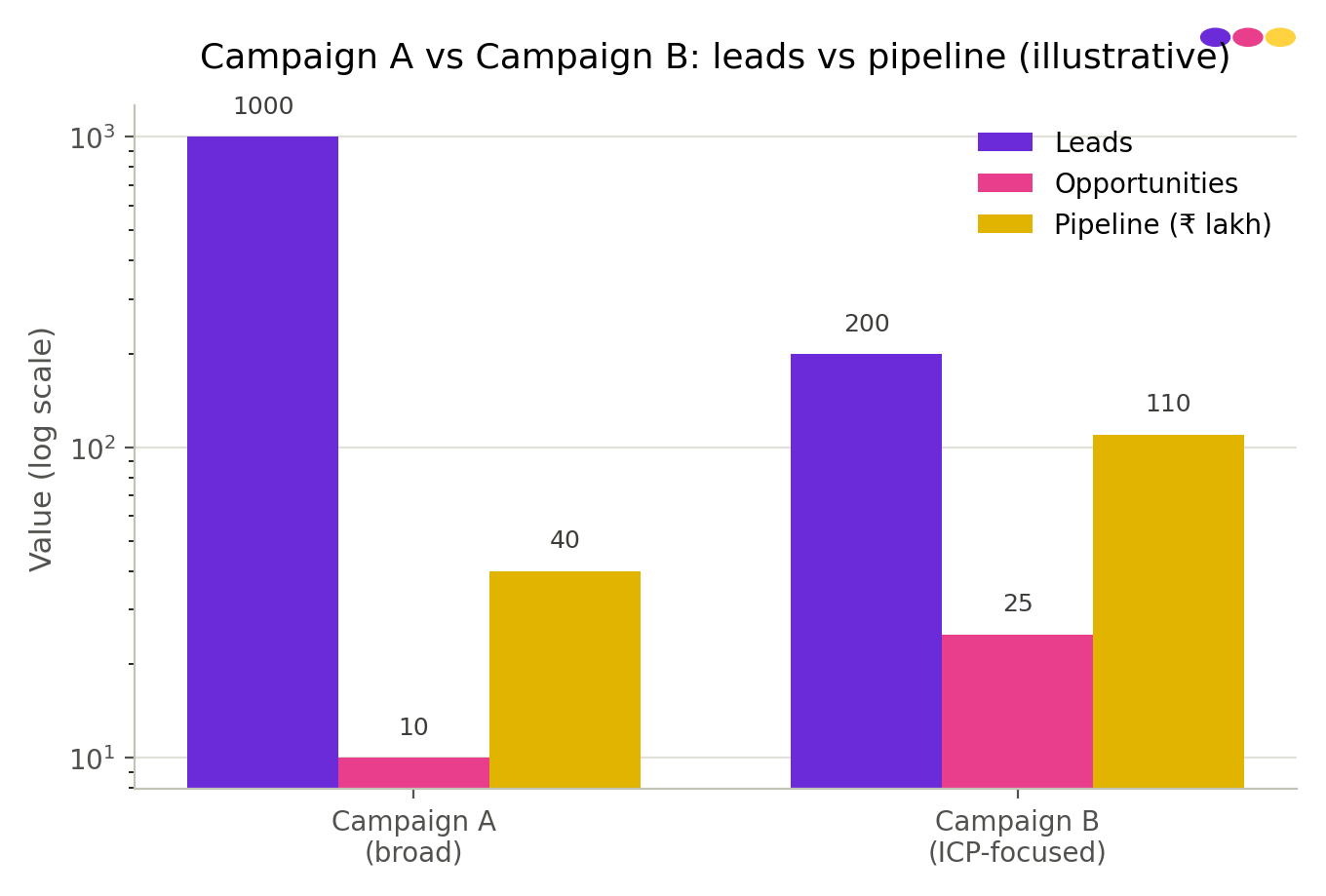
Campaign A produced five times more leads. Campaign B produced nearly three times more pipeline, because it filtered for fit and intent before scaling. A CMO reporting only lead counts would have rated Campaign A the stronger performer the opposite of what the business actually needed.
| Metric | What it tells you | What it doesn’t tell you |
|---|---|---|
| Leads | Initial interest or response | Whether the company fits your ICP |
| MQLs | Marketing-qualified interest | Whether sales sees genuine readiness |
| SQLs | Sales-qualified demand | Whether the deal will close |
| Opportunities | Active, potential deals | The final win or loss |
| Pipeline | Potential revenue in motion | Guaranteed revenue |
What Are the Most Effective B2B Marketing Strategies in 2027?
The strategies that consistently work are the ones that help buyers discover a solution, evaluate it against alternatives, build internal trust, and eventually choose a vendor with confidence largely before a salesperson enters the conversation.
SEO & Organic Search
B2B SEO is the practice of ranking for the searches your buyers run while researching a problem, a category or a shortlist of vendors. It works for B2B specifically because most of the buying journey now happens before any contact with a salesperson. Gartner’s B2B buying research describes buying groups of six to ten stakeholders, each gathering information independently through problem-based, comparison and category searches, long before filling out a contact form. Content that ranks for these queries shapes the shortlist before sales gets a seat at the table.
This week: Build one keyword cluster around a specific, high-value problem your ICP searches before they search your category. A workflow-automation vendor might cluster around “manual approval delays manufacturing” rather than only “workflow software India.”
Content Marketing (Educational, Not Promotional)
B2B content marketing is the practice of publishing material that answers a buyer’s real questions rather than promoting your service directly. It works for B2B because purchases are complex, involve financial risk, and are rarely approved by one person. Educational formats buying guides, comparison pages, implementation guides, ROI calculators and case studies reduce perceived risk and let buyers who are not yet ready to talk to sales keep evaluating you on their own timeline.
This week: Take the ten questions your sales team hears most often on discovery calls and turn each into a short, direct piece of mid- or bottom-funnel content.
LinkedIn & Social Media
LinkedIn and social media, for B2B, function as a channel for professional discovery, category authority and repeated visibility, not as a direct lead-generation machine on their own.
They work because B2B buying cycles are long, and buyers form an opinion about a company well before they engage. Consistent, useful posts from founders, leaders and subject-matter experts build familiarity and social proof, so that by the time a buyer starts evaluating vendors, your company already feels credible.
This week: Build a weekly content series around three recurring problems your ICP faces, instead of posting generic company updates. Founder-led posts tend to perform especially well in high-consideration categories like enterprise software and professional services.
Account-Based Marketing (ABM)
ABM is a focused strategy that targets a defined list of high-value accounts with tailored content and coordinated outreach, instead of running one broad campaign for an entire market.
It works because large deals usually involve multiple stakeholders inside a small number of target companies, where personalisation has a real chance of being noticed. Instead of targeting “Indian manufacturing businesses” broadly, an enterprise SaaS company might identify 50 named manufacturing accounts and build outreach around each account’s specific operational bottlenecks.
This week: Pick 20–30 named accounts that match your ICP closely, and build one piece of account-specific content a short problem-and-solution brief for the five accounts furthest along in awareness.
Email Marketing & Lead Nurturing
Email nurturing is the practice of sending a sequence of relevant, staged messages to leads based on what they’ve shown interest in, rather than one generic promotional blast to everyone.
It works because long sales cycles create a large group of people who are interested but not yet ready to buy. A single template sent to every lead ignores where each person actually is in their decision, which is why it underperforms segmented nurturing.
This week: Segment your leads by the content they consumed or the problem they searched for, and build a short 3–5 email sequence addressing that specific problem in more depth. Many businesses run this through outsourced B2B marketing services when they lack the internal bandwidth to build and maintain multiple sequences.
How Do You Build a B2B Marketing Strategy from Scratch?
A B2B marketing strategy holds together when each step feeds logically into the next: Business Goal → ICP → Buyer Problem → Channel → Content → Conversion → Sales Handoff → Pipeline.
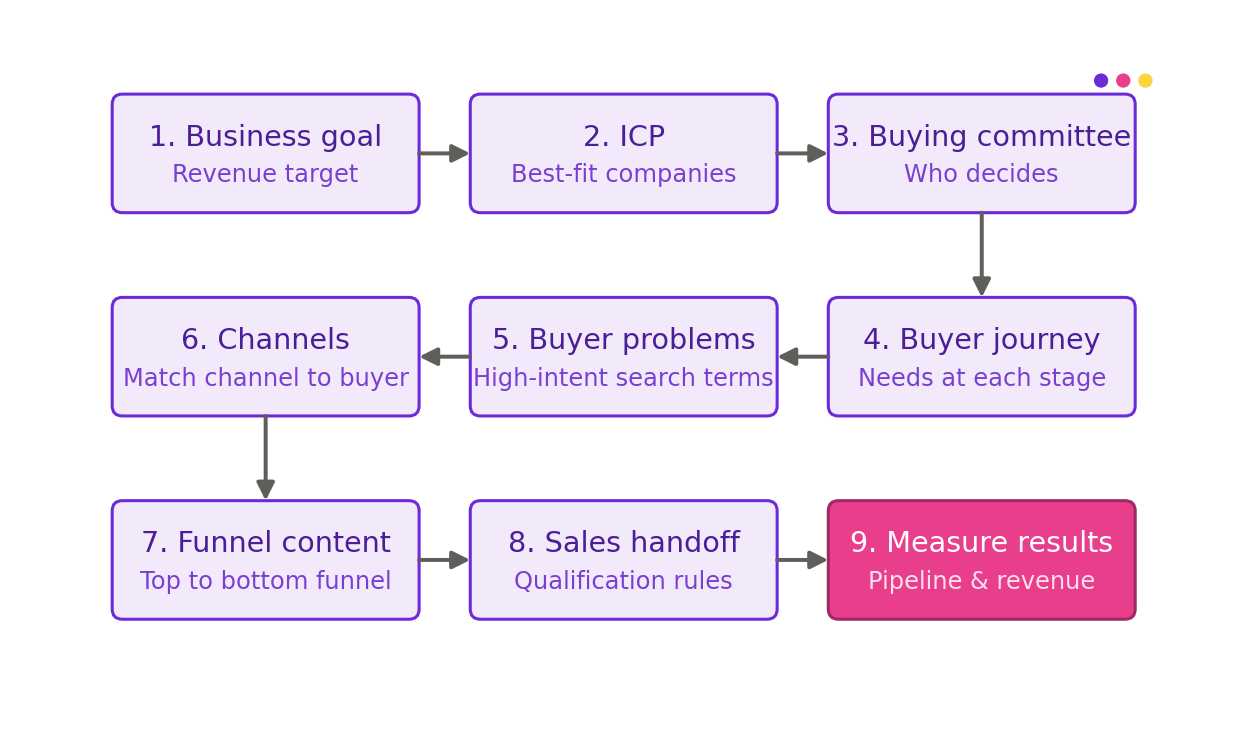
- Define the business goal. Revenue target, new market entry, or account expansion this decides everything downstream.
- Build the ICP. Narrow down to companies most likely to buy and succeed with your product.
- Map the buying committee. Identify who influences, decides, and approves budget.
- Map the buyer journey. Understand what each stakeholder needs to know at each stage.
- Identify high-intent problems and search behaviour your ICP shows before they search your brand.
- Select channels based on buyer behaviour SEO and content for research-stage buyers, ABM for high-value accounts, LinkedIn for visibility.
- Build content around funnel stages, so top-of-funnel education and bottom-of-funnel proof aren’t treated the same way.
- Establish sales handoff rules what qualifies a lead to move to sales, and how fast sales should respond.
- Measure pipeline and revenue, not just activity, and feed learnings back into the ICP and content plan.
An Indian fintech company selling expense-management software could apply this by defining a revenue goal, narrowing its ICP to companies still using outdated expense tools, mapping the CFO-IT-procurement committee, and building comparison content and ABM outreach for a shortlist of target accounts instead of running broad, unfocused ads.
How Do You Get Sales and Marketing Actually Aligned?
Alignment starts with shared definitions, not shared meetings. If marketing calls something an MQL and sales quietly disagrees, both teams are working from different scoreboards.
Practical alignment requires: shared pipeline targets rather than separate marketing and sales goals; agreed lead-qualification criteria, revisited quarterly; CRM hygiene, so stage changes and lost reasons are logged consistently; sales feedback on lead quality, fed back into targeting; clear lead-response expectations, since slow follow-up wastes the spend behind a qualified lead; regular pipeline reviews between marketing and sales leadership; and closed-loop reporting that traces a lead through to a closed deal or a documented loss.
The difference this makes is visible in how marketing reports its own work. Saying “we generated 5,000 leads” tells a CMO almost nothing about revenue impact. Saying “these campaigns generated 180 ICP-fit leads, 42 sales-qualified opportunities and ₹2.3 crore in influenced pipeline” gives the leadership team something they can actually act on.
A simple monthly rhythm works for most mid-sized teams: a weekly lead-quality check between marketing and sales operations, and a monthly pipeline review where both teams look at the same funnel numbers together.
How Do You Measure ROI on B2B Marketing?
Impressions, clicks, followers, traffic and raw lead count are useful as diagnostic signals they tell you whether a campaign is reaching people but they are insufficient as the primary measure of marketing’s success, because none of them confirms revenue impact.
More meaningful metrics include: Marketing Qualified Leads (MQLs) and Sales Qualified Leads (SQLs), MQL-to-SQL conversion, opportunity creation, pipeline generated and influenced, customer acquisition cost (CAC), cost per opportunity, win rate, sales cycle length, and revenue attributed or influenced by marketing.
Attribution in B2B is rarely linear. A buyer might discover you through organic search, follow your company on LinkedIn for months, read a comparison guide, and only then respond to an email with several channels contributing across a long cycle. Multi-touch attribution and pipeline-influence reporting give a more honest picture than crediting a single “first-click” or “last-click” channel.
A CMO comparing two quarterly campaigns should look past which one generated more form-fills, and instead compare which one produced more opportunities and a shorter sales cycle for equivalent spend. HubSpot and Salesforce both cover funnel-stage metrics in more depth for teams building this out for the first time.
Conclusion
The strongest B2B marketing strategies are not the ones that fill a CRM the fastest. They are the ones that consistently reach the right accounts, help buyers make an informed decision, and turn that interest into qualified opportunities and real pipeline. Lead count makes for an easy slide in a review meeting; pipeline and revenue are what actually justify the budget.
Getting there requires discipline across ICP definition, content built around real buying questions, coordinated account targeting, and metrics that sales and marketing both trust. Many Indian businesses reach a point where building this in-house, across SEO, content, LinkedIn, ABM and analytics, stretches a small team too thin, which is where specialised B2B marketing services can help close the gap.
At Social Pill, this is the lens we bring to B2B engagements: connecting marketing activity to pipeline that a CMO or founder can actually stand behind in a revenue conversation, rather than a report full of vanity metrics.
FAQs
1. What are B2B marketing strategies?
Strategies businesses use to attract, engage and convert other businesses into customers.
2. What are the most effective B2B marketing strategies?
SEO, content marketing, LinkedIn, ABM, email marketing and lead nurturing are among the most effective strategies.
3. How do you create a B2B marketing strategy?
Define your goals and ICP, understand buyer needs, choose the right channels, create targeted content and track the pipeline.
4. What are the best B2B marketing channels?
SEO, LinkedIn, content marketing, email, paid search, ABM, and industry events are key B2B channels.
5. How do you measure B2B marketing success?
Measure qualified leads, opportunities, pipeline, CAC, win rate, sales cycle and marketing-influenced revenue.