
You post regularly, you respond to comments. Your team spends hours every week on reels, carousels and captions. The question that comes up time and again though is ‘is social media actually working for the business?’ And there’s no one in the room who can say with any degree of confidence. That’s the classic complaint we hear from new clients at Social Pill, a social media marketing in Mumbai. The solution isn’t necessarily to post more. The solution is to step back and do a social media audit.
In this guide we’ll walk you through a practical 9 step audit you can run yourself, a simple scorecard you can use to rate every channel and a decision framework for what you do with the results. Nothing fancy required, just your own analytics, Google Analytics and a spreadsheet.
What Is a Social Media Audit?
A social media audit is a proper review of all the social accounts that your business owns. It’s a review of your profiles, your content, your audience, your results and above all the link between your social activity and actual business outcomes. It answers the three key questions: what’s working, what’s not and what should we do next?
It’s important to distinguish an audit from two things it’s very frequently confused with. A report is simply a record of what happened over a period of time. A strategy is the plan for what you’re going to do in the future. An audit is the diagnosis that tells you where you currently stand. That’s the basis on which your strategy is then built rather than being based on speculation.
Signs You’re Overdue for an Audit
If any of these sound familiar, it’s time.
- Followers are growing, but enquiries and sales are not
- Likes and views are steady, but nobody can say which posts bring business
- You inherited accounts from a previous agency, employee, or freelancer
- You’ve recently rebranded, changed your offer, or launched a new service
- You’re posting on five platforms but have energy for only two.
- Leadership is asking you to justify the social media budget
How to Run a Social Media Audit
Step 1: Decide What Each Platform Is For
Before you open up a single analytics dashboard, write one line for each platform explaining what it does. So for example: Instagram for brand awareness and enquiries via DMs, LinkedIn for B2B leads, YouTube for educational search traffic, WhatsApp for customer conversations.
This is important because numbers mean nothing in the absence of a purpose. A 2% engagement rate could be absolutely fantastic for one objective and completely meaningless for another. If every platform has a defined job then you know what metrics you’re going to be judging it on.
Step 2: Take Inventory of Every Account and Who Controls It
List every account your business has (including the dead ones). Search your brand name on each platform to find the old pages, duplicate profiles and impersonator accounts. A lot of businesses end up with a long forgotten Facebook page or an abandoned YouTube channel as a result of this exercise.
Then look at who has admin access to each one. If the only admin on your Instagram or Facebook page is a former employee or an agency you’ve now split from, that’s a genuine business risk and it’s far better to discover that during an audit than during a crisis.
Step 3: Review Branding and Profile Quality
Treat each profile as a mini landing page. A new visitor will make their decision in seconds as to whether or not to follow you so check the following on every platform:
- Profile photo and cover image: current, on-brand, and correctly sized
- Bio: clearly says what you do, who you do it for, and what to do next
- Link: goes to the right page, not an expired campaign or a broken URL
- Handle and name: consistent across platforms so people can find you easily
- Pinned posts and highlights: up to date and still relevant
- Contact details: phone number, email, and location are correct
Step 4: Analyze Content Performance
Get the last 90 days of data for each platform. For each platform identify your top 10 and bottom 10 posts and for each of those: format (reel, carousel, static image, video), topic, opening hook, length, time posted and call to action.
Judge each post by the metric that aligns with the platform’s objective. Saves and shares are indicative of awareness and perceived value. Link clicks, DMs and form fills are the metrics that indicate lead generation. Look for patterns in the performance of different types of posts: are educational posts outperforming promotional ones? Are reels outperforming carousels? Is there a particular topic that keeps coming out on top?
Don’t skip the bottom 10. Most teams will only look at their winners, but your weakest posts will tell you what to stop doing. Also separate organic from paid so a boosted post doesn’t get counted as organic reach.
Step 5: Understand Who Your Audience Really Is
The aim is to work out whether the people following you are actually the people who buy from you. Look at age, location, language and active times on each platform and compare that to your ideal customer.
If you’re a service business based in Mumbai and the majority of your followers are from other cities and other countries you do have an audience, just not the right one. Also be on the lookout for the signs of low quality followers (sudden spikes with no corresponding engagement etc).
Step 6: Benchmark Against Real Competitors
Pick three to five businesses that are actually competing with you for the same customer base. These need to be real competitors, not big brands that you’re just in awe of. For each of them, note down their follower counts, how often they post, what formats they use, what their level of engagement is, what their content is all about and anything they’re doing particularly well that you’re not.
You could do it manually in a very simple spreadsheet. The point isn’t to copy them. It’s to identify the gaps: the topics they don’t cover, the formats they don’t use, the questions their audience are asking that no-one is actually answering.
Step 7: Trace Social Activity to Leads and Revenue
Followers don’t pay the bills so this is the most important step for the business. Use UTM parameters on your links and then go into GA4 to see how much traffic each platform is sending and what those visitors are doing. You also need to track the enquiries that don’t show up in GA4 (i.e. the DMs, the WhatsApp messages, the phone calls that start with “I saw your post”).
Step 8: Check Your Social Search Visibility
People are increasingly using Instagram, YouTube and LinkedIn as search engines. You should be doing an audit to check that your content is discoverable in that way. Is your profile name and bio clear as to what you do and where you’re based? Are your captions, video titles and descriptions written using the actual phrases that people would search for? Do you have alt text on your images?
This is where social media and search come together. If you’re looking for help in terms of aligning your keywords across your website, YouTube and your social channels then an SEO agency in Mumbai can create one keyword strategy that will then be applied across all your channels so they’re all working in unison rather than in isolation.
Step 9: Review Security, Compliance, and Governance
Finally, check the behind-the-scenes health of your accounts. Remove access for people who no longer need it and turn on two-factor authentication. Confirm you have an approval process for posts, especially if you work in a regulated area like healthcare, finance, or real estate. Check that you follow each platform’s policies, disclose paid partnerships properly, and have the rights to the music, images, and videos you use.
Score Each Channel with a Simple Scorecard
Once you’ve gathered your findings, give every platform a score from 1 to 5 on each of the five criteria below. The maximum total is 25.
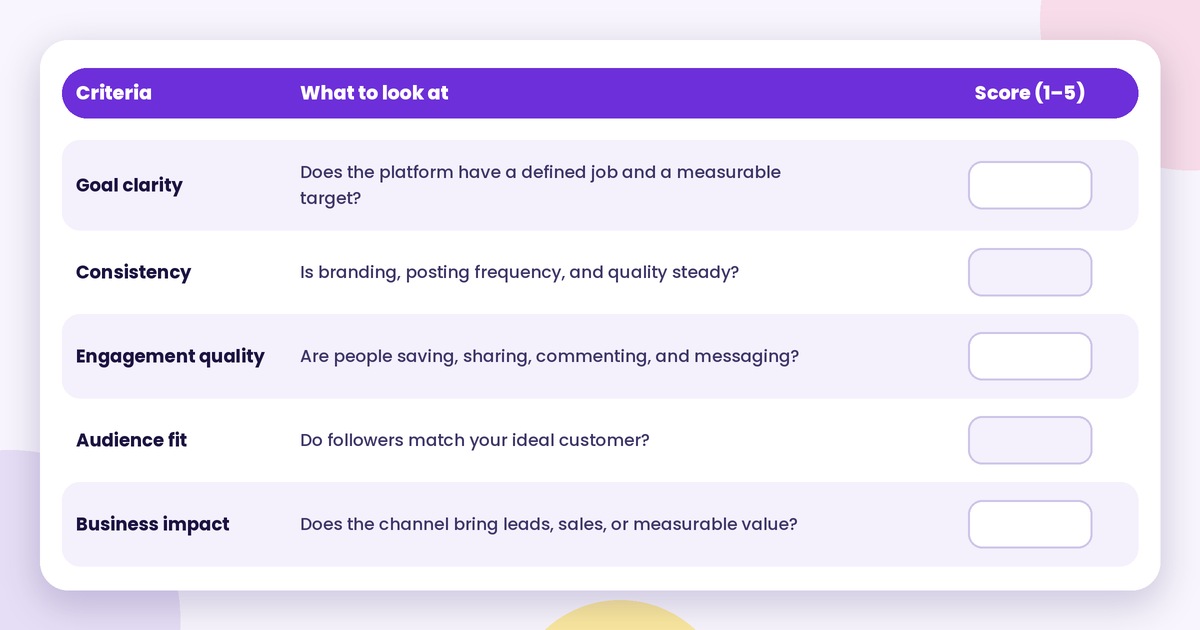
20 to 25: strong channel, so invest more. 13 to 19: has potential but needs work. Below 13: rethink the approach or consider stepping back.
Common Social Media Audit Mistakes
- Chasing vanity metrics. Follower count and likes don’t equate to business results.
- Skip the goal setting altogether. If you don’t have a reason for being on each platform the data is just going to be meaningless.
- Ignore the paid vs organic. If you mix them you’re going to hide what’s actually working.
- We’re only looking at the winning posts. The under performers are just as instructive.
- Forget the website. A brilliant social strategy can fall apart on a clunky, slow or confusing landing page.
- Auditing once and moving on. Platforms, algorithms and audiences are all in a state of constant flux.
How often should you run a social media audit?
A full audit every quarter works well for most businesses. If you post at high volume or run frequent campaigns, add a light monthly check of top-line metrics, best and worst posts, and profile basics. Run an extra audit after a rebrand, a major campaign, a team change, or when you take over an account from someone else.
Final Thoughts: Let the Data Decide Where to Focus
Social media can feel like a treadmill, with constant posting and little clarity about what it’s achieving. A social media audit replaces that feeling with evidence. You find out which channels deserve more effort, which need fixing, and which you can safely let go. That’s how small teams compete with bigger ones: not by doing more, but by doing the right things.
That’s where Social Pill, a digital marketing agency in Mumbai, can help. Our team works across social media management, performance marketing, SEO, website development, app marketing, video production, and AI-driven solutions. We can audit your accounts, score each channel, benchmark you against competitors, and give you a clear action plan.
Want to know what’s really working on your social media? Visit https://socialpill.in to request a free social media audit.