Social media strategies for FMCG brands are the planned content, distribution, creator and community choices a brand makes to become instantly recognisable before a purchase decision is even made. The goal isn’t a higher engagement rate. It’s repeated exposure to the same distinctive cues, so a consumer’s brain retrieves the brand without effort when standing in front of a shelf, a quick-commerce app or a search bar.
FMCG categories are crowded by design. A consumer scrolling Instagram between a biscuit ad, a detergent reel and a skincare carousel is making dozens of these snap judgments a week. Engagement tells you people reacted once. Recall tells you whether the brand survived that scroll and resurfaced at the moment of choice. This article works through the strategies that actually build that survival not generic social media advice repackaged for FMCG.
Why Brand Recall Matters More for FMCG Than Other Industries
FMCG purchases are frequent, habitual and low-consideration. Nobody spends twenty minutes comparing toothpaste brands the way they might research a mattress. Decisions happen in seconds, often on autopilot, which means the brand that surfaces fastest in memory usually wins the basket, not necessarily the “best” one on paper.
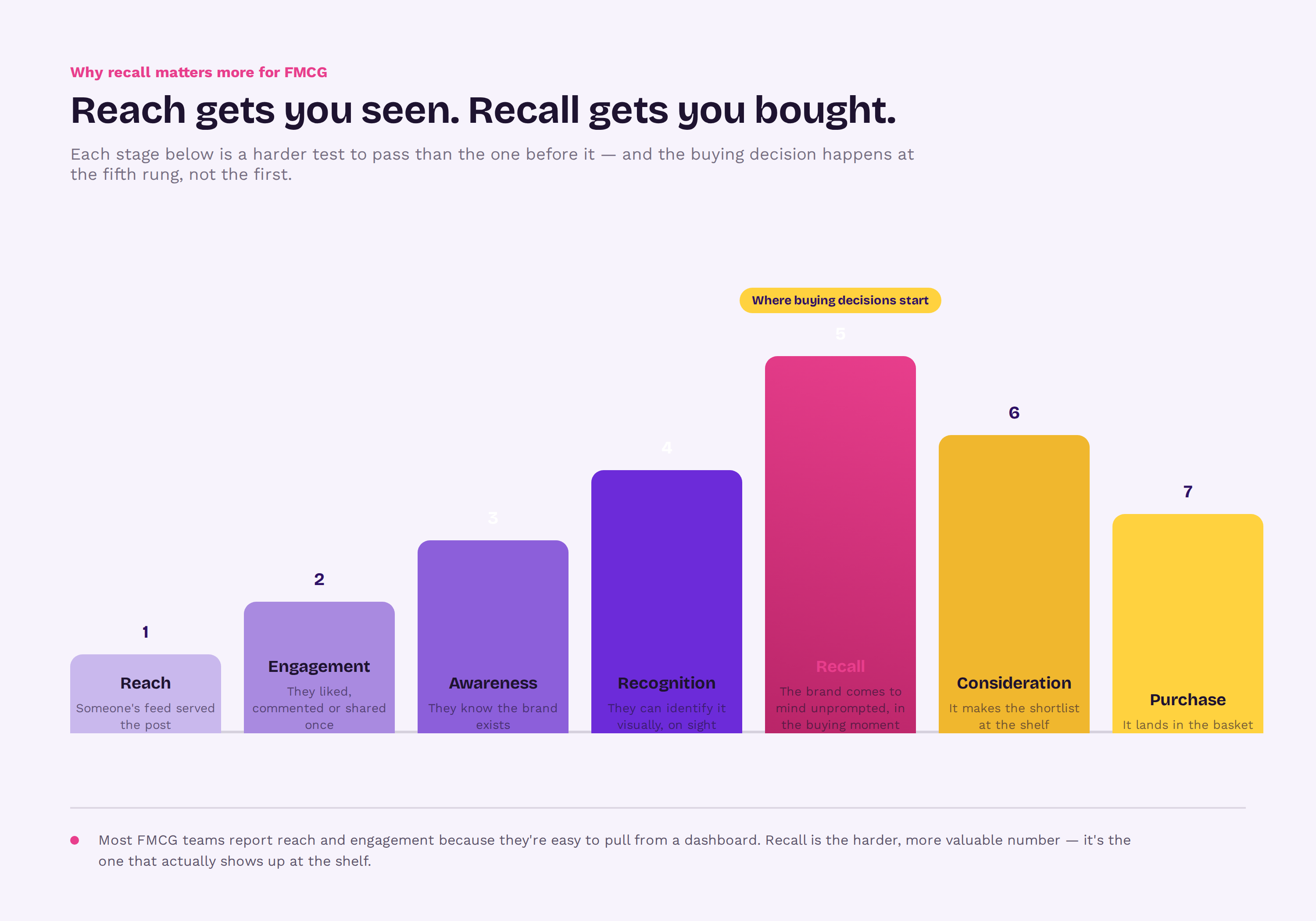
This is where the funnel from reach to purchase gets misread. Reach tells you how many people saw a post. Engagement tells you how many reacted. Awareness means someone knows the brand exists. Recognition means they can identify it visually. Recall is sharper still it means the brand comes to mind unprompted, in a specific buying situation, without being shown a logo. Consideration and purchase follow only after recall does its job.
Most FMCG marketing teams optimise the top of that chain reach and engagement because those numbers are easy to report. But a detergent brand with three million views and no recognisable colour, jingle or pack cue hasn’t built anything durable. Compare that to a masala brand that repeats the same red packaging shot, the same three-second sizzle sound and the same tagline across every reel for a year. By month nine, a shopper in a Tier 2 kirana store or scrolling Blinkit at 9 pm recognises it before reading the name. That’s social media doing its real job: building mental availability long before the consumer reaches the shelf or the app.
If your team is still mapping how paid and organic reach fit into this picture, covers the broader planning layer that sits underneath everything in this article.
The Core Strategies for Building FMCG Brand Recall on Social Media
The strategies below aren’t a checklist of platform features. Each one is built around a single test: does this make the brand easier to retrieve from memory when the consumer is ready to buy? Strategies that don’t pass that test however good for vanity metrics are left out deliberately.
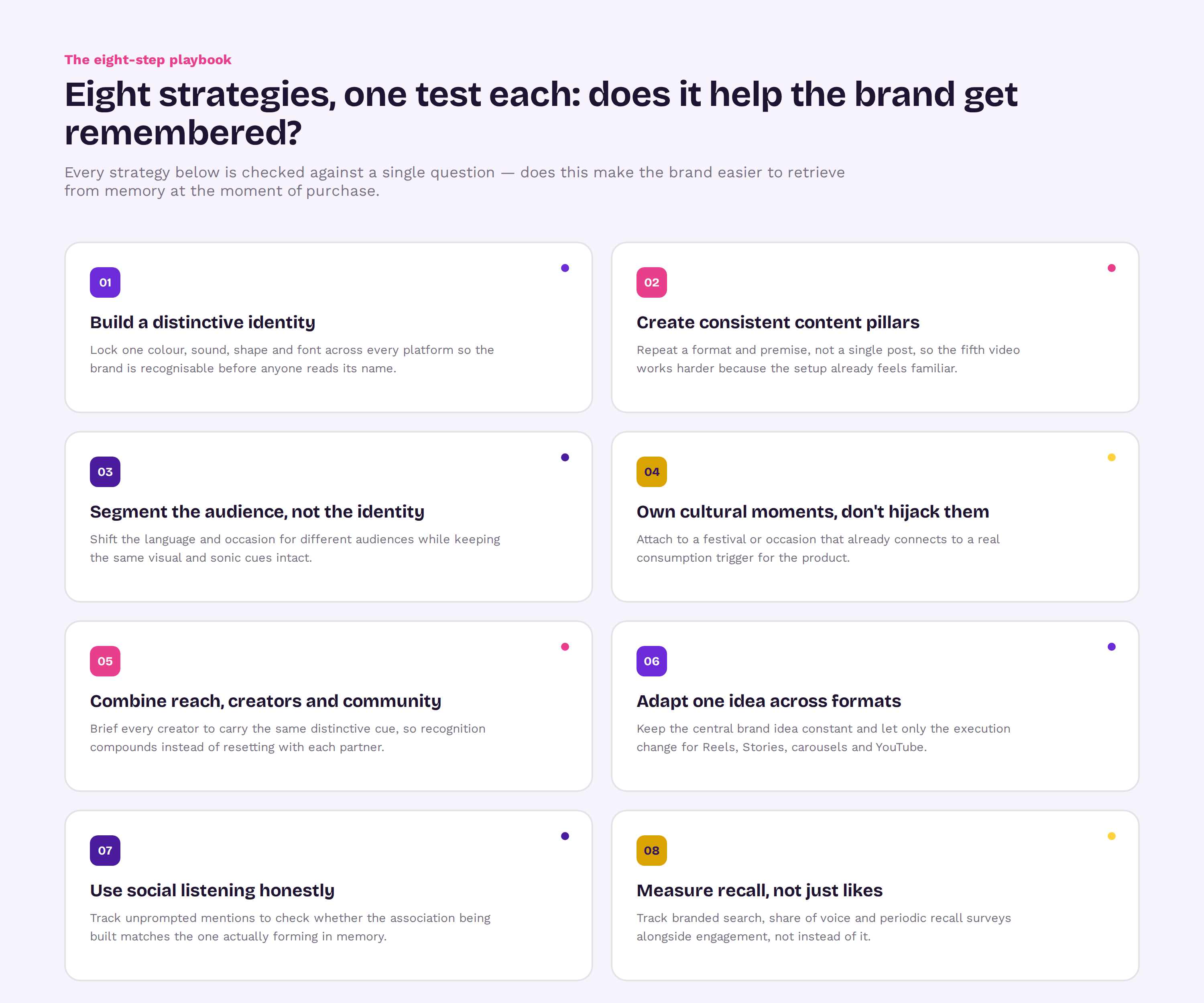
Step 1: Build a Distinctive Brand Identity Across Social Platforms
A distinctive identity is the set of visual and sonic cues colour, typography, packaging shape, mascot, sound that let a consumer identify a brand before they read its name. For FMCG, this matters because shelf and scroll decisions both happen faster than conscious reading; shape and colour register pre-attentively, while text takes longer to process.
In practice, this means auditing every asset a design team touches: thumbnail colour, intro sound, caption font, even the crop ratio used for product shots. A ghee brand, for instance, might commit to always opening reels on the same brass-vessel shot with the same background score, regardless of the campaign theme underneath. Consistency at this layer should be non-negotiable even when creative concepts change month to month. Research from the Ehrenberg-Bass Institute on distinctive asset measurement backs this up: assets only build mental availability when they’re deployed consistently enough to become reliably linked to one brand rather than the category as a whole.
This week: Pull your last 15 Instagram posts and check how many would be recognisable with the logo removed. If fewer than half are, build a one-page distinctive-assets sheet colour, sound, shape, font and circulate it to every creator and agency partner before the next content cycle.
Step 2: Create Consistent Content Themes Consumers Can Associate With the Brand
Content pillars are recurring themes or formats a brand owns over time, rather than one-off posts built around whatever is trending that week. For FMCG, pillars give a scrolling audience a pattern to recognise, so the fifth video in a series works harder than the first because the setup is already familiar.
Repetition here doesn’t mean posting the same video twice. It means keeping the format and premise stable while varying the specific content inside it. A snack brand could run a weekly “two-minute fix” series solving a small kitchen problem, always shot in the same style, with a new problem each week. That’s repetition without fatigue. Reposting identical creative with a new caption is repetitive content, and audiences tune it out fast.
This week: List every content format you posted last month. Identify which one got repeated at least three times in a recognisable pattern that’s your emerging pillar. Commit to running it weekly for the next eight weeks before judging its performance.
FMCG brands also need to think beyond individual posts and build a broader system around these pillars. Walks through how that system can be structured across a monthly calendar.
Step 3: Use Audience Segmentation Instead of One-Size-Fits-All Content
Segmentation means tailoring message and context to different audience groups while keeping the underlying brand identity untouched. FMCG brands often sell into genuinely different life stages and use-cases under one master brand, and treating every follower identically wastes relevance without adding recall.
A hair-oil brand, for example, might run the same distinctive pack shot and sonic cue across all content, but frame the message differently for a college-going audience in a metro city versus a homemaker audience in a Tier 2 town different language, different occasion, same visual DNA. The brand stays instantly recognisable; only the hook and context shift. This is different from running an entirely separate visual identity per segment, which fragments recall instead of reinforcing it.
This week: Map your last quarter of content against two or three real audience segments you sell to. Flag any post where the message changed but the core visual or sonic cue didn’t carry over, and fix the template going forward.
Step 4: Build Content Around Cultural Moments Without Losing Brand Relevance
Cultural-moment content ties a brand to an existing occasion Diwali, IPL season, monsoon, a regional festival rather than manufacturing a reason for attention from scratch. For FMCG, these moments already carry consumption cues (festive snacking, monsoon comfort food, cricket-watching snacks), which makes it easier to attach the brand to a real buying trigger instead of a generic trend.
The distinction that matters is between trend participation and trend hijacking. A biscuit brand joining a viral audio trend with no link to snacking or sharing is hijacking attention it hasn’t earned. The same brand building a Holi content series around sharing a plate of biscuits with neighbours is trend participation rooted in an existing brand association. Not every cultural moment deserves a brand’s involvement pick the ones that connect to an existing occasion in the brand’s story.
This week: List the next three cultural moments on the calendar and, for each, write one sentence connecting it to an existing consumption occasion for your product. If you can’t write that sentence honestly, skip the moment.
Step 5: Combine Reach, Creators and Community to Increase Repeated Exposure
This strategy blends paid social, organic content, creator partnerships and community engagement with one goal repeated exposure to the same brand cues across different contexts, not simply borrowing a creator’s follower count once. For FMCG, a single influencer post rarely moves recall; a consumer needs to encounter the brand’s colours, sound or tagline several times, across several credible voices, before it sticks.
Creator selection should be filtered through category and existing associations, not follower size alone. A home-care brand working with micro-influencers who already film cleaning routines will build recall faster than a one-off collaboration with an unrelated lifestyle creator, because the product fits the creator’s existing content and audience expectation. Brief creators to include the distinctive pack shot or sound rather than leaving execution entirely open, so recognition compounds across every partner instead of resetting each time. A joint Google and Kantar study on short-form video in India found creators play an outsized role in how Indian audiences discover and trust new products another reason creator content needs the same distinctive cues as owned content, not a separate visual language.
This week: Audit your last five creator collaborations for whether the distinctive brand cue actually appeared on screen. Build a one-line creative requirement into every future brief: “include [specific cue] within the first three seconds.”
Step 6: Adapt the Same Brand Idea to Different Social Media Formats
Platform adaptation means keeping one central brand idea consistent while changing its execution for each platform’s behaviour not copy-pasting the same creative everywhere. FMCG audiences use Instagram, YouTube and other platforms differently, and identical creative dropped across all of them wastes the format-specific strengths of each.
A dairy brand’s “morning routine” idea, for instance, could become a fifteen-second Reel showing the product in use, a carousel breaking down the nutrition angle slide by slide, a Story poll asking which breakfast people prefer, a longer creator video demonstrating a recipe on YouTube Shorts, and a still-image post for community engagement. The idea stays constant; only the format-specific execution changes, which keeps recall intact while respecting how each platform is actually consumed. Google’s guidance on short-form video advertising makes a similar point about Shorts specifically: branding needs to feel intrinsic to the story rather than bolted on, or it gets scrolled past before it registers.
This week: Take one upcoming campaign idea and write out five format-specific executions before production starts, instead of adapting a single hero video after the fact.
Step 7: Use Social Listening to Find What Consumers Actually Remember
Social listening means tracking brand mentions, category conversations, competitor chatter and unprompted consumer language to understand what associations already exist in people’s minds. For FMCG, this reveals whether the brand recall being built matches the intended category benefit, or whether consumers remember something else entirely.
If a personal-care brand’s intended association is “gentle for daily use” but listening consistently surfaces mentions about fragrance instead, that’s a signal the content strategy is reinforcing the wrong cue. Tracking unprompted associations, recurring complaints and frequently asked questions gives a more honest read on recall than any internal brand-tracker survey, because it captures what people say when nobody’s asking them to evaluate the brand.
This week: Pull the last 100 organic mentions or comments referencing your brand and tag each one by the association it reflects product benefit, price, packaging, or something unrelated. Feed the pattern back into next month’s content brief.
Step 8: Measure Recall, Not Just Likes and Followers
Recall measurement means tracking indicators that show whether a brand is being retrieved from memory, not just whether content was seen or liked. Likes and follower counts are engagement indicators; they say little about whether a consumer can name the brand unprompted at the moment of purchase.
Useful recall proxies include branded search volume growth, share of voice against named competitors, direct traffic to the website or app, and where budget allows periodic brand-lift or aided/unaided recall surveys. Engagement metrics still matter, but they sit earlier in the chain; consideration indicators like saves, branded hashtag use and repeat creator mentions sit closer to recall; business outcome indicators like branded search and assisted conversions confirm recall is translating into intent.
This week: Add branded search volume (via Google Search Console or a simple branded-keyword tracker) to your monthly reporting deck alongside engagement metrics, even if it’s just one row on the sheet.
Choosing the right mix of metrics is its own discipline. Goes deeper into building a reporting stack that separates vanity metrics from business outcomes.
How to Measure If Your Strategy Is Actually Building Brand Recall
Recall isn’t fully visible in a platform dashboard, because dashboards report what happened on the platform, not what stuck in someone’s memory afterward. A practical monthly framework should combine both layers.
On the low-budget end, track branded search volume trends, direct website or app traffic, share of voice against two or three named competitors, and the ratio of branded to unbranded mentions in social listening. These can be pulled from free or low-cost tools and reviewed monthly without hiring a research agency.
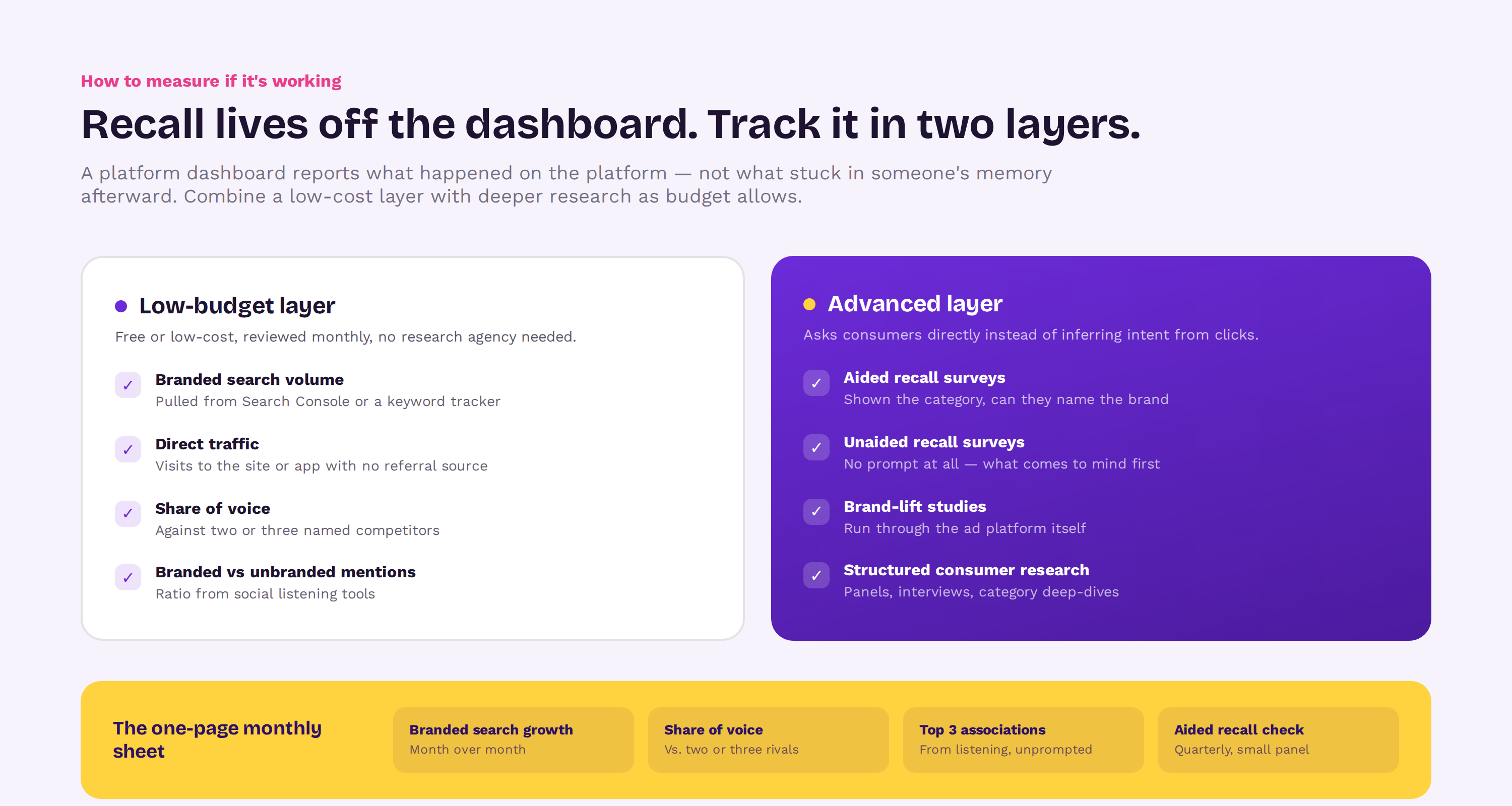
On the advanced end, aided and unaided recall surveys, brand-lift studies run through ad platforms, and structured consumer research add a layer dashboards can’t replace, because they ask consumers directly rather than inferring intent from clicks. Not every FMCG brand needs this immediately a challenger brand with a modest budget can start with the low-cost layer and add survey-based recall tracking once social spend justifies it.
A simple version: build a one-page monthly sheet with branded search growth, share of voice, top three recurring unprompted associations from listening, and quarterly an aided recall check with even a small consumer panel. That combination tells a CMO more about recall than a month of engagement charts.
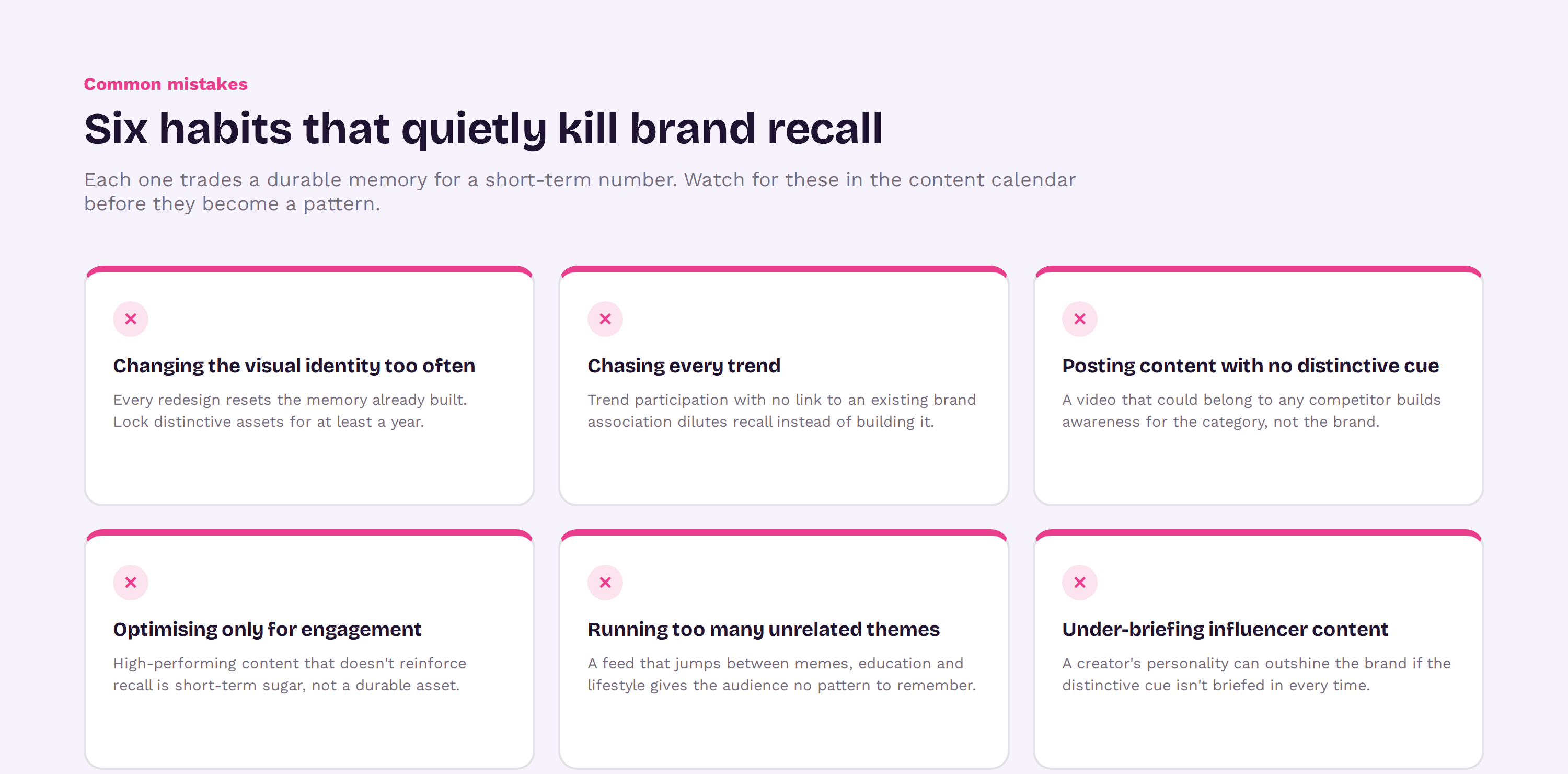
Common Mistakes That Kill Brand Recall on Social Media
Changing the visual identity too often. Every redesign resets the memory a brand has built. Lock distinctive assets for at least a year unless there’s a genuine strategic reason to shift them.
Chasing every trend. Trend participation without a link to the brand’s existing associations dilutes recall instead of building it. Filter every trend through the question: does this connect to something we already own in the consumer’s mind?
Posting content with no distinctive cue. A well-produced video that could belong to any competitor builds awareness for the category, not the brand. Every piece of content should carry at least one recognisable asset.
Optimising only for engagement. High-performing content that doesn’t reinforce recall is short-term sugar. Balance content calendars between reach plays and consistent, recall-building formats.
Running too many unrelated content themes. A feed that jumps between memes, product education and unrelated lifestyle content gives the audience no pattern to remember. Narrow down to two or three pillars and repeat them.
Over-relying on influencers without brand integration. A creator’s personality can outshine the brand if the distinctive cue isn’t briefed in. Require the pack shot, sound or tagline to appear on screen every time.
Conclusion
Strong FMCG social media isn’t about posting everywhere or producing endless content. It’s about choosing a small set of distinctive brand associations, repeating them with enough discipline to survive a crowded scroll, adapting them intelligently to different audiences and platforms, and measuring whether any of it actually sticks in memory. Reach and engagement are useful signals, but recall is the one that shows up at the shelf, the search bar and the quick-commerce cart.
Building that kind of consistency across creators, platforms and campaigns takes a system, not a single campaign burst. If your team is working through what that system should look like for your category, that’s the kind of strategy conversation Social Pill works through with FMCG and retail brands regularly.
FAQs
- What are the best social media strategies for FMCG brands?
The most effective strategies combine distinctive branding, consistent content themes, audience segmentation, creators, cultural moments, platform-specific content, and social listening. - How can FMCG brands increase brand recall on social media?
FMCG brands can build recall by consistently repeating distinctive visual, sonic, and messaging cues across their social content. - Which social media platforms are best for FMCG brands?
Instagram, YouTube, and other high-reach social platforms can work well for FMCG brands when content is adapted to each platform’s audience and format. - How do FMCG brands measure social media success?
FMCG brands should track branded search growth, share of voice, direct traffic, social associations, engagement, and aided or unaided recall. - Why is brand recall important for FMCG brands?
Brand recall helps FMCG brands come to mind quickly when consumers make frequent, low-consideration purchase decisions.