Ranking and being found have quietly become two different problems. Here is what changes between now and 2027, and what you can start doing about it today.
When someone searches on Google today, there is a very good chance they will never visit a website to get their answer.
That one sentence is the whole story of the next two years.
For twenty years, SEO had a single job: move the blue link higher up the page. Rank higher, earn more clicks, win more customers. The chain was simple, and it held.
It does not hold anymore.
Google now reports that AI Overviews reach more than 2.5 billion people a month and AI Mode has passed a billion monthly users. Meanwhile SparkToro found that 68.01% of United States Google searches ended without a click in the first four months of 2026, up from 60.45% in 2024. Your page can rank beautifully and still never be seen.
So the question for 2027 is no longer how to rank. It is a harder one: how do you get understood, chosen, and quoted by a machine that answers on your behalf?
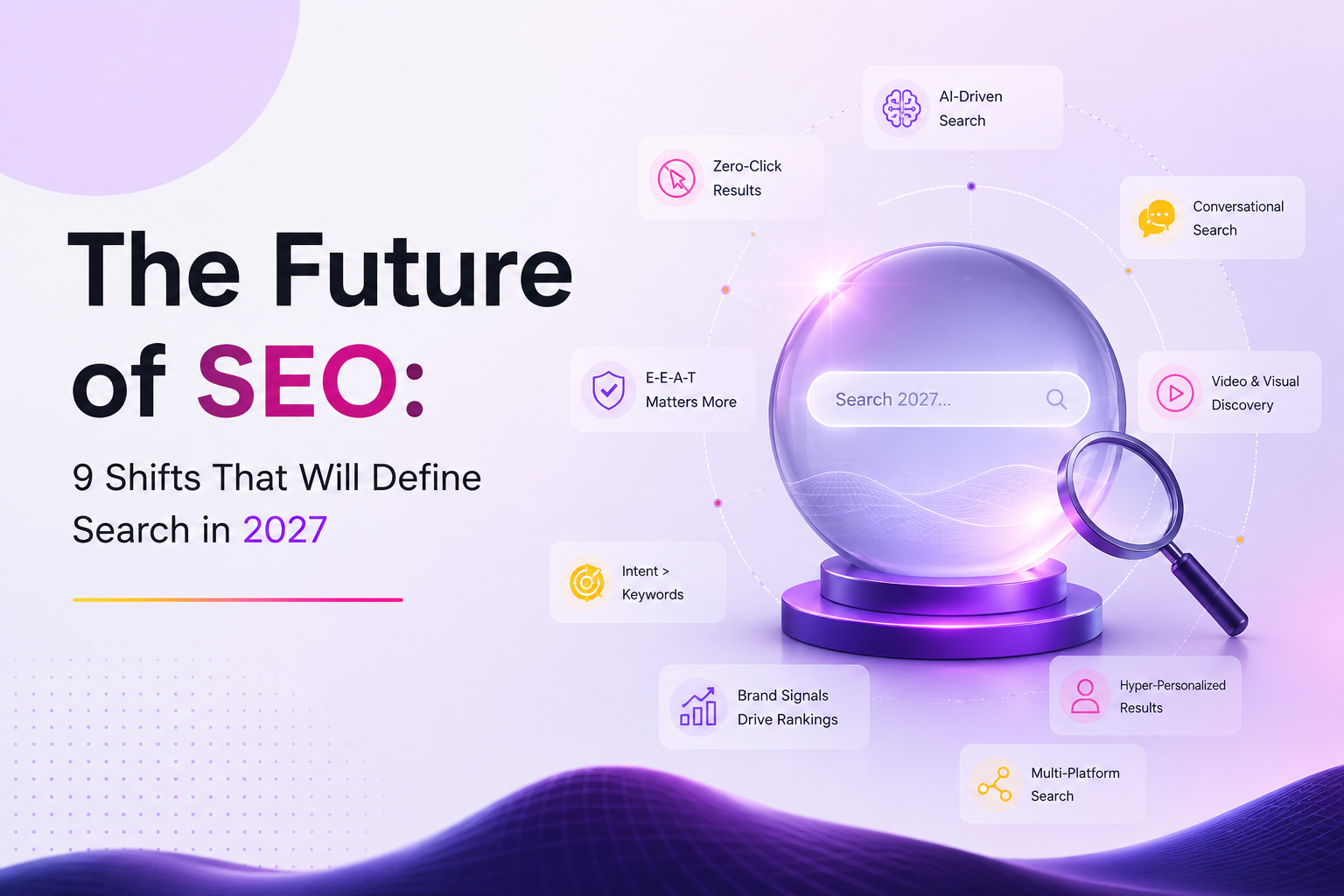
Here are the nine shifts that will decide it.
Ranking and visibility have come apart
This is the shift everything else follows from, so it is worth being precise. Ranking is where you sit on a results page. Visibility is whether a human being registers that you exist. Those two things used to be close in measurement. They are not anymore.
The clearest evidence we have is not from a study. It is from an account we run. These are the search numbers for a large Indian hospital network over the past 87 days.
“It collected 15.2 million search impressions at an average position of 7.9, which is page one, day after day. It earned 263,478 clicks. That is a click-through rate of 1.73%. It was seen 15 million times and passed over roughly 98% of the time. Over that same period, daily impressions rose by about 40% while clicks stayed flat.”
Google Search Console, 24 May to 18 August 2026. Client name withheld.
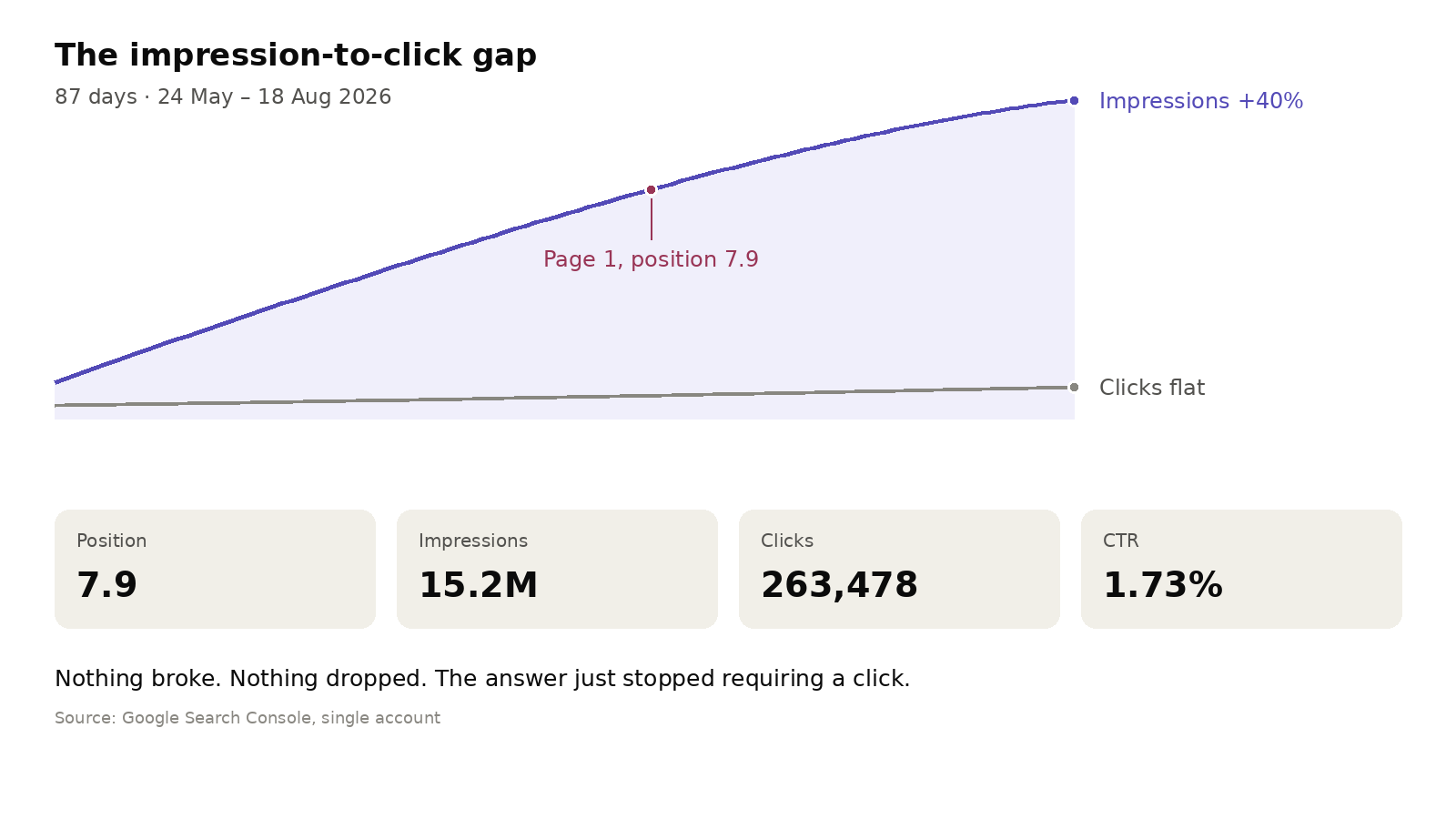
Nothing broke. No ranking was lost. The results page started answering more of the questions on its own. We have started calling this the impression to click gap, and we now track it as a first class metric rather than treating it as noise in a CTR column. When that gap widens on a page that hasn’t moved, it usually means the answer has gone over your head.
Try this: open Search Console, sort your top pages by impressions rather than clicks, and find every page where impressions are climbing while clicks are not. Those are not broken pages. They are pages whose answer is already being delivered without you.
Answer engines are becoming the front door
Google and the large language models are converging on the same behaviour. They no longer want to hand you a list of places where an answer might live. They want to hand over the answer itself and cite whoever earned it.
That changes what a search is. One question now turns into several smaller searches behind the scenes, pulls from multiple sources at once, and gives you one combined answer. You are no longer competing for a position. You are competing to be one of the sources from which the response is assembled.
The commercial side of this is already measurable. Adobe reported that traffic to United States retail sites from generative AI tools rose 693.4% year over year during the 2025 holiday season, against a small base. Fewer people arrive from these sources than from classic search, but they arrive having already been filtered by the machine.
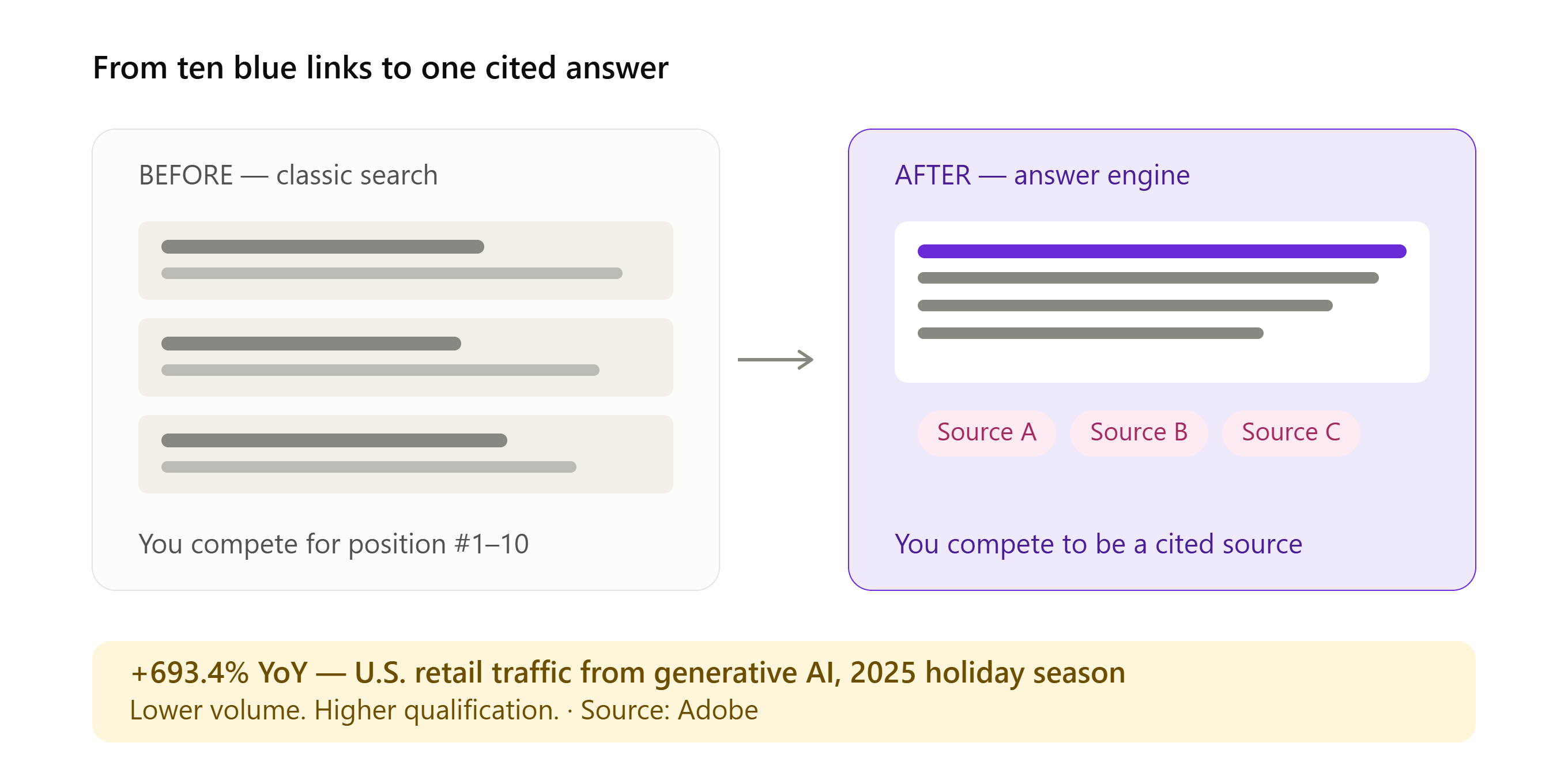
This is the trade of the next two years. You lose volume at the top of the funnel and gain qualification at the bottom of it. Teams that only report sessions will conclude that SEO is dying. Teams that only report who showed up and what they did will end up with a very different answer.
Being mentioned is overtaking being linked to
For two decades, the link was the currency of authority. It is being quietly devalued.
Ahrefs analysed 75,000 brands to see which signals predict appearing in AI Overviews. Branded web mentions came out strongest, at a correlation of roughly 0.664. Backlinks came in at 0.218. Mentions on YouTube were higher still, at around 0.737. The researchers are explicit that correlation is not causation, and that caveat matters.
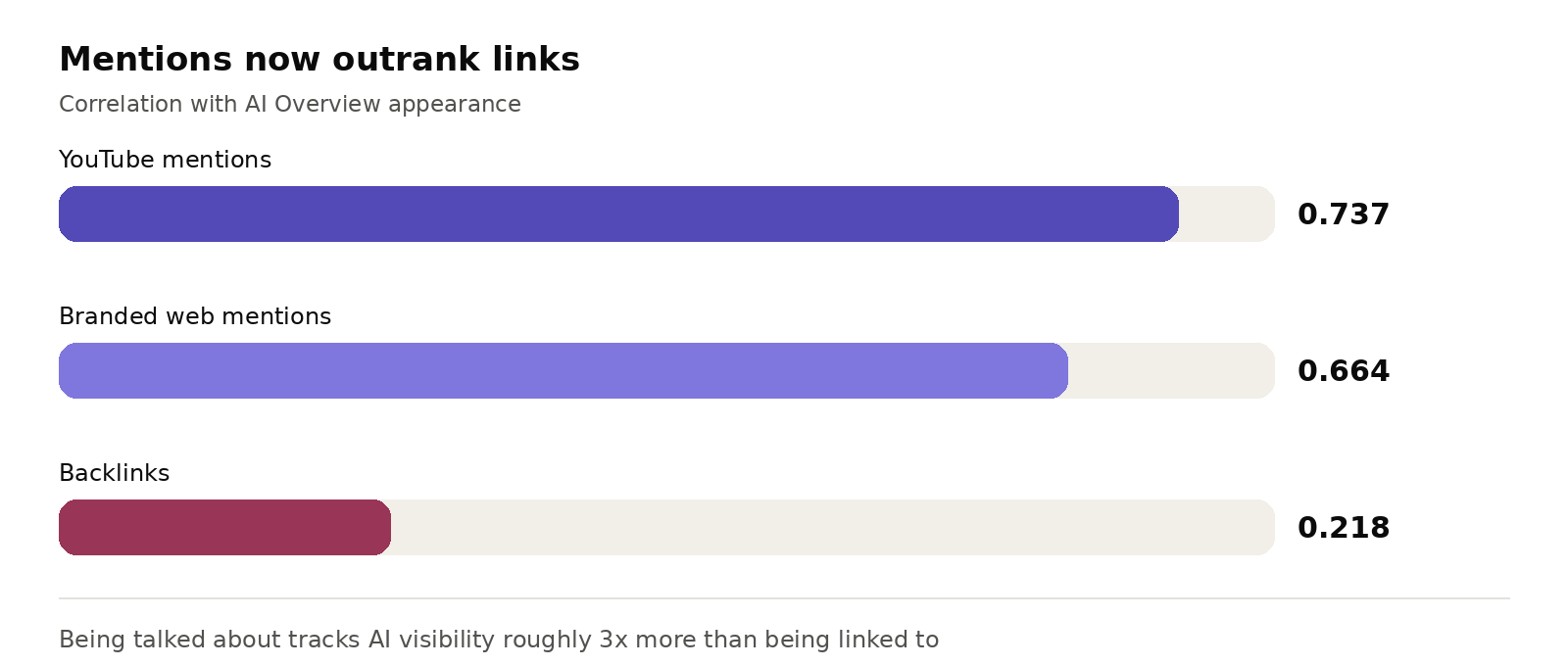
Being talked about now tracks AI visibility roughly three times more closely than being linked to.
That makes sense. A language model doesn’t follow links the way a crawler does.
It learns which brands get discussed, in what context, and how consistently. A mention with no link attached still teaches it something. A link buried on a page nobody reads teaches it very little.
The tricky part for most SEO teams is that the two biggest drivers of AI visibility are now outside their control. Digital PR, and putting your actual experts in front of an audience on podcasts, on video, in trade press, and in research nobody else has bothered to produce.
Try this: search your own brand name and count how many results on pages one and two you did not create yourself. If the answer is close to zero, every machine that has ever assessed you has only heard your own account of yourself. That is not authority. That is a monologue.
Credibility has become an engineering problem
Back in 2020, Jason Barnard argued on Semrush that search resolves into three sequential judgements: whether a machine understands you, whether it finds you credible against the alternatives, and whether it believes you can actually deliver the answer in a usable form. It was a useful model then. It describes AI search almost exactly now.
What has changed in the years since is where those judgements get made, and how little of it you control directly.
Understanding used to be something you could largely engineer on your own site with clean markup and clear copy. It is now assembled from everywhere you are described, and inconsistency between those descriptions is read as uncertainty rather than variety. Credibility used to be approximated by link metrics. It is now closer to a reading of public sentiment, which means your review profile and your press coverage do more work than your domain rating. Deliverability used to mean a fast, mobile friendly page. It increasingly means the answer box itself, where the format is chosen for you, and your only remaining job is to be the source behind it.
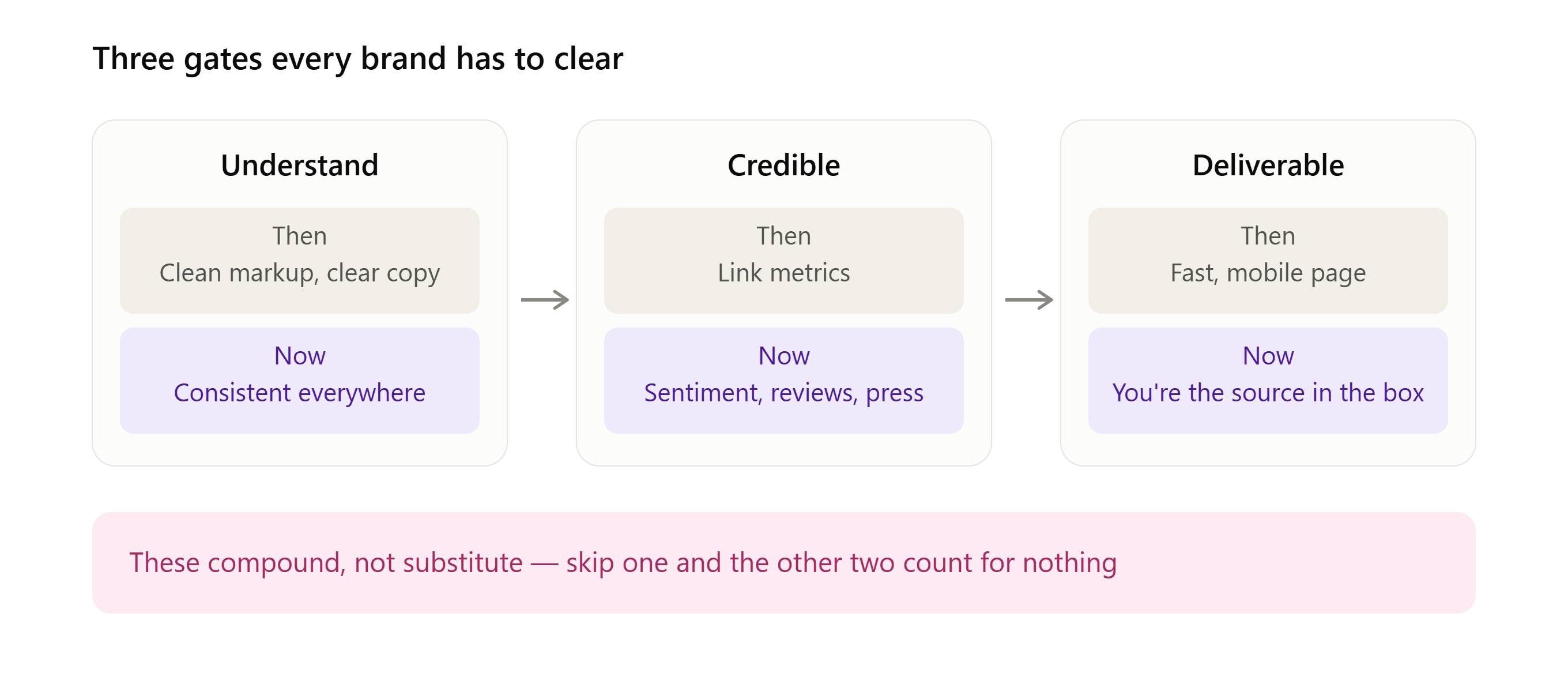
The useful part of the model is that these compounds are used as substitutes. Being understood without being credible gets you nothing. Being credible without being deliverable gets you nothing either. Most audits we run find a team that has invested heavily in one of the three and assumed the other two would follow.
Machines read your content before humans do
For the first time, your first reader is almost always a machine, and it reads nothing like a person. It does not work patiently through a warm up paragraph to reach your point. It extracts passages, takes whichever chunk answers the question cleanly, and discards the rest.
That makes structure consequential in a way it never quite was. In practice:
- Put the answer first. If a section is headed with a question, the opening forty to sixty words should answer it completely, before any context or throat – clearing.
- Write headings as the questions people actually type, not as clever labels.
- Use lists and tables for anything comparative. Prose hides structure; formatting exposes it.
- Add every number in the text, with a link to the original source. Claims without a source are being skipped more often.
- Keep a visible last-updated date on evergreen pages, and actually honour it.
None of this is a trick, and none of it is new advice dressed up. It is simply the difference between content that can be quoted and content that has to be summarised. Quotable content gets cited. Summarisable content gets absorbed.Entities are replacing keywords as the unit of strategy
A keyword is a string of text. An entity is a thing in the world that a machine records: a company, a person, a product, or a place, with properties and relationships attached to it. Search engines have been migrating from the first to the second for over a decade. AI systems have finished the journey.
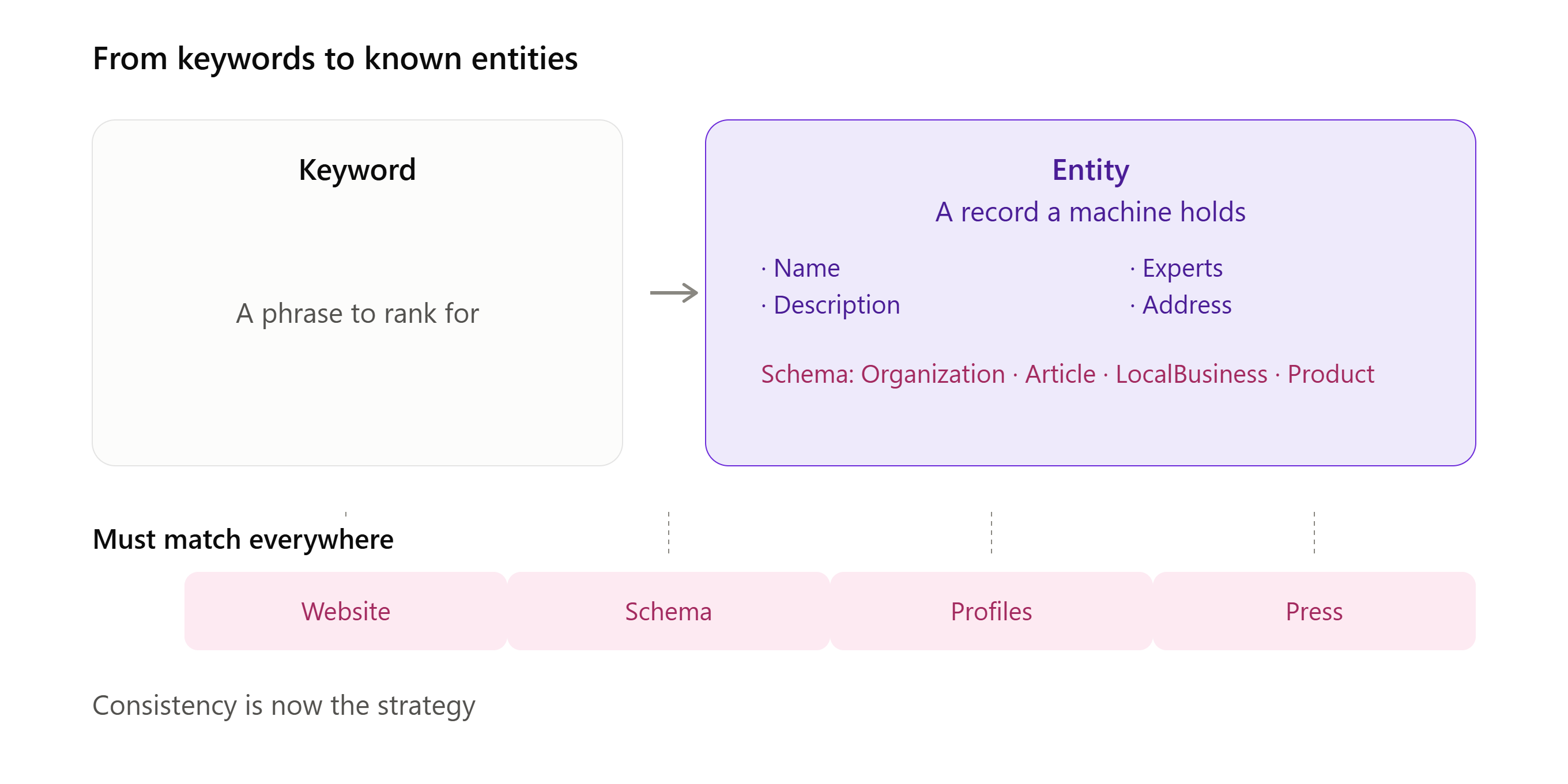
In practice, your strategy stops being a list of phrases to rank for and becomes a set of facts about you that must be true, consistent, and verifiable wherever a machine might look. The same business name, the same address, the same description of what you do, the same named experts, on your site, in your schema, on your profiles, and in your press coverage.
Structured data stops being a rich-results tactic and becomes the machine-readable version of your identity. Organization markup on the homepage, Article markup with a real named author, LocalBusiness for physical sites, Product where it applies. It is unglamorous work that quietly decides whether a model can tell you apart from a company with a similar name
Zero-click search needs a different scoreboard
If two-thirds of searches end without a click, sessions have stopped being a fair measure of whether search is working. Judging 2027 performance with 2019 metrics will make good work look like failure.
Category matters here far more than most dashboards admit. Compare two brands we run over the same period.
The hospital network averaged position 7.9 and a 1.73% click-through rate. A national ice cream brand averaged position 6.7, barely a place higher, and a 4.21% click-through rate. Two and a half times the clicks from an almost identical ranking.
Google Search Console, both properties, 24 May to 18 August 2026. Client names withheld.
The likely explanation is not that one team is better than the other. Health questions are exactly the kind of searches AI answers tend to take over, while someone looking for a flavour, pack size, or nearby store still wants to click through. Your exposure to zero-click is largely a function of what people ask you, not of how well you optimise. That is worth knowing before you set a target.
So the scoreboard has to widen. Alongside clicks, start tracking share of voice inside AI answers for your priority questions, branded search volume as the closest available proxy for whether people remember you, referral sessions from AI tools isolated in GA4, and conversion rate by source, which is where AI traffic tends to flatter itself.
The technical floor rises rather than disappears
People sometimes think AI search makes technical SEO irrelevant. It’s actually the opposite. When a machine has to choose between sources, small signs of reliability can make the difference.
- Core Web Vitals still matter. Google’s published thresholds are largest contentful paint under 2.5 seconds, interaction to next paint under 200 milliseconds, and cumulative layout shift under 0.1.
- Content that only exists after client-side JavaScript runs is a genuine risk. Many AI crawlers do not execute it. If your answer is not in the HTML, assume it does not exist.
- Decide deliberately which AI crawlers your robots.txt allows. Blocking all of them is a decision to be absent. Allowing all of them is a decision to be trained on. Both are defensible. Neither should happen by accident.
- Agents are beginning to complete tasks on websites rather than just read them. Forms, booking flows, and checkouts that only work with a mouse and a human eye will fail quietly.
SEO stops being a channel and becomes a company-wide function
This is the shift most organisations are least ready for, because it is structural rather than tactical.
If mentions beat backlinks, your PR team is doing SEO. If YouTube mentions are the strongest single signal, your video team is doing SEO. If credibility is assembled from public sentiment, your customer service team is doing SEO. If entity consistency decides whether a model understands you, whoever writes your company boilerplate is doing SEO.
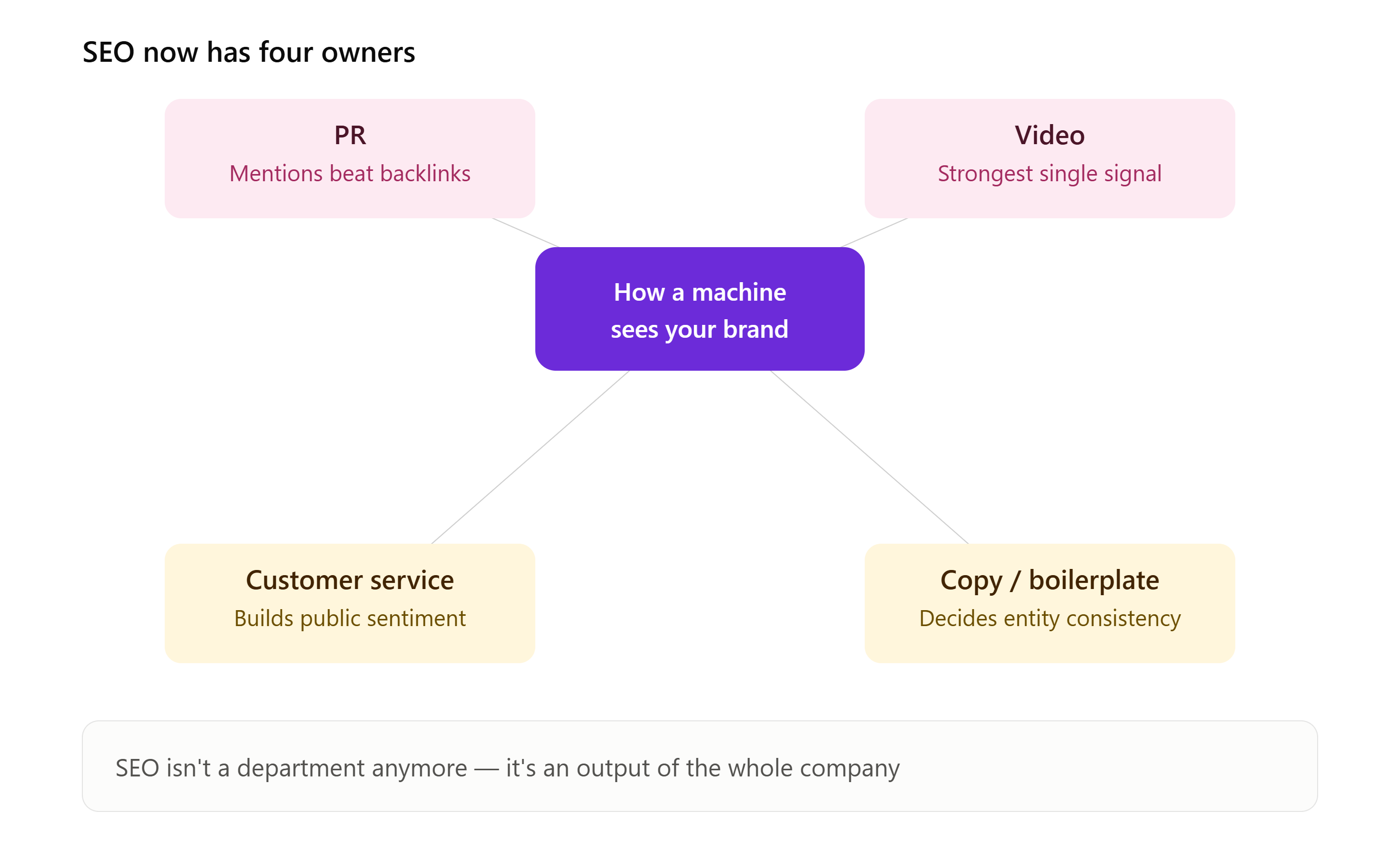
The teams that do well in 2027 will not be the ones with the best keyword tools. They will be the ones who got PR, content, social, product, and search working from a single agreed account of what the brand is and how it should be described.
What still works, and probably always will
A great deal of current commentary implies everything has changed. It has not, and it is worth being clear about the parts that have held.
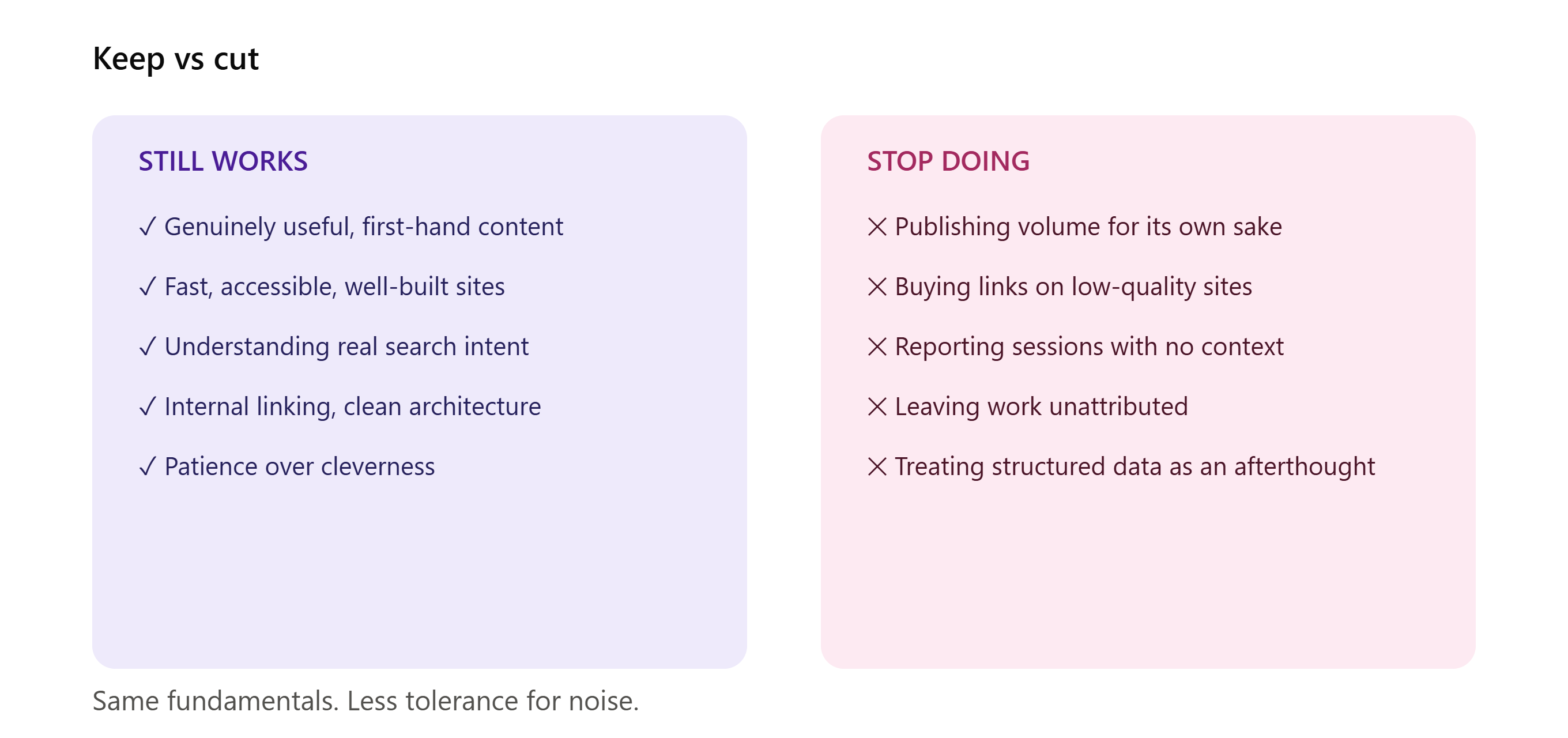
- Genuinely useful content written by someone who has done the thing still outperforms content assembled by someone who has only read about it. Shifts three and four make this more true, not less.
- Fast, accessible, well-built websites still win, and per shift eight, they now win by more.
- Understanding what someone actually wants when they search is still the whole game.
- Internal linking, sensible architecture, and clean URLs still do exactly what they always did.
- Patience still beats cleverness. Authority has never compounded quickly, and the signals in shift three compound more slowly than links ever did.
What to stop doing
- Publishing volume for its own sake. Thin content was a mild liability in 2020. It is now an active drag on how machines assess your credibility.
- Buying links on low-quality sites. It was already a poor investment. It now buys a signal that has been measurably devalued.
- Reporting sessions as the headline SEO number with no context on impressions or answer-engine visibility.
- Leaving work unattributed. Author bios with verifiable credentials stopped being a nice touch.
- Treating structured data as a plugin setting rather than as your machine-readable identity.
Where to start: the first 90 days
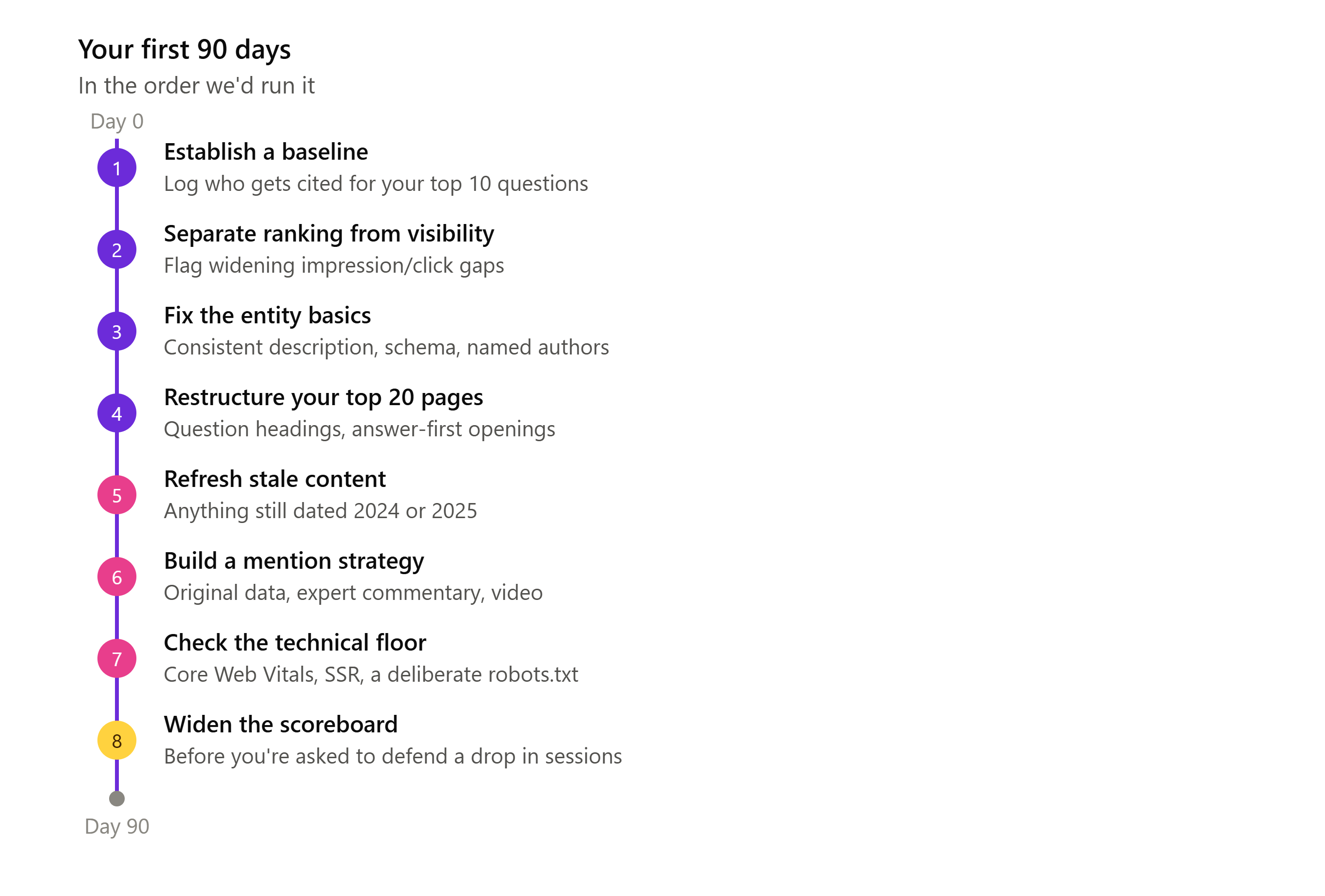
If the list above feels large, it is. This is the order we would run it in.
- Start by checking how your brand shows up today. Ask ChatGPT, Perplexity, and Google AI Mode the ten questions your best customers would ask, and note what they return, including who they cite instead of you.
- Separate ranking from visibility in your reporting. Pull impressions, clicks, position, and click-through rate by page group, and isolate every page where the impression to click gap is widening.
- Fix the entity basics. One consistent description of the business everywhere, an organizational schema on the homepage, and named authors with real credentials on every article.
- Restructure your top twenty pages for extraction. Question-form headings, answer-first openings, sourced statistics, visible update dates.
- Refresh anything still dated 2024 or 2025. Stale dates are the fastest credibility leak there is.
- Build a mention strategy rather than a link strategy. Original data, expert commentary, podcasts, video, trade press. Reclaim the unlinked mentions you already have.
- Check the technical floor. Core Web Vitals, server-side rendering of anything that matters, and a deliberate robots.txt position on AI crawlers.
- Widen the scoreboard before you are asked to defend a drop in sessions, not after.
Questions we get asked
Is SEO dead in 2027?
No, but the definition has changed. Trying to rank in the top ten blue links is becoming less useful. Being the source a machine cites is becoming more important. The basics of being clear, credible, and useful matter more than ever.
What is the difference between SEO, AEO, and GEO?
SEO is optimising to rank in search results. AEO, or answer engine optimisation, is optimising to be the answer rather than a link to it. GEO, or generative engine optimisation, is optimising to be cited inside AI-generated responses. In practice, the work overlaps heavily, and treating them as three separate budgets usually creates more problems than it solves.
Do backlinks still matter?
Yes, but less, and less exclusively. The Ahrefs analysis above puts branded mentions at roughly three times the correlation of backlinks for AI Overview visibility. Links remain a real ranking signal in classic search. They are simply no longer the only currency, and buying them was never a good idea.
How do I measure SEO when nobody clicks?
By measuring presence rather than only traffic. Track how often you are cited in AI answers for your priority questions, your branded search volume over time, referral sessions from AI tools in GA4, and conversion rate by source. Rising impressions with a falling click-through rate are evidence of visibility, not evidence of failure.
Should I block AI crawlers?
It depends on your business, so this should be a choice, not a default. Blocking keeps your content out of training data and out of AI answers. Allowing gives up some control, but it gives you a chance to be cited. Most brands that sell something are better off being easy to find.
The short version
Search is becoming a system that understands things, judges them, and answers on your customer’s behalf. Your job is no longer to climb a list. It is to be the brand that the system understands clearly, trusts genuinely, and can hand over confidently.
Rankings were something you won. Visibility is something you have to be chosen for.
The brands that start this in 2026 will spend 2027 being cited. The brands that wait will spend 2027 asking where their traffic went.
At Social Pill, we build search strategies for brands that need to be found by people and machines alike, combining traditional SEO fundamentals with the entity, credibility, and answer-engine work that decides visibility in AI search.
Want to get on the Social Pill? Let’s schedule a consultation.